George E. Thornburg: Lifelong Depot Agent

George E. Thornburg: Lifelong Depot Agent

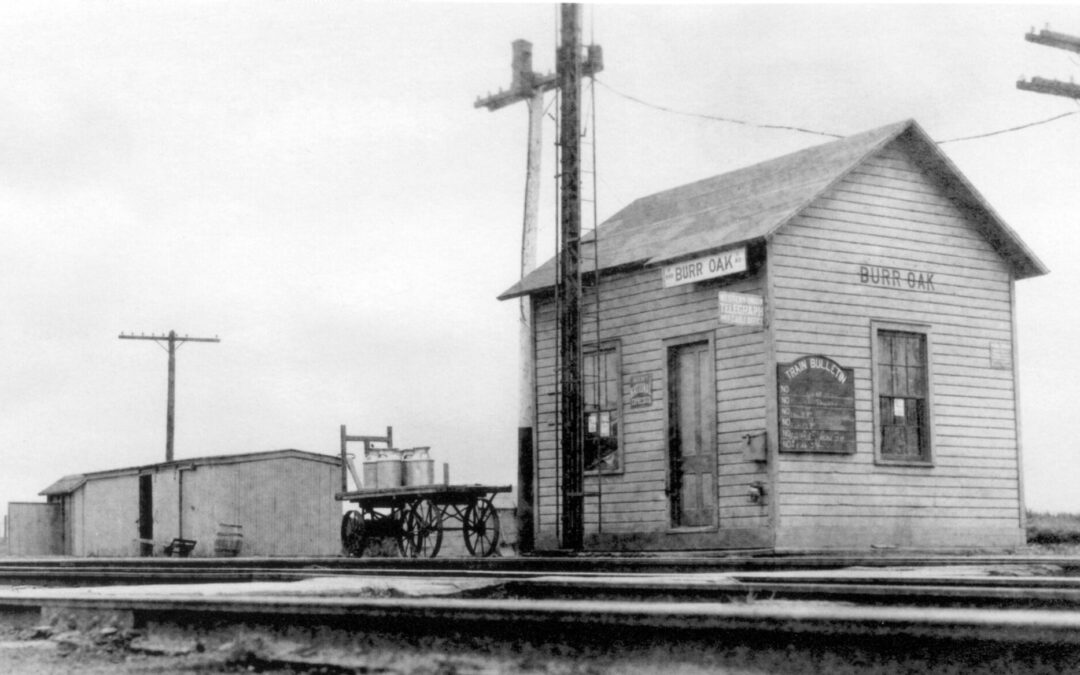
Burr Oak Depot, undated.

The information below comes from the Indianapolis Star Magazine, November 18, 1956, and the Culver Citizen of September 18 and 25, 1957.

Early Life of George Thornburg

George Edgar Thornburg was born at Stillwell, IN on April 3, 1891, one of four children of William Henry and Malinda (Kaser) Thornburg.  By the time George was 9 years old, the family was living in the LaPaz area.

He married Amanda Lodema Strang on May 17, 1910, and they made their home in Burr Oak.  They had five daughters, Opal, Elwyn, Kathryn, Mary Jane and Ramona.  All five daughters grew to adulthood, married and lived in Marshall County.

A Career In Railroading

Thornburg went into “railroading” in 1910 and would have a 47-year career.  Since telegraphy was the up and coming thing, he started by watching the telegraph key at the local junction in LaPaz.  After George had mastered the code, he and his cousin rigged a line between their houses and practiced sending messages.

After a brief interval as a streetcar conductor in South Bend, he came back to the steam locomotives.  ‘There’s something about a railroad,” he stated.  So many people at that time felt the pull of the railroads.

At the time employees of the railroad worked nine hours, seven days a week.  If the freight loads were heavy, the shift might stretch to 12 hours.  Trains were dispatched by orders telegraphed ahead to each station.  Thornburg would receive the orders, fasten them to a hook at the end of a long pole and hand them up to the engineer.  If the train was not scheduled to stop at the station, he had to move fast, for the train’s speed would not slacken as the locomotive thundered past.  Sometimes the orders involved two engineers, and he would have to get the orders to both.

Thornburg was employed by the Nickel Plate Railroad as an agent first at Ober, then Hibbard, then Burr Oak.  In 1954 he was transferred to Hibbard again.

Memorable Days On the Railroad

In 1917 he said he saw a derailment, “and it was plenty for a lifetime.”  A wreck occurred on August 30 of that year, described in the Bremen Enquirer of September 6, 1917.   An arch bar broke under a car in a long line of cars going about 30 miles an hour.  Fifteen freight cars were smashed to pieces and piled up along the south side of the B & O track near the bridge over the Yellow River a mile and a half west of Bremen.  Oats, sugar, agricultural implements and various freight were all mixed up.  Fortunately, no one was hurt.  It was several days before the wreckage was cleaned up.

Thornburg did get to meet a celebrity, the well-known opera singer Mme. Schumann-Heink, whose son attended Culver Military Academy.  George said she “had a nice way, pleasant and not a bit put on.”  Tycoons then often travelled by private railroad car, and Thornburg would occasionally be the recipient of some delicious food shared by their chefs.  On occasion a hobo would sneak in for a nap on a bench in the waiting room.

In the 1950s some Culver Military Academy students still used the Nickel Plate Railway station at the Hibbard depot, which was a flag stop.  He would have to handle the luggage and make sure no items were left behind by the boys.

George Thornburg's Everyday Duties

Eventually the telephone and automatic signals replaced the skills of telegraphy and teletyping.  But Thornburg still had to sell tickets and keep up with paperwork for baggage and freight.  He had to receive the mail from trains that did not stop.  He was sometimes helped in this by “a youthful assistant, Bobby Albert.”  Bob Albert would grow up to work for the railroad and as a lifelong train enthusiast, still volunteers at the railroad museum.

Thornburg also had the regular duties of keeping the station swept, the waiting room benches dusted and the potbellied stove ready for a fire.  A phone call would tell him if the train was on schedule.  If a taxi was requested, he would call a cab company in Culver.  When passengers wanted to board the train, Thornburg would put on his billed railroad cap and step out well ahead of the train to flag for a stop.  He also figured tickets and helped plan trips.  The longest ticket he ever sold was a 13-coupon ticket to Vancouver.  He said he prided himself on being a good consultant and had a flair for scenic routes.

An important duty for Thornburg was that he had to closely inspect every passing wheel for “hotboxes,” an axle bearing that became excessively hot due to friction.  If one got hot enough to burn out a journal bearing (a plain bearing without rolling elements), or a journal box, which housed the journal bearing, it could cause a wreck.

A Tragic Ending

On Monday, September 16, 1957, Thornburg said he called the Culver Citizen with a heavy heart to report bad news.  He had received a telegram: “On and after September 24 all business in the Hibbard and Burr Oak stations will be handled at Knox.  Tuesday, September 23 will be the last day that the Hibbard station will be open to the public.”  This was perhaps the saddest disappointment of his long life of service.

But he never had to see the closing of the Hibbard station.  A week before it was scheduled to close, he passed away of coronary thrombosis while sitting in a chair in his home at Burr Oak on the morning of September 18, 1957.  Can a person die of a broken heart?  If so, perhaps George Thornburg did. George Thornburg was faithful to his job working for the railroad for 47 years.  He was a true railroad devotee.

Marshall County’s history is full of great stories about the people and events that shaped our area. The Marshall County Historical Society & Museum offers the opportunity to research and learn about our forebears. We are open from 10:00 until 4:00, Tuesday through Saturday, at 123 N. Michigan St., Plymouth. Call us at 574-936-2306.

Christian Seiler of Bremen

Christian Seiler of Bremen

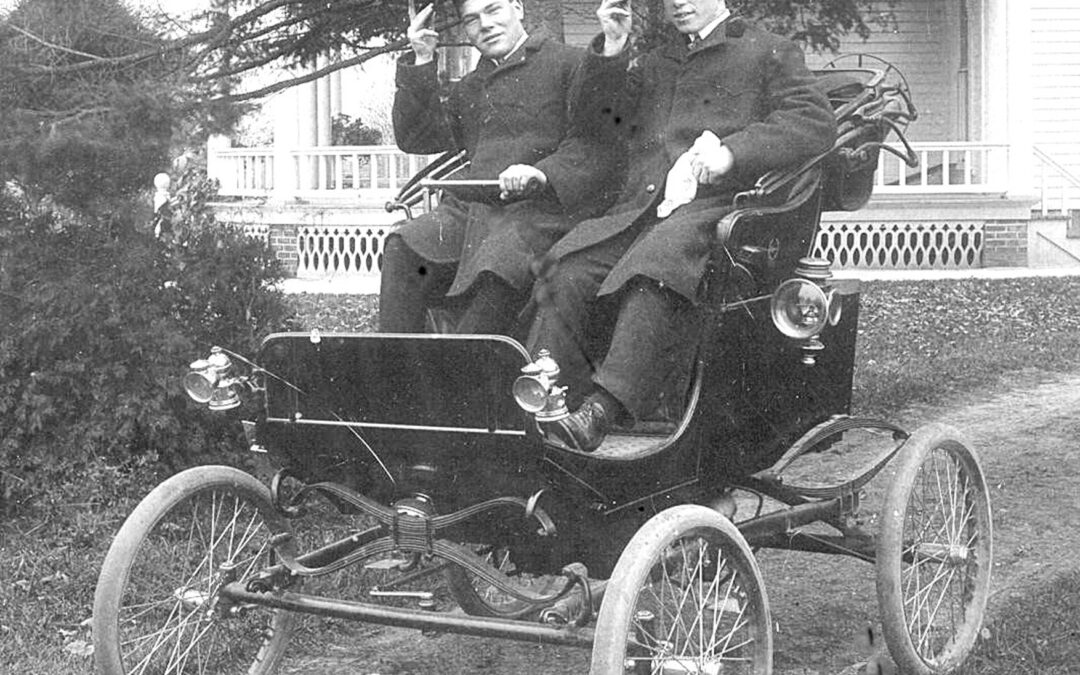
Christian Seiler and his wife, Mary Ann.

The history of Christian Seiler, Jr., of Bremen is a fascinating example of how Marshall County grew and prospered during the 1800s. Some of the beautiful descriptive phrases used by the original writer have been left in this essay, as they perfectly convey the picture of an earlier time.

Birth and Childhood of Christian Seiler

In the spring of 1837, Christian Seiler, Sr., and Anna Fents were united in marriage, and unto them six children were born. Christian Seiler, Jr., first saw the sun rise on the morning of March 18, 1838, on the shore of Lake Brienz, near Interlaken, Canton Berne, in Switzerland. His father was born in the same house on August 10, 1806. His mother was Anna Fentz, born August 15, 1810, in Gsteigwyler, a romantic spot within two miles of Interlaken.

In the year 1798, when French generals took control of Berne, the capital of Switzerland, they demanded all the money that had been hoarded there in the national treasury. Grandfather Fentz was called on as a militiaman to help defend his country. Perhaps the first and only duty he performed was to obey the orders of some French commander to watch the money that was boxed up and ready on the sidewalk in front of the treasury building for shipment to Paris. Afterward, the old man often said that he was a fool for not taking a box of the gold and walking away with it. He was in that day considered a wealthy man, as he owned a great deal of land, cows, horses and sheep. In the summer season he was always up in the Alps herding his stock and making cheese and butter.

Moving to America

In the year 1853, the Seiler family determined to emigrate to America to better their fortunes, having heard and read much of this fruitful land and the opportunities it offered to those who were seeking homes. So, on the 13th day of October 1853, the entire family started from their native home for the western world. They made their way across Switzerland, through France to Paris, and thence to Havre where they took passage in a French sailing ship. After a voyage of 28 days, they arrived safely in the harbor of New York. They remained there over Sunday, and then proceeded west by way of the Erie railroad to Buffalo, by boat to Cleveland and Toledo, thence by the Lake Shore to South Bend, IN, where they arrived on the 1st of December.

On the 5th of that month, they rode on an ox wagon, owned by Uncle John Dietrich, to the town of Bremen, which was their destination. Christian Seiler, Sr., bought eighty acres of land one mile west of Bremen from his brother-in-law, for $700, of which $300 was paid in cash. His son, Christian, was then bound out to his uncle, John Dietrich, for the period of five years to earn the $400 that was unpaid on the land.

About June 1, 1854, Dietrich with his family moved to Bremen into a log house, and in the spring of that year erected the first cabinet shop, in which Christian learned his trade and served his time, which ended January 1st, 1859. Christian then went to Olney, IL, where he worked as a carpenter in summer and as a cabinetmaker in winter. He received wages of $1.25 a day and board.

Returning to Bremen, Christian continued to work at his trade successfully until the civil war broke out in 1861. In the fall of that year he enlisted in Company K, Twenty-Ninth Indiana volunteer infantry. He took part in the battles of Shiloh, Stone River, Chickamauga, and the siege of Corinth. During several months in 1863, Christian occupied the honorable position of color-bearer of his regiment. In October 1863, he received an injury that sidelined him, and a month later was discharged as his service commitment expired. Returning to Bremen, he resumed work at his trade.

Christian and Mary Ann Seiler

Christian Seiler's Later Life

On the 15th of February 1866, Christian Seiler, Jr., was united in marriage to Mary Ann Beylor, who was born in German Township in 1846. To their union were born the following children: Frederick William, Margaret Ellinore, Eda Annie, Edward Clayton, Clara Erclina, Jennetta May, Emma Estalla, Josephine and two sons who died at birth.

Mary Ann’s father was George Beyler, a native of Alsace, France, who came to this county in 1833, first settling in Ohio, and later in Marshall County. In 1837 he married Rebecca Lehr, a native of Lancaster, PA. Mr. Beyler cleared land and was very successful. He accumulated a great deal of property during his life. He was a good Christian man and held membership with the Evangelical association for 35 years. He was respected and loved by all who knew him, and died in 1881, at age 70, sincerely lamented by the entire community.

Christian Seiler worked at his trade until 1871 when he built a shop and storehouse and went into the furniture and undertaking business. He prospered until 1882, when he sold out to John Miller of LaPorte.

He has held the position of assessor of German Township, member of the town school board, clerk and treasurer of Bremen and justice of the peace. He filled all the offices conscientiously and gave satisfaction to the people who appointed him.

Christian built a house in Bremen for his father, when he retired from farming in 1873 because of old age. Christian Seiler, Sr., died there December 17, 1873, at age 67. He was followed by his wife on the 16thday of March 1887 at age 76.

Christian Seiler, Jr., was not a member of any church, but belonged to the Masonic Fraternity and the G.A.R. post of Bremen, IN. In 1881, he took a trip to the old country, revisiting beautiful Switzerland, the scene of his birth and childhood, and visited other countries, remaining abroad three months. Mary Ann Seiler died on April 12, 1891 at age 45. Christian died on July 18, 1914, at age 76.

The Museum is proud to preserve and share family stories. If you have a Marshall County family story, please share it with us. Stop in anytime between 10 and 4 on Tuesday through Saturday! The Museum is located at 123 N. Michigan St. in Plymouth. Call us at 574-936-2306.

John R. Jacoby’s Meat Preservation Technique

John R. Jacoby’s Meat Preservation Technique

Food planning and preparation books.

Meat preservation involves methods to retain the taste, texture and safety of meats. Artificial refrigeration began in the 1750s, and developed more fully in the early 1800s, but it wasn’t until the 1930s that refrigerators became popular in the U.S. Before this, knowing how to preserve food without refrigeration was vital for families!

Read this excerpt from the memories of John R. Jacoby, born in Center Township in 1859, on his days-long process of preserving meat. Jacoby was a lifelong Marshall County farmer and secretary of the Jacoby Church and Cemetery in Plymouth, which his grandfather co-founded. The article has been edited for clarity.

How to Preserve Meat by John R. Jacoby

“First to do is to rub saltpeter over the meat. Then, put salt in the kettle, enough to cover the hams and shoulders good. Get the salt good and hot so it smokes.

Take a hoe and dig a hole in the salt, then drop a ham in and cover it completely. Leave in for two minutes and then take it out and turn it over. Leave in salt for two minutes more, or a little longer according to the size of the hams.

Then wash the meat again with Borax and hang the meat up. Let it drip for a couple of days, then smoke the meat all it needs. Then take down the meat and wrap in paper and put in sacks. Then it is ready to put away.”

The MCHS and Museum is currently renovating its Dairy and Ice Room which tells all about the history of refrigeration and ice harvesting in Marshall County. Stay tuned for its grand reopening later this year! The Museum is open Tuesday through Saturday from 10 am-4 pm at 123 N. Michigan St. Call us at 574-936-2306 for more information.

Grandma Hollett’s Educational Firsts

Grandma Hollett’s Educational Firsts

Emmett School roster 1914-1915.

The following is an article written by avid genealogist and former resident of Plymouth, Mary Jo Jacob, who now lives in California. She recounts the history of her grandmother, Tillie Scott Hollett, whose determination resulted in the education of hundreds of Marshall County children.

Grandma Hollett's Educational Firsts

My Grandma Tillie Scott Hollett worked hard and overcame obstacles to become a teacher. Her love of learning and teaching animated her life and influenced her children and grandchildren. In my case, Grandma reassured my mother I would do just fine in first grade even though I could not go to kindergarten. (We lived in the country outside of Plymouth where the rural school bus schedule did not accommodate kindergarten hours.) Grandma advised mom to teach me my numbers and letters from the cookbook we used when baking. The year I was five, I baked my way into numeracy and literacy and was well prepared to start first grade at Washington School in Plymouth. Grandma’s own education began more conventionally, but her educational achievements were hard-won “firsts” in the family and inspired my own educational goals.

Born in a covered wagon in What Cheer, Iowa in 1898, Tillie Scott’s educational prospects were initially dim but improved when her parents returned home to their farming community in Pulaski County, Indiana. One room schoolhouses sprouted up every couple of miles alongside the cornfields that covered the county. For seven or so years between September and April, whether it was sunny, rainy or snowing, Tillie tramped down the dirt road from her family’s farm to the nearest school. By age thirteen or fourteen, she finished the sixth grade, the highest grade completed by each of her parents.

Around that time, the one room schools in her part of the county were consolidated. Thereafter, Tillie journeyed further to school in the nearby town of Kewanna which is where she graduated from the eighth grade. Subsequently Tillie studied at Kewanna High School for three years. When she entered her senior year, her family moved away from the farm and the county. Tillie likely had to fight with her parents to continue in high school. If so, she won the battle.

Tillie moved thirty miles from the farm to the town of Logansport where her Scott family relatives lived, and where she enrolled for her senior year. Although she was a new student, the high school yearbook noted Tillie gave a memorable speech to the school on women’s suffrage, a topic about which she was passionate. Tillie graduated from Logansport High School in 1909.  She was twenty years old and proud to be the first high school graduate in the family. According to one family story, Tillie felt her parents did not fully value her accomplishment because their graduation gift was a mirror from a coffee tin, put there as a promotional gimmick.

Tillie Scott, high school graduation.

Tillie aspired to higher education but had to set her educational ambitions aside. After high school, she moved to her parents’ home in Plymouth where she found a job working at Schlosser Brothers Creamery. The job enabled Tillie to help her family financially as well as save money for herself. Her goal was to become a schoolteacher. To do so, she needed to take college courses and pass a state teacher’s license exam.

In 1912, Tillie applied to nearby Valparaiso University which at the time was the second largest school in the nation after Harvard University. In fact, Valparaiso University was nationally known as the “Poor Man’s Harvard” because of its affordability and high quality. (Valparaiso University History https://www.valpo.edu/about/history/). She was accepted into the Teacher’s Department and enrolled for two consecutive twelve-week terms.

Tillie was an excellent student who scored 95 percent or better in most of her classes. One of her worst grades was in cooking – 87 percent. Not a surprise to her grandchildren who remember that Grandma was not a good cook. On the other hand, she excelled in American and English literature which is also unsurprising to those who knew her. Tillie instilled a love of poetry, literature and books in her children who, in turn, shared that love with their own.

After two terms at Valparaiso and passing the state teacher’s license exam, Tillie returned to a one room schoolhouse in Pulaski County, this time as the teacher at the Emmett School in the village of Denham. For two years, she taught kindergarten through the eighth grade to a group of thirty students. At the end of her first year, she returned to Valparaiso University to complete her third and last term. Ten days after she completed her second year of teaching, Tillie married Clarence Hollett and left Denham because Harrison Township did not employ married women. In fact, Harrison Township did not hire its first married female teacher until 1942.

Tillie Scott Hollett with her BS. degree.

Tillie moved to Culver in neighboring Marshall County where the school system had no restrictions on married women teaching. She initially taught the third and fourth grades and eventually taught home economics at Culver High School in 1918-1919. While in Culver, Tillie became involved in women’s clubs which were important organizations for women to educate themselves, develop their leadership skills, and improve their communities through volunteer efforts. Through her membership in the Culver City Club, Tillie continued her educational and advocacy work on behalf of the Susan B. Anothony amendment. She was thrilled when the Nineteenth Amendment was ratified in 1920.

During the next three decades, marked by the Great Depression and World War II, Tillie’s teaching and educational endeavors were focused on her four children and channeled into her club activities. She wrote poetry and compiled research papers that she read to club members as part of club educational programs. After the war, and after her children were married, Tillie wanted to teach in the classroom again. However, she needed a new teaching credential, and that required a bachelor’s degree.

Ever determined, Tillie enrolled at Manchester College (now Manchester University) and completed her B.S. degree in Elementary Education in 1953 at age sixty-four. Her graduation was a family affair attended by a proud husband, her mother, her four children, eight grandchildren, and her brother’s family. Tillie had accomplished another educational first. She was the first person in the family to graduate from college.

Tillie taught elementary school for nine years in Tyner, a small town near her home in Plymouth. During my “baking kindergarten year,” Grandma invited me to visit her classroom for a day. Whether it was the excitement of finally being able to go to school, or the fact that I got to ring the bell to end the recess period, I never forgot my first day of school. Years later Grandma encouraged me to go to college, but her less than encouraging reaction to my decision to continue for a master’s and doctorate surprised me. She worried, “You won’t become a wife and mother.” She came to my wedding but did not live to meet my son or see me receive my advanced degrees. Given her profound influence, I like to think she would have been pleased with my own educational first, the first in the family to get those two degrees.

The Museum is proud to preserve and share family stories. Stop in anytime between 10 and 4 on Tuesday through Saturday to learn more or bring your own! The Museum is located at 123 N. Michigan St. in Plymouth. Call us at 574-936-2306.

Betty Jane Smith: A Culver Tragedy

Betty Jane Smith: A Culver Tragedy

Feature Image. From left: Betty Jane Smith; Mildred Isom, Betty Jane Smith, and Eleanor Turner (photo courtesy Mildred Isom)

By: By Mildred Isom, Edited by Jeff Kenney and Anita Boetsma

In July 2007, Mildred Isom, originally of Culver, sent an essay about her recollections of her friendship with — and subsequent grief at the death of — Betty Jane Smith, one of the four African American children drowned in the 1947 tragedy. Betty Jane was buried in Mildred’s band uniform, a fact which Mildred blocked from memory.

Betty Jane Smith was a member of our exclusive quartet of friends at Culver High School.  She was an orphan who came from Chicago to live with her grandparents in our little farm town of Culver, IN, in the early 1940’s.  The four of us were immediately drawn together into the same activities with the same goals.  Marching Band, softball and other sports were our first choices but we soon we all joined Chapel Choir and the orchestra.  Our band and sports teams went out of town each year to compete in contests statewide.

Betty Jane Smith.

Betty’s bubbly personality kept us all cheerful, and her long black sausage curls were natural.  Never before and never after have I been a part of such a fun loving, loyal and hardworking group.  Before long Betty’s cousins, Eleanor, Winston and Paul, arrived to live with the grandparents.  Their parents were professionals in Chicago, a dentist, doctor and podiatrist.  I did not even know what a podiatrist was at that time.  Betty’s grandmother’s name was Augusta, but we all called her Ga Ga because the little ones could not pronounce her name.  The grandfather was Lloyd Smith, a rotund, jolly white-haired gentleman who kidded us for our attempts at cooking but never failed to consume it.  This family was one of the only two black families in our town and were not related.  In Plymouth, a mere 10 miles north, blacks were not allowed in town after 6:00 pm.  This was a mystery to us in our teenage years in the mid-1940s.*

More time was spent at Betty Jane’s house than mine.  I was always invited for Friday night sleepovers, Sunday dinners and holidays.  My mother had passed away many years before, my older sister was married, and my father worked long hours and was seldom home.  Betty Jane, although much loved and always cheerful, still I think, felt like an orphan and basically so did I at the time.  We were a comfort to each other and felt like sisters.  During the summers one or more of the quartet joined us in swimming, fishing, bike riding and any kind of sports, music and babysitting.

On Friday nights during the summer, we usually rode our bikes around the north side of Lake Maxinkuckee to attend the free movies offered by the Culver Military Academy.  During the winters we walked directly across the lake which was frozen over three months of the year.  One Friday night I had the flu and did not go with them.  About 8:30 p.m. my father came home and told me that he and two friends had pulled Betty Jane, Winston and Paul from the lake.  They had fallen through a thin spot in the ice.  Betty Jane’s cousin, Eleanor Turner, was the only survivor.  Eleanor said that her brother, Winston Turner, had lifted and pushed her up onto solid ice before he succumbed.  She was able to retrace her steps back to the starting point.  Although my father was gentle in telling me, I doubt if he really ever knew how it affected me.  My only real confidant at that time was Betty Jane’s grandmother.  I remember visiting her once right after the event.  We experienced tears, hugs and holding each other.  As far as I remember, I never went back.  I could never bear to again step into the house.  This occurred when we were in the 8th grade.

Life went on, of course. Eleanor continued high school with us but we did not become any closer as she was the studious one and being chubby all her life, she did not care for sports.  She did continue to be in the marching band.  At our class reunion in 2001, she wrote saying she was married, living in New York and regretted she would not be able to attend the reunion.

After the reunion banquet, three of us left in the quartet met at Helen Sikora Zalas’ house, my longtime girlfriend’s, in South Bend, to carry on with our own reunion.  After rehashing and chuckling about a lot of past incidents, Betty Jane’s name was brought up.  Helen turned to me and said, “That was really nice of you to let them use your band uniform for Betty to be buried in.”  I said something like “huh?”  Then the other two girls told me the Band Director had asked if I would donate my uniform and I had said yes, so they transferred my medals onto a maroon cardigan sweater.  Helen asked if I remembered going to the services.  I had to say “no.” I was told we all marched fully uniformed down Main Street to the Evangelical Church for services and further to the cemetery.  One of the girls said that the band director accumulated enough funds to purchase a new uniform jacket for me about a year later.  I had no recollection of these events at the time and still do not.

As the years go by I still think of Betty Jane, and the way we were a long time ago.

*Editor’s Note: According to the Encyclopedia Britannica and other online resources, ”Sundown Towns” excluded people of color from being in town after sunset. This practice existed across the U.S. during the 20th Century.

The Museum is home to many stories like this one. Information about the history of Black communities in Culver is available as well. The Museum is open from 10 until 4 from Tuesday through Saturday at 123 N. Michigan St., Plymouth. For more information, call 574-936-2306.

Plymouth’s Oldest Resident

Plymouth’s Oldest Resident

Norman S. Woodward was 83 years old on December 11, 1911. He had lived in Plymouth for longer than anyone else at that time. A Weekly Republican reporter asked him “How does it feel to be 83?”  “Oh, I have no reason to complain” was his reply. The interview that followed was full of stories about the earliest days of Marshall County. I will share just a few.

Mr. Woodward was known to have a mind “as bright as a silver dollar” and was frequently asked to settle disputes dating back before formal records were kept in Marshall County. He knew the given names and initials of men who lived back in the 1830s and 1840s. He knew the first officers of the county, things in the city, the cemeteries, the politics, the markets, the money used, and the facts of every character.

“I came to Plymouth on May 1, 1835, with my father and uncle,” said Mr. Woodward. “I was then only six years old, but I remember everything as distinctly as though it were yesterday.” At the time there were only five houses in the town without a name. Chester Rose ran a little store on the site at the corner of what is now Center and LaPorte Streets. Grove Pomeroy had the hotel at 101 N. Michigan. The hotel housed the Yellow River Post Office. Mail came once a week via horseback carrier, on a route that ran from Logansport to Niles, MI.

At that time, the county was unorganized and there were only a few white people among the many Indians. Five miles north, the first house belonged to Peter Schroeder, who was later elected the first probate judge in Marshall County. A half mile further north lived Adam Vinnedge, the first county treasurer. As Mr. Woodward states, “These people were curious to see us as we were Yankees, having moved to Indiana from Vermont. My uncle and father traded a wagon and some of their horses for 80 acres of Michigan Road lands.”

 “In August of that year was the great Government land sale at LaPorte. Uncle and father went there to buy land. They went nearly to LaPorte before they saw a white man. At the Kankakee River the bridge was gone all but the stringers. Father and Uncle had their money in French francs and Mexican dollars, and it was quite a burden.  The problem of crossing the Kankakee on stringers was a hard one. My father got across with his money, but Uncle could not do it. Father came back and got Uncle’s money and carried it across. Still Uncle could not make it. Father then saw a boat downstream. Leaving the money on the bank, he went and got the boat and took Uncle across. They bought their land for $1.25 an acre. Our home then became the farm now located just a half-mile north of the Brightside Orphanage on the west side of the road.”

“It is hard today to understand the hardships of that time,” said Mr. Woodward. “There was no food, no money, no market for anything if there had been anything to sell. My father went twenty-one miles beyond Logansport to Delphi to get grain ground for corn meal. That was the closest mill. Near there we bought some white corn and had it ground, but they did not “bolt” the meal then as hey do now, and mother had to sift it.” Bolting refers to a machine that had spinning screens that sifts the grain. He continues, “We had some cows, and hogs ran wild and fattened on the nuts in the forest. These pigs were shot for meat and game of all kind was plentiful. Neighbors would kill a beef at different times and divide with each other, trading back and forth. There was no market closer than Michigan City where we hauled our wheat. The price was 31 cents a bushel and later we got 40 cents. In a few years there was a mill at Bertrand, a mile north of South Bend, and people hauled their wheat there to be ground.”

Marshall County's First Election

“The first election was in the fall (1836) to organize the county. They called the town “Plymouth” after the New England Plymouth Rock. All the people of the county voted at Plymouth, though one could vote at any place he could find a voting place. I watched them vote. A man would come to the voting place and be asked how he wanted to vote. He would tell the name of his candidate, and the vote would be written down by the clerk. There were 83 votes in Center Township. In those days it was about an even split between the Whigs and the Democrats.

“A.L. Wheeler was the first man to run a real dry goods and general merchandise store. In the back part of his store were pails of New England rum for voters. In the rum had been put some “Black-strap” molasses, and all who wished, boys as well as men, could go there and drink. But there was never any drunkenness. It seemed that the human system needed whiskey to kill off the malaria so prevalent in those early days, and it being pure whiskey, did not affect them as now.

“The courthouse was at first a small wooden building located where Welcome Miller now resides on Michigan Street. The present site was donated to the county and that is the reason the building stands where it does today.

“On the present site of the Washington School building was the first cemetery. When they wanted to build the schoolhouse, they moved the bodies and made a new cemetery on the spot now occupied by the Pennsylvania Depot. When the railroad came to Plymouth, it passed directly through this cemetery and the bodies were again taken up and moved to the Stringer Cemetery and the present Oak Hill. My father was buried in the cemetery when it was located at the Pennsylvania Depot site.”

Woodward Joins the Gold Rush

In 1852, Woodward joined the thousands of daring men who crossed the plains to California, hunting gold. He and his companions made the trip in a wagon pulled by oxen. “We started in March,” said Woodward, “and on April 24 we crossed the Missouri River. At Fort Carney, we saw the first white people. From there it was 500 miles to Fort Laramie, the next white settlement.”

While crossing the plain, the group saw one of the most thrilling sites on their journey – a huge herd of buffalo stretching as far as the eye could see. The travelers let them pass, as it was too dangerous to get in front of them. “I bought two fine black buffalo hides from the Indians,” said Woodward. “They were nicely tanned and splendid ones in every way. I paid two cups of sugar for them.

“In July we arrived in Sacramento City, and there on Jay Street I met Charles Crocker, a Plymouth man, who afterwards become a millionaire gold miner.” For about two years, Woodward and his companions prospected, and during that time they “struck it rich” and were able to come back home with several thousand dollars in gold.

“Nobody trusted the banks in those times,” said Woodward, “so we all carried our money around our bodies in belts. My companions arranged to come home by way of Panama and had chosen the steamer Yankee Blade from San Francisco. Before we started, we met a friend who was also coming home that way and he advised us to take the steamer Sonora instead, because, he said, there is going to be racing between the boats and it is dangerous to go on the Yankee Blade. We took his advice and luckily so, for the Yankee Blade struck a rock and went down with all aboard on that very trip.

“Arriving at Panama, the ship came to anchor three miles out to sea and natives in boats came and took us within ten feet of the shore, where they stopped, and naked natives came and carried us ashore on their backs. There were 1400 on the boat.

“The first seven miles of the way across the isthmus was as fine as a paved road as I ever saw. Bolivar had made it when the Spaniards were in control, from the pebbles of the seashore. The railroad covered only 25 of the 50 miles across the isthmus, and we had to walk the rest of the way. In rained continuously. Finally, we came to the railway, a little narrow gauge one, but only about 600 of us could get on the train. The conductor promised to come back the next day, however, and take us. He came on the third day, and we were soon at the seashore. Here, the hundreds of passengers went pell mell over each other to see who could be the first to the ship and get the best berths. There was no order or direction of the passengers. Everybody took the best he could get.

“An awful storm overtook our vessel off of Cape Hatteras, and for many hours we saw our ship climb up and down the monster waves, expecting every one to go over her and send us to the depths of the sea. She rode it out however, but even after repairs in dock, sprung a leak on her next voyage and went down with a third of her passengers.”

Personal Life

While in San Francisco, Mr. Woodward met Henry Humrichouser, who would later become his brother-in-law, and they made the trip home together. Mr. Woodward was back in Plymouth in 1854. He became smitten with his friend’s sister, Miss Elizabeth Hunrichouser when she visited from Ohio. They were married on September 1, 1855. In the spring of that same year, he and H.B. Pershing started a drug store on the spot where Tanner’s drug store was at 122 N. Michigan Street. After a year, Mr. Woodward sold his share of the drug store to Mr. Pershing. He then started the first bakery in Plymouth at 106 N. Michigan Street. “One of those who worked for me at that time was H.W. Hill,” said Mr. Woodward. “But I was not long in the business for in March 1856 the whole town burned down, and my business with it.”

He continues “After this I bought the lot where the Star Restaurant is now (116 N. Michigan Street) and opened a little grocery store. In 1857, the Pittsburgh railway was being built through and I sold much supplies to the men. But the company went broke and could not pay its hands, so I could not get my pay, and bankruptcy stared me in the face. The company, however, agreed to pay its men in stock of the railroad. Mr. A.L. Wheeler came to me and said for me to take all the stock I could get from the men, and he would give me 25 cents on the dollar. I did so, and got much of it, paying 20 cents on the dollar. Some of it I kept, but most of it I turned over to Wheeler because I had to have money to buy goods with. Later this stock went up to $1.55 on the hundred and I sold all I had at that price, which made me a neat sum to continue my business. Wheeler, who had a large amount of the stock, sold it at the same price, and made a barrel of money out of it.”

The firm of Hewitt & Woodward built the first brick block in Plymouth at 113 N. Michigan Street, currently the home of Wild Rose Moon. It was three stories high and considered a fine structure. Fire destroyed it in 1866 and the firm lost $15,000, as the insurance company went broke. After the fire, Mr. Woodward rebuilt the entire block.

He was successful in the sawmill and lumber business as well in the firm of Woodward, Oglesbee & Co. He was also in the grain business with Henry G. Thayer. He became a partner in the reorganization of the First State Bank that occupied one of his buildings. The bank was successful for many years and sold to Theodore Cressner in about 1867. After a varied and successful business career, Mr. Woodward retired in 1891.

Mr. Woodward Attends the Lincoln Convention

Early on, Mr. Woodward was a Democrat, but later became a Republican. In 1860 he attended the great Lincoln Convention in Chicago as an alternate delegate. He remembers every detail of what he calls “the most wonderful convention ever held.

“I remember when they brought in the rails and put them on the platform,” said Mr. Woodward. “I remember the moment when Lincoln was nominated. The convention went wild. Hats filled the air and yells were deafening. I assure you there has never been another such convention and probably never will be.”

The rails referred to by Mr. Woodward were symbolic wooden rails carried onto the convention floor. Lincoln was cast as a “rail-splitter,” a home-spun hero full of prairie wit and folk wisdom. People did not see Lincoln as a life-long politician and corporate lawyer with a decent income.

On March 3, 1904, Elizabeth Woodward died at Age 69. She is buried in Oakhill cemetery. 10 years later, in 1913, Mr. Woodward decided to leave Plymouth to live with some of his children, although he kept in contact with his Plymouth friends.

In 1915, he wrote “I am glad to say to all my friends that I am in splendid health and not dependent physically or financially on anyone. I transact most of my own business and hope it will be many years before I am incapacitated.

“I send greeting and good cheer to all of you, and though I am eighty-eight years old I trust the good Lord will spare me many years before I am called to Plymouth to my final resting place. God bless and protect all of you. Very sincerely yours, N.S. Woodward.”

Sadly, Norman S. Woodward died on November 27, 1916, succumbing to apoplexy while taking his morning walk. His obituary ran front and center in the Republican newspaper. Mr. Woodward returned to Plymouth for the final time and was laid to rest next to his wife in Oakhill Cemetery.

Visit the Museum from 10:00 am until 4:00 pm, Tuesday through Saturday to learn about early Marshall County or research your own family. The Museum is located at 123 N. Michigan St., Plymouth. Call us at 574-936-2306.