Christian Seiler of Bremen

Christian Seiler of Bremen

Christian Seiler and his wife, Mary Ann.

The history of Christian Seiler, Jr., of Bremen is a fascinating example of how Marshall County grew and prospered during the 1800s. Some of the beautiful descriptive phrases used by the original writer have been left in this essay, as they perfectly convey the picture of an earlier time.

Birth and Childhood of Christian Seiler

In the spring of 1837, Christian Seiler, Sr., and Anna Fents were united in marriage, and unto them six children were born. Christian Seiler, Jr., first saw the sun rise on the morning of March 18, 1838, on the shore of Lake Brienz, near Interlaken, Canton Berne, in Switzerland. His father was born in the same house on August 10, 1806. His mother was Anna Fentz, born August 15, 1810, in Gsteigwyler, a romantic spot within two miles of Interlaken.

In the year 1798, when French generals took control of Berne, the capital of Switzerland, they demanded all the money that had been hoarded there in the national treasury. Grandfather Fentz was called on as a militiaman to help defend his country. Perhaps the first and only duty he performed was to obey the orders of some French commander to watch the money that was boxed up and ready on the sidewalk in front of the treasury building for shipment to Paris. Afterward, the old man often said that he was a fool for not taking a box of the gold and walking away with it. He was in that day considered a wealthy man, as he owned a great deal of land, cows, horses and sheep. In the summer season he was always up in the Alps herding his stock and making cheese and butter.

Moving to America

In the year 1853, the Seiler family determined to emigrate to America to better their fortunes, having heard and read much of this fruitful land and the opportunities it offered to those who were seeking homes. So, on the 13th day of October 1853, the entire family started from their native home for the western world. They made their way across Switzerland, through France to Paris, and thence to Havre where they took passage in a French sailing ship. After a voyage of 28 days, they arrived safely in the harbor of New York. They remained there over Sunday, and then proceeded west by way of the Erie railroad to Buffalo, by boat to Cleveland and Toledo, thence by the Lake Shore to South Bend, IN, where they arrived on the 1st of December.

On the 5th of that month, they rode on an ox wagon, owned by Uncle John Dietrich, to the town of Bremen, which was their destination. Christian Seiler, Sr., bought eighty acres of land one mile west of Bremen from his brother-in-law, for $700, of which $300 was paid in cash. His son, Christian, was then bound out to his uncle, John Dietrich, for the period of five years to earn the $400 that was unpaid on the land.

About June 1, 1854, Dietrich with his family moved to Bremen into a log house, and in the spring of that year erected the first cabinet shop, in which Christian learned his trade and served his time, which ended January 1st, 1859. Christian then went to Olney, IL, where he worked as a carpenter in summer and as a cabinetmaker in winter. He received wages of $1.25 a day and board.

Returning to Bremen, Christian continued to work at his trade successfully until the civil war broke out in 1861. In the fall of that year he enlisted in Company K, Twenty-Ninth Indiana volunteer infantry. He took part in the battles of Shiloh, Stone River, Chickamauga, and the siege of Corinth. During several months in 1863, Christian occupied the honorable position of color-bearer of his regiment. In October 1863, he received an injury that sidelined him, and a month later was discharged as his service commitment expired. Returning to Bremen, he resumed work at his trade.

Christian and Mary Ann Seiler

Christian Seiler's Later Life

On the 15th of February 1866, Christian Seiler, Jr., was united in marriage to Mary Ann Beylor, who was born in German Township in 1846. To their union were born the following children: Frederick William, Margaret Ellinore, Eda Annie, Edward Clayton, Clara Erclina, Jennetta May, Emma Estalla, Josephine and two sons who died at birth.

Mary Ann’s father was George Beyler, a native of Alsace, France, who came to this county in 1833, first settling in Ohio, and later in Marshall County. In 1837 he married Rebecca Lehr, a native of Lancaster, PA. Mr. Beyler cleared land and was very successful. He accumulated a great deal of property during his life. He was a good Christian man and held membership with the Evangelical association for 35 years. He was respected and loved by all who knew him, and died in 1881, at age 70, sincerely lamented by the entire community.

Christian Seiler worked at his trade until 1871 when he built a shop and storehouse and went into the furniture and undertaking business. He prospered until 1882, when he sold out to John Miller of LaPorte.

He has held the position of assessor of German Township, member of the town school board, clerk and treasurer of Bremen and justice of the peace. He filled all the offices conscientiously and gave satisfaction to the people who appointed him.

Christian built a house in Bremen for his father, when he retired from farming in 1873 because of old age. Christian Seiler, Sr., died there December 17, 1873, at age 67. He was followed by his wife on the 16thday of March 1887 at age 76.

Christian Seiler, Jr., was not a member of any church, but belonged to the Masonic Fraternity and the G.A.R. post of Bremen, IN. In 1881, he took a trip to the old country, revisiting beautiful Switzerland, the scene of his birth and childhood, and visited other countries, remaining abroad three months. Mary Ann Seiler died on April 12, 1891 at age 45. Christian died on July 18, 1914, at age 76.

The Museum is proud to preserve and share family stories. If you have a Marshall County family story, please share it with us. Stop in anytime between 10 and 4 on Tuesday through Saturday! The Museum is located at 123 N. Michigan St. in Plymouth. Call us at 574-936-2306.

Grandma Hollett’s Educational Firsts

Grandma Hollett’s Educational Firsts

Emmett School roster 1914-1915.

The following is an article written by avid genealogist and former resident of Plymouth, Mary Jo Jacob, who now lives in California. She recounts the history of her grandmother, Tillie Scott Hollett, whose determination resulted in the education of hundreds of Marshall County children.

Grandma Hollett's Educational Firsts

My Grandma Tillie Scott Hollett worked hard and overcame obstacles to become a teacher. Her love of learning and teaching animated her life and influenced her children and grandchildren. In my case, Grandma reassured my mother I would do just fine in first grade even though I could not go to kindergarten. (We lived in the country outside of Plymouth where the rural school bus schedule did not accommodate kindergarten hours.) Grandma advised mom to teach me my numbers and letters from the cookbook we used when baking. The year I was five, I baked my way into numeracy and literacy and was well prepared to start first grade at Washington School in Plymouth. Grandma’s own education began more conventionally, but her educational achievements were hard-won “firsts” in the family and inspired my own educational goals.

Born in a covered wagon in What Cheer, Iowa in 1898, Tillie Scott’s educational prospects were initially dim but improved when her parents returned home to their farming community in Pulaski County, Indiana. One room schoolhouses sprouted up every couple of miles alongside the cornfields that covered the county. For seven or so years between September and April, whether it was sunny, rainy or snowing, Tillie tramped down the dirt road from her family’s farm to the nearest school. By age thirteen or fourteen, she finished the sixth grade, the highest grade completed by each of her parents.

Around that time, the one room schools in her part of the county were consolidated. Thereafter, Tillie journeyed further to school in the nearby town of Kewanna which is where she graduated from the eighth grade. Subsequently Tillie studied at Kewanna High School for three years. When she entered her senior year, her family moved away from the farm and the county. Tillie likely had to fight with her parents to continue in high school. If so, she won the battle.

Tillie moved thirty miles from the farm to the town of Logansport where her Scott family relatives lived, and where she enrolled for her senior year. Although she was a new student, the high school yearbook noted Tillie gave a memorable speech to the school on women’s suffrage, a topic about which she was passionate. Tillie graduated from Logansport High School in 1909.  She was twenty years old and proud to be the first high school graduate in the family. According to one family story, Tillie felt her parents did not fully value her accomplishment because their graduation gift was a mirror from a coffee tin, put there as a promotional gimmick.

Tillie Scott, high school graduation.

Tillie aspired to higher education but had to set her educational ambitions aside. After high school, she moved to her parents’ home in Plymouth where she found a job working at Schlosser Brothers Creamery. The job enabled Tillie to help her family financially as well as save money for herself. Her goal was to become a schoolteacher. To do so, she needed to take college courses and pass a state teacher’s license exam.

In 1912, Tillie applied to nearby Valparaiso University which at the time was the second largest school in the nation after Harvard University. In fact, Valparaiso University was nationally known as the “Poor Man’s Harvard” because of its affordability and high quality. (Valparaiso University History https://www.valpo.edu/about/history/). She was accepted into the Teacher’s Department and enrolled for two consecutive twelve-week terms.

Tillie was an excellent student who scored 95 percent or better in most of her classes. One of her worst grades was in cooking – 87 percent. Not a surprise to her grandchildren who remember that Grandma was not a good cook. On the other hand, she excelled in American and English literature which is also unsurprising to those who knew her. Tillie instilled a love of poetry, literature and books in her children who, in turn, shared that love with their own.

After two terms at Valparaiso and passing the state teacher’s license exam, Tillie returned to a one room schoolhouse in Pulaski County, this time as the teacher at the Emmett School in the village of Denham. For two years, she taught kindergarten through the eighth grade to a group of thirty students. At the end of her first year, she returned to Valparaiso University to complete her third and last term. Ten days after she completed her second year of teaching, Tillie married Clarence Hollett and left Denham because Harrison Township did not employ married women. In fact, Harrison Township did not hire its first married female teacher until 1942.

Tillie Scott Hollett with her BS. degree.

Tillie moved to Culver in neighboring Marshall County where the school system had no restrictions on married women teaching. She initially taught the third and fourth grades and eventually taught home economics at Culver High School in 1918-1919. While in Culver, Tillie became involved in women’s clubs which were important organizations for women to educate themselves, develop their leadership skills, and improve their communities through volunteer efforts. Through her membership in the Culver City Club, Tillie continued her educational and advocacy work on behalf of the Susan B. Anothony amendment. She was thrilled when the Nineteenth Amendment was ratified in 1920.

During the next three decades, marked by the Great Depression and World War II, Tillie’s teaching and educational endeavors were focused on her four children and channeled into her club activities. She wrote poetry and compiled research papers that she read to club members as part of club educational programs. After the war, and after her children were married, Tillie wanted to teach in the classroom again. However, she needed a new teaching credential, and that required a bachelor’s degree.

Ever determined, Tillie enrolled at Manchester College (now Manchester University) and completed her B.S. degree in Elementary Education in 1953 at age sixty-four. Her graduation was a family affair attended by a proud husband, her mother, her four children, eight grandchildren, and her brother’s family. Tillie had accomplished another educational first. She was the first person in the family to graduate from college.

Tillie taught elementary school for nine years in Tyner, a small town near her home in Plymouth. During my “baking kindergarten year,” Grandma invited me to visit her classroom for a day. Whether it was the excitement of finally being able to go to school, or the fact that I got to ring the bell to end the recess period, I never forgot my first day of school. Years later Grandma encouraged me to go to college, but her less than encouraging reaction to my decision to continue for a master’s and doctorate surprised me. She worried, “You won’t become a wife and mother.” She came to my wedding but did not live to meet my son or see me receive my advanced degrees. Given her profound influence, I like to think she would have been pleased with my own educational first, the first in the family to get those two degrees.

The Museum is proud to preserve and share family stories. Stop in anytime between 10 and 4 on Tuesday through Saturday to learn more or bring your own! The Museum is located at 123 N. Michigan St. in Plymouth. Call us at 574-936-2306.

Remembering the Argos Boy Scouts: A 1950s Story

Remembering the Argos Boy Scouts: A 1950s Story

Feature Image. Argos Explorer Scouts two weeks before their canoe trip in Wisconsin, ca 1954.

First Row (Sitting L-R):Mark Dunlap, Gene Good, Jim Free, Robert Kepler, Eugene Snyder, Maurice Hagan, Steve Gonce, Art Redinger, Larry Gordon.

Second Row (Kneeling L-R): John Drapalik, Jim Herrin, Sonny Kepler, George Stults, Ted Hooker, Terry Gonce, Ross Mackey, Walter Gordon, Robert Grossman.

Third Row (Standing, L-R): Edwin Pearson, post committeeman; Bob Brooks, write for Boys’ Life Magazine; Jack Overmyer, Dick Shunk, Ed Hill, Nick Kring, Warren Davis, Jarrell Hagan, Henry Kepler, post committeeman, and Bruce Van Der Weele, post advisor.

By Kerri Langdon-Martin and Jon VanDerWeele

In the 1950s, scouting was woven into the fabric of American life. Troops gathered weekly in church basements or school gyms, boys wore their uniforms with pride, and weekends often meant pitching tents in nearby woods, cooking over open fires, and learning skills that built confidence as much as character. For many small towns, including Argos, the local Boy Scout troop was a source of pride, shaping young men into leaders while giving them a sense of adventure and belonging.

An Argos Troop Goes National

For the Argos troop, one of those campouts would become much more than a local memory. What began as an ordinary weekend in Wisconsin turned into a moment of national recognition when their camping adventure was captured on Walter Cronkite’s CBS radio program You Are There and later profiled in Boys’ Life magazine. Suddenly, the values lived out by a handful of boys from Argos were being shared with audiences across the country.

At the time, You Are There was a groundbreaking program that invited viewers to “experience” stories through the lens of radio journalism. For Cronkite, turning the attention on a troop of scouts from Indiana was a way to illustrate the deeper values behind America’s youth movements: teamwork, outdoor education, and civic responsibility.

The segment features the Argos Scouts from the 1950s. National attention was drawn to the Argos Scout troop because what may have felt like a one-of-a-kind campout for the boys quickly became an extraordinary camping adventure. Families from coast to coast saw the Argos troop as a living example of what scouting represented in the 1950s.

Plymouth Cycle Manufacturing Co.

At the same time, Boys’ Life, the official magazine of the Boy Scouts of America blending real-life adventure with educational content, carried their story into print, offering readers across the country a closer look at the Argos scouts. The publication, read by millions of boys and their families, amplified the troop’s recognition and cemented Argos as part of scouting history.

Decades later, as part of a commemorative project spearheaded by the Marshall County Historical Society, video interviews were conducted with George Stults and Gene Snyder, two individuals who led the Argos troop. Museum staff were able to stitch together portions of the interviews with photos from the era, the Walter Cronkite program and clippings from the Boy’s Life article to produce a video. Stults reflected warmly on the values that scouting had instilled – teamwork, perseverance, and a commitment to service. He recalled how being in Boys Scouts instilled connection with community and gave the scouts of Argos a sense of pride and recognition beyond their small community.

Snyder, whose family also has deep roots in Argos, shared his perspective of how leadership, pride, and service instilled intergenerational bonds with scouting – how fathers, uncles, and local leaders all played roles in guiding the boys and building a community. Together, their interviews preserve the memory of a unique cultural moment while affirming the timeless values of scouting.

A 14-year-old Steve Gonce receives packing advice from Explorer advisor Bruce VanDerWeele before their 1954 wilderness trip.

The Argos troop’s national recognition may have been unique, but the spirit it represented was shared by thousands of troops across the country. In the mid-20th century, scouting stood as one of the most influential youth programs in America. Its focus on character, citizenship, and outdoor skills connected to the era’s emphasis on building strong families and strong communities.

In Argos, as in many towns, the Boy Scouts were more than a pastime. They were part of the community’s identity, a place where boys grew into men who would carry forward values of service and leadership.

The MCHS Museum has many artifacts dedicated to the history of scouts in our Boy Scouts Room upstairs. Our Museum is open Tuesday to Saturday from 10:00 am to 4:00 pm.

One-Room Jail in the Fire House

One-Room Jail in the Fire House

Feature Image. Old Marshall County Jail and sheriff’s residence, postmarked 1911.

A “calaboose” was usually a one-room jail used to house transients and drunks overnight, before sending them on their way. The following un-edited articles were found in a couple of our early newspapers.

Dealing With Crime

According to the Marshall County Independent of November 23, 1894, “Every day a number of tramps drift into Plymouth and enjoy the luxuriant sleeping accommodations of the city calaboose. It is due to the efforts of Marshalls Meyers and Mead that these gentlemen of indolent leisure are induced to continue their weary wanderings after only partaking of Plymouth hospitality for a few hours. Unless this class of citizens is watched closely by the police everywhere, and more especially in the smaller cities, they quickly become a nuisance. The way to treat them is to give them some place to sleep at night and then send them on their way.”

The Independent of December 2, 1898, said “A report made by the committee on police, heartily recommended that a new calaboose be built, and more, that it be built on the city’s property now occupied partially by the waterworks plant. It was deemed advisable to heat the structure with the waste steam from the exhaust pipe of the pumping engine. The facts which seem to argue strongest for erecting the new calaboose are, first, that the old one is uninhabitable and unsafe. Second, $12 a year rent must be paid for the old one, and the fuel costs much more. The matter of locating and constructing the building has been left in the hands of a committee who will report at the next meeting.

A New Calaboose

Apparently, the new calaboose was built, because the Independent of April 20, 1900, stated” The new calaboose has already been put to a very good use. For several nights it has been filled with those knights of idleness commonly called hobos and others of a more degenerative order.”

Interestingly, Plymouth’s last “calaboose” was located inside the old Fire House. The headline of the Weekly Republican of October 13, 1910, was “Hobos in Fire House.” The article went on to say “The old calaboose in which many a “weary willie” has been sheltered from the icy blasts of a cold night in Plymouth, is soon to be effaced from the landscape of Plymouth. In its place, a cell is to be fitted up in the fire house, which will harbor the unfortunates during the winter months. The abandonment of the calaboose was made necessary because of the impossibility of heating the little house, as before. The council last evening voted to fix up a cell in the fire house.”

Using the Calaboose

The new calaboose was put to good use according to the Weekly Republican of September 21, 1911. “A well-dressed young man who was decidedly under the weather, made his appearance on Michigan St. Saturday at a little past 7:30. Being unable to keep the sidewalk, officer Jacoby was called to his assistance, and placed him in the cage at the fire house.

The man was well dressed and offered practically no resistance to being locked up. Officer Jacoby states he is from Fort Wayne.”

If you love trivia about history, check out the newspaper files in the Historical Society & Museum archives. We are open from 10:00 until 4:00, Tuesday through Saturday.

Plymouth Was a Bicycle Manufacturing Hub

Plymouth Was a Bicycle Manufacturing Hub

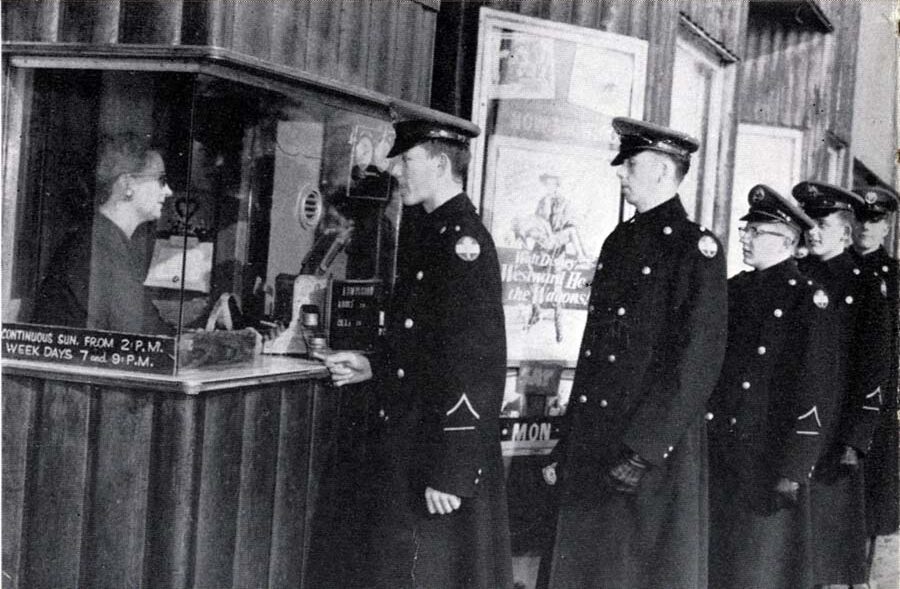
Feature Image. Rialto line to see Smiley Burnette, ca 1952.

By Dennis Gibson

During the 1890s, the U.S. was in the midst of its first bicycle craze. Bikes helped bridge the gap between horses and automobiles. The boom awakened an interest in good roads, furthered the cause of women’s liberation and was even linked to changes in social behavior. Improvements in bike technology fueled the fad. Once it was both safe and comfortable to ride, everyone wanted in. The average cost of a bike in the 1890s was $75 – that’s $2,625 today!

Plymouth Cashes In On Bikes

The attitude toward women riders was still very conservative during the 1890s. There were questions of whether women should ride, how they should ride, whom they should ride with and what their reputation would be if they did ride! The long, heavy skirts women commonly wore also made biking difficult. Bloomers and shorter skirts were an option but could draw scorn and unwanted attention. However, suffrage advocates praised the bicycle as means of giving women more freedom.

Marshall County cashed in. Bicycle parts made in Plymouth were sold to dealers throughout the United States. There were two bicycle factories located here, as well as one that manufactured handlebars.

Built in 1891, covering nearly 50,000 sq. ft., even featuring its own fire department, the Indiana Novelty Manufacturing Company was one. It was the largest factory in the world that made wooden rims for bikes, as well as mud and chain guards. In 1893, co-founder George W. Marble patented a method of making one-piece bicycle rims from ash that were both lighter and stronger than metal ones. Two carloads of lumber were used daily and by 1895, the plant was producing 700,000 rims a year, as well as 100,000 sets of guards. Indiana Novelty supplied nearly all the leading bicycle companies in the U.S. and had agents in most principal cities, as well as Toronto, London and Paris. They made more than half of the wooden rims used by bicycle manufacturers.

Plymouth Cycle Manufacturing Co.

Safety bikes were the alternative to high wheelers, or penny farthings, introduced in the 1880s. Some sources credit Marble with inventions linked to these and other early types of bikes. Marble also created most of the machinery used by Indiana Novelty in the manufacture of its wooden rims. In 1892, he and several other founding members of Indiana Novelty formed the Marble Cycle Manufacturing Company, with the addition of W.D. Smalley, who also had years of experience in the bike trade, and was the namesake for their bike, the Smalley.

In 1894, the company was sold and became the Plymouth Cycle Manufacturing Company.

“It is estimated that the company made approximately 700 bikes a year for the first two years. The output was increased to 4,500 bikes in 1895, with hopes of making 6,000 for 1896. It was reported in the Plymouth Republican that ‘Plymouth Cycle had been operating for months at 13 hours per day. The factory was limited to 5,000 bicycles but now has orders for 2,000 more.’”

However, the country was in recession, and large orders that had been placed were never paid for. Plymouth Cycle was taken over by creditors Bass and McDonald. They reopened the factory in 1897 as the Elektron Cycle Company, but work was halted in 1898 and a judgment secured by former employees for wages due. The company’s machinery and materials were sold to the Shelby Manufacturing Company and moved to Ohio. The bicycle business that had boomed in the early 1890s became a thing of the past. According to the Department of Transportation, bike sales nationwide plunged 79 percent from 1897 to 1904. The craze was over.

Smalley pins.

Unfortunately, the MCHS Museum does not currently have a Smalley or Elektron bicycle to display, but we do have more good information on display in our transportation room. We always welcome donations of any items made by any Marshall County manufacturer! Our Museum is open Tuesday to Saturday from 10:00 am to 4:00 pm.