
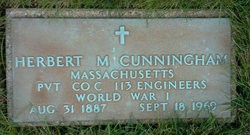
Herbert M. Cunningham’s gravesite.
The Plymouth Republican of April 23, 1908 had an interesting article about a Maine family searching for long lost nephews in Indiana. The boys were sent to Indiana on an orphan train. The Orphan Train movement (1853–early 1900s) was a massive social welfare experiment that relocated over 120,000 to 200,000 orphaned, abandoned or homeless children from crowded Eastern cities—primarily New York—to foster homes in the rural Midwest.
About 20 years earlier, the father of the boys, William Morey, died and their mother, Lillie Dean Morey, was in very poor health. Lillie was sent to a sanitorium where she later died. Her brother, D.L. Dean, was unable to care for the boys, having a family of his own, so he placed them in a Boston orphanage who promised to take very good care of the brothers. Before long, the Morey brothers were shipped west on the Orphan Train. The Dean family were not told of their whereabouts.
The Morey brothers, William and Herbert, were both taken in by a Mr. Cunningham in Plymouth, who intended to keep Herbert and find another home for William. In 1908, Cunningham said that William had been shifted from home to home and “had a hard time of it.” At first William made his home with Preacher Clark in Plymouth. He later spent time with Sam Swaysgood, and then John Cook, living west of Plymouth. He returned for a time to Preacher Clark and finally went to Peter Brown in Michigan City.
Dean remained interested in his nephews and as time passed and he prospered, he began to seek information about them and their whereabouts. He found out “in a roundabout way” that William was working for a farmer in Michigan City named Peter Brown. He determined to take a trip to Indiana and look for his missing family. In 1908, the Deans visited Peter Brown in Michigan City. He indicated that William Morey had left his employ two years earlier, and he did not have a new address for him.
While they did not locate William, they did receive a clue about where to find Herbert. Upon visiting him in Plymouth a few days later, they found a young man close to turning 21. Herbert had a good home with the Cunninghams and was satisfied with his present lot. He did not know of the death of his mother, nor that he had an uncle and aunt living until shown a clipping from a LaPorte newspaper.
Herbert Cunningham went on to fight in WWI and was discharged to the Veteran’s Home in Marion, IN, with a diagnosis of Constitutional Psychopathic State. This diagnosis covered a wide range of problems, including shellshock. In 1920, Herbert was living in South Bend with his foster sister.
In 1921 Herbert married Mary Cannon, and they had a son, Rex, in 1922. He was apparently still struggling with mental health issues, as he was sent to Longcliff, later named the Logansport State Hospital, in 1929. By 1930, Herbert was back at the Veteran’s Home in Marion. At some point he was transferred to the Veteran’s Hospital in Dayton, OH, where he died on September 18, 1969.
This is just one of the fascinating stories contained in our archives. Our library is available from Tuesday through Saturday from 10:00 AM until 4:00 PM. The Museum is located at 123 N. Michigan St. in Plymouth. Call us at 574-936-2306.