Tragic Death of J. Nilas Wolf of Bourbon, 1926

Tragic Death of J. Nilas Wolf of Bourbon, 1926

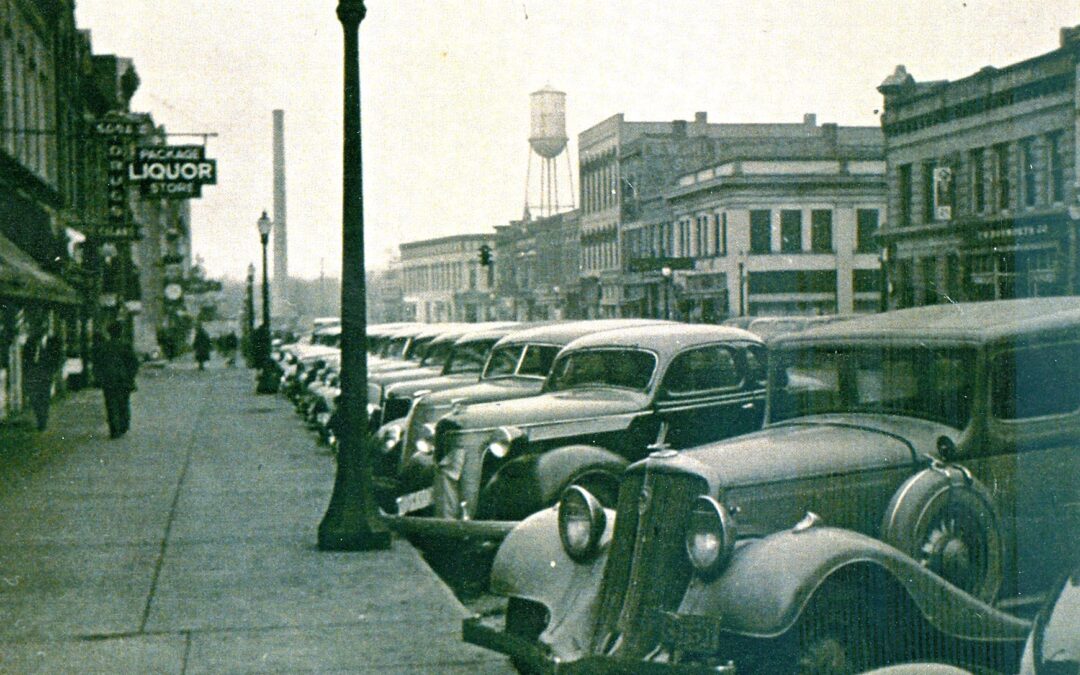
Cars along downtown Plymouth, IN in the 1930s.

This article is from about 100 years ago from the Bourbon News Mirror on June 3, 1926. It can be found in our vast collection of microfilms from various newspapers in Marshall County. It has been edited lightly for clarity.

“TRAGIC DEATH OF J. NILAS WOLF FALLS FROM RUNNING BOARD OF AUTO AND SUSTAINS THE FATAL INJURY

Nilas Wolf is dead!

Death came to him Tuesday afternoon, about 4:45, following a fall from an auto. He never regained consciousness from the time he fell, which was about eleven o’clock a.m., until he died.

His death was one of the greatest shocks the community has had in a long time, and the bereaved family and innumerable friends of the deceased are dazed even yet.

The accident happened as follows:

Chauncey Berkey and Mr. Wolf had the same kind of cars. Both were new. Mr. Berkey came into town Tuesday morning and on seeing Mr. Wolf asked him if his car had a peculiar click as it ran. Mr. Wolf replied that it did not. Mr. Berkey explained to him what he had noticed about his car for a few days whereupon Mr. Wolf said he would get in the car and ride a piece to see if he could detect it. They went east on Center Street. When about the Walter Senour home, Mr. Wolf told him he heard it and asked that Mr. Berkey stop and he would get on the running board, with the left side of the hood open and ride there to see if he could find just where the trouble was. Mr. Berkey drove about 12 to 14 miles per hour. When near the Orville Martin home, Mr. Wolf raised up and called “Oh,” or “Woah,” Mr. Berkey did not know, and before the car could stop, he had fallen off. The car did not hit him and was stopped within about thirty feet. Mr. Berkey rushed back to Mr. Wolf, to find him unconscious and with blood flowing from a small wound in his head and some from his mouth. He began calling for help and Orville Martin heard it, at the same time his little daughter, Frances, was telling her father she had seen a man fall off the car. It was Mr. Wolf she saw. Mr. Martin rushed out, Herbert Sickman came, too, and a young man and lady going by stopped and the limp body of Mr. Wolf was taken into the Martin home where Dr. Graham and Dr. Marshall were called. Indications were that a fracture of the skull had taken place, as well as a concussion of the brain, and he never regained consciousness.

Just what was the real cause of the fall never will be known. Some thought he had touched a wire of the machine and got shocked so that he fell: others believed he had been attacked with a dizzy spell and fell, though he had not complained of this to his wife. But Frank Newcomb, partner of Mr. Wolf. In the auto business, stated to us that Mr. Wolf had not been feeling well for a few days and had complained of some slight dizzy spells at times. Mr. Wolf was in this office the night before and we visited with him quite a little while, but he did not complain, though we suspicioned by his conversation he was not feeling as well as usual.

Where Mr. Wolf fell from the car there is much coarse gravel and the wound in the back of the head indicated a stone had caused it. His glasses were found later on, devoid of the glasses, only the frame remaining and it was in fair state of preservation.

Mr. Berkey remained at the Martin home all the time the injured man was there and went after the mother, Mrs. Sarah Wolf, and brought her to the home. The grief of the wife, the mother and other members of the family is too pitiful to narrate.

No blame whatever is attached to Mr. Berkey, for it is more than likely, in fact more than possible, that Mr. Wolf had been attacked with a dizzy spell when he rode on the running board and fender of the car, and this caused the fall.

One peculiar incident was the fact that Mrs. Wolf felt a premonition that day that something terrible was to happen. Try as hard as she might she could not dispel the idea, and the tragedy verified her fears.

Mr. Wolf had been identified with the business interests of the community for a number of years and for several years was postmaster. At the time of his death, he was director of the Chamber of Commerce, being recently elected. He was a member of, and a hard worker, in the U.B. Church, a fine man, highly esteemed by everyone.

The funeral is Friday afternoon at the U.B. Church with burial in the Parks Cemetery.

Obituary later.”

If you would like to scroll through microfilms or research a specific topic, visit our research library in the Museum. We are located at 123. N. Michigan St in Plymouth, IN. Our hours are Tuesday to Saturday, 10-4. Call at (574)-936-2306.
High School Construction Disasters

High School Construction Disasters

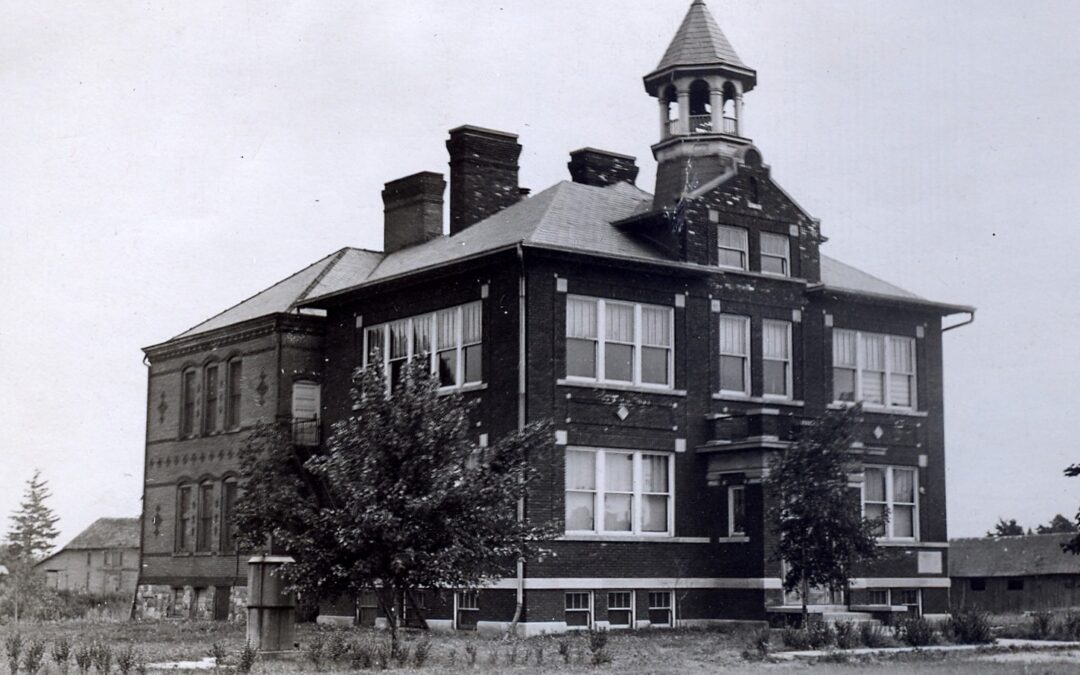
Inwood Schoolhouse south side view, undated.

People have been promoting education in Marshall County almost as long as the county has existed, going from just a few students in isolated one-room schoolhouses, to our current large, modern buildings. The path has not always been smooth. In addition to the varying attitudes and opinions of the taxpayers over the years, accidents and natural disasters have had their impact as well. Following are a few examples. Excerpts have been lightly edited.

Inwood Schoolhouse Tragedy

The Town of Inwood’s school building apparently needed a new roof before the start of the 1911 school year, but the effort ended tragically. The August 31 edition of The Weekly Republican newspaper covered the accident.

“Hueston C. Kramer, the Plymouth tinner, was perhaps fatally injured at about 1:45 Monday by falling from the roof of the public schoolhouse at Inwood. Mr. Kramer was at work putting a tin roof on the building when in some way he fell to the ground, a distance of two full stories, landing on his head on the cement sidewalk below. He sustained a broken shoulder blade and severe injuries about the face and head. It is thought that he can live but a short time at the best.

No one witnessed the accident, but Doctors Kaszer and Loring were immediately summoned. The injured man was carried into the basement of the building and everything possible was done for him. He has remained in an unconscious condition since the time of the accident.”

The 28-year-old Kramer died three hours later.

Bourbon Township Consolidated School Corp.

In 1928 the Bourbon Township Consolidated School Corporation built a new addition to their existing building. The work started in October and was slated to be completed by spring of 1929. Students were dismissed for Christmas break on December 21, and seven days later the building, including the new addition, went up in flames. In the process, the school learned a very expensive lesson. According to the Bourbon High School Chronicle 1884 – 1963,

“The building was a total loss of $125,000, with only $50,000 in insurance. The fire was discovered about 1:15 a.m. by Ernest Hurford. He hurried back to town and turned in the alarm to the Bourbon Fire Company. Help was immediately called from Plymouth and Warsaw.

“The blaze started on the upper floor in the room of the Latin teacher. It was thought it might have started with the electric wiring. The flames spread rapidly through the center of the building and to the south end…. At 4:00 a.m. the water supply failed. The town pumps filling the standpipe could not supply water at the same rate as it was being used on the fire and the firemen had to wait until it was replenished. By dawn the fire had gutted the building.”

Argos Builds A New School

The wave of school consolidations in the 1950s led to the need for a new school building in the town of Argos. Incoming students from Green and Walnut townships quickly rendered the Argos K-12 building too small, so in 1957 construction began on a new school. As work was progressing on the gymnasium, 23 steel support trusses suddenly collapsed, injuring three workmen.

The Culver Citizen of June 12, 1957, described the event. “The heavy girders collapsed in chain reaction fashion at the site of the construction of a $1,000,000 school and gymnasium of the recently organized Argos Community School.

“One of the injured workmen, Robert Treber, 31 years old, Argos, is in fair condition…. He suffered several fractured ribs and facial and arm cuts. The others injured, Antal Marton, 35, Culver, and John Brewer, 31, Argos, were treated for minor injuries and released.”

An investigator sent in to determine the cause of the collapse concluded that one of the girders had been dropped and sustained some damage, but was installed anyway, and an attempt to straighten it in place had been made. It was also noted that the joists were curving away from the starting end, some bracing clips were broken at the welds and one of the wires connecting the first joist to the end of the column failed. It could have been much worse than it was.

Laville Junior-Senior High School & Palm Sunday

And sometimes no amount of human intervention can stop a disaster. The new Laville Junior-Senior High School was still under construction in April 1965 when the Palm Sunday tornados struck Marshall and St. Joseph counties. The April 12 South Bend Tribune reported, “…the north wall of the gymnasium was badly damaged, and some damage was also done to an east wall. Building material was scattered throughout the area.” Regardless of the setback, the new consolidated school opened on time.

The MCHS staff is hard at work on an upcoming exhibit highlighting the public high school buildings of Marshall County. Details will be coming soon. The Museum is open Tuesday through Saturday from 10 a.m. – 4 p.m. at 123 N. Michigan St. Call us at 574-936-2306 for more information.

The Famous Fairs of Bourbon

The Famous Fairs of Bourbon

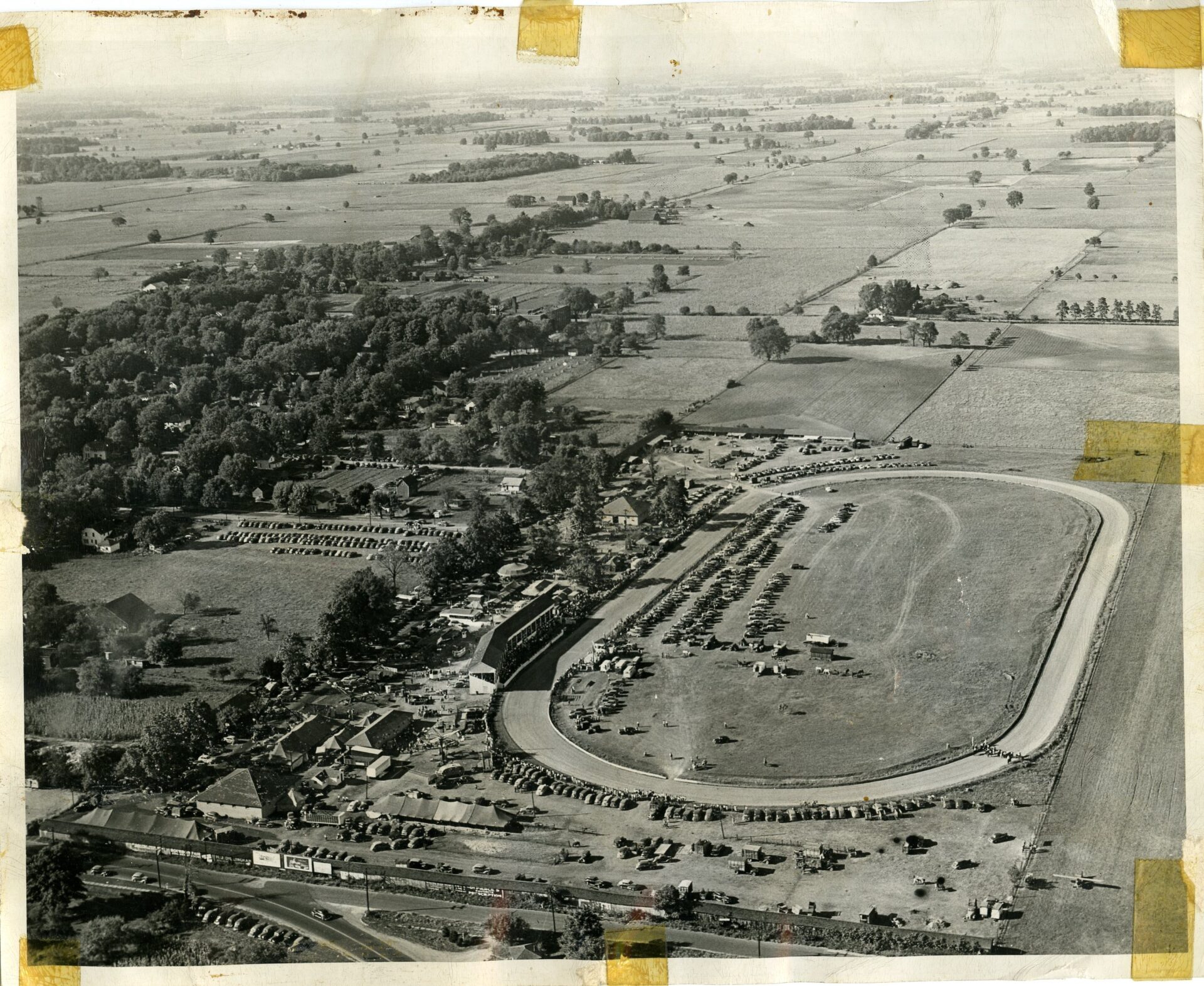
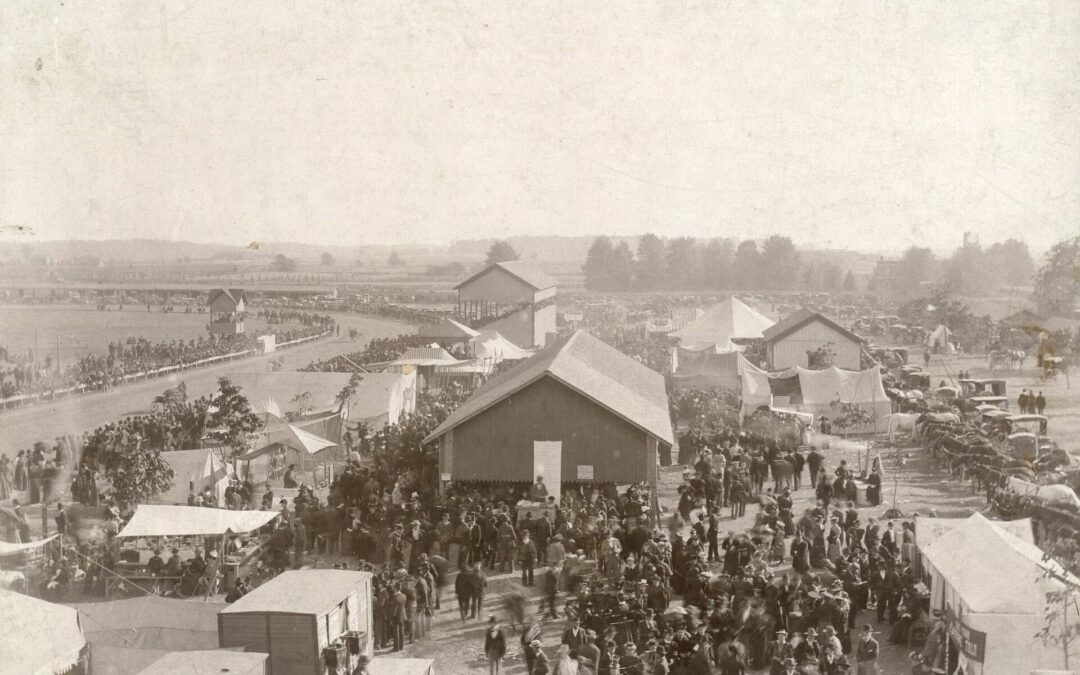
Feature Image. Undated birds-eye-view of fair.

The Town of Bourbon 1872 fair was the first one established in the county. It took place in a schoolhouse 1½ miles east of Bourbon. The fair was discontinued for a few years and started again in 1891, as an 1892 ticket listed it as the Second Annual Fair. Some days the crowds were as large as 10,000 to 14,000 visitors. They usually took place in late September or early October, and often school would be dismissed so students could attend.

The Purpose of the Bourbon Fair

Among the Bourbon fair’s goals was to improve livestock breeding, to promote the area’s agricultural, mechanical and industrial interests and to provide good clean entertainment. They erected several permanent buildings: a grandstand with a half mile track, an art hall, stables and fenced-in animal pens.


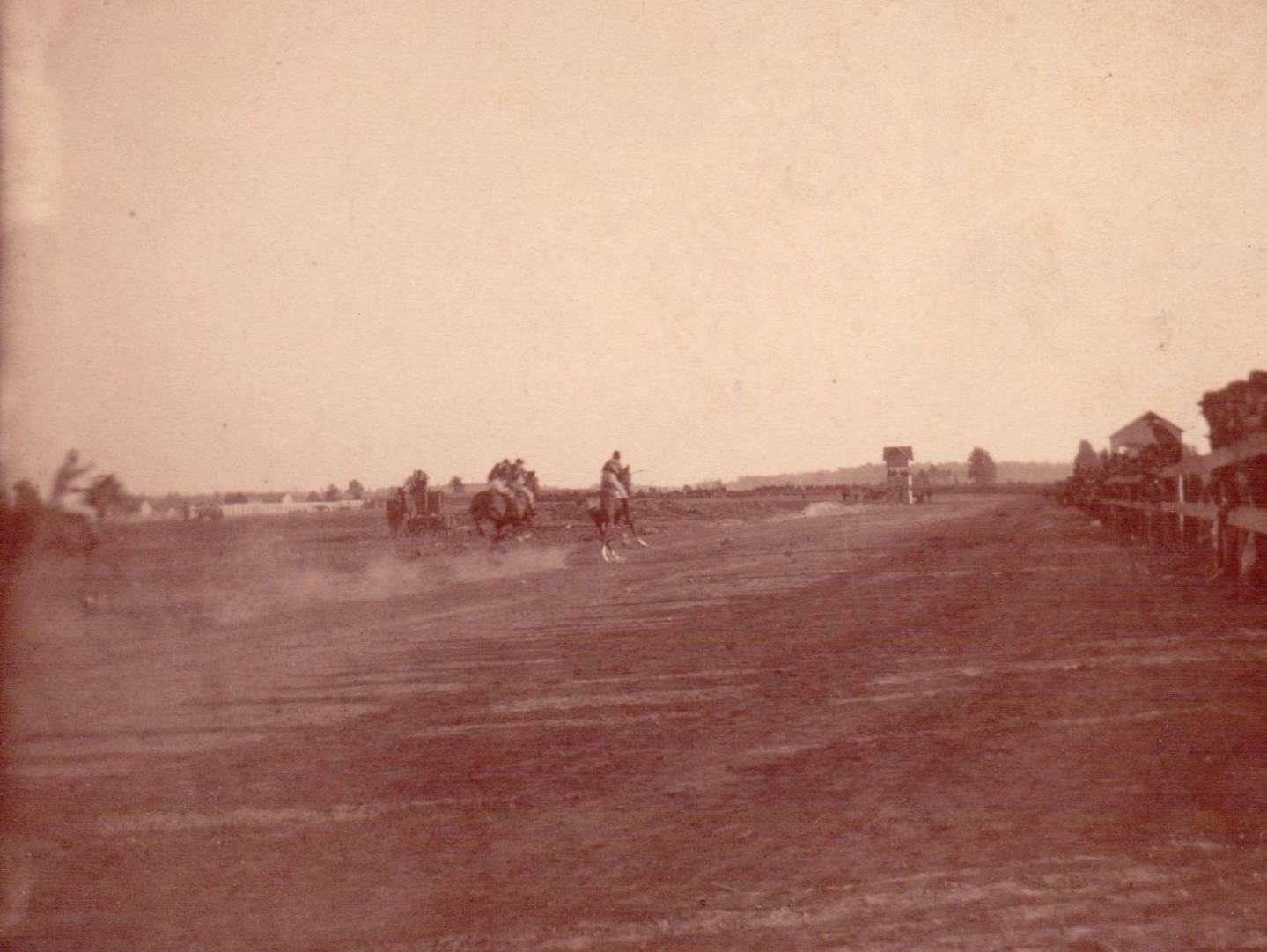
Race track looking north.

Each year a brochure was printed showing everything that was going to be happening at the fair.  The catalog also provided plenty of opportunities for local businesses to advertise. As a sample of the fair offerings, the 1933 catalog listed various cattle, sheep, swine, poultry, turkeys, waterfowl, and pet stock (eagle with cage, pea fowl, guineas, pigeons, rabbits, cage of squirrels, largest cat, ferret, pair of silver foxes). Also to be shown in all categories imaginable were grains and seeds, vegetables and roots, apples, pears, peaches, plums, persimmons, chestnuts, quinces and grapes, cut flowers, shrubs and flowers. The table luxuries category included canned fruits and vegetables, jellies, breads, cakes, cookies, fudge and candy.

The art hall contained “ladies fancy work” of coverlets, quilts, spreads, pillows, knitted goods -including socks, mittens and clothing – and every kind of rug. Embroidery and needlework included dresser scarves and handkerchiefs, pillowcases and tablecloths. All sorts of collections were featured, including coins, stamps, curiosities of any kind, shells, marbles, etc. Fine arts covered clay molding, landscapes, drawings in oil, pen, pencil, crayon and charcoal, baskets and “miscellaneous article not otherwise entered.”

And we cannot forget the most exciting activity, the Speed Program – horse races in trot or pace, pulling contests and mule races. Any mule winning the race two years in a row was barred. Straw and stalls were free for all horses entering the race. Horse racing was the big attraction and took place throughout the years to the last fair.

Horses on racetrack.

Other activities through the years included a firemen’s tournament, a band contest, bicycle races, trick bicycle riders and ball games. There were large pumpkin contests. In 1927 a “calling cows” contest was planned. The champion caller was to be rewarded with a handsome old-fashioned cow bell. In 1941 they added an amateur night.

The Bremen Enquirer: October 23, 1891

“About sixteen or seventeen years ago Bourbon began to have fairs…. The excellence of these fairs gave them a great reputation, far and wide, and everybody who attended spoke in the most flattering terms of them. One of the strong features of these fairs was the splendid exhibit of stock of all kinds, and to them is due much of the advancement in stock breeding in and around Bourbon which for many years could boast of being far in advance of any other section of country in this part of the state….  

“Last Friday found us at the Bourbon fair…. We were agreeably astonished at the very excellent buildings they have erected, and which were just finished during the fair. The sound of the saw and hammer was mingled with the cry of the fakir and the music of the merry-go-round and the hum of human voices.

“It will be impossible in the limits of this article to describe in detail the many attractive features of Bourbon’s fair. The exhibits in stock were fine and quite large…and the parade was something that would make the heart of the fellows who have been raising ‘scrub’ stock chock full of envy at the progressive farmers who believe in keeping up with the march of progress.

“The agricultural department was well filled with the choicest products of a rich soil and a propitious season and elicited words of praise from all who viewed it.

“The poultry department contained many fine specimens of thoroughbred fowls that would delight the eyes of any poultry fancier on earth.

“The implement department contained the regulation wares in the way of necessary and labor-saving machinery that is necessary for the systematic tickling of the productive soil.

“The floral and art hall contained a wonderful collection of fine fabrics wrought into articles of usefulness and beauty by the nimble fingers of the ladies. Stepping into this art hall is like stepping out of this old prosaic world into a fairy land, an elysian bower of beauty and whose radiance dazzles the eye and beauty charms the soul. So different from what we meet in our everyday life that one forgets that he is on this mundane sphere but thinks rather that he has been transported to a new world where all the beauty, loveliness and grandeur of nature and art has been gathered, combined and blended together in a manner to mystify our temporal senses and induce the belief that by some means we have caught a brief glimpse of Paradise.

“Without question the most remarkable thing about the entire grounds is the fine race track that the association has succeeded in building. It is constructed on the most approved plan and the very fact that it is only a few weeks old as yet and has had such splendid time made upon it shows conclusively that it is destined to be one of the best in the state. . ..”

The Bremen Enquirer: A Few Years Later

“Bourbon has a very fine race track and up to the Bremen fair this year the best time ever made on a track in Marshall County was made over the Bourbon track, 2:21 by Billy the Kid (presumably a horse, not the outlaw). This time was cut down to 2:19¼ at the Bremen fair last week and now the managers of the Bourbon fair say that the time will be again lowered over the Bourbon track next week, therefore you may look for some very fast going. Do not miss it. You may regret it if you do.”

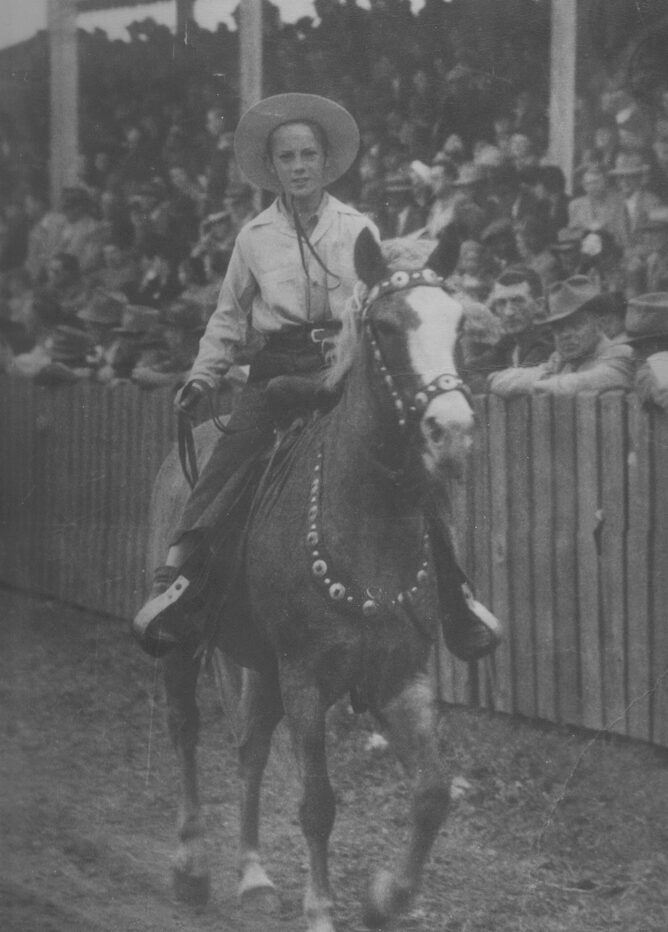
Jim Bates Sr. on horse.

The Bremen Enquirer: October 12, 1894

“A correspondent from Bourbon to Wednesday’s Chicago Times says a prize of $200 is to be awarded at the Bourbon fair on Thursday to the man who drinks the most whiskey. It is a foregone conclusion that the $200 will remain in Bourbon.” (Perhaps the residents felt they should live up to the name of the town.)

The Argos Reflector: October 11, 1900

“The crowd on Wednesday was . . . larger than expected by the management. But on Thursday the vast throngs of people simply overwhelmed the officers in charge. The number of single tickets sold on this day was 6,400. This does not include children, holders of season tickets, exhibitors, caretakers of exhibits, race horses, nor stock holders. The treasurer of the association informed our reporter that he could not be far wrong in saying there were more than 10,000 people in the grounds on Thursday. On Friday the attendance was not so large but was larger than expected.

Other Bourbon Fair Stories

There was not always a happy ending at the fair. Dolphus was a magnificent Shropshire ram of fine proportions, good weight and clean heavy fleece of high quality. He was exhibited at the Bremen fair in 1895 and then later entered at the Bourbon fair. While on exhibition he was seized with an illness and died. Another time a horse tied up with a rope fell, choked and died.

There was snow at the Bourbon fair in 1906. October 10 saw the area receive ten inches of snow.  Tents fell beneath the weight of the snow, tree limbs were snapped and bushes were bent to the snow. People came to the fair in boots to see the snow. The next couple of days the weather was very mild.

As the automobile became more popular, accidents involving them began to take the place of accidents with horses, wagons and buggies. In 1910 Dr. Nichols broke his arm while cranking his “machine” when leaving the fair. The next day another doctor did the very same thing. The Bremen Enquirer concluded that “Automobiles appear to have a special grudge against doctors just at present.”

More difficulty with doctors and automobiles. In 1915 Dr. and Mrs. Hammon Imus were thrown out of their buggy, and it was smashed when it was struck by an automobile on their way home from the fair.

In 1935 Ida Helmlinger of Bremen, the founder and president of the Old Maids Association of the World, was invited to visit the Bourbon fair. “We’ll find a place for you somewhere,” she was told, “even if we have to put you with the chickens.” She still went and met hundreds of people, after which she went to the Warsaw fair.

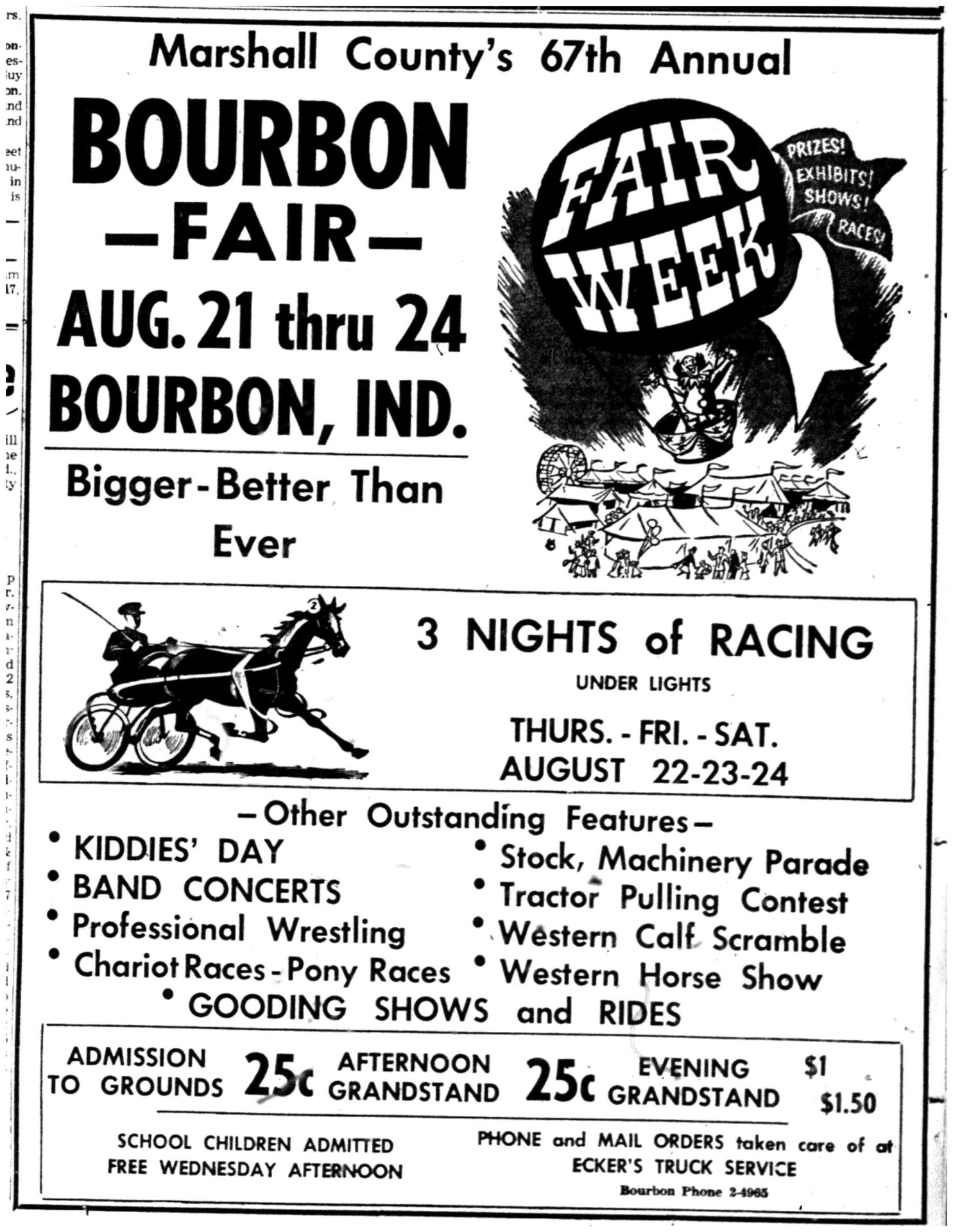
By the 1940s and 50s the fair featured four days of racing. Besides the usual races, there were pony races, farmers’ running races, and farmers’ cart races. Modern times brought tractor pulling contests.

Eventually, as interest in harness racing waned, and the county fair grew and became more popular, the Bourbon fair ceased to be. In 1963 the fairgrounds were sold to Triton School Corporation, and sadly, one of Marshall County’s most beloved institutions passed into history. The last fair was said to have been in 1962, though there are a couple of newspaper items mentioning people attending the fair in 1964.

Bourbon Fair, 67th Annual poster.

The Museum is open from 10 until 4 from Tuesday through Saturday at 123 N. Michigan St., Plymouth. For more information, call 574-936-2306.

A Bold Robbery in Bourbon

A Bold Robbery in Bourbon

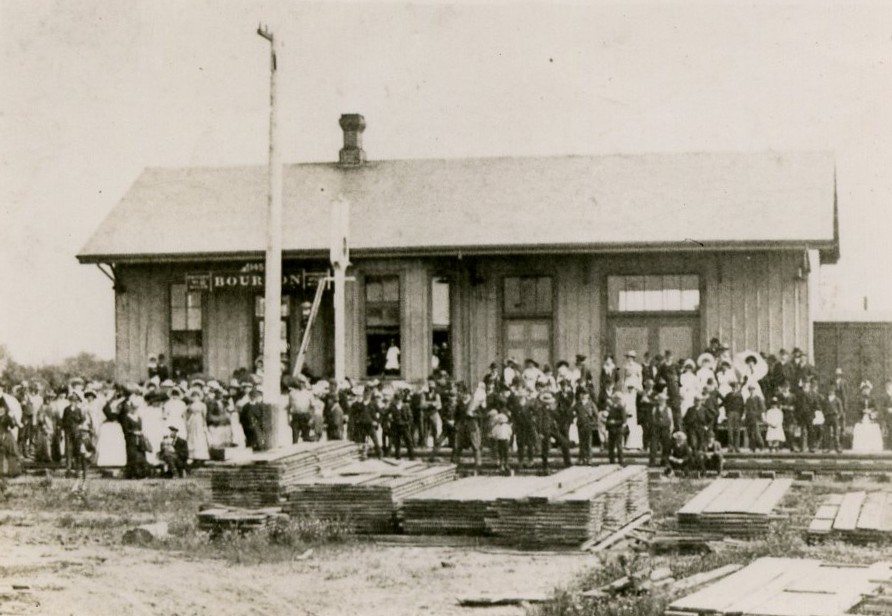
Feature Image. Bourbon railroad depot, ca 1883.

While the advent of railroads brought many advantages to the community, including easier access in and out of the area and an easier way for the farmer to move his crops, it also brought more people into the county, some of whom were unsavory characters.  A group of robbers decided to make Bourbon their home base.

The story is told in McDonald’s History of Marshall County of those bold robbers who operated in Bourbon:

A History By McDonald

“During a considerable period before and after the completion of the Pittsburg, Fort Wayne & Chicago Railroad, the town of Bourbon was infested with a gang of counterfeiters and robbers who kept the inhabitants in a constant fever of excitement and fear.  The existence of this gang and many of those connected with it were well known, but the evidence of their guilt was not sufficient to warrant legal proceedings.  Some of them were, however, finally arrested, but the law’s delay and the many technicalities brought into requisition enabled all of them to escape the penalty they undoubtedly deserved.

“One night in the summer of 1867 a large number of housebreakers and robbers entered the residence of Joseph W. Davis.  Before entering they blackened their faces and otherwise disguised themselves.  They had taken the precaution to give the watchdog, a very fine Newfoundland, a dose of strychnine, which had put him effectively out of the way.  They procured a large scantling (a piece of lumber of small cross section) and, using it as a battering ram, drove it with such force against the front door as to break it open with the first blow. 

“Two of the robbers rushed into the bedroom where Mr. Davis and wife and infant child were sleeping and laid violent hands upon them before they realized the true condition of affairs.  A pistol was under Mr. Davis’ head, and in making a desperate effort to procure it, he was struck several times on the head and face, making the blood run profusely.  The burglars secured the pistol and (with one) holding Mr. Davis down by the throat, the remainder of the robbers went through the several rooms in the house, taking them one by one, going through the house and taking everything of value that suited their fancy.  In one of the rooms they found the hired girl; in another, the hired man.  At each of these rooms they placed one of their number on guard, and now, having everything arranged safely, they began to rummage every part of the house,  They made Mr. Davis open his safe, from which they took all the money and papers and other valuables contained in it. 

“They prepared an excellent supper from the supply of cooked provisions they found in the kitchen and buttery, of which they partook with evident relish.  They remained about two hours and, having finished their work, bade the occupants an affectionate good night and hastily took their departure.

 “When the robbery became known early the next morning, the whole town was in a furor of excitement and threats of lynching suspected parties were freely made, but as nothing definite could be ascertained as to who the guilty parties were, nothing was done.  Sometime afterward the pocketbook and papers were found close to the railroad track near Bucyrus, Ohio, and shortly after returned to the owner.  Several of the suspected parties soon left town and others were not slow to follow, and this was the last trouble Bourbon ever had with housebreakers.”

Who was Joseph W. Davis?

Who was Joseph W. Davis?  The thieves picked their victim well. 

Joseph W. Davis was a lumber dealer and farmer.  He was in the milling business with his brother Omar and built a hotel in Bourbon.  The Davis mills had been destroyed by fire in 1865.  In 1867, the year of the robbery, the Davis brothers built again after the Davis block was destroyed by fire.   In December of that year Joseph W. Davis was chosen to represent his party on the Board of Registry for Bourbon Township.  Davis was also a lawyer, practicing law for over thirty years, and a state legislator.  The gang would have figured Davis had something worth stealing when they broke into his house.

Born on January 22, 1829 in Ulysses, Davis would have been thirty-eight years old when he visited by the gang of thieves who ransacked his house.  He lived to be seventy-two years old and passed away on February 1, 1901.

MCHS & Museum is full of great stories, and you are free to look anytime! We are located at 123 N. Michigan St. in Plymouth. Our hours are 10:00 until 4:00, Tuesday through Saturday. Call us at 574-936-2306.

Hunting Tales

Hunting Tales

With the annual hunting season in full swing, it’s time to look at hunting tales from long ago from the archives at the Marshall County Historical Society. Documents tell us: “The tradition of the last bear that was shot in Marshall County, comes from the lips of John Thomas, who is as familiar with the unwritten history hereabouts for the last 40 years as a draft horse is with the four corners of his feed box.” said John Thomas.

“In the winter of 1865,” says Thomas, “a number of bears wandered down from the woods of Wisconsin and terrified cattle and farmers throughout Northern Indiana.  This particular bear was a huge black fellow and had been seen in various parts of the county before he met his doom.  I had just come home from town when the women folks ran to meet me and said they had seen the much-dreaded animal run across a field.  I rushed to the house but found the hired man had taken the gun before me and started in pursuit.  Going to the neighbors, I borrowed another gun, mounted my horse and galloped away on the trail.  When I came up to the Whaley place on the Wolf Creek Road, I found the two boys in a very excited mood.  They had just shot the bear.  They told me that their father had gone to town, and they had been left at home to feed the pigs.  Suddenly one of the yelled, ‘See that pig on the fence!’  The other one looked.  Sure enough there was a pig on the fence.  But a pig on the fence was absurd.  When they took a better look, they saw the supposed pig was a bear.  A gun was brought from the house and inside of two minutes the big brute lay dead upon the ground.  Many hunters arrived in time to help gloat over the victory.  The hide was sold to Jepeth Disher, who paid $8 for it.  It was afterward worked up into a fine robe.” Plymouth Democrat – July 31, 1902

“The latest diversion of Bourbon men of affairs is that of racoon hunting.  The town, that is the sporting part, is now in the throes of a revival of the art of hunting the animals, that in the early days was a favorite pastime.  Whether it is a case of heredity, just now cropping out of the fourth generation, we have no means of knowing, but there is one thing certain, the craze has hit the town hard.  As far as we have been able to learn Jonas Rettinger is the only one who has, in the years past, kept up the sport enough to not forget its requirements.  Later Samuel Lemlar, Phillip Steinman and Arch Myers formed a company (limited) and purchased a hound after they had sold the one Sam had owned to Rettinger.  Lemler then purchased another hound and his deep sonorous voice had been sending cold chills up and down Mr. Racoon’s spine with painful regularity.  When Harl Stewart got the fever, he purchased another dog, and the old days of gentlemen following the hounds is returning.  Lemler, Myers & Steinman gave a racoon feast at the Vernette & Fretz restaurant Wednesday evening, and the smacking of lips told the tale, as their friends passed in and out.  Harl Stewart and Otis Thacker went Friday night and so far, hold the palm of good catches.  They secured three large, fat young racoons and a skunk.  And the beauty of the whole thing is that the skunk wasn’t quick enough to use his defense.” Bourbon News-Mirror – November 28, 1907

Skeleton Found in a Bourbon Barn

Skeleton Found in a Bourbon Barn

It is said that every family has a skeleton in their closet. One Bourbon family had a skeleton in their barn:

“After the body was accidentally discovered by a hired hand and became publicly known, an inquest was held. Witnesses were called, a jury summoned, and testimony was given on August 25, 1855, in S.M. Adams’ storeroom. The jurors examined the skeleton of a female body between fourteen to twenty years of age, about five feet two inches tall. The top part of the skull and the left side of the lower jaw were gone. The name of the person and the cause of her death were unknown. The body was found on the premises hidden in the barn of Grason Parks.

“Henry Strunk testified the body was found in Grayson Parks’ haymow in the northwest part of the barn. It appeared to be covered up and secreted. He helped remove the body from the barn by the order of the coroner. The body was removed on the evening of August 24, 1855, shortly after dark.

“Thomas Wilkins said he discovered the body. Grason Parks had sent him up in the hayloft after a piece of lumber. Wilkins saw a small corner of a box and supposed it to be the lumber he was sent for but upon taking hold of it, he discovered it to be a box. On August 20 Grason Parks had employed him to help haul in oats. Wilkens examined the box again and was led to suppose that it contained a human body. The box was in the same place and condition as it was when he had first seen it in Grayson Parks’ barn. Wilkins supposed the box to have been secreted in the hay with which was covered. Wilkins next saw the box on the evening of August 24 when he went up into the haymow by the order of the coroner to show where the box was. Wilkins saw the box opened in the barnyard. At that time, he discovered to a certainty for the first time that there was a human body in the box. Wilkins had no knowledge as to how the box came to be in the barn.

“Abraham Baker said he was frequently about the Parks barn the previous spring and summer. He often noticed that there was a bad smell in the barn. He said he was working for Grayson Parks in May, and while the cattle were eating at noon, Baker went up into the haymow and for the first time, he discovered the bad smell. Baker asked Grayson Parks’ son what smelled so bad. The boy replied that his father had killed a cat in the hay but had burned it the day before. Baker said that when he first discovered the box his brother was with him; he shook the box, and it gave a disagreeable smell and that he supposed it to contain a dead body.

“Dr. David Hazzard testified he had examined the body which had come from the barn of Grayson Parks and discovered no marks of violence. It was a female body. The upper part of the skull had been removed and the left under jaw was taken off. Dr. Hazard stated that Grayson Parks was not a physician or surgeon.

“Dr. J. E. Brooks also examined the body and saw no marks of violence. The skeleton was a female. Dr. Brooks supposed the subject to have been between fourteen and twenty years of age.  He thought the body had been fairly well prepared. There was as little smell about it as any he had ever seen which was so recently prepared.

“James O. Parks said he had seen the body many times. He saw it in Leesburg. He said it is the property of Dr. Edward Parks. It was prepared by Dr. Edward Parks and probably others. James Parks said he saw it before it was dry. He said it was brought from Michigan. He never learned the name of the person. James Parks said it was a young female; he did not know the age but said it was “hardly matured.” He identified the skeleton to be the property of Dr. Ed Parks from the fact of the removal of the upper part of the skull and the loss of part of the under jaw and teeth.

“James Parks stated he could not say that he ever heard Dr. Ed Parks say that the body was his property, but he saw the body in Dr. Ed Parks’ lecture room in Kosciusko County. James Parks had no knowledge of the body being at Grayson Parks.’ James Parks said he was invited into Dr. Ed Parks’ lecture room by some of the students and went afterward without an invitation because they made him welcome. He said that it was prepared over a year ago.

“Dr. John F. Parks said he did not recognize the skeleton for a certainty to be the one which he had once or twice seen in the room of Dr. Ed Parks. Dr. John Parks said he had no knowledge of the skeleton being at Grayson H. Parks.’ He believed the skeleton to be the property of Dr. Ed Parks. He had seen a skeleton in Dr. Edward Parks’ room over a year ago and supposed this was the same one. It was in much the same condition as it was at the inquest. Dr. John Parks had requested Dr. Ed Parks to send him a skeleton two months before. Dr. John Parks had passed by Grayson H. Parks’ place but had received no notice of a skeleton being there for him.”

Apparently, the body was an open secret in the Parks family because they all seemed to know about it. In the early days of the study of internal medicine, it was very common for a doctor to acquire a cadaver to study. Some doctors were known to pay someone to dig up a recently deceased body, as in Charles Dickens’ A Tale of Two Cities.

The jury found Grayson Parks guilty of unlawfully secreting the skeleton of a human body. Those involved in what happened to the skeleton are gone now, all buried properly under tombstones with their names on them. They received much better treatment after their decease than that which was given to the young girl, whose name is still known only to God.

Be sure to stop by the Museum! We are open from 10:00 until 4:00, Tuesday through Saturday at 123 N. Michigan St, Plymouth.