
High School Construction Disasters

High School Construction Disasters

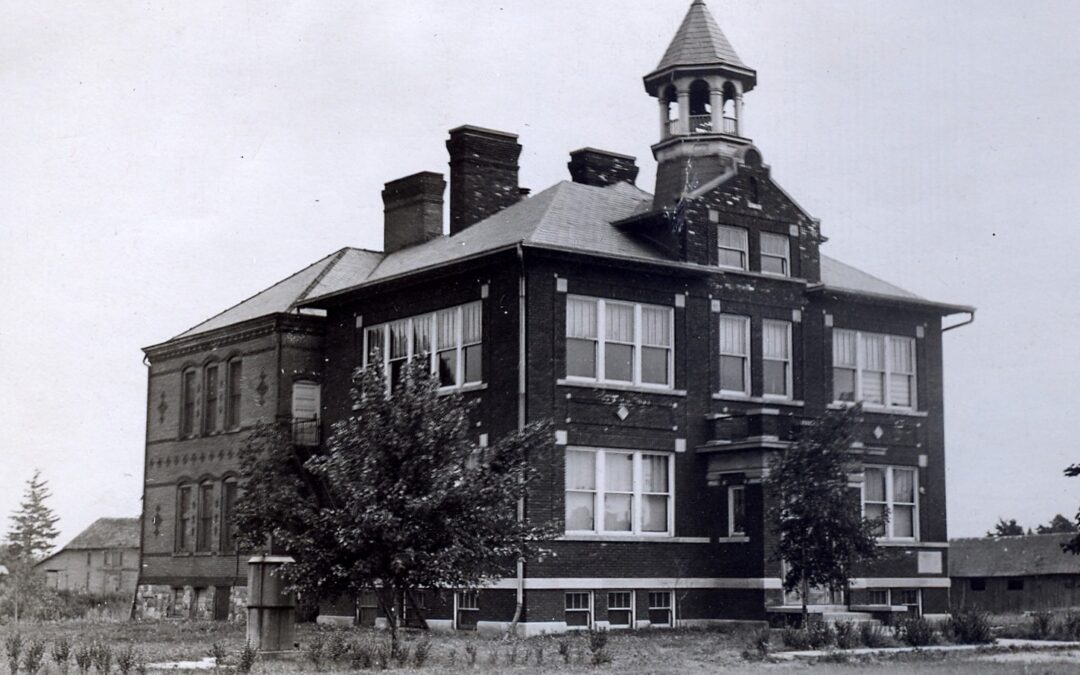
Inwood Schoolhouse south side view, undated.

People have been promoting education in Marshall County almost as long as the county has existed, going from just a few students in isolated one-room schoolhouses, to our current large, modern buildings. The path has not always been smooth. In addition to the varying attitudes and opinions of the taxpayers over the years, accidents and natural disasters have had their impact as well. Following are a few examples. Excerpts have been lightly edited.

Inwood Schoolhouse Tragedy

The Town of Inwood’s school building apparently needed a new roof before the start of the 1911 school year, but the effort ended tragically. The August 31 edition of The Weekly Republican newspaper covered the accident.

“Hueston C. Kramer, the Plymouth tinner, was perhaps fatally injured at about 1:45 Monday by falling from the roof of the public schoolhouse at Inwood. Mr. Kramer was at work putting a tin roof on the building when in some way he fell to the ground, a distance of two full stories, landing on his head on the cement sidewalk below. He sustained a broken shoulder blade and severe injuries about the face and head. It is thought that he can live but a short time at the best.

No one witnessed the accident, but Doctors Kaszer and Loring were immediately summoned. The injured man was carried into the basement of the building and everything possible was done for him. He has remained in an unconscious condition since the time of the accident.”

The 28-year-old Kramer died three hours later.

Bourbon Township Consolidated School Corp.

In 1928 the Bourbon Township Consolidated School Corporation built a new addition to their existing building. The work started in October and was slated to be completed by spring of 1929. Students were dismissed for Christmas break on December 21, and seven days later the building, including the new addition, went up in flames. In the process, the school learned a very expensive lesson. According to the Bourbon High School Chronicle 1884 – 1963,

“The building was a total loss of $125,000, with only $50,000 in insurance. The fire was discovered about 1:15 a.m. by Ernest Hurford. He hurried back to town and turned in the alarm to the Bourbon Fire Company. Help was immediately called from Plymouth and Warsaw.

“The blaze started on the upper floor in the room of the Latin teacher. It was thought it might have started with the electric wiring. The flames spread rapidly through the center of the building and to the south end…. At 4:00 a.m. the water supply failed. The town pumps filling the standpipe could not supply water at the same rate as it was being used on the fire and the firemen had to wait until it was replenished. By dawn the fire had gutted the building.”

Argos Builds A New School

The wave of school consolidations in the 1950s led to the need for a new school building in the town of Argos. Incoming students from Green and Walnut townships quickly rendered the Argos K-12 building too small, so in 1957 construction began on a new school. As work was progressing on the gymnasium, 23 steel support trusses suddenly collapsed, injuring three workmen.

The Culver Citizen of June 12, 1957, described the event. “The heavy girders collapsed in chain reaction fashion at the site of the construction of a $1,000,000 school and gymnasium of the recently organized Argos Community School.

“One of the injured workmen, Robert Treber, 31 years old, Argos, is in fair condition…. He suffered several fractured ribs and facial and arm cuts. The others injured, Antal Marton, 35, Culver, and John Brewer, 31, Argos, were treated for minor injuries and released.”

An investigator sent in to determine the cause of the collapse concluded that one of the girders had been dropped and sustained some damage, but was installed anyway, and an attempt to straighten it in place had been made. It was also noted that the joists were curving away from the starting end, some bracing clips were broken at the welds and one of the wires connecting the first joist to the end of the column failed. It could have been much worse than it was.

Laville Junior-Senior High School & Palm Sunday

And sometimes no amount of human intervention can stop a disaster. The new Laville Junior-Senior High School was still under construction in April 1965 when the Palm Sunday tornados struck Marshall and St. Joseph counties. The April 12 South Bend Tribune reported, “…the north wall of the gymnasium was badly damaged, and some damage was also done to an east wall. Building material was scattered throughout the area.” Regardless of the setback, the new consolidated school opened on time.

The MCHS staff is hard at work on an upcoming exhibit highlighting the public high school buildings of Marshall County. Details will be coming soon. The Museum is open Tuesday through Saturday from 10 a.m. – 4 p.m. at 123 N. Michigan St. Call us at 574-936-2306 for more information.

Inwood High School

Inwood High School

As with other towns in Marshall County, at one time Inwood had its own high school.

The Inwood neighborhood may have been small, but it was spunky. Some indication of that was seen in the Marshall County Independent in April 1899 when Trustee McCrory decided to transfer graduates of the eighth grade in Center Township to Inwood High School instead of Plymouth High School, as was the custom. In 1906, Inwood graduated five scholars, eight in 1907, thirteen in 1908 and nine in 1909.

The Weekly Chronicle in November 1908 reported, “The Inwood schools are making good progress this year under the direction of Prof. Fry and an efficient corps of teachers. A visit to the schools gave the impression of a thorough system and of excellent deportment of pupils. The greater number of pupils are from the country and are transported to and from school in wagons. There are two classrooms upstairs and three on the first floor and a basement. The basement has a cement floor and is supplied with water from a reservoir. There is a large water basin, cups and towels. It is entered both from the inside and the outside.

“The basement room presents a lively and busy scene at noon time. Three long tables are arranged, with tablecloths and benches, and at these tables the pupils eat dinner. Their dinners are brought from home and are spread out in inviting shape. The manner in which the pupils perform this exercise of the day is not slow. The janitor, Jr. Gerrard, remains with them at the noon hour to assist them and to preserve order.”

In 1911 the Weekly Republican stated, “Rev. Arlington Singer gave the baccalaureate address to the four graduates of the Inwood High School Sunday night at the Methodist church of that place. His theme was class motto Labor Omnia Vincit, and by illustration and argument he showed how labor did conquer, as well as how necessary it was that we all work with all our might. The sermon and the quartet song, ‘Why Stand Ye Here Idle,’ came in so nicely together that it pleased all…. After the baccalaureate exercises, a banquet was given by the members of the senior class to the singers and the two ministers and their wives.”

But that August tragedy struck at the Inwood school. As reported in the Bremen Enquirer and the Weekly Republican, Hueston C. Kramer fell two full stories while putting a tin roof on the school. He landed on his head on the cement walk. Drs. Kaszer and Loring were immediately summoned. He had suffered a broken shoulder blade, in addition to more serious injuries. There was little hope of recovery, and he passed away three hours later without regaining consciousness. Kramer, a single 28-year-old, had come from Wabash just three weeks before to open a tin shop under the Marshall County Trust & Savings Bank at Plymouth.

In December 1914 the Bremen Enquirer reported that a large number of northern Indiana towns were having contagious and infectious diseases, mostly smallpox. The Inwood school was closed for at least ten days because of diphtheria.

In 1915 the Inwood school was remodeled and an addition on the south doubled its size. It contained two classrooms and two cloakrooms on the first floor. The spacious auditorium on the second floor was for both school and community activities.

On December 19, 1918, the Enquirer reported that the Inwood school was closed until after the holidays because of a case of scarlet fever.

Things began to get wild and crazy in the 1920s. And it wasn’t just the students, either. Plenty of adults got into the act, including the principal.

During the winter of 1923, a student “snowballed” principal Rose’s wife. Evidently it bothered her husband. As reported in the Bremen Enquirer, Rose went to the residence of Otto Ames and complained that Ames’ son had snowballed Mrs. Rose. Rose demanded that the boy apologize. “In the fight that followed his demand, Ames’ leg was fractured. Rose was said to have flourished a gun in the fracas, though there was no shooting, and the gun incident, if a gun was flourished, appears to have cut no figure in the trial at Plymouth, as a result of which Rose was fined $10 and costs, aggregating $30, for assault and battery.”

The newspaper editorialized, “Many people believe that lack of proper discipline is a common fault of country schools, but Mr. Rose appears to have gone to the other extreme and attempted to cover too much territory.”

But Mr. Rose stayed on the job and in April 1924, as reported in the Bremen Enquirer, “Flaming youth had its little flare at Inwood Thursday, when eight pupils of the Inwood school, feeling the urge of spring and to vent their surplus pep, ‘borrowed’ an automobile, took it for a joy ride and came to a sudden and unhappy stop in the ditch at Johnson’s Corners, two miles north of Bourbon. Two of them were injured and all of them should have been spanked, according to the older heads thereabout.

“The pupils had just finished their examinations at school and felt the need of air. Harry McCullough, son of Mr. and Mrs. Charles McCullough, who live two and a half miles north of Inwood, had driven his father’s car to school. He was still at work on his examinations when the pepful eight conceived the notion of the joy ride. They asked him for the key to the car, but he refused to give it to them.

“One ingenious member of the joy seekers used a knife to turn the switch to start the car. Maxine Kizer took the wheel and seven others piled in – Eloise Shoda, Evalyn Shoda, Thelma Sands, Shed Cramer, Vernon Apple, George Daniels and Leota Thompson.

“The party proceeded to Bourbon and then north on the paved road. In making the turn at Johnson’s Corners, the car left the road and went into the ditch. Daniels was cut in the arm and side and had a bump on the head. Cramer was also injured. The others were bruised and shocked but not badly hurt. The car was almost a complete wreck, it is said.

“On Saturday principal O.B. Rose of the Inwood school called the parents of all the boys and girls together with the owner of the car, and the parents agreed to share the expense of settlement for the damage to the car. Mr. McCullough, owner of the wrecked machine, is just recovering from injuries received last fall when his car was struck by another machine. His son Harry, while driving a horse and buggy last winter, was also struck by a car. This is the third accident for the family this year.”

Mr. Brock, living near Johnson’s Corners, gathered up the “joyless joy riders” and took them to Bourbon for medical attention. George Daniels, son of Mr. and Mrs. Wm. Daniels, was brought to Kelly Hospital in Argos, where several stitches were taken in his arm. He remained in the hospital a couple of days before he could be removed to his home.

But nothing shook Harry McCullough as he pursued his education. The Bremen Enquirer of April 24, 1924, reported that the Inwood High School commencement took place in the high school auditorium. Two graduates, Gertrude Forbes and Harry McCullough, were awarded diplomas.

That October, Inwood High School was used as an example in the Argos Reflector when discussing whether Walnut Township should have a high school, “The Inwood High School will perhaps throw some light on the subject. About a year ago a warm meeting of protest regarding closing their high school was held. It was a pretty warm affair. One of the protesting patrons got his leg broke by the superintendent. The meeting ended with ‘weak-minded men carrying out the babies, and strong-minded women carrying out the stoves.’ That incident closed the high school of Inwood, and the pupils are now being transported to Plymouth at a savings of $2,000 a year to the taxpayers of Center Township.”

And the South Bend Tribune concluded on July 15, 1991, “…the brick Inwood School that housed students for 57 years was built in two parts with the north half erected in 1908…. The north section had no lights and no indoor plumbing. The south addition, built in 1915 and which faced the railroad track, brought electricity and water into the school…. Three teachers instructed the primary grades and three teachers taught all of the high school courses…. High school classes were taken to Plymouth in 1924 (when Lincoln High School opened), Harry McCollough, 83, of Bourbon was a member of that last graduating class at Inwood. At age 16, he was the youngest person to ever graduate from Inwood High School.”