
Grandma Hollett’s Educational Firsts

Grandma Hollett’s Educational Firsts

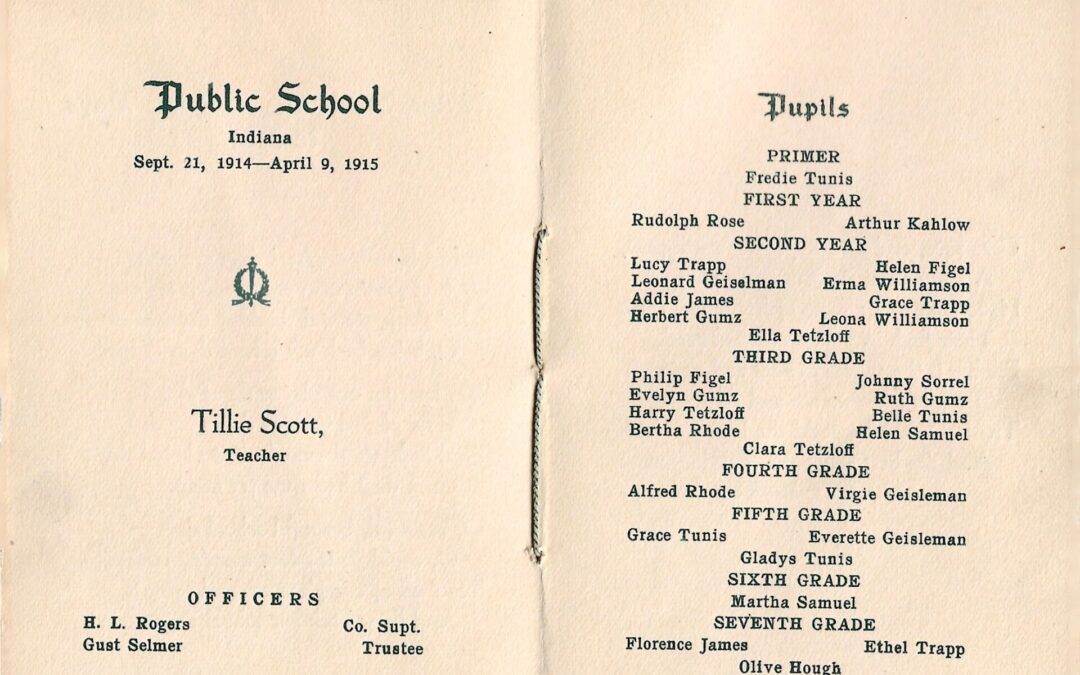
Emmett School roster 1914-1915.

The following is an article written by avid genealogist and former resident of Plymouth, Mary Jo Jacob, who now lives in California. She recounts the history of her grandmother, Tillie Scott Hollett, whose determination resulted in the education of hundreds of Marshall County children.

Grandma Hollett's Educational Firsts

My Grandma Tillie Scott Hollett worked hard and overcame obstacles to become a teacher. Her love of learning and teaching animated her life and influenced her children and grandchildren. In my case, Grandma reassured my mother I would do just fine in first grade even though I could not go to kindergarten. (We lived in the country outside of Plymouth where the rural school bus schedule did not accommodate kindergarten hours.) Grandma advised mom to teach me my numbers and letters from the cookbook we used when baking. The year I was five, I baked my way into numeracy and literacy and was well prepared to start first grade at Washington School in Plymouth. Grandma’s own education began more conventionally, but her educational achievements were hard-won “firsts” in the family and inspired my own educational goals.

Born in a covered wagon in What Cheer, Iowa in 1898, Tillie Scott’s educational prospects were initially dim but improved when her parents returned home to their farming community in Pulaski County, Indiana. One room schoolhouses sprouted up every couple of miles alongside the cornfields that covered the county. For seven or so years between September and April, whether it was sunny, rainy or snowing, Tillie tramped down the dirt road from her family’s farm to the nearest school. By age thirteen or fourteen, she finished the sixth grade, the highest grade completed by each of her parents.

Around that time, the one room schools in her part of the county were consolidated. Thereafter, Tillie journeyed further to school in the nearby town of Kewanna which is where she graduated from the eighth grade. Subsequently Tillie studied at Kewanna High School for three years. When she entered her senior year, her family moved away from the farm and the county. Tillie likely had to fight with her parents to continue in high school. If so, she won the battle.

Tillie moved thirty miles from the farm to the town of Logansport where her Scott family relatives lived, and where she enrolled for her senior year. Although she was a new student, the high school yearbook noted Tillie gave a memorable speech to the school on women’s suffrage, a topic about which she was passionate. Tillie graduated from Logansport High School in 1909.  She was twenty years old and proud to be the first high school graduate in the family. According to one family story, Tillie felt her parents did not fully value her accomplishment because their graduation gift was a mirror from a coffee tin, put there as a promotional gimmick.
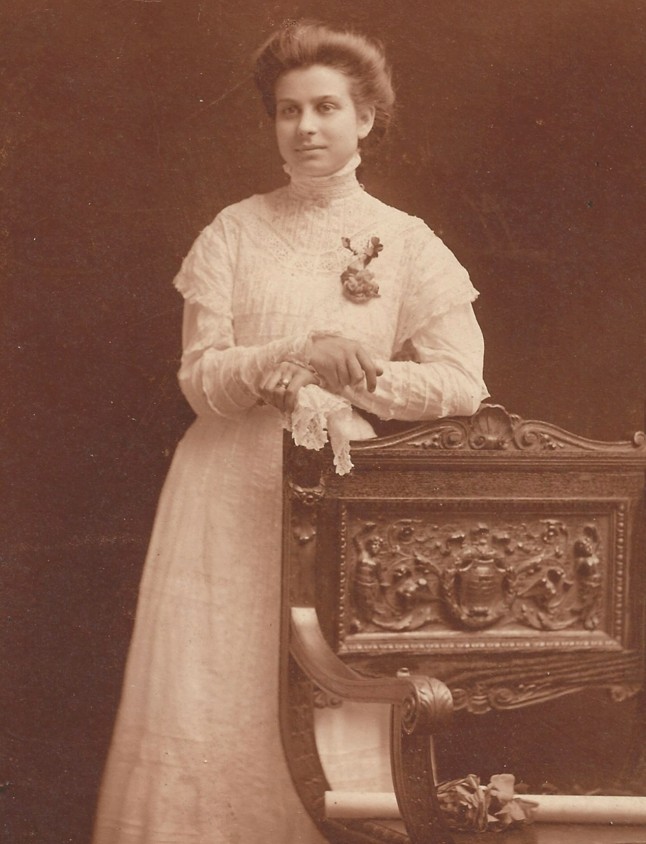
Tillie Scott, high school graduation.

Tillie aspired to higher education but had to set her educational ambitions aside. After high school, she moved to her parents’ home in Plymouth where she found a job working at Schlosser Brothers Creamery. The job enabled Tillie to help her family financially as well as save money for herself. Her goal was to become a schoolteacher. To do so, she needed to take college courses and pass a state teacher’s license exam.

In 1912, Tillie applied to nearby Valparaiso University which at the time was the second largest school in the nation after Harvard University. In fact, Valparaiso University was nationally known as the “Poor Man’s Harvard” because of its affordability and high quality. (Valparaiso University History https://www.valpo.edu/about/history/). She was accepted into the Teacher’s Department and enrolled for two consecutive twelve-week terms.

Tillie was an excellent student who scored 95 percent or better in most of her classes. One of her worst grades was in cooking – 87 percent. Not a surprise to her grandchildren who remember that Grandma was not a good cook. On the other hand, she excelled in American and English literature which is also unsurprising to those who knew her. Tillie instilled a love of poetry, literature and books in her children who, in turn, shared that love with their own.

After two terms at Valparaiso and passing the state teacher’s license exam, Tillie returned to a one room schoolhouse in Pulaski County, this time as the teacher at the Emmett School in the village of Denham. For two years, she taught kindergarten through the eighth grade to a group of thirty students. At the end of her first year, she returned to Valparaiso University to complete her third and last term. Ten days after she completed her second year of teaching, Tillie married Clarence Hollett and left Denham because Harrison Township did not employ married women. In fact, Harrison Township did not hire its first married female teacher until 1942.
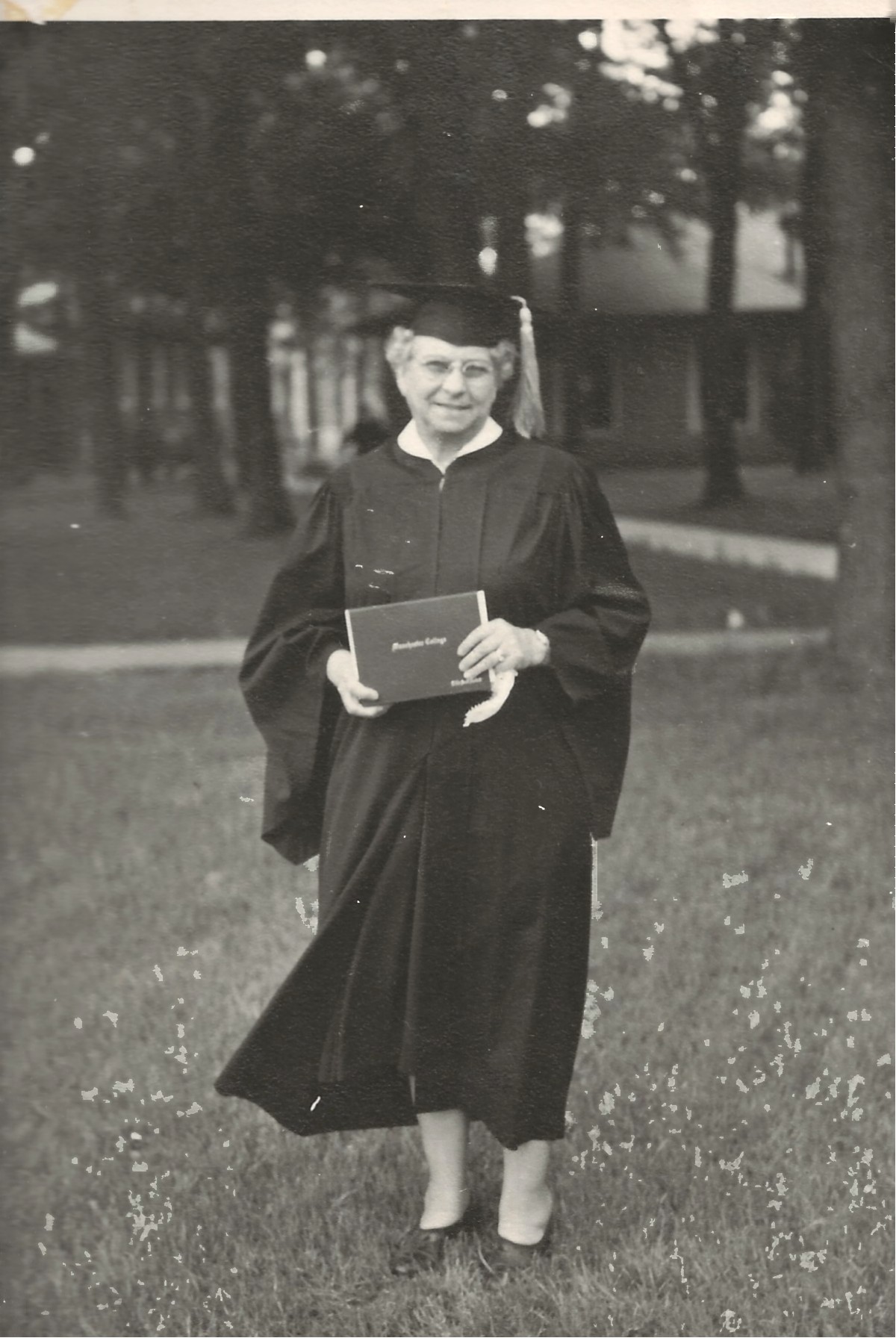
Tillie Scott Hollett with her BS. degree.

Tillie moved to Culver in neighboring Marshall County where the school system had no restrictions on married women teaching. She initially taught the third and fourth grades and eventually taught home economics at Culver High School in 1918-1919. While in Culver, Tillie became involved in women’s clubs which were important organizations for women to educate themselves, develop their leadership skills, and improve their communities through volunteer efforts. Through her membership in the Culver City Club, Tillie continued her educational and advocacy work on behalf of the Susan B. Anothony amendment. She was thrilled when the Nineteenth Amendment was ratified in 1920.

During the next three decades, marked by the Great Depression and World War II, Tillie’s teaching and educational endeavors were focused on her four children and channeled into her club activities. She wrote poetry and compiled research papers that she read to club members as part of club educational programs. After the war, and after her children were married, Tillie wanted to teach in the classroom again. However, she needed a new teaching credential, and that required a bachelor’s degree.

Ever determined, Tillie enrolled at Manchester College (now Manchester University) and completed her B.S. degree in Elementary Education in 1953 at age sixty-four. Her graduation was a family affair attended by a proud husband, her mother, her four children, eight grandchildren, and her brother’s family. Tillie had accomplished another educational first. She was the first person in the family to graduate from college.

Tillie taught elementary school for nine years in Tyner, a small town near her home in Plymouth. During my “baking kindergarten year,” Grandma invited me to visit her classroom for a day. Whether it was the excitement of finally being able to go to school, or the fact that I got to ring the bell to end the recess period, I never forgot my first day of school. Years later Grandma encouraged me to go to college, but her less than encouraging reaction to my decision to continue for a master’s and doctorate surprised me. She worried, “You won’t become a wife and mother.” She came to my wedding but did not live to meet my son or see me receive my advanced degrees. Given her profound influence, I like to think she would have been pleased with my own educational first, the first in the family to get those two degrees.

The Museum is proud to preserve and share family stories. Stop in anytime between 10 and 4 on Tuesday through Saturday to learn more or bring your own! The Museum is located at 123 N. Michigan St. in Plymouth. Call us at 574-936-2306.

Inwood High School

Inwood High School

As with other towns in Marshall County, at one time Inwood had its own high school.

The Inwood neighborhood may have been small, but it was spunky. Some indication of that was seen in the Marshall County Independent in April 1899 when Trustee McCrory decided to transfer graduates of the eighth grade in Center Township to Inwood High School instead of Plymouth High School, as was the custom. In 1906, Inwood graduated five scholars, eight in 1907, thirteen in 1908 and nine in 1909.

The Weekly Chronicle in November 1908 reported, “The Inwood schools are making good progress this year under the direction of Prof. Fry and an efficient corps of teachers. A visit to the schools gave the impression of a thorough system and of excellent deportment of pupils. The greater number of pupils are from the country and are transported to and from school in wagons. There are two classrooms upstairs and three on the first floor and a basement. The basement has a cement floor and is supplied with water from a reservoir. There is a large water basin, cups and towels. It is entered both from the inside and the outside.

“The basement room presents a lively and busy scene at noon time. Three long tables are arranged, with tablecloths and benches, and at these tables the pupils eat dinner. Their dinners are brought from home and are spread out in inviting shape. The manner in which the pupils perform this exercise of the day is not slow. The janitor, Jr. Gerrard, remains with them at the noon hour to assist them and to preserve order.”

In 1911 the Weekly Republican stated, “Rev. Arlington Singer gave the baccalaureate address to the four graduates of the Inwood High School Sunday night at the Methodist church of that place. His theme was class motto Labor Omnia Vincit, and by illustration and argument he showed how labor did conquer, as well as how necessary it was that we all work with all our might. The sermon and the quartet song, ‘Why Stand Ye Here Idle,’ came in so nicely together that it pleased all…. After the baccalaureate exercises, a banquet was given by the members of the senior class to the singers and the two ministers and their wives.”

But that August tragedy struck at the Inwood school. As reported in the Bremen Enquirer and the Weekly Republican, Hueston C. Kramer fell two full stories while putting a tin roof on the school. He landed on his head on the cement walk. Drs. Kaszer and Loring were immediately summoned. He had suffered a broken shoulder blade, in addition to more serious injuries. There was little hope of recovery, and he passed away three hours later without regaining consciousness. Kramer, a single 28-year-old, had come from Wabash just three weeks before to open a tin shop under the Marshall County Trust & Savings Bank at Plymouth.

In December 1914 the Bremen Enquirer reported that a large number of northern Indiana towns were having contagious and infectious diseases, mostly smallpox. The Inwood school was closed for at least ten days because of diphtheria.

In 1915 the Inwood school was remodeled and an addition on the south doubled its size. It contained two classrooms and two cloakrooms on the first floor. The spacious auditorium on the second floor was for both school and community activities.

On December 19, 1918, the Enquirer reported that the Inwood school was closed until after the holidays because of a case of scarlet fever.

Things began to get wild and crazy in the 1920s. And it wasn’t just the students, either. Plenty of adults got into the act, including the principal.

During the winter of 1923, a student “snowballed” principal Rose’s wife. Evidently it bothered her husband. As reported in the Bremen Enquirer, Rose went to the residence of Otto Ames and complained that Ames’ son had snowballed Mrs. Rose. Rose demanded that the boy apologize. “In the fight that followed his demand, Ames’ leg was fractured. Rose was said to have flourished a gun in the fracas, though there was no shooting, and the gun incident, if a gun was flourished, appears to have cut no figure in the trial at Plymouth, as a result of which Rose was fined $10 and costs, aggregating $30, for assault and battery.”

The newspaper editorialized, “Many people believe that lack of proper discipline is a common fault of country schools, but Mr. Rose appears to have gone to the other extreme and attempted to cover too much territory.”

But Mr. Rose stayed on the job and in April 1924, as reported in the Bremen Enquirer, “Flaming youth had its little flare at Inwood Thursday, when eight pupils of the Inwood school, feeling the urge of spring and to vent their surplus pep, ‘borrowed’ an automobile, took it for a joy ride and came to a sudden and unhappy stop in the ditch at Johnson’s Corners, two miles north of Bourbon. Two of them were injured and all of them should have been spanked, according to the older heads thereabout.

“The pupils had just finished their examinations at school and felt the need of air. Harry McCullough, son of Mr. and Mrs. Charles McCullough, who live two and a half miles north of Inwood, had driven his father’s car to school. He was still at work on his examinations when the pepful eight conceived the notion of the joy ride. They asked him for the key to the car, but he refused to give it to them.

“One ingenious member of the joy seekers used a knife to turn the switch to start the car. Maxine Kizer took the wheel and seven others piled in – Eloise Shoda, Evalyn Shoda, Thelma Sands, Shed Cramer, Vernon Apple, George Daniels and Leota Thompson.

“The party proceeded to Bourbon and then north on the paved road. In making the turn at Johnson’s Corners, the car left the road and went into the ditch. Daniels was cut in the arm and side and had a bump on the head. Cramer was also injured. The others were bruised and shocked but not badly hurt. The car was almost a complete wreck, it is said.

“On Saturday principal O.B. Rose of the Inwood school called the parents of all the boys and girls together with the owner of the car, and the parents agreed to share the expense of settlement for the damage to the car. Mr. McCullough, owner of the wrecked machine, is just recovering from injuries received last fall when his car was struck by another machine. His son Harry, while driving a horse and buggy last winter, was also struck by a car. This is the third accident for the family this year.”

Mr. Brock, living near Johnson’s Corners, gathered up the “joyless joy riders” and took them to Bourbon for medical attention. George Daniels, son of Mr. and Mrs. Wm. Daniels, was brought to Kelly Hospital in Argos, where several stitches were taken in his arm. He remained in the hospital a couple of days before he could be removed to his home.

But nothing shook Harry McCullough as he pursued his education. The Bremen Enquirer of April 24, 1924, reported that the Inwood High School commencement took place in the high school auditorium. Two graduates, Gertrude Forbes and Harry McCullough, were awarded diplomas.

That October, Inwood High School was used as an example in the Argos Reflector when discussing whether Walnut Township should have a high school, “The Inwood High School will perhaps throw some light on the subject. About a year ago a warm meeting of protest regarding closing their high school was held. It was a pretty warm affair. One of the protesting patrons got his leg broke by the superintendent. The meeting ended with ‘weak-minded men carrying out the babies, and strong-minded women carrying out the stoves.’ That incident closed the high school of Inwood, and the pupils are now being transported to Plymouth at a savings of $2,000 a year to the taxpayers of Center Township.”

And the South Bend Tribune concluded on July 15, 1991, “…the brick Inwood School that housed students for 57 years was built in two parts with the north half erected in 1908…. The north section had no lights and no indoor plumbing. The south addition, built in 1915 and which faced the railroad track, brought electricity and water into the school…. Three teachers instructed the primary grades and three teachers taught all of the high school courses…. High school classes were taken to Plymouth in 1924 (when Lincoln High School opened), Harry McCollough, 83, of Bourbon was a member of that last graduating class at Inwood. At age 16, he was the youngest person to ever graduate from Inwood High School.”