High School Construction Disasters

High School Construction Disasters

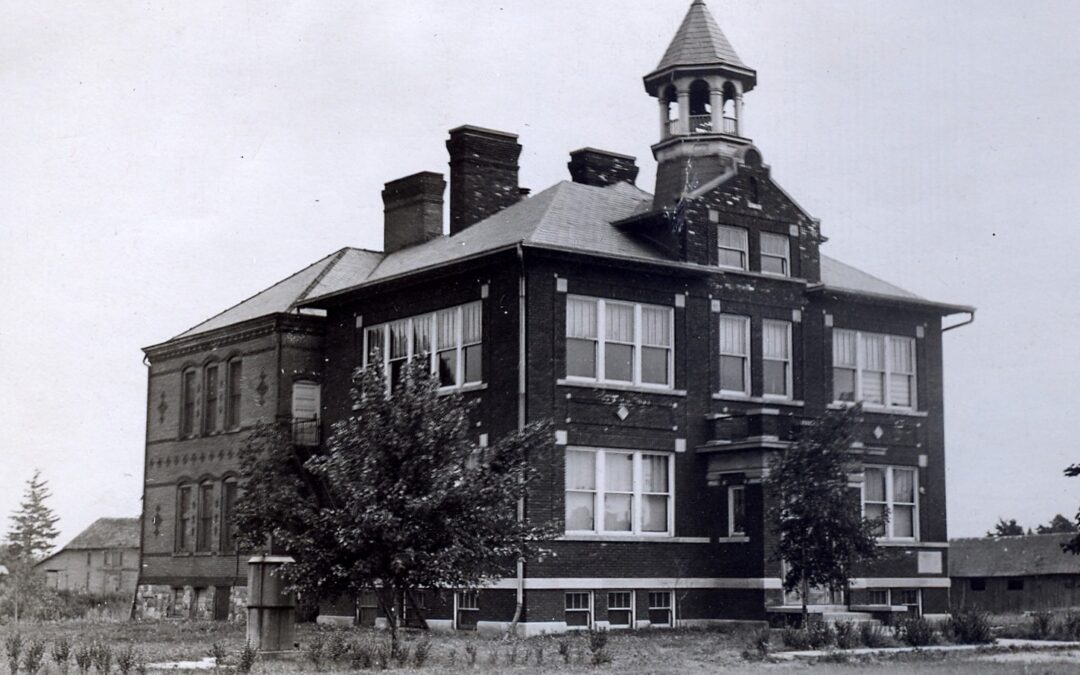
Inwood Schoolhouse south side view, undated.

People have been promoting education in Marshall County almost as long as the county has existed, going from just a few students in isolated one-room schoolhouses, to our current large, modern buildings. The path has not always been smooth. In addition to the varying attitudes and opinions of the taxpayers over the years, accidents and natural disasters have had their impact as well. Following are a few examples. Excerpts have been lightly edited.

Inwood Schoolhouse Tragedy

The Town of Inwood’s school building apparently needed a new roof before the start of the 1911 school year, but the effort ended tragically. The August 31 edition of The Weekly Republican newspaper covered the accident.

“Hueston C. Kramer, the Plymouth tinner, was perhaps fatally injured at about 1:45 Monday by falling from the roof of the public schoolhouse at Inwood. Mr. Kramer was at work putting a tin roof on the building when in some way he fell to the ground, a distance of two full stories, landing on his head on the cement sidewalk below. He sustained a broken shoulder blade and severe injuries about the face and head. It is thought that he can live but a short time at the best.

No one witnessed the accident, but Doctors Kaszer and Loring were immediately summoned. The injured man was carried into the basement of the building and everything possible was done for him. He has remained in an unconscious condition since the time of the accident.”

The 28-year-old Kramer died three hours later.

Bourbon Township Consolidated School Corp.

In 1928 the Bourbon Township Consolidated School Corporation built a new addition to their existing building. The work started in October and was slated to be completed by spring of 1929. Students were dismissed for Christmas break on December 21, and seven days later the building, including the new addition, went up in flames. In the process, the school learned a very expensive lesson. According to the Bourbon High School Chronicle 1884 – 1963,

“The building was a total loss of $125,000, with only $50,000 in insurance. The fire was discovered about 1:15 a.m. by Ernest Hurford. He hurried back to town and turned in the alarm to the Bourbon Fire Company. Help was immediately called from Plymouth and Warsaw.

“The blaze started on the upper floor in the room of the Latin teacher. It was thought it might have started with the electric wiring. The flames spread rapidly through the center of the building and to the south end…. At 4:00 a.m. the water supply failed. The town pumps filling the standpipe could not supply water at the same rate as it was being used on the fire and the firemen had to wait until it was replenished. By dawn the fire had gutted the building.”

Argos Builds A New School

The wave of school consolidations in the 1950s led to the need for a new school building in the town of Argos. Incoming students from Green and Walnut townships quickly rendered the Argos K-12 building too small, so in 1957 construction began on a new school. As work was progressing on the gymnasium, 23 steel support trusses suddenly collapsed, injuring three workmen.

The Culver Citizen of June 12, 1957, described the event. “The heavy girders collapsed in chain reaction fashion at the site of the construction of a $1,000,000 school and gymnasium of the recently organized Argos Community School.

“One of the injured workmen, Robert Treber, 31 years old, Argos, is in fair condition…. He suffered several fractured ribs and facial and arm cuts. The others injured, Antal Marton, 35, Culver, and John Brewer, 31, Argos, were treated for minor injuries and released.”

An investigator sent in to determine the cause of the collapse concluded that one of the girders had been dropped and sustained some damage, but was installed anyway, and an attempt to straighten it in place had been made. It was also noted that the joists were curving away from the starting end, some bracing clips were broken at the welds and one of the wires connecting the first joist to the end of the column failed. It could have been much worse than it was.

Laville Junior-Senior High School & Palm Sunday

And sometimes no amount of human intervention can stop a disaster. The new Laville Junior-Senior High School was still under construction in April 1965 when the Palm Sunday tornados struck Marshall and St. Joseph counties. The April 12 South Bend Tribune reported, “…the north wall of the gymnasium was badly damaged, and some damage was also done to an east wall. Building material was scattered throughout the area.” Regardless of the setback, the new consolidated school opened on time.

The MCHS staff is hard at work on an upcoming exhibit highlighting the public high school buildings of Marshall County. Details will be coming soon. The Museum is open Tuesday through Saturday from 10 a.m. – 4 p.m. at 123 N. Michigan St. Call us at 574-936-2306 for more information.
A History of Extreme Weather

A History of Extreme Weather

Indiana has had some really memorable winter seasons, but in 1816, everything went haywire. Snow in June destroyed all of the crops, it was bitterly cold on the 4thof July, and blizzards struck in August! How could that happen? The dust from Mount Tambora, which erupted in early April 1815, had covered the entire globe. With all of that volcanic dust in the upper atmosphere, the sun was blocked and that created a weather phenomenon that led to food shortages all over the world.

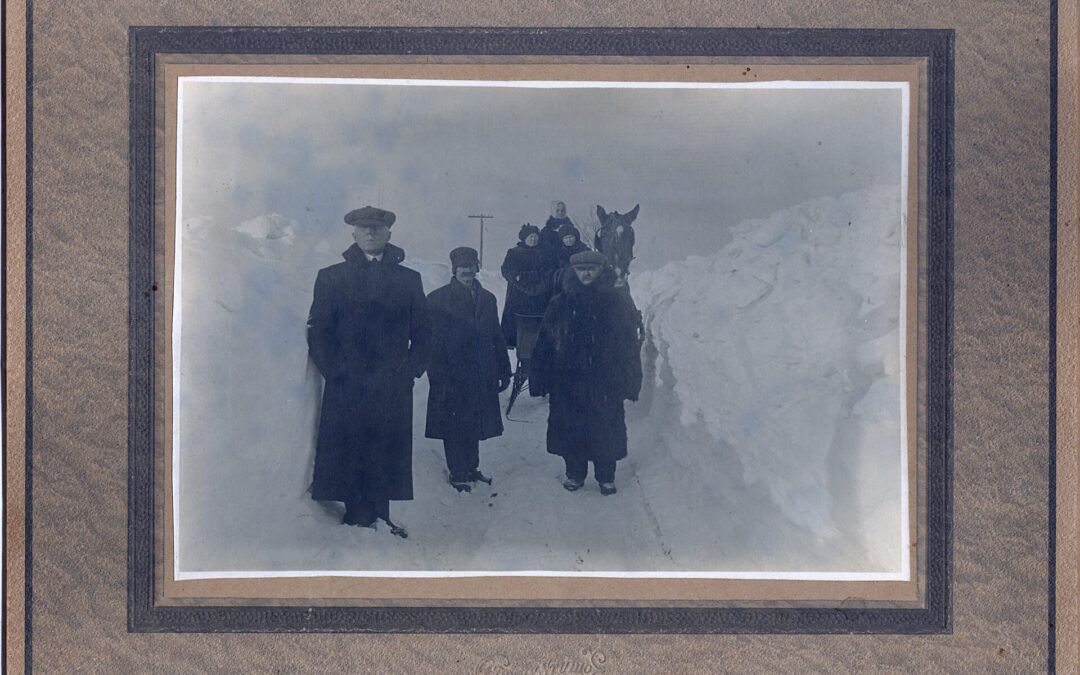
The fast forward about a hundred years. On January 11, 1918, Marshall County was hit with a blizzard that created travel mayhem for weeks afterward. The following is an excerpt from The Argos Reflector on January 31, 1918: “Since the big blizzard on Friday, January 11th, undertaker O.L. Grossman has had to use the bob-sleds for all funerals. January 8th was the last time that he was able to use the hearse. The north and south road to the Maple Grove Cemetery has a drift about six feet deep, the full width of the road. The rural mail carriers have been able to make only a part of their trips during the past week or more. Saturday was a hard day to get through and after another snow and heavy wind on Sunday, they decided not to try to deliver on Monday morning.  John Leland brought W.D. Corley and family to town Sunday to attend the funeral of J.S. Wickizer. They started quite early in the morning and did not arrive until about noon. It was a five-mile drive.”

The coldest day in Indiana was recorded on January 19, 1994, in New Whiteland, just south of Indianapolis– a minus 36 degrees, not including wind chill. Just for the record, an easy way to calculate wind chill is if it’s minus 5 degrees outside and the wind is blowing at 25 mph, the wind chill is minus 30 degrees.

Who remembers the winter of 1977-78? It all started on December 29, 1977. Then temperatures started dropping, and Indiana would have 34 days of below freezing temperatures. That figures out to 880 consecutive hours of cold, brrr. The arctic temperatures lasted long enough to usher in the “great blizzard of 1978.”

The first ever Blizzard Warning for the entire state of Indiana was issued at 3:45 p.m. EST on January 25th, 1978.  A heavy snow warning had been issued 12 hours earlier. Winds would approach 50 mph or more by midnight and continue through the 27th. Temperatures would plummet to a low of zero during the storm with wind chills approaching -50 degrees. Snowfall rates of nearly one half to one inch per hour were not unusual, but the duration of the heavy snow was. Significant snowfall for 30 plus hours, followed by continued cold and high winds, was a serious issue. This hampered recovery and relief efforts, leaving much of Indiana crippled for days. In areas, up to three feet of snow fell. The howling winds would push drifts up to as much as 20-25 feet. Visibilities would remain at or below one quarter mile for 25 hours.

Highways were clogged with stranded motorists. Doctors and emergency personnel were forced to reach people on skis and snowmobiles. The governor sent National Guard tanks onto I-65 to remove stranded semis. Indiana Bell was forced to halt all phone traffic but emergency calls. The governor declared a snow emergency for the entire state on the morning of the 26th. During the afternoon of the 26th, the Indiana State Police considered all Indiana roads closed. Seventy people died during the storm.

Hopefully, the winter of 2025-26 will spare us!

Introducing the Balcony Building

Introducing the Balcony Building

Some of the buildings in Marshall County’s cities and towns have quite an interesting history. They have changed ownership, of course, but some have even changed size and shape! A good example we have covered previously is the REES Theatre. It went from a three-story, three-bay Italianate structure to a two-story, two-bay Art Deco one.

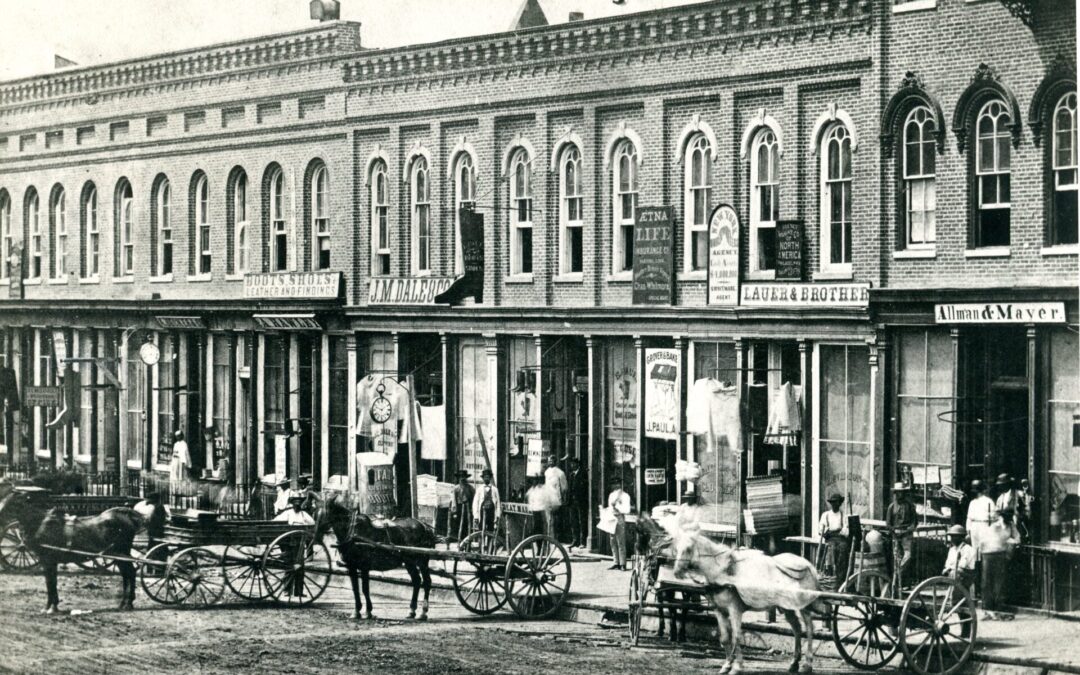
The subject of this article is the “Balcony Building” at 113-115 N. Michigan Street, now the home of Aldridge Diagnostic Medicine and the Wild Rose Moon. Since it was built in 1866, it has undergone some pretty drastic transformations.

This Italianate building was built with three floors, two store front bays and an iron balcony between the second and third floors. Thus, it became known as the “Balcony Building.” Ironically, it lost its balcony sometime during its early lifetime but held on to the moniker for a good many years.

First Occupants of the Balcony Building

Apparently, the north store front bay was first occupied by Freese & Behrens, a dry goods and notions store, with a grocery on the south side. The second floor housed business offices, a millinery (hat-making) shop and perhaps even a living quarters. The third floor housed Balcony Hall, a performance venue with a stage. The building was constructed according to the latest city ordinances requiring brick fire walls and the most modern lighting and heating systems, enacted after a catastrophic downtown fire destroyed most of the remaining wooden frame buildings earlier that year.

When Simon Becker, a subsequent long-term tenant, left for Argos in 1878 the building changed hands several more times, housing a “dry goods and fancy goods” store, a drug store, and a grocery store on the north side, and Bunnell & Son Furniture & Undertaking on the south.

Political Address Outside

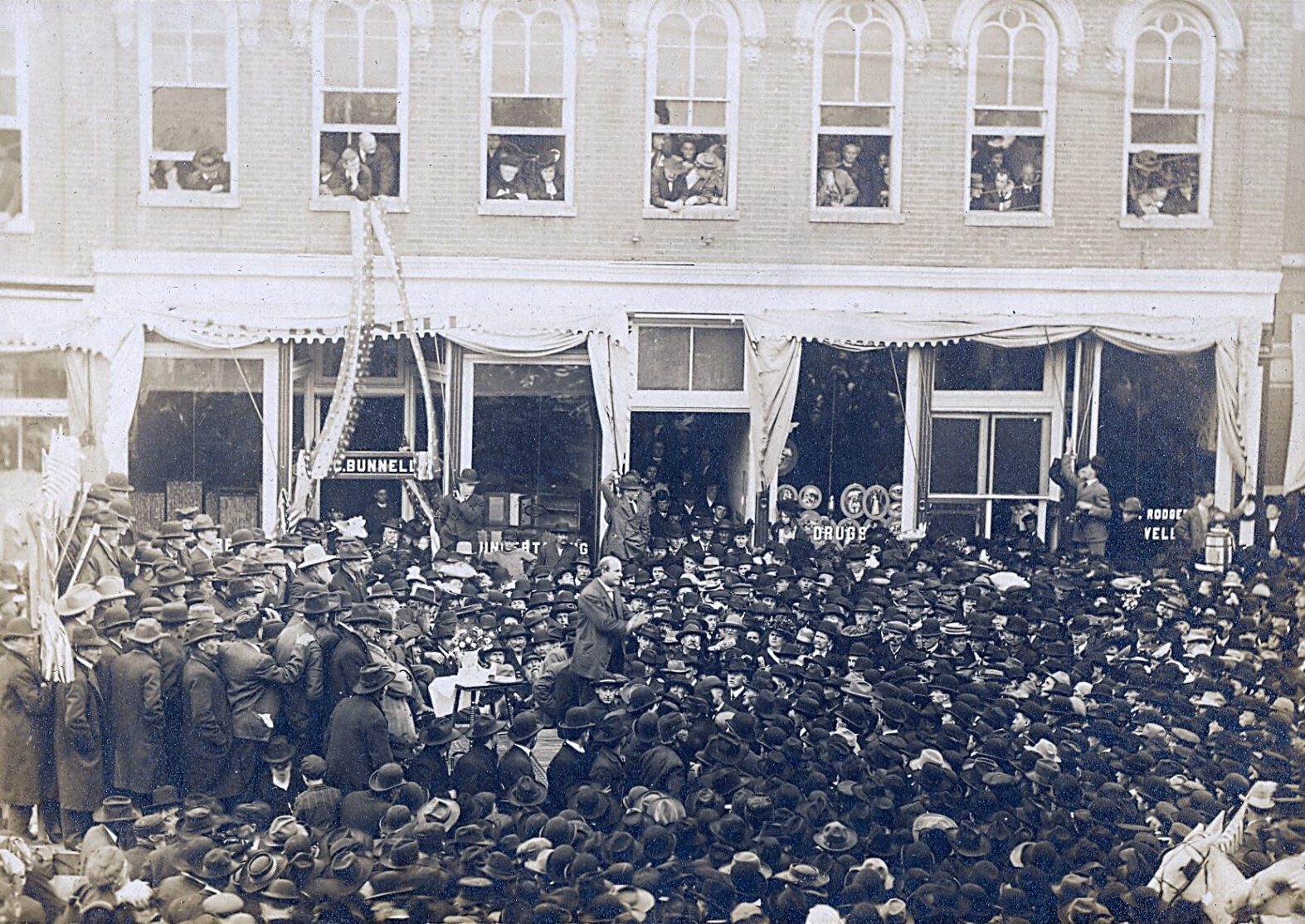
Distinguished visitor William Jennings Bryant, known as the “American Commoner” and leader of the Democratic Party, spoke to a huge crowd in front of the Balcony Building in 1906. A platform was erected in the street and people from all over the county gathered to hear him speak for 40 minutes. According to reports, however, strong winds, crowd noise and no modern sound system made it hard for most people to even hear the speech.

William Jennings Bryan’s address, October 24, 1906.

Right around this time, the building became the property of Frank W. Bosworth and his wife Mabel. The couple’s two daughters, Esther and Muriel, eventually inherited the property, and that is how the building got passed down to its current owner, George Schricker. George is the great nephew of Esther and grandson of Muriel. You might have noticed the upper floor – now apartments – are named the William Jennings Bryan Suites.

Fire Devastates the Balcony Building

Then in 1927, Charles Glaub moved his ‘cash and carry’ grocery into the building. Before this innovation, grocery stores often operated a bit like warehouses – customers would choose items they wanted, employees would find and pack the items, and then the order would be delivered to the customer’s home or business with the bill being paid at the end of the month. A three-way partnership, consisting of Mrs. Anna Glaub & sons, Chuck & Walter, was formed in 1938 due to the death of Charles H. Glaub.

Interestingly, a few years after Mr. Bunnell moved across the street, the A&P Grocery & Meats moved into the south bay, creating side-by-side grocery stores in the same building. And that is the way it was at the time of the November 27, 1946 fire that engulfed the third floor of the building.

The Moose Lodge met on the third floor, G&G Grocery occupied the north bay, and A&P Grocery occupied the south. The Knights of Columbus also met upstairs. The theory about the fire was that a Moose left a cigar burning. (Now there is a word picture!) The third floor was a total loss and had to be removed. The demolition took with it the ornate Italianate cornice. It is a testimony to the brick structures that the neighboring buildings, and even the lower floors were not severely damaged. G&G remained in the building until they relocated in 1953. In 1954 Derf Jewelers moved into the north bay, and at about the same time Lord’s Dress Shop took over the south bay.

Moose Lodge fire ignites the balcony building, November 27, 1946.

Post-Fire

In subsequent years, several businesses moved in and out of the building, and it underwent significant renovation. Today it houses the Wild Rose Moon on the north side and Aldridge Diagnostic Medicine on the south side.

Are you curious about other buildings in the county? Let us know! We love doing research. If you are more interested in researching a topic of your own, the Marshall County Historical Society Research Library has LOTS of resources. Come in Tuesday – Saturday, 10 a.m. to 3:45 p.m. and our research specialists can get you pointed in the right direction.