
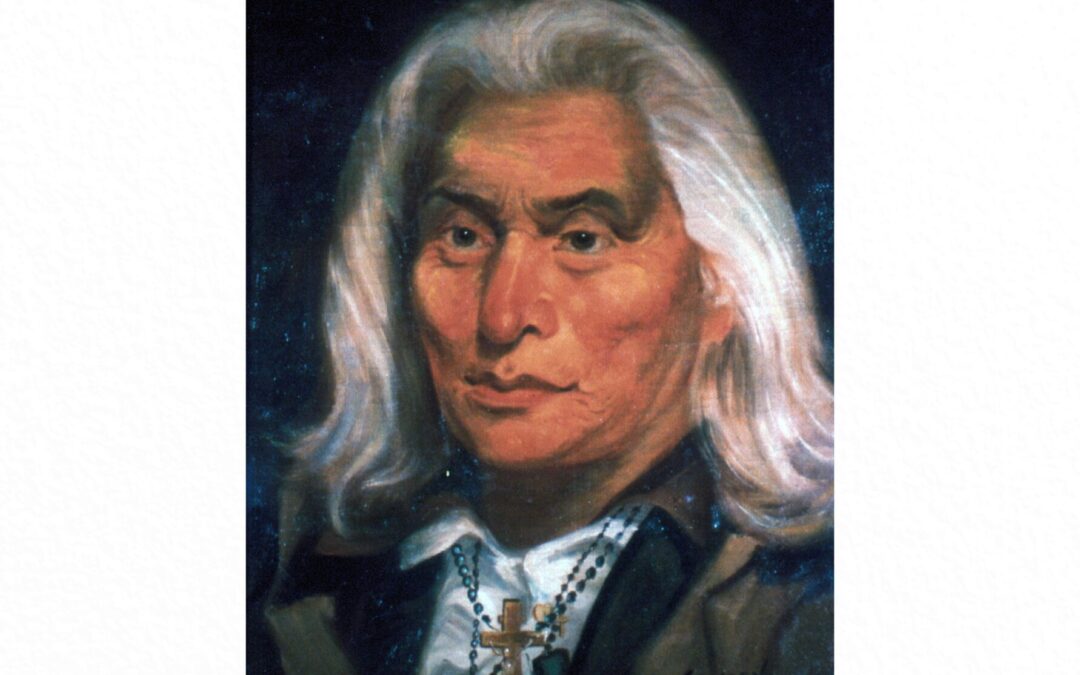
Leopold Pokagon by Van Sanden. ca 1850s from the Indiana Center for History.
Daniel McDonald was a historian who was born in Plymouth, Indiana and lived from 1833 to 1916. His writing reflects his ideas and may contain language common in 19th century writing that may not reflect modern standards. The article has been lightly edited for clarity.
The story is told in Daniel McDonald’s 1881 "History of Marshall County"
Simon Pokagon was born at what was known as Pokagon village, on the Pottawattomie lands in Indiana in 1830. He was sent to Notre Dame University, where he graduated with honors. He wrote many articles on the Pottawattomies and also gave lectures. He died on January 25, 1809.
A short time before his death he wrote the story of his courtship and marriage to Lonidaw, a fair Pottawattomie maiden. The great charm of the story, “O-gi-maw-kwe Mit-i-gwa-ki, Queen of the Woods,” lies in the simplicity with which the lover pours forth the passion of his heart. It is the beautiful legend of the princely Hiawatha and the fair Minehaha in real life.
Pokagon begins his story by telling how he chanced to meet the shy and winsome Lonidaw and how he sought her favor, doubting and hoping in turn, until she graciously smiled on him. Then he was forced to be absent from her for several months.
Pokagon with a lover’s enthusiasm paints the scene in the morning when he returned: on the journey to Lonidaw’s wigwam the sun though yet unseen had painted the eastern sky a brilliant red. High in the air were multitudes of wild pigeons, sweeping the heavens as far as the eye could reach and moving in a line, like columns of trained soldiers, southward to procure their morning meal. All the twigs and branches of the grand old forest were thickly fringed with needled frost, forming a silvery screen through which the sunshine was sprinkled down, shedding the glory in the tree tops, on the ground, filling my youthful soul with love for the Divine.
Stillness reigned almost supreme along the trail I passed, only broken now and then by the woodpecker beating his chiseled bill into some decaying wood in search of food, or some partridge on a prostrate tree sounding his rolling drum to entertain his lady love of early spring. I paused and listened to his oft repeated drumbeats of love, poured forth in military style, and to myself I said: Happy lover, no doubts disturb thy trusting heart, which fear and sore distrust are warring in my soul.
I reached the wigwam of my bride to be. All was quiet as the morning air. My fluttering heart was all the sound I heard, that like a bird in a cage beat the bars that held it fast. While standing before the door a strange feeling held me there in bonds which none but a doubtful lover can ever know and which no language can express.
While there I stood Lonidaw opened wide the door, bidding me come in. The chilling gloom of yesterday had left no impress on her face, but instead the fondest smiles of maidenhood were plainly written there. Then well I knew those smiles so sweet were all for me alone.
With mutual hearts we clasped each other and sealed again the marriage vow with concert kisses, imparting a thrill of joy that only they who truly love can ever feel and fully understand.
The wedding followed, a description of which is given by the bridegroom himself:
When the moon of flowers and bloom came, and mating birds were moving northward and wild flowers were blooming and the trees were putting on their robes of green, I took the hand of my dear beloved Lonidaw and she became my bride. No wedding cards were passed around, no gifts were made, no bells were rung, no feast was given, no priest declared us one. We only pledged our sincere faith before her mother and the King of Heaven. Our hope, our joys were one. Hand in hand along an ancient trail we took our course until we reached a land of game. Here we paused and like two mated birds that search and find a place to build their nest of mud and straw, so we, beside an inland lake where towering woods embrowed its shore and flags, rushes and wild rice in plenty could be found, built our wigwam home of poles and bark. There oft at dawn and eventide we fished from our birch canoe, and that she would have more success than I, ofttimes I would bait well her hook and let my own go bare, then wonder why she caught more fish than I.
Oft, returning from the chase, weary and tired of carrying game, I’d follow down the trail upon a narrow neck of land that ran into the open shore, and I never failed to see Lonidaw’s erect and slender form on hasty run. No swan ever faster swam or more elegantly appeared than she when bending to the oars, pushing her birch canoe across the swelling bosom of the lake. As she would approach me while waiting on the shore I always hailed her “queen of the woods.” On our return across the lake she would cling to the oars and have me steer. I always felt her image in my heart and loved to see it in the lake and oft would ask her if her feelings were akin to mine. Her only answer was an approving glance and downcast smile. Thus happy in each other’s love we floated down life’s stream.
Phone: 574.936.2306
Learn more about the history of the Potawatomi people in Marshall County in our Historic Crossroads Center exhibit. We are open Tuesday through Saturday from 10:00 AM until 4:00 PM. The Museum is located at 123 N. Michigan St. in Plymouth. Call us at 574-936-2306.