High School Construction Disasters

High School Construction Disasters

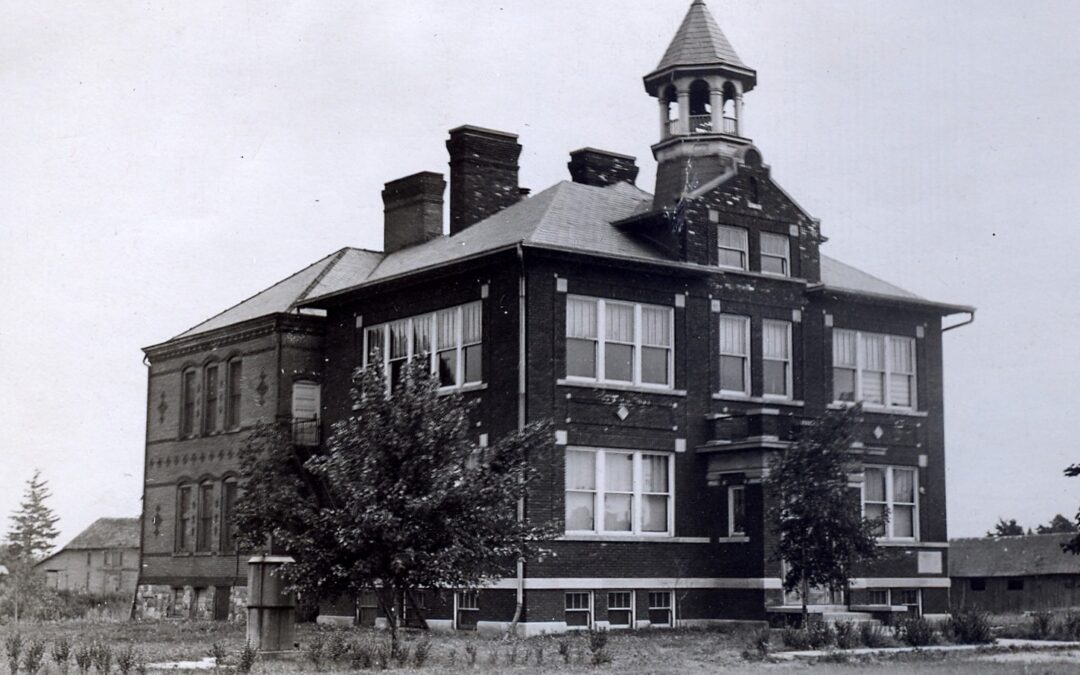
Inwood Schoolhouse south side view, undated.

People have been promoting education in Marshall County almost as long as the county has existed, going from just a few students in isolated one-room schoolhouses, to our current large, modern buildings. The path has not always been smooth. In addition to the varying attitudes and opinions of the taxpayers over the years, accidents and natural disasters have had their impact as well. Following are a few examples. Excerpts have been lightly edited.

Inwood Schoolhouse Tragedy

The Town of Inwood’s school building apparently needed a new roof before the start of the 1911 school year, but the effort ended tragically. The August 31 edition of The Weekly Republican newspaper covered the accident.

“Hueston C. Kramer, the Plymouth tinner, was perhaps fatally injured at about 1:45 Monday by falling from the roof of the public schoolhouse at Inwood. Mr. Kramer was at work putting a tin roof on the building when in some way he fell to the ground, a distance of two full stories, landing on his head on the cement sidewalk below. He sustained a broken shoulder blade and severe injuries about the face and head. It is thought that he can live but a short time at the best.

No one witnessed the accident, but Doctors Kaszer and Loring were immediately summoned. The injured man was carried into the basement of the building and everything possible was done for him. He has remained in an unconscious condition since the time of the accident.”

The 28-year-old Kramer died three hours later.

Bourbon Township Consolidated School Corp.

In 1928 the Bourbon Township Consolidated School Corporation built a new addition to their existing building. The work started in October and was slated to be completed by spring of 1929. Students were dismissed for Christmas break on December 21, and seven days later the building, including the new addition, went up in flames. In the process, the school learned a very expensive lesson. According to the Bourbon High School Chronicle 1884 – 1963,

“The building was a total loss of $125,000, with only $50,000 in insurance. The fire was discovered about 1:15 a.m. by Ernest Hurford. He hurried back to town and turned in the alarm to the Bourbon Fire Company. Help was immediately called from Plymouth and Warsaw.

“The blaze started on the upper floor in the room of the Latin teacher. It was thought it might have started with the electric wiring. The flames spread rapidly through the center of the building and to the south end…. At 4:00 a.m. the water supply failed. The town pumps filling the standpipe could not supply water at the same rate as it was being used on the fire and the firemen had to wait until it was replenished. By dawn the fire had gutted the building.”

Argos Builds A New School

The wave of school consolidations in the 1950s led to the need for a new school building in the town of Argos. Incoming students from Green and Walnut townships quickly rendered the Argos K-12 building too small, so in 1957 construction began on a new school. As work was progressing on the gymnasium, 23 steel support trusses suddenly collapsed, injuring three workmen.

The Culver Citizen of June 12, 1957, described the event. “The heavy girders collapsed in chain reaction fashion at the site of the construction of a $1,000,000 school and gymnasium of the recently organized Argos Community School.

“One of the injured workmen, Robert Treber, 31 years old, Argos, is in fair condition…. He suffered several fractured ribs and facial and arm cuts. The others injured, Antal Marton, 35, Culver, and John Brewer, 31, Argos, were treated for minor injuries and released.”

An investigator sent in to determine the cause of the collapse concluded that one of the girders had been dropped and sustained some damage, but was installed anyway, and an attempt to straighten it in place had been made. It was also noted that the joists were curving away from the starting end, some bracing clips were broken at the welds and one of the wires connecting the first joist to the end of the column failed. It could have been much worse than it was.

Laville Junior-Senior High School & Palm Sunday

And sometimes no amount of human intervention can stop a disaster. The new Laville Junior-Senior High School was still under construction in April 1965 when the Palm Sunday tornados struck Marshall and St. Joseph counties. The April 12 South Bend Tribune reported, “…the north wall of the gymnasium was badly damaged, and some damage was also done to an east wall. Building material was scattered throughout the area.” Regardless of the setback, the new consolidated school opened on time.

The MCHS staff is hard at work on an upcoming exhibit highlighting the public high school buildings of Marshall County. Details will be coming soon. The Museum is open Tuesday through Saturday from 10 a.m. – 4 p.m. at 123 N. Michigan St. Call us at 574-936-2306 for more information.

The Bloomer Costume

The Bloomer Costume

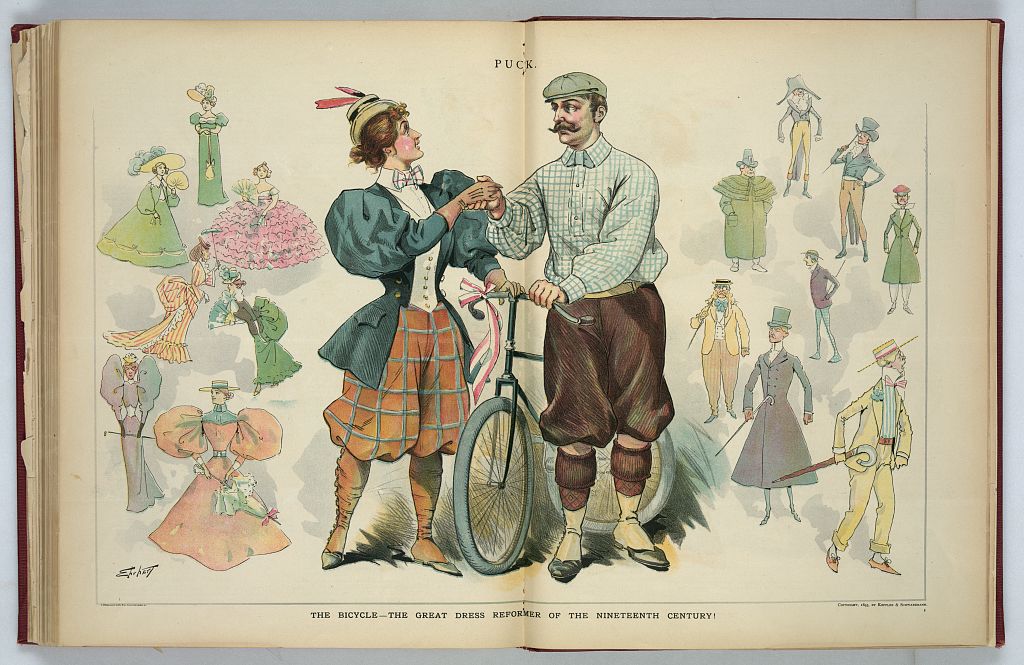
Ehrhart, S. D. (1895) The bicycle – the great dress reformer of the nineteenth century! / Ehrhart. , 1895. N.Y.: Published by Keppler & Schwarzmann, August 7. [Photograph] Retrieved from the Library of Congress, https://www.loc.gov/item/2012648650/.

This article is taken directly from “A Twentieth Century History of Marshall County,” written by Daniel McDonald. Although McDonald is adept at expressing himself, I have edited lightly. Here he takes on a contemporary fashion craze – bloomer suits. Bloomers were known as “Turkish Pants,” hence the editorial rant below.

All About Bloomers by Daniel McDonald

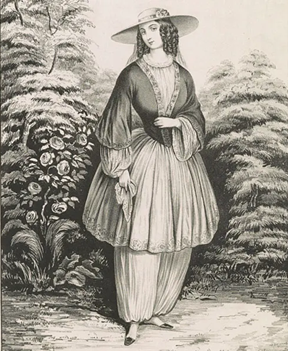
The bloomer costume for ladies, which created much excitement throughout America during 1851, was just then being introduced in Plymouth. On this topic, the editor of The Pilot delivered himself as follows:

“New Dress – The bloomer costume is decidedly an improvement upon the dress of the female portion of the community. It is light, graceful and seraphic, well suited to the female figure. It will be welcomed by all the lovers of taste and refinement in the fashionable world. The Asian societies have long been celebrated for their beauty, polished manners and splendid attire. Our rivers will now be the Golden Horn; our valleys the Valley of Sweet Waters and our Seas the Bosphorus of the Turkish capital. A voyage to Constantinople will be useless. We may now take our siesta in the gay pavilion, and glide over the moonlit waters in the light caique (skiff)! Come ladies, step forth in your gorgeous apparel, decked with rose of gold and leaves of silver, and gladden our hearts with sweet smiles.”


The Bloomer Costume, Nathaniel Currier (1851)

Evidently, this was a facetious way the editor had of poking fun at the “costume” and killing it before the fad got a fair start here. At any rate, that was perhaps the result of it. Apparently, only one or two Plymouth ladies had the courage to procure bloomer suits and attempt to introduce them by wearing them as they would other female apparel. When they appeared in the streets, it was reported that they were objects of much curiosity—as if they had been untamed animals from Borneo. There is no easier way to kill anything that the people do not take very kindly to than to make fun of it, just as the editor of The Pilot did in his hifalutin article above quoted. At least that was what happened to the bloomer costume. McDonald might say, “It disappeared from the social horizon like the morning mist before the rays of the rising sun.”

Suffice it to say, ladies’ apparel has come a long, long way. If you want more commentary on life in Marshall County in the 1800s, McDonald’s book is for sale in our Museum Shop. Stop in anytime between 10 and 4 on Tuesday through Saturday and pick up your copy. The Museum is located at 123 N. Michigan St. in Plymouth. Call us at 574-936-2306.
Fun Facts about Valentine’s Day

Fun Facts about Valentine’s Day

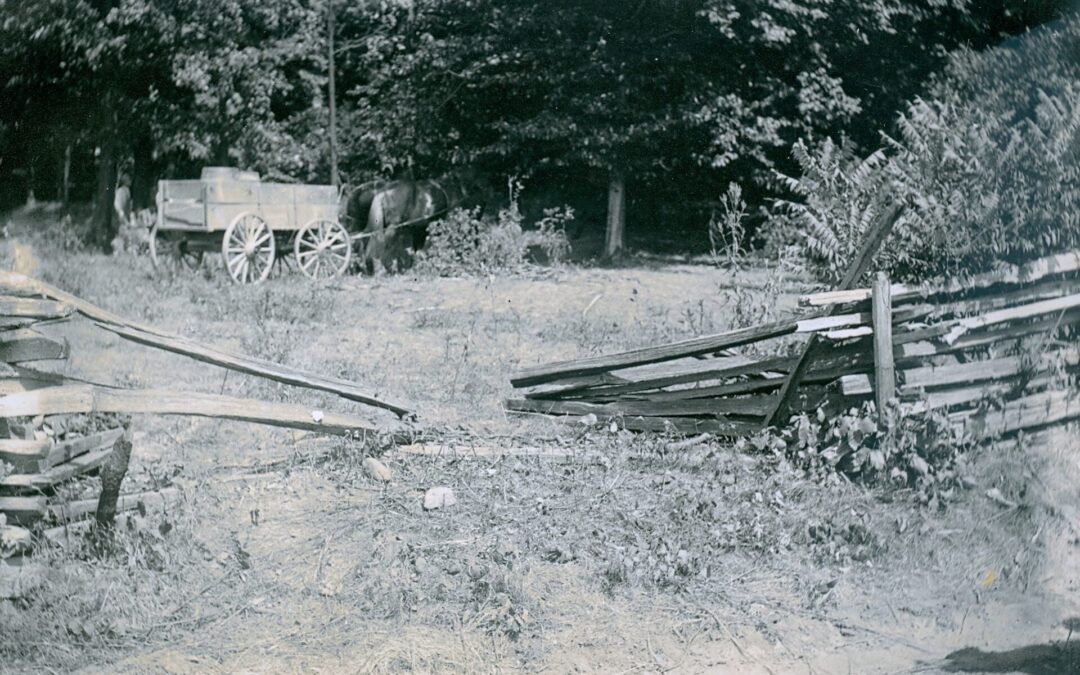
Feature Image. An assortment of Valentine’s cards from the Museum collection.

The iconic cupid of Valentines Day, with a cherubic face and angelic wings, began as the Greek god, Eros. He was the son of Aphrodite, the goddess of love and procreation. Cupid is known to shoot two types of arrows, one to cause people to fall in love, and one to make them hate each other. We’ve compiled some fun and interesting Valentine’s Day info from the web!

Food Is the Way to the Heart

Candy hearts began with a Boston pharmacist Oliver Chase. He invented a machine that produced small medical lozenges for the throat. When he saw how popular they were, he turned them into candy with cute messages on them.

Of course, chocolate is a huge part of Valentine’s Day now, but it has a sad beginning. Physicians in the old days would recommend chocolate to people suffering from a broken heart or pining for a lost love. It was Richard Cadbury, a British chocolatier, who invented the first chocolate box. Always the businessman, he realized that he could capitalize on Valentine’s Day by producing chocolate boxes and marketing them as something to be given to your sweetheart.

Valentine’s Day is not celebrated the same way all over the world. In Japan for instance, on February 14th, women give gifts and chocolates to their male companions. The men don’t reciprocate until March 14, which is known as “White Day.” On Valentine’s Day in England, women used to place five bay leaves on their pillows. This was done with an aim to bring dreams of their future husbands. In Norfolk, England, Jack Valentine acts as a Santa for Valentine’s Day. Children anxiously wait for the treats, though they don’t get to see Old Father Valentine. In many places, Valentine’s Day is also celebrated as the beginning of spring.

People Associated with Valentine's Day

Venus, the goddess of love, adored red roses, making them a perfect symbol to express love for another person. To the Victorians, the deeper the rose color, the deeper the passion. A white rose would have been appropriate for a young girl or woman who had not felt passionate love. In a contradiction, the white rose symbolized soul-deep love and marriage. White roses are often referred to as “bridal roses.”

Saint Valentine, for whom the holiday is named, defied the emperor Claudius of Rome. Marriage was outlawed because the emperor believed single men made better soldiers. Saint Valentine performed weddings in secret in defiance of the unfair law. Pope Gelasius later declared the Valentine’s Day holiday in 498 A.D.

Another fun fact. Penicillin, the world’s first antibiotic and one of the greatest scientific discoveries, was introduced to the world on Valentine’s Day. Alexander Fleming was the Scottish physician-scientist who was recognized for discovering penicillin. The simple discovery and use of the antibiotic agent has saved millions of lives and earned Fleming – together with Howard Florey and Ernst Chain, who devised methods for the large-scale isolation and production of penicillin – the 1945 Nobel Prize in Physiology/Medicine.

Sharing Love Notes

In one ironic twist, Alexander Graham Bell applied for the patent to the telephone on February 14th, 1876, never imagining that it would become the biggest medium for sending Valentine’s Day greetings almost 150 years later.

As for sending cards, Valentine’s Day is second only to Christmas in the number of cards sent around the world. Today, most cards are mass-produced and generally the selection is pretty sparce by the 14th. Artist Esther Howland was one of the first American printers to start producing Valentine’s Day cards beginning in the 1850s. Ornate cards trimmed with lace became treasured mementos, but why lace? Lace is commonly used in making bouquets of roses and in other items during Valentine’s Day. The word ‘lace’ comes from the Latin word ‘laques’ which means to snare or trap a person’s heart. Isn’t that fitting?

We sign our valentines with Xs and Os to send kisses and hugs. This is not the letter X’s original purpose. In medieval times, most people could not read or write. If a need arose to sign their name, most would simple mark an X. To show affection and loyalty, the writer would kiss the X on the paper before sending.

The often-heard term “wear your heart on your sleeve” began with an old custom. People would pick a name out of a bowl to see who their valentine would be. They would then pin the paper to their sleeve for everyone to see.

The oldest known valentine still in existence today is perhaps a poem written in 1415 by Charles, Duke of Orleans, to his wife while he was imprisoned in the Tower of London following his capture at the Battle of Agincourt. A lot of his poetry was not so cheerful as he wasn’t released until 1440, and the poem below was written after his wife died.

Let men and women of Love’s party
Choose their St. Valentine this year!
I remain alone, comfort stolen from me
On the hard bed of painful thought.

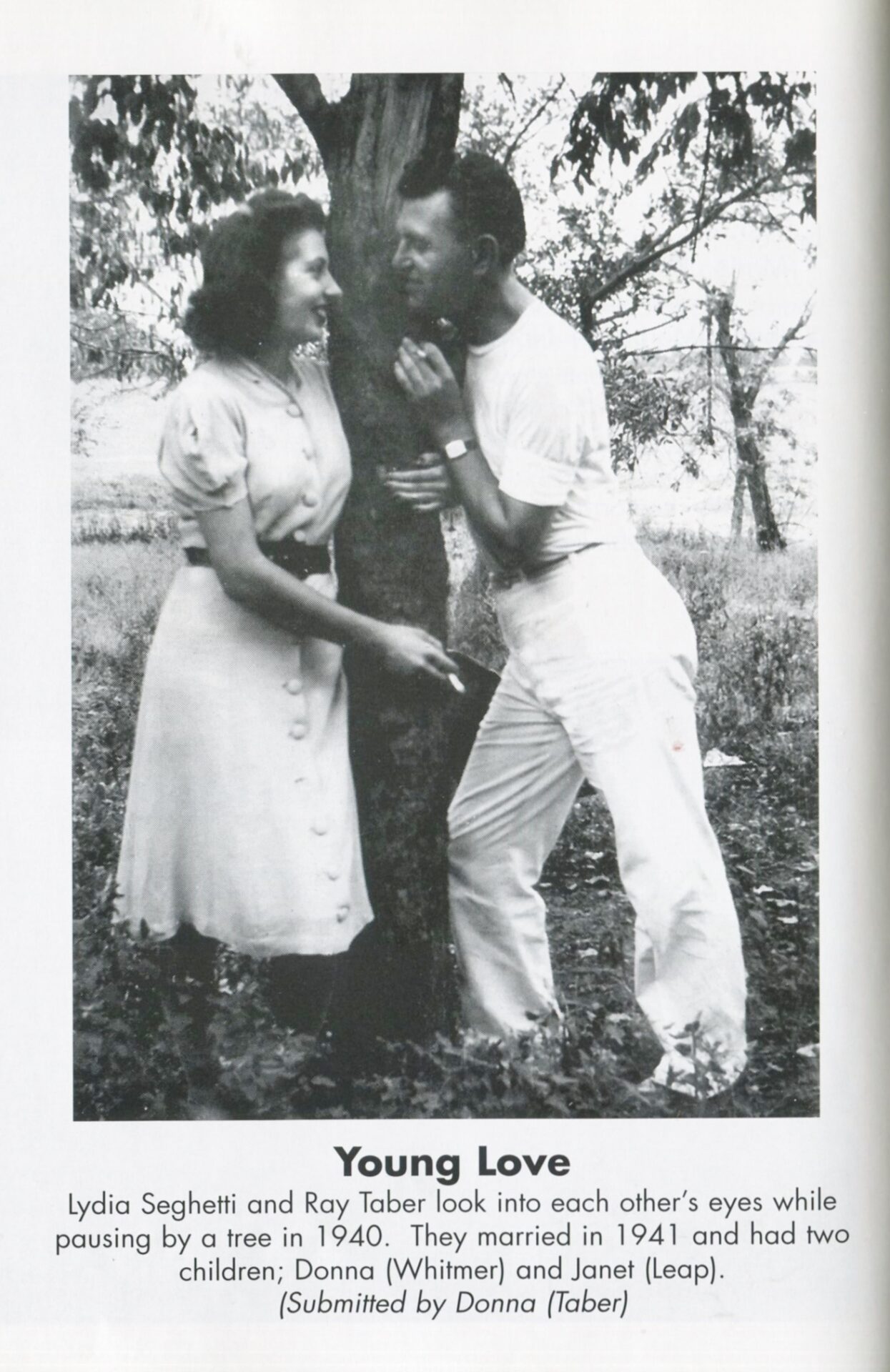
Lyda Seghetti and Ray Taber leaning agaist tree, ca. 1940. Featured in Plymouth Remembered, page 80.

The Museum is home to a large selection of antique and vintage valentines, although not currently on display. You can still come see our treasures, perhaps as a lovely museum date! The Museum is open from 10 until 4 from Tuesday through Saturday at 123 N. Michigan St., Plymouth. For more information, call 574-936-2306.

A History of Extreme Weather

A History of Extreme Weather

Indiana has had some really memorable winter seasons, but in 1816, everything went haywire. Snow in June destroyed all of the crops, it was bitterly cold on the 4thof July, and blizzards struck in August! How could that happen? The dust from Mount Tambora, which erupted in early April 1815, had covered the entire globe. With all of that volcanic dust in the upper atmosphere, the sun was blocked and that created a weather phenomenon that led to food shortages all over the world.

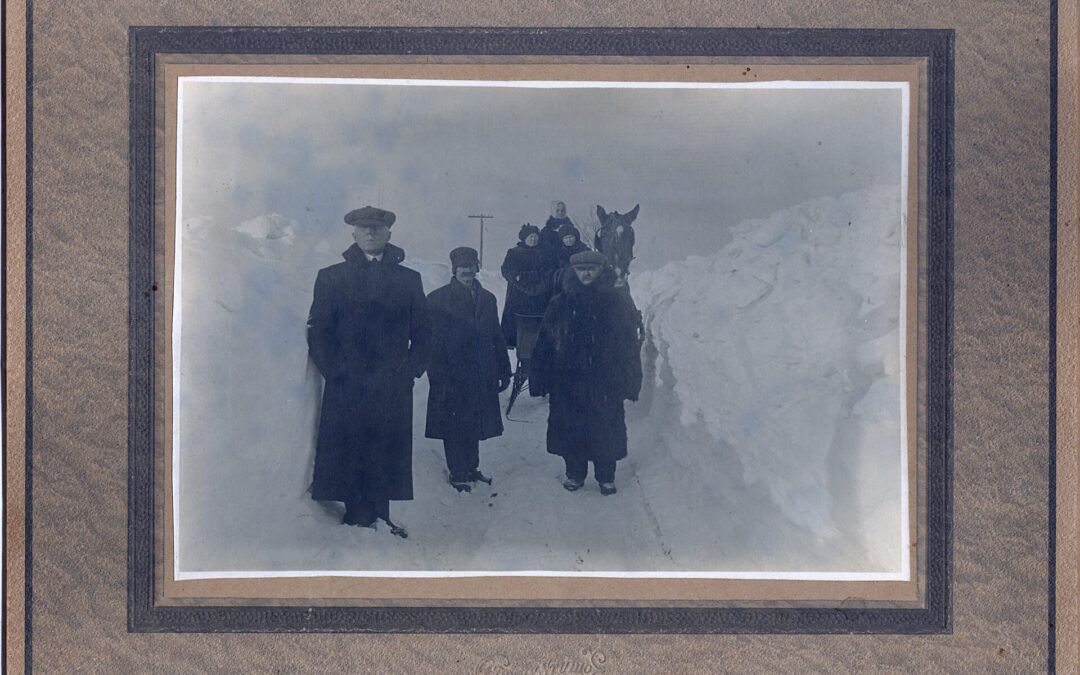
The fast forward about a hundred years. On January 11, 1918, Marshall County was hit with a blizzard that created travel mayhem for weeks afterward. The following is an excerpt from The Argos Reflector on January 31, 1918: “Since the big blizzard on Friday, January 11th, undertaker O.L. Grossman has had to use the bob-sleds for all funerals. January 8th was the last time that he was able to use the hearse. The north and south road to the Maple Grove Cemetery has a drift about six feet deep, the full width of the road. The rural mail carriers have been able to make only a part of their trips during the past week or more. Saturday was a hard day to get through and after another snow and heavy wind on Sunday, they decided not to try to deliver on Monday morning.  John Leland brought W.D. Corley and family to town Sunday to attend the funeral of J.S. Wickizer. They started quite early in the morning and did not arrive until about noon. It was a five-mile drive.”

The coldest day in Indiana was recorded on January 19, 1994, in New Whiteland, just south of Indianapolis– a minus 36 degrees, not including wind chill. Just for the record, an easy way to calculate wind chill is if it’s minus 5 degrees outside and the wind is blowing at 25 mph, the wind chill is minus 30 degrees.

Who remembers the winter of 1977-78? It all started on December 29, 1977. Then temperatures started dropping, and Indiana would have 34 days of below freezing temperatures. That figures out to 880 consecutive hours of cold, brrr. The arctic temperatures lasted long enough to usher in the “great blizzard of 1978.”

The first ever Blizzard Warning for the entire state of Indiana was issued at 3:45 p.m. EST on January 25th, 1978.  A heavy snow warning had been issued 12 hours earlier. Winds would approach 50 mph or more by midnight and continue through the 27th. Temperatures would plummet to a low of zero during the storm with wind chills approaching -50 degrees. Snowfall rates of nearly one half to one inch per hour were not unusual, but the duration of the heavy snow was. Significant snowfall for 30 plus hours, followed by continued cold and high winds, was a serious issue. This hampered recovery and relief efforts, leaving much of Indiana crippled for days. In areas, up to three feet of snow fell. The howling winds would push drifts up to as much as 20-25 feet. Visibilities would remain at or below one quarter mile for 25 hours.

Highways were clogged with stranded motorists. Doctors and emergency personnel were forced to reach people on skis and snowmobiles. The governor sent National Guard tanks onto I-65 to remove stranded semis. Indiana Bell was forced to halt all phone traffic but emergency calls. The governor declared a snow emergency for the entire state on the morning of the 26th. During the afternoon of the 26th, the Indiana State Police considered all Indiana roads closed. Seventy people died during the storm.

Hopefully, the winter of 2025-26 will spare us!

Indiana Statehood

Indiana Statehood

On December 11, 1816, Indiana became the 19th state to join the Union. The journey to statehood was long with several hurdles along the way. In honor of Indiana’s 209th birthday, we retell the story of our state. Today, we are known for our demonym “Hoosier,” corn, the Indy 500, our sports teams and more. Our history, however, spans thousands of years, starting with Paleo-Indians who roamed the Americas, including present-day Indiana, around 8000 BC following the end of the Ice Age.

Prehistoric Era

Paleo-Indians were nomadic hunter-gatherers who used stone tools and hunted large game animals (you can learn about the Ice Age in our Prehistoric Animals book, available now in our store).  There is evidence of more permanent habitation around 5000 BC with earthen mounds that were used for habitats, ceremonies and temples. The Hopewell People around 1000 BC grew various crops, created pottery and engaged in trade. Between 1000 and 1450 AD, there was a Mississippian settlement near Evansville, Indiana on the Ohio River. They created complex mounds and earthworks that aligned with celestial events with incredible precision. You can visit this archaeological site today.

European Exploration

In the 17th century, French explorers reached present-day South Bend and traded with Native Americans for highly desired fur skins. French and French Canadians soon established trading posts, and some tried to control Native trade routes. When the British arrived, they also wanted control of the fur trade. The Natives sided with the French in these tensions and eventually went to war against the British. When the British won the French and Indian War in 1763, all French lands east of the Mississippi River and northwest of the colonies were ceded. The Crown proclaimed the land west of the Appalachians as “Indian Territory” and did not allow colonists to settle there, angering many people.

During the American Revolution, Congress passed a “Resolution on Public Lands” and allowed settlements west of the Appalachians with the intent to create new states. The United States gained its independence in 1783 with the signing of the Treaty of Paris. In 1787, present-day Indiana became part of the “Northwest Territory.” The Northwest Ordinance of 1787 gave this territory a government and a process to create states if they met certain stipulations. To apply for statehood, you had to have sixty thousand people or more, prohibit slavery and have a bill of rights, amongst other things. This land would eventually become Indiana, Ohio, Michigan, Wisconsin, and Illinois.

Expanding Settlements

In 1800, Congress divided the land again into the Northwest Territory, which would become Ohio three years later, and the rest was the Indiana Territory. The territories would be divided and changed many times as new states formed. The Indiana Territory was governed by William Henry Harrison, and its capital was Vincennes. In August 1804, Harrison called for an election to see if voters wanted a state government. By December, Harrison proclaimed that the Indiana Territory would have a General Assembly, moving it one step closer to statehood.

By 1809, the borders of our state were outlined with the formation of the Michigan and Illinois Territories. Ohio was still the only state that had formed from the original Northwest Territory, however. Becoming a state was controversial. Some people wanted to continue slavery, and some did not want the increased taxes and costs that came with statehood. It also meant leaders would be far away in Washington, making it difficult to communicate with them. Statehood slowly chugged along, and fighting between settlers and Natives continued.

Road to Statehood

In 1811, the Indiana General Assembly voted 4-3 to petition Congress for statehood. Congress denied their petition until the state’s population reached 35,000. Efforts were abandoned by the territory due to a lack of money and the beginning of the War of 1812. During this time, the territory’s capital was moved to Corydon because it was more central and less likely to be attacked by the Natives after the Battle of Tippecanoe.

The General Assembly petitioned for statehood yet again in 1815. With 63,000 people, we were above the minimum population. The only thing left was to form a constitution, which President Madison allowed by signing the Enabling Act in May 1816. The constitutional convention was led by Jonathon Jennings and continued through August, when Jennings himself was elected as the first governor of Indiana. While writing it, there were heated debates. Ultimately, the constitution did not allow for women or people of color to vote. It prohibited slavery within Indiana. It was also the first state to start a state-funded school system, which is now Indiana University. That November, we held our first General Assembly under the 1816 Constitution. Finally, on December 11, 1816, President Madison admitted Indiana into the Union as the 19th state!

For those curious, Indianapolis became our capital in 1825 after it was chosen and built in 1821 for its central location. Visit the Museum from 10:00 am until 4:00 pm, Tuesday through Saturday to learn about early Marshall County. The Museum is located at 123 N. Michigan St., Plymouth. Call us at 574-936-2306.
Santa’s Political Past

Santa’s Political Past

Although the history of Santa Claus stretches back to the third century, you might be surprised how much influence the United States has had on his image. The origin of Santa Claus is St. Nicholas, who was born around 230 A.D. in Patura in Turkey. St. Nicholas was known for both his piety and his kindness. As his popularity spread, he became known as the protector of children and sailors. His feast day is celebrated on the date of his death, December 6th.

St. Nicholas’ reputation grew such that by the Renaissance, he was the most popular saint in Europe. Even after the Protestant Reformation, when the veneration of saints began to be discouraged, St. Nicholas maintained a positive reputation, especially in Holland.

Santa Comes to America

St. Nicholas was first introduced in the United States in December 1773, and again in 1774, when a New York newspaper reported that Dutch families had gathered to honor him on his feast day. The name “Santa Claus” is derived from the Dutch “Sinter Klaas,” which is a shortened form of “Sint Nikolaas,” Dutch for “Saint Nicholas.”

Washington Irving declared Santa Claus the patron saint of New York in 1809 in his book, A History of New York. One of the first “Americanized” images of Santa Claus was distributed at the New York Historical Society annual meeting in 1810 by member John Pintard. The background of the woodcut images contained stockings full of toys and fruit hung over a fireplace.

Media Representations of Santa

In 1822, Episcopal minister Clement Moore wrote a long Christmas poem for his daughters, “An Account of a Visit from St. Nicholas.”. Of course, we know it as “’Twas the Night Before Christmas.” The Santa Claus Moore described cemented the image of a portly “right jolly old elf,” with the ability to move through a chimney with a nod of his head. The miniature sleigh and eight tiny reindeer flying from house to house to deliver presents to good children is legendary. “An Account of a Visit from Saint Nicholas” created a new and immediately popular American icon.

The image that first introduced our modern idea of Santa Clause was drawn in 1862 by political cartoonist Thomas Nast, an illustrator for Harpers Weekly magazine.  In the image, Santa is pictured distributing gifts from his sleigh, with reindeer, in a Union Army camp. The centerfold inside was a two-sided woodcut image of a wife praying at home and a husband far away at war. Nash wanted to memorialize the family sacrifices of the Union during the early, and for the North, dark days of the Civil War. Nast went on to create a total of 33 images of Santa, all illustrated his support for the military.

More on Nast

Nast created his most famous, and much jollier drawing in 1881 of the Santa Claus we recognize today. Nast drew upon the Clement Clark Moore poem to illustrate all of his Santa drawings, but he alone created Santa’s bright red suit trimmed with white fur, North Pole workshop, elves and his wife, Mrs. Claus.

Ryan Hyman is a curator at the Macculloch Hall Historical Museum in Nast’s hometown of Morristown, N.J., which holds a large collection of his work. Even after the end of the war, Nast’s drawings were pointed, and the 1881 Santa drawing was a political commentary about the government’s indecisiveness about paying higher wages to the members of the military.

Hyman said “On his back isn’t a sack full of toys—it’s actually an army backpack from enlisted men. He’s holding a dress sword and belt buckle to represent the Army, whereas the toy horse is a callback to the Trojan horse, symbolizing the treachery of the government. A pocket watch showing a time of ten ’til midnight indicates the United States Senate has little time left to give fair wages to the men of the Army and Navy.”

Merry Old Santa Clause by Thomas Nast, 1881.