Theaters of Marshall County

Theaters of Marshall County

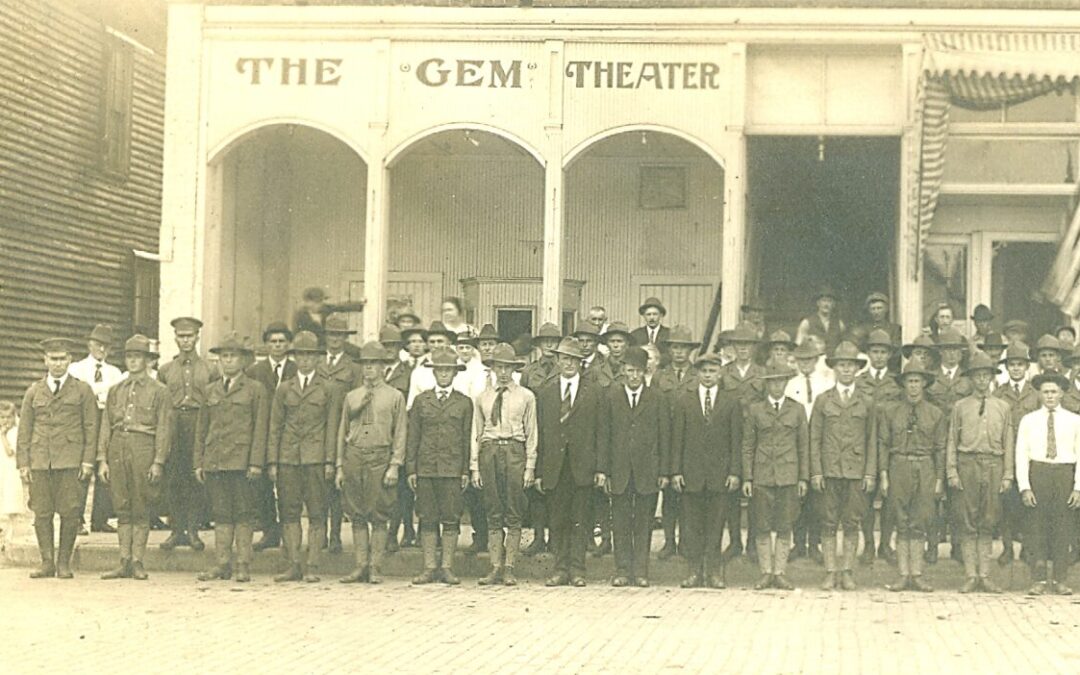
The Gem Theater.

One big change that took place at the end of the 19th century was the rise of commercial entertainment, especially for the growing middle class. Workers began to have more leisure time, and electric lights in towns and cities made the evening hours available for fun pursuits.

Sports, live music and vaudeville shows flourished, but nothing revolutionized leisure time quite like the motion picture. As early as 1910, there were already almost 10,000 movie theaters nationwide, and the movies had become one of America’s most popular pastimes. In Marshall County alone, there was at least one movie house in most towns almost continually throughout the first half of the 20th century. Young people especially sought amusement, escape and freedom from parental control. The relatively inexpensive movie theaters gave them a place to go to experience something new with every film.

The last half of the 20th century saw a return to home-based entertainment that continues today. Television in the 1950s, videocassette recorders (VCRs) in the 1980s, then high-definition TVs, and most recently, the various streaming services, all led to the demise of local movie theaters.

However, in recent years, interest in iconic downtown movie houses has surged, and many communities have found creative ways to restore and repurpose those buildings. One thing remains clear – Americans still love their movies!

The first theater in Argos opened in 1912 as the Princess. A movie-goer could see one whole reel for a nickel. By 1926 the cost of a double feature had gone up to 10 cents for children and 25 cents for adults. Ernest Parren purchased the theater in 1937 and changed the name to the Lido, after a famous theater in Italy. It operated for just under a year under Parren’s leadership before he closed the doors, leaving Argos without a movie house for the first time in 25 years.

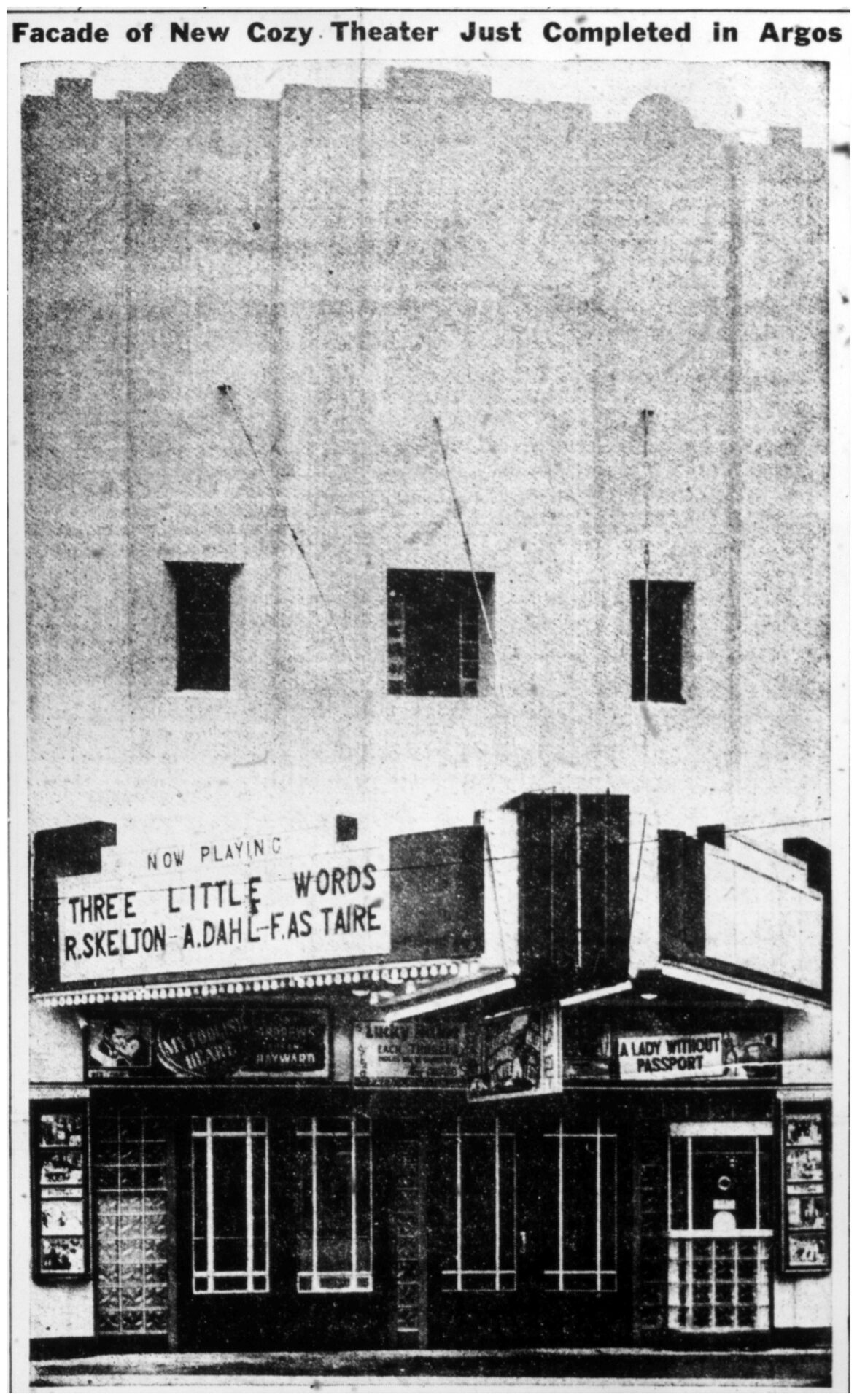
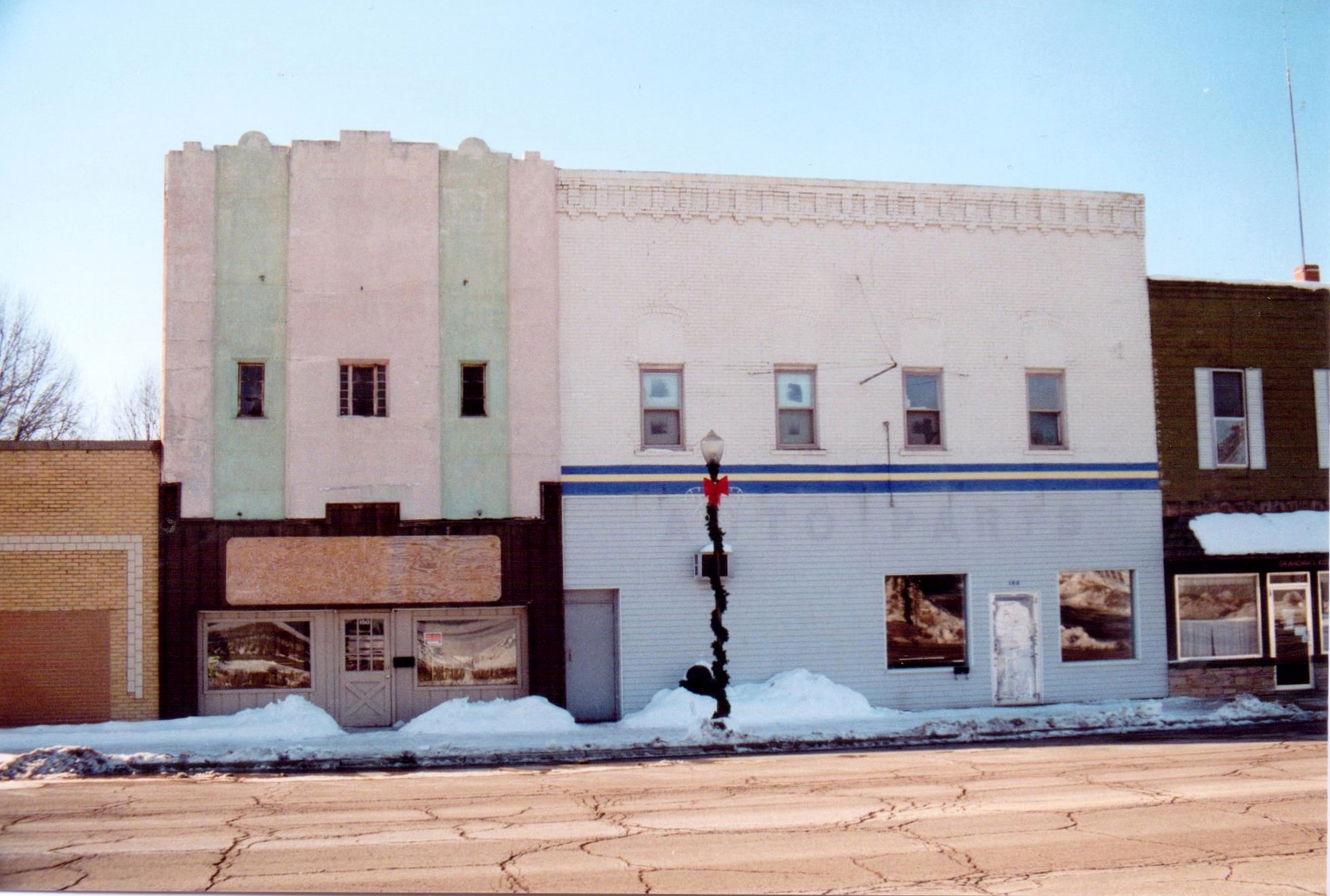
Anthony Bokas from Chicago purchased the Lido in March of 1939 and remodeled it extensively. On April 12, 1941, the new Lido reopened with the movie Fargo Kid, starring Culver Military Academy graduate, Tim Holt. The following day, Rosalind Russell and Brian Aheme came to Argos to celebrate the new Lido opening and to promote their film, Hired Wife. The theater operated as the Lido until 1944, when it changed hands and became The Cozy. During the 1950s, the Cozy also showed Spanish language movies for the migrant workers during the season.


Facade of the Cozy Theater in Argos.

Modern image of theater building.

The August 8, 1907, issue of the Bourbon Mirror reported that, “We (Bourbon) have a permanent motion picture theater in the room just north of Vink & Co.” For 5 cents, proprietors Ward and Kern promised exhibitions every night except Sunday. In May 1910 a new moving picture theater, the Gem opened. Either the Gem changed its name, or a new theater opened in October 1911 as the Navarre, showing “the choicest in picture dramas.” Local history teacher and coach Gene Rovenstine built the Comet theater in 1946. It was named for the Bourbon High School sports teams. The movie changed three times a week, and the cost to see the opening film, Our Hearts Were Growing Up, was 14 cents for children and 35 cents for adults.

The Comet was the scene of a daring burglary in 1950. A man from out of town parked near the back door and bought a ticket to the last show of the evening. Before the movie ended, he made his way to the basement and waited. After the staff left, the burglar came upstairs, muscled the safe to the back door and loaded it into the back seat of his car. Approximately $900 was stolen, along with the safe. A few months later the safe was found in a field near Lapaz. It had been emptied of cash and dumped.

The Comet Theater in Bourbon, undated.

About the closure of his business in 1957, Rovenstine later wrote, “The theater was interesting work which I enjoyed and prospered doing, until television reared its ugly head.” Many early theaters started out as opera houses and followed the trend into moving pictures, as was the case in the town of Bremen. Animated pictures were shown at the opera house as early as 1897. Wilbur W. Drake was owner and manager of the Majestic Theatre and got himself into trouble during his tenure for “Sabbath desecration.” He pled guilty to showing movies on Sunday and paid a $5 fine.

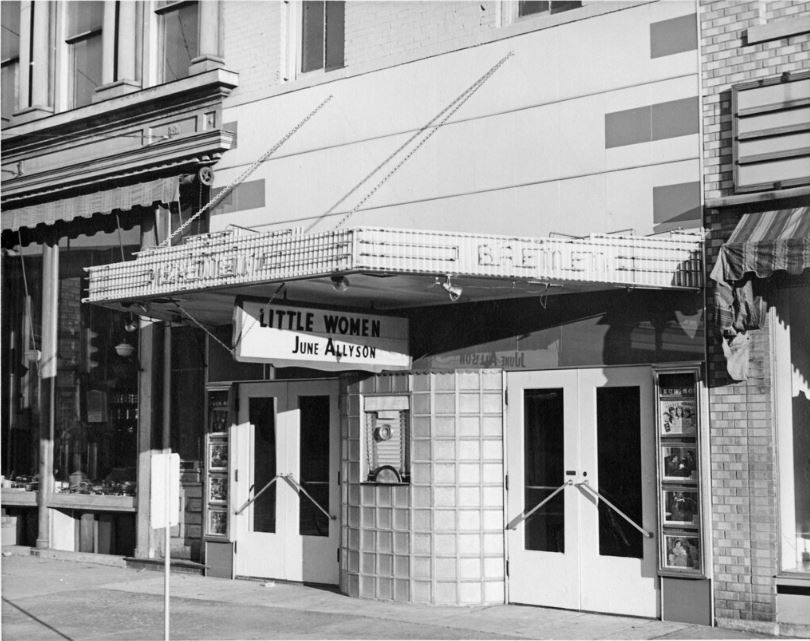
The Majestic was the scene of the only known theater shooting in Marshall County history. On an October evening in 1917, there were about 260 people in the theater when a 16-year-old boy, who had just stolen a revolver, attempted to show it off to a friend. The gun accidentally fired, hitting a young boy across the aisle in the leg. Worried that children would be trampled in a rush to the door, Manager Drake rushed in and yelled for everyone to sit down. The victim went to the hospital and the shooter went to the “calaboose.” Sometime between 1920 and 1930, the movies shown at the theater, now called the Gem, became questionable in decency and taste. It finally closed in 1932. The new Bremen Theatre reopened in the same building two years later, offering only “first class, clean, talking pictures.” In December 1982, Jim and Sue Holliger of Goshen purchased the Bremen Theater, which had, once again, been closed for a couple of years.

Bremen Theater showing Little Women, ca. 1949.

In September 1913 Billy Link bought a building lot in Culver for $675 and built a brick two- story building. The first floor housed a drug and novelty store, and the second floor was a movie theater. By 1919, Link expanded into the Liberty Theater, located on Scott Street. Known as “Culver’s Temple of Mirth,” it was remodeled from Hayes Garage into an 800-seat auditorium. Featuring two shows nightly, it was billed as “a big city show – all for twenty-five cents, plus war tax.”

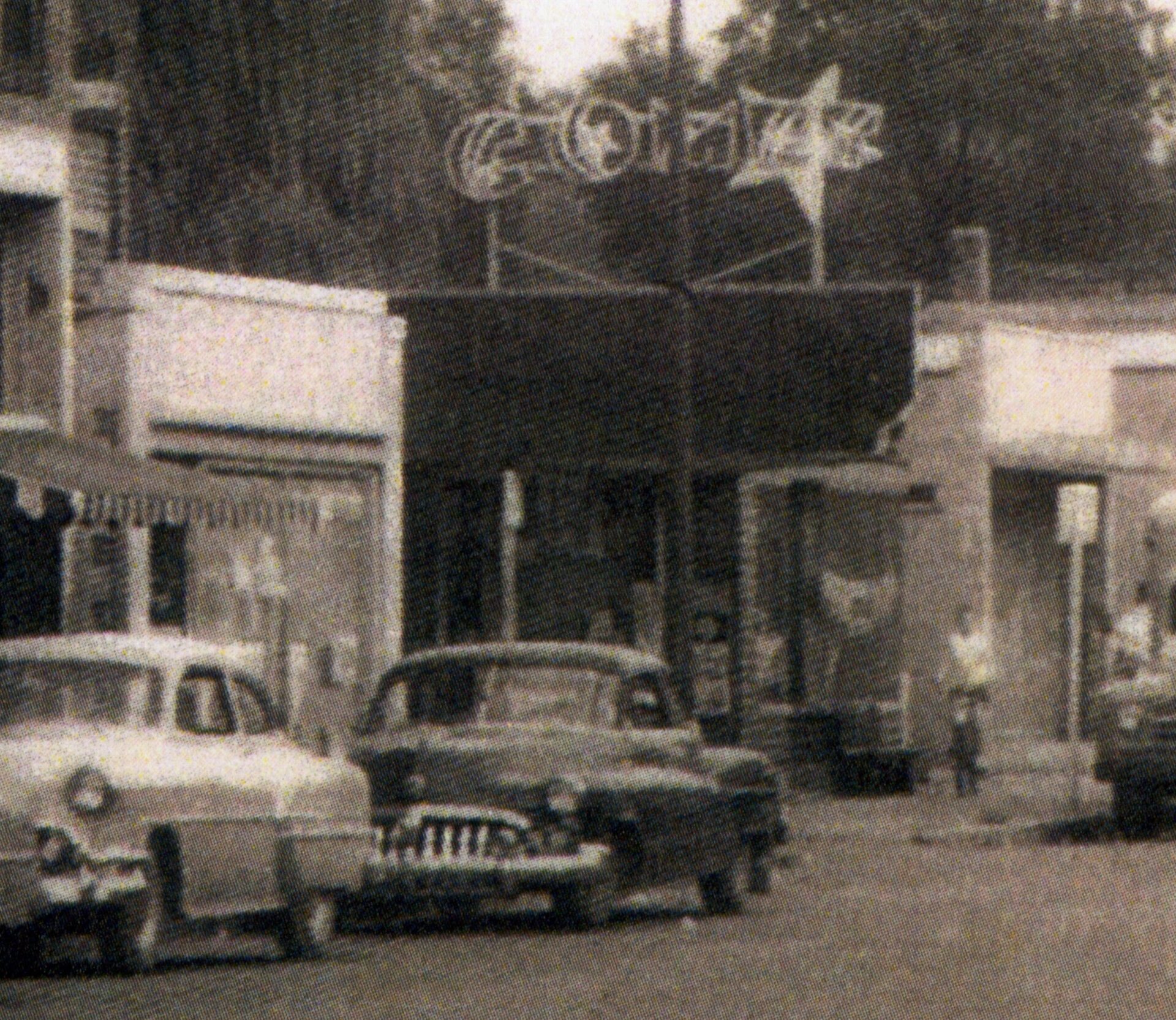
The Home Theater on South Main Street was first owned by John Osborn and showed silent films. Ruth and Martha Werner played the piano. Osborn offered a free serial film to children after school. The catch was that they had to come back later to learn the fate of their heroes. The theater opened in 1914 and closed in 1930. A 1979 survey also listed a Star Theater located on the southeast corner of Main and Washington streets which opened in 1917 and closed in 1920. It was owned and operated by Milton Robinson, who also ran a bakery.  In August 1931 the New Palace Theatre opened. It was located across from the train depot and had been completely remodeled. The grand opening featured Will Rogers in Young As You Feel. The New Palace Theatre later became the El Rancho, owned by Everett Hoesel. The El Rancho theater has changed hands a few times since then, but is currently closed.

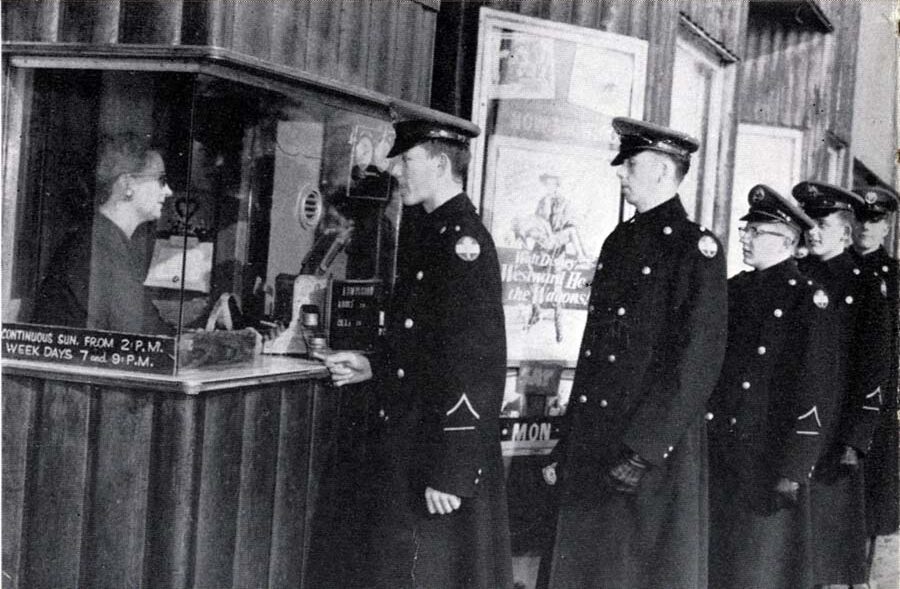
El Rancho Theater with cadets, ca. 1957.

It’s always worth your while to come in the see the rest of the Museum, located at 123 N. Michigan St., Plymouth, open Tuesday through Saturday from 10 a.m. until 4 p.m.

Plymouth Was a Bicycle Manufacturing Hub

Plymouth Was a Bicycle Manufacturing Hub

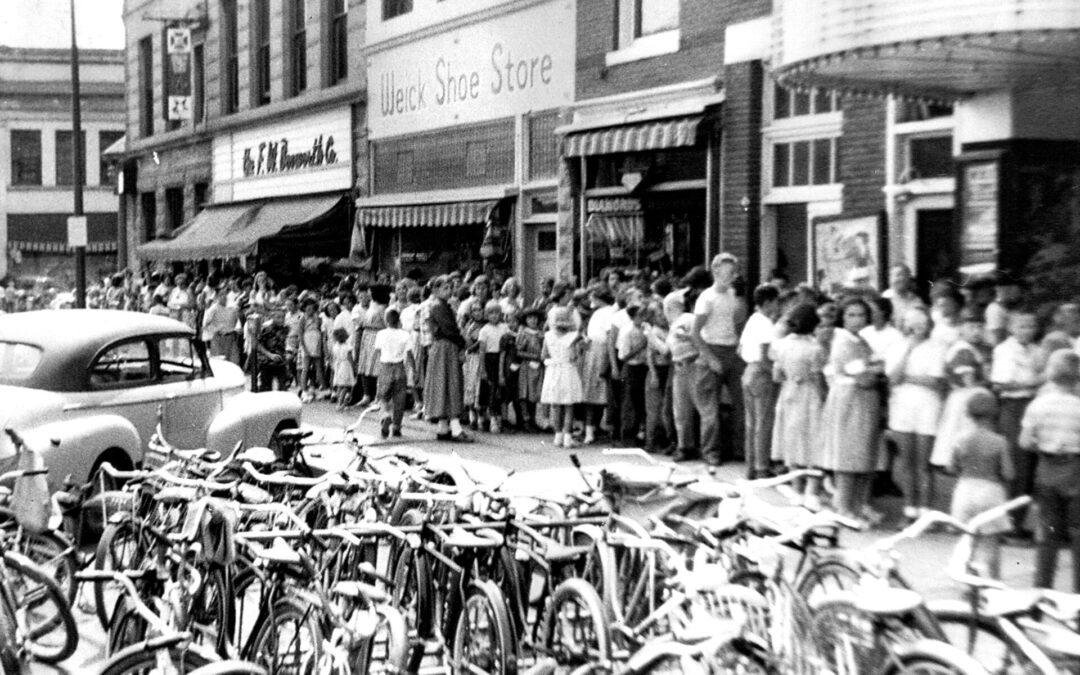
Feature Image. Rialto line to see Smiley Burnette, ca 1952.

By Dennis Gibson

During the 1890s, the U.S. was in the midst of its first bicycle craze. Bikes helped bridge the gap between horses and automobiles. The boom awakened an interest in good roads, furthered the cause of women’s liberation and was even linked to changes in social behavior. Improvements in bike technology fueled the fad. Once it was both safe and comfortable to ride, everyone wanted in. The average cost of a bike in the 1890s was $75 – that’s $2,625 today!

Plymouth Cashes In On Bikes

The attitude toward women riders was still very conservative during the 1890s. There were questions of whether women should ride, how they should ride, whom they should ride with and what their reputation would be if they did ride! The long, heavy skirts women commonly wore also made biking difficult. Bloomers and shorter skirts were an option but could draw scorn and unwanted attention. However, suffrage advocates praised the bicycle as means of giving women more freedom.

Marshall County cashed in. Bicycle parts made in Plymouth were sold to dealers throughout the United States. There were two bicycle factories located here, as well as one that manufactured handlebars.

Built in 1891, covering nearly 50,000 sq. ft., even featuring its own fire department, the Indiana Novelty Manufacturing Company was one. It was the largest factory in the world that made wooden rims for bikes, as well as mud and chain guards. In 1893, co-founder George W. Marble patented a method of making one-piece bicycle rims from ash that were both lighter and stronger than metal ones. Two carloads of lumber were used daily and by 1895, the plant was producing 700,000 rims a year, as well as 100,000 sets of guards. Indiana Novelty supplied nearly all the leading bicycle companies in the U.S. and had agents in most principal cities, as well as Toronto, London and Paris. They made more than half of the wooden rims used by bicycle manufacturers.

Plymouth Cycle Manufacturing Co.

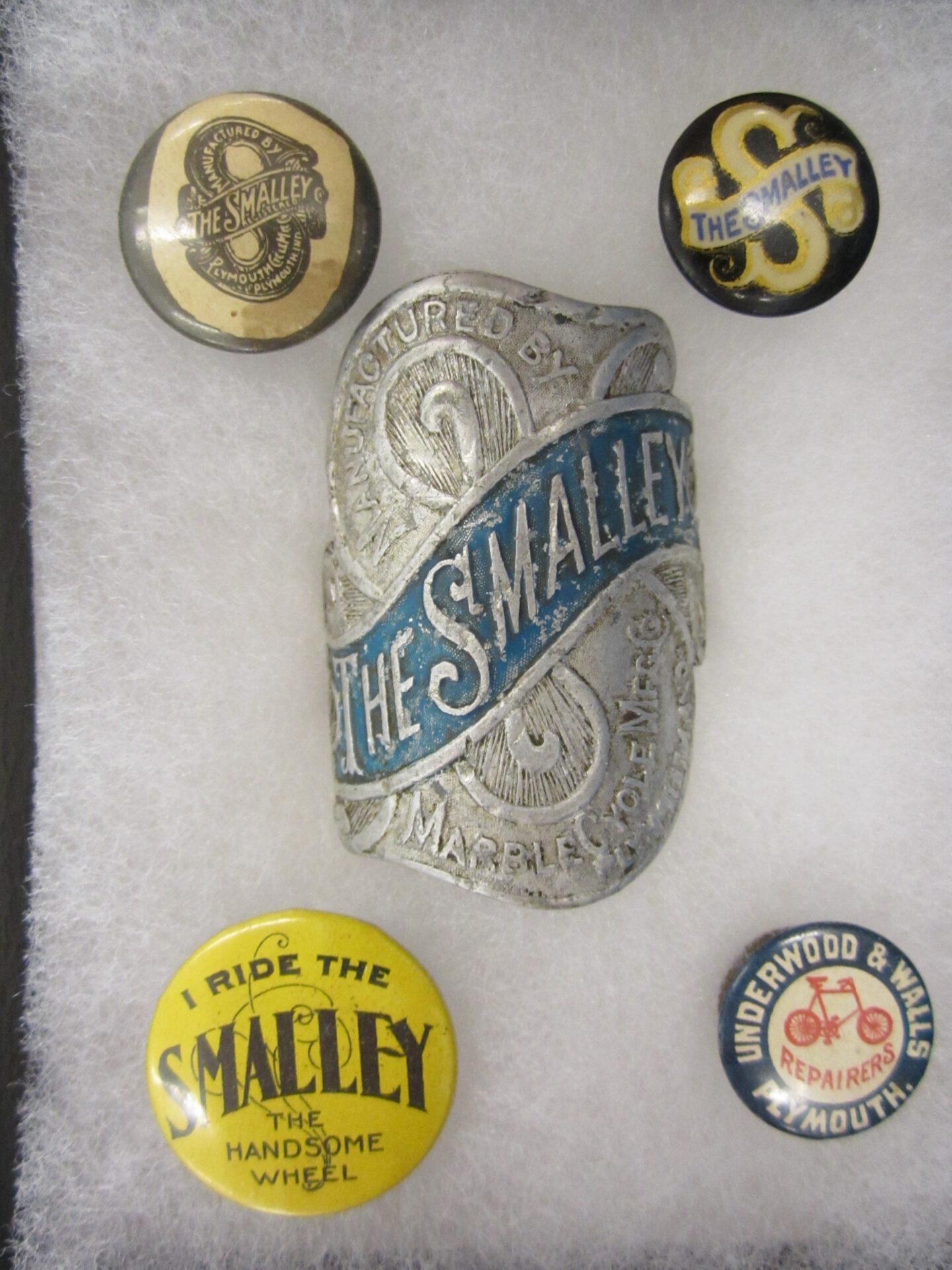
Safety bikes were the alternative to high wheelers, or penny farthings, introduced in the 1880s. Some sources credit Marble with inventions linked to these and other early types of bikes. Marble also created most of the machinery used by Indiana Novelty in the manufacture of its wooden rims. In 1892, he and several other founding members of Indiana Novelty formed the Marble Cycle Manufacturing Company, with the addition of W.D. Smalley, who also had years of experience in the bike trade, and was the namesake for their bike, the Smalley.

In 1894, the company was sold and became the Plymouth Cycle Manufacturing Company.

“It is estimated that the company made approximately 700 bikes a year for the first two years. The output was increased to 4,500 bikes in 1895, with hopes of making 6,000 for 1896. It was reported in the Plymouth Republican that ‘Plymouth Cycle had been operating for months at 13 hours per day. The factory was limited to 5,000 bicycles but now has orders for 2,000 more.’”

However, the country was in recession, and large orders that had been placed were never paid for. Plymouth Cycle was taken over by creditors Bass and McDonald. They reopened the factory in 1897 as the Elektron Cycle Company, but work was halted in 1898 and a judgment secured by former employees for wages due. The company’s machinery and materials were sold to the Shelby Manufacturing Company and moved to Ohio. The bicycle business that had boomed in the early 1890s became a thing of the past. According to the Department of Transportation, bike sales nationwide plunged 79 percent from 1897 to 1904. The craze was over.

Smalley pins.

Unfortunately, the MCHS Museum does not currently have a Smalley or Elektron bicycle to display, but we do have more good information on display in our transportation room. We always welcome donations of any items made by any Marshall County manufacturer! Our Museum is open Tuesday to Saturday from 10:00 am to 4:00 pm.

The Town of Bourbon: 1911

The Town of Bourbon: 1911

This article about the Town of Bourbon appeared in the Weekly Republican on November 30, 1911.

Weekly Republican, 30 Nov 1911, pg 28 cols 3 & 4

Farm and Industry

Bourbon is one of the larger towns in Marshall County, its population according to the last census is 1,163. It is the center of what is considered the best farming lands in the county. While there are good lands all over the county, the Government geological survey shows that the best of them lie in the eastern third of the county.

Surrounded by such rich farming lands, Bourbon is a very prosperous town. Here the E. E. Delp Grain Co., does an elevator business of from $30,000 to $40,000 monthly. There are extensive coal and lumber yards, sawmill, cooperative creamery, two banks, many stores, three churches, Presbyterian, U. B. and Methodist, fraternal societies of Masons, I. O. O. F., Red Men and Knights of Pythias. A good newspaper, the News-Mirror, upholds the best in and for the community.

Some of the best of the Bourbon institutions are represented in this edition, which shows how enterprising and up-to-date they are. The Bourbon Fair, held every fall, is one of the greatest attractions of northern Indiana. On the biggest days the attendance usually reaches eight or ten thousand. Fruit growing, which is given much attention in this vicinity, is always well represented at these fairs.

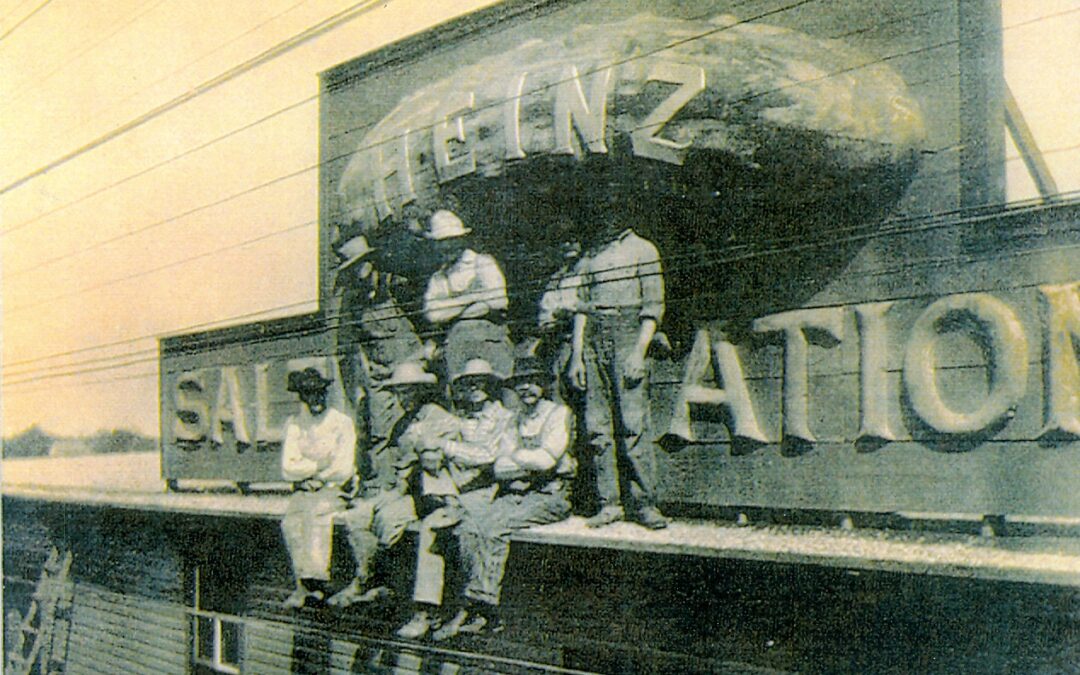
The Heinz company has a salting station here also and many pickles are grown. Four of the chief growers are Otto Ames, who from a half-acre cleaned up $94.87; Conrad Hand, who made $136.82 on one acre; Jos. Hurford, who had out 1 1-2 acre and got $149.76 from it; and Fred Lemler, who took in $227.89 from two acres.

That Bourbon is a good center for farming and livestock raising, is evident from the large number of farmers in the district who feed and ship their own cattle and hogs. It is a fact that more livestock is shipped by rail out of Bourbon than is the case at any point between Ft. Wayne and Chicago.

The following figures showing the number of cars of livestock that have left Bourbon during the past eight years will be of interest: 1903: 105 Cars; 1904: 122 cars; 1905: 135 cars; 1906: 194 cars; 1907: 192 cars; 1908: 243 cars; 1909: 182 cars; 1910: 126 cars.

The figures for this year are, of course, incomplete, but the railway officials at Bourbon expect them to equal those of 1909.

Onion Growing in Bourbon

The onion crop in the vicinity of Bourbon is cultivated to a considerable extent, and with a success which is surprising especially to the layman. The industry has grown amazingly in this part of Marshall County and provides something more than a good living to those in the business. The soil in these parts is peculiarly adapted to the successful raising of this onions.

Over 200 acres around Bourbon, are yearly planted out, and usually the yield is good and pays the farmer well. This year, however, it was only 60 per cent of the normal yield.

It is five years since the industry was started around Bourbon, and, during that time it has assumed large proportions. A considerable number of men are employed, especially in the weeding season. The onions from Bourbon are shipped to all parts of the country, Boston taking large quantities for export purposes. Quantities are also sent to New Orleans for export to Panama. Most of the crop, however, is sent to the south and southwest.  F. F. Fribley, who is one of the pioneers in the business, and who has made a success of it from the very start, owns two large storage houses in Bourbon, from which he ships.

In conversation with a representative of the Republican he instanced the case of George Gouchenour who owns five acres of onion soil, and who, this year, made a net profit of $1000. Another man cleaned up $125 on one acre this year, while still another, Emanuel Coon, with 12 acres, had a net profit of $1920.

As showing how the value of onion lands has increased, it may be mentioned that a very few years ago, they were considered almost worthless, and went begging at from $5 to $10 per acre. Today these same lands are held firmly at from $100 to $125 an acre with improvements. Mr. F. F. Fribley is an enthusiast of onion raising and has done well in the business. He is of the opinion that the industry will soon develop into one of the most important and remunerative in the county.

The Edgerton Basket Factory

The Edgerton Basket Factory

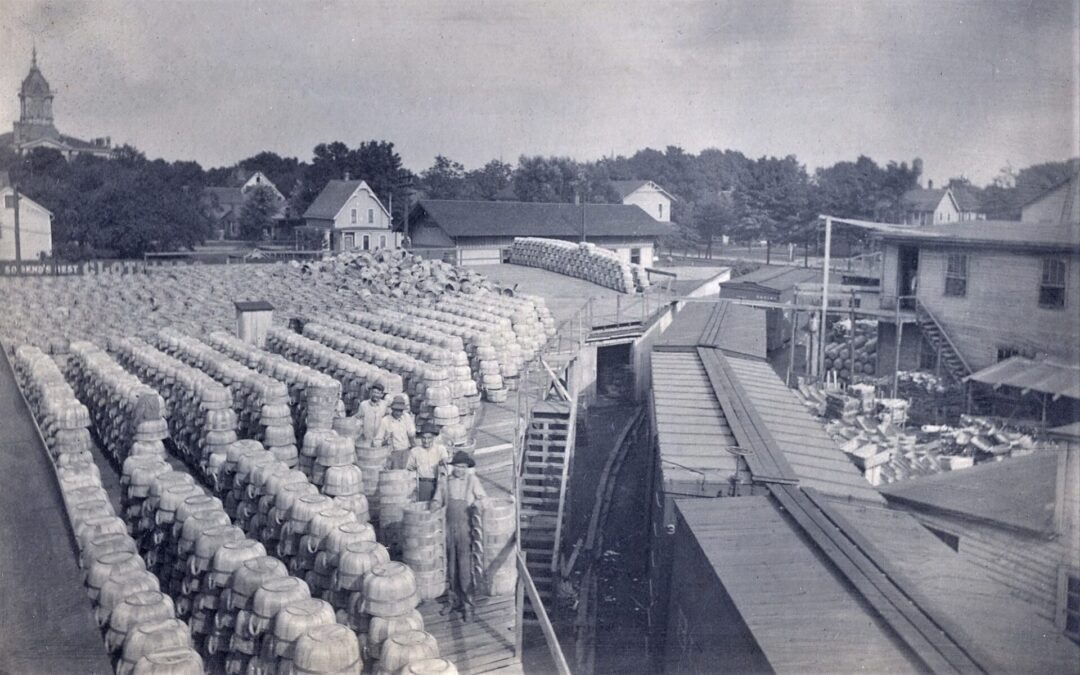
One of the most successful early businesses in Marshall County was the Edgerton Basket Factory. Ease of transportation is critical for growth of trade. And Marshall County, being a crossroads, was attractive to businesses looking for a home. One such was Edgerton Manufacturing, which grew to become the LARGEST BASKET FACTORY in the entire country. Baskets were crucial shipping containers for agricultural products, and Edgerton Baskets were the gold standard.

Peak Volume in 1910

In 1910 alone, 1,632,892 baskets were created. That’s enough baskets to line the road from Niles, MI, to Bloomington, IN, ROUND-TRIP, and still have 45 miles of baskets left over.

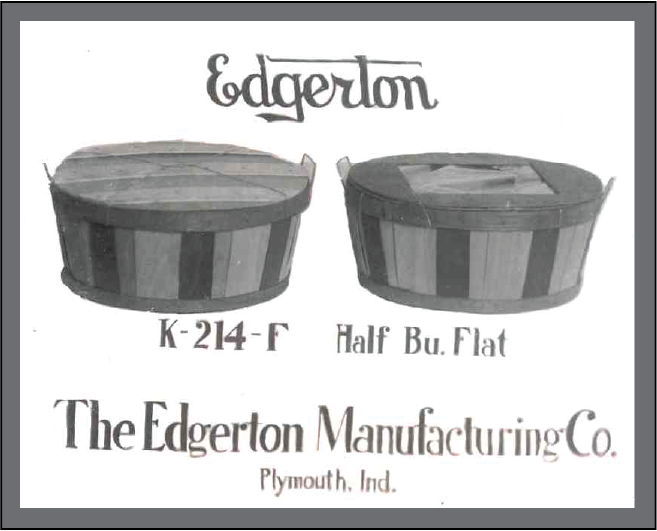
At one time, Edgerton offered thirty-nine grades of baskets in 178 different sizes!  Some of these sold as low as thirty cents per dozen, and others as high as $106 per dozen.  This translates to $9.23 to $3,621. per dozen today. There were shipping baskets for fruits, vegetables, crackers, candy and coffee; carrying baskets for coal, lime and cement; round baskets for feeding and cotton picking; reed, splint and diamond weave baskets for clothes; bamboo, splint and diamond weave baskets for delivery, market, display, crockery, satchels or lunch, fancy waste hampers, and all kinds of laundry baskets.

Advertisement for Edgerton Baskets

Local and Imported Woods

The wood varieties used included oak, elm, beech, maple sugar, basswood, poplar, cottonwood, gum, sycamore, ash, hickory and other kinds.  The company imported 55,900 pounds of rattan from Germany at a cost of five cents per pound. Sadly, Edgerton Basket Factory closed their doors in 1939.

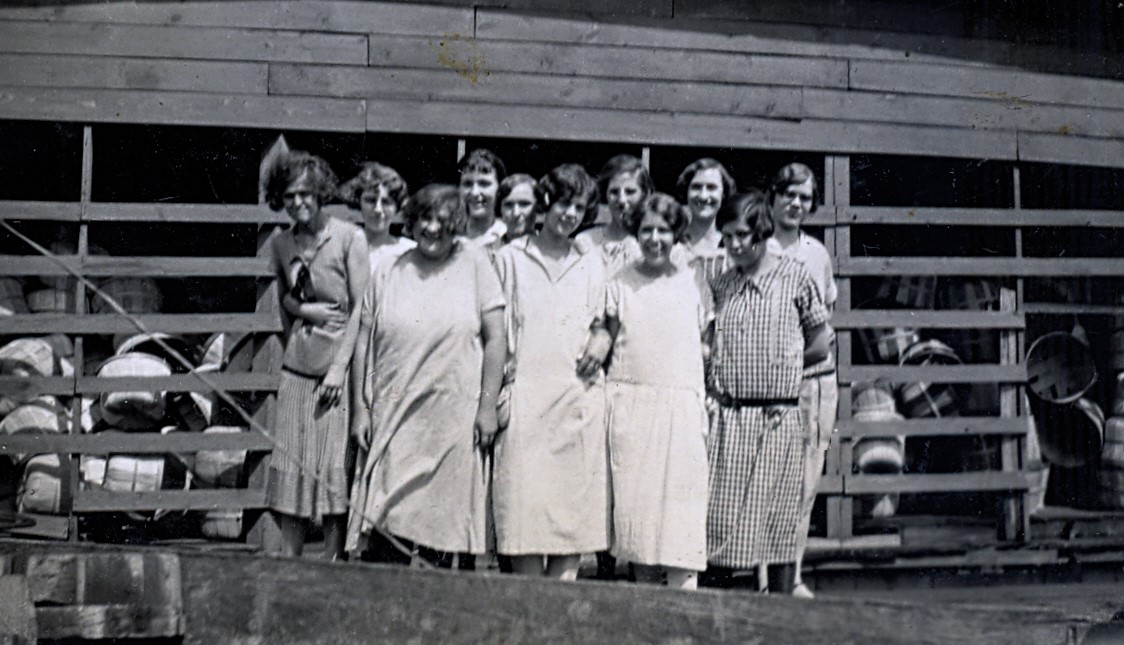
Women employed at Edgerton Basket Company

Ahead of Their Time

Edgerton was unusual for its day in that they actively recruited and employed women and offered insurance as an employment benefit. Just one example of some forward thinking by county residents. A child labor law was passed in 1897 and in May Edgerton discharged all those under the age of fourteen.  It was reported that there were less than a dozen under that age.

At the Marshall County Historical Society Museum, we have the “warning whistle” which was sounded before the startup of the main engine so that anyone working on the line-shafting had time to get down safely.  We also have several beautiful examples of Edgerton baskets. Stop at the front desk the next time you visit and ask to see them.