Magnetic Park

Magnetic Park

Plymouth’s Magnetic Park should be a top stop on a tour of Marshall County. Located along the Yellow River, Magnetic Park has a fascinating history.

Creating the Well

Magnetic Park gets its name from the flowing well of magnetic water. It is 11 inches in diameter and 38 feet deep, with a pipe that is 12 inches in diameter.

The well was driven in 1875 by Bailey & Capron, the owners of the Plymouth Water Mills. A horsepower tread was used to operate the drive hammer. The well was dug with the idea that an underground river would be found, into which the water from the mill race could be drained, giving more power to the water turbine. Instead, a gushing stream of water spouted eight feet high above the top of the well.  Mr. Bailey commented, “Of all the wells I’ve driven this is the first one I wanted the water to run into and here the water is running out.”

A Magnetic Discovery

In 1876 Holland’s City Directory was talking about how clear and cold the water was. At first no one knew about the well’s magnetic properties, but it was shortly to be discovered. The directory stated that recent tests showed that the water was highly charged with magnetism and was possessed of medicinal and curative properties in an eminent degree. It stated, “It is without doubt the largest and finest flow of magnetic water in the world!”

Magnetic wells appear in area where the ground has a lot of iron. Soil can also be slightly magnetic. This is true of Marshall County. At one time, we had a place called Sligo where bog iron was processed. We will share an article about Sligo soon. To be fair, some believe that a magnetic water is not possible, but that the iron oxide that gathered around the mouth of the well dictated the name “magnetic” at that time.

Magnetic Well flowing into drain.

Healing Properties and Pastimes

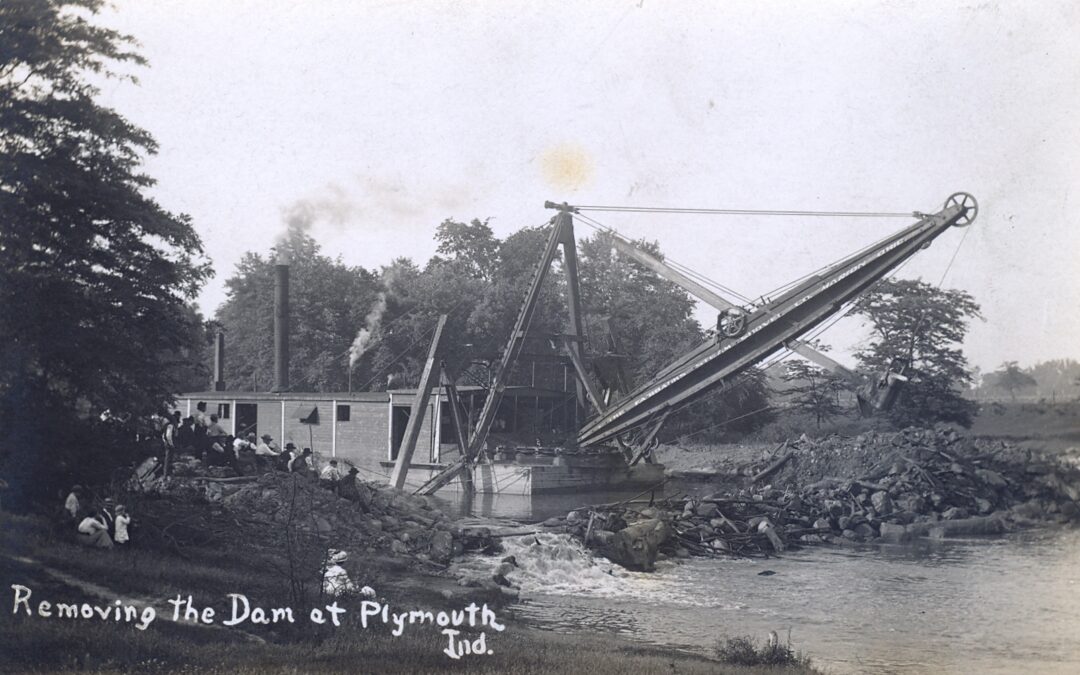
The writer of the article in the directory said the volume of water discharged was enormous, 500 gallons per minute, or 30,000 gallons per hour, and 720 gallons a day. It said that people suffering with rheumatic and dyspeptic complaints greatly benefitted by drinking the water, even before they imagined it was anything more than pure spring water. It was thought that Plymouth could become the Bethesda of the west. The reference was to the pool of Bethesda in Jerusalem, where Jesus healed the paralyzed man. After the removal of the old dam, the flow of water was decreased considerably.

The alleged healing properties were not the only reason people came to the well. A popular pastime was to suspend a metallic object into the well and let it remain for several hours.  Due to the unique properties of the water, the object would become magnetized. Knives, shears, scissors, hooks and small bars of steel became magnetized by being placed in the water. A compass was said to be under its control at a distance of two feet.

Community Renovations

An 1878 newspaper article said that a movement was underway to improve the grounds at the flowing well. The place was called “Magnetic Park” in quotations. They planned to build a bridge across the race and an arbor over the “magnetic flowing well” and to clear and beautify the grounds.  Bailey & Capron agreed to allow the free use of the grounds for the benefit of the public.

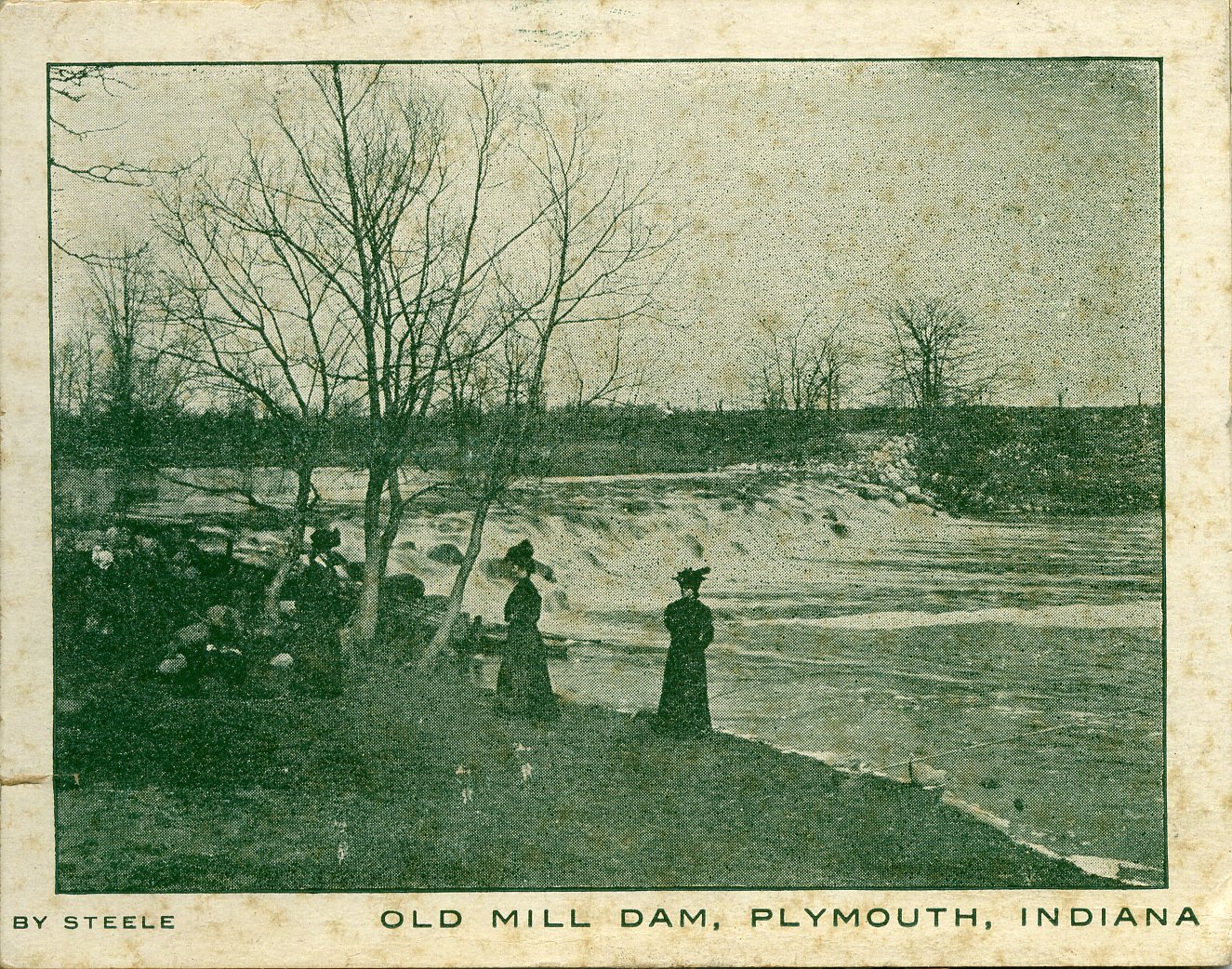
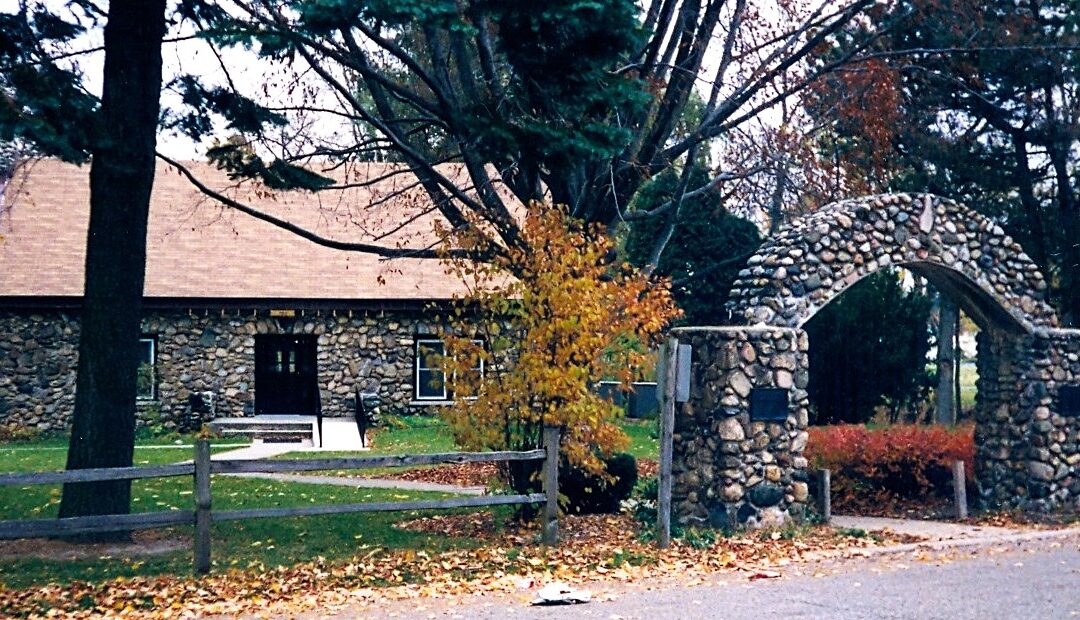
In 1914 a postcard pictured a small wooden shelter around the well, with two ladies in front of it.  Later it was rebuilt with stone and has two identical markers on opposite sides of the structure.  The markers are metal, one foot x two feet. Both markers read: “This shelter house – made possible – by the donations of – Mr. and Mrs. Jacob Price – of – ‘Price’s Steak House’ – erected in 1937 – for the public.”

Two women at the “Old Flowing Well” ca. 1908.

Additional historical markers are located at the park, which is at 700 N. Water St. in Plymouth. Try to find them when you walk through this gem of a park along the Yellow River!

Curious Findings

A 1935 newspaper article discussed the articles found when the WPA cleaned out what was then called the “Old Flowing Well.” The workers reached the bottom of the well and the “relics” were recovered were put on display in the show window of the Eagle building, one door north of the Ball Store, which was at 116 N. Michigan Street.

There were more than 200 items. Among them was a bayonet from an old army musket, thought to be used on a gun during the War of 1812. There are War of 1812 soldiers buried in Marshall County, among them Benjamin Cruzan. Other articles included a gold locket, a silver spoon engraved E.M.E., an unbroken glass goblet and a boy’s pewter whistle which still blew loudly. Of course, there were the usual items like old whiskey bottles. A drive shaft of an automobile was recovered.

Prohibition and Marshall County

Prohibition and Marshall County

Years before the enactment of the 18th Amendment, many locals were involved in the temperance movement. The temperance movement promoted the ban of alcoholic beverages. There were even organizations dedicated to the cause, such as the Women’s Christian Temperance Union. Members would ask individuals to pledge to vote for anti-saloon politicians. They also called on ‘druggists’ to dole out alcohol by prescription only, visited saloon keepers to ask them to stop selling alcohol and prayed outside saloons.

Feelings were intense on both sides of the debate. On Thursday evening, August 27, 1891, a dynamite cartridge was exploded in the United Brethren Church in Bourbon. Straightaway, the Bourbon Mirror called for a temperance meeting to be held the next day. A large number assembled for the meeting, undeterred.

Tough On Alcohol

Eventually, in 1909, Marshall County voted to go dry, well before Indiana did. When the Wright “Bone Dry” Law in Indiana was passed in 1925, it became one of the toughest prohibition laws in the nation. During Prohibition, the United States Treasury Department authorized physicians to write prescriptions for medicinal alcohol. The “Bone Dry” Law outlawed the possession of all liquor – even by prescription for medicinal purposes, which was allowed under federal law.

Illicit Activity During Prohibition

Even with the strict laws, Marshall County had its own speakeasy. A speakeasy was a secret establishment that sold alcohol illegally during Prohibition. The most notorious use of the Hoham-Klinghammer-Weckerle property in Plymouth occurred during Prohibition. In the 1920s the property was a roadhouse called the Pine Tree Inn. In 1928 officers led what was considered the county’s greatest raid on the roadhouse. Evidence was found that beer was being sold there. Two officers and three deputies went in just before midnight and took patrons by surprise. Officers found “Monte Carlo style gambling and free flowing liquor.” No one attempted to flee, and 35 violators were taken into custody, some from as far away as Ohio. Officers seized 38 cases of beer and found two slot machines.

Large headlines in the Plymouth Daily Pilot on July 30, 1928, read, “14 ARRESTED IN RAID ON LOCAL GAMBLING HOUSE,” with subtitles like “OFFICERS STAGE CLEANUP – MINORS BROUGHT TO COURT.” In large print the newspaper called the event the “COUNTY’S GREATEST RAID.”

One article stated that practically all of the boys and men arrested had brought girl friends with them to spend the evening. Many of the men involved were “prominent in their communities.” The house was leased by Bertha Bozarth from W.J. Hayes of Chicago. Hayes pled innocent of any knowledge of the use of the property. Bozarth was assisted by Robert Wolcotte; both were arrested and charged with operating gaming devices and the possession of intoxicating liquors.

An underground brick vault used to ferment beer
One of two brick vaults at the house constructed underground and used to ferment beer.

The End of The Speakeasy

The paper reported that the business had grown until it became more publicly known, at which time the county prosecutor took steps to investigate. This would assume that the public knew of the illegal activites. Judge Albert B. Chipman of Marshall County then ordered the establishment padlocked for one year. The Plymouth Daily Pilot ran front-page headlines such as “PADLOCKS PINE TREE INN FOR ONE YEAR” and “CHIPMAN ENDS CAREER OF PRETTY LAKE ROADHOUSE.” They stated that the “Pine Tree Inn has come to the end of its short but hectic career.” The padlocking of the establishment included the “brick house and garage, all out buildings, the tunnels (vaults) and the frame house to the west of the brick (house).” A bond was placed on the property for $1,000 stating that only the owner, W. J. Hayes of Chicago, could use the property else.

Bozarth claimed under oath that she paid “protection” money to Justice of the Peace Walter A. Zeroll. After the raid Zeroll left the city in the middle of the night and a warrant was issued for his arrest. A month later Bozarth was found guilty. She was fined $150 and sentenced to 60 days at the Indiana Women’s Reformatory. That was the end of the speakeasy.

The Marshall County Historical Society Museum has an interesting display on Prohibition. Check out our west window on Garro Street to learn more! 

Travelers on the Orphan Train

Travelers on the Orphan Train

In 1892, Plymouth was a stop for an “orphan train” that transported thousands of children. They came from the streets of New York and New England to new homes in the Midwest. From 1854-1929, nearly 4,000 orphans, ranging from ages 1 to 12 were brought to Indiana. All together almost 250,000 “little waifs” climbed aboard the orphan trains and headed west in search of a family. They got off the train with name cards pinned to their clothing. Many were orphaned not only by the death of a parent, but because of poverty and neglect, and would have died on the streets. The image above features the New England Home for Little Wanderers of Boston. Rev. H.S. Kimball, an agent of the home, preaches at the M.E. Church in Argos.

Who Took In Travelers from the Orphan Train?

Children from the orphan trains were placed in homes depending on the needs of prospective adoptive parents. Sometimes their own child had died and they were seeking to expand their family. Some older couples needed someone to look after them, or a farm family needed an extra pair of hands to help with the chores. Some of the agricultural families believed the abandoned children should work to “earn their keep.” Sadly, some siblings went to different homes. The orphans were at the mercy of their adoptive families.

Locally, 26 orphans found permanent homes in Marshall County from the New England Orphan’s Home, although the supply didn’t meet the demand for these kids. “The children were the objects of considerable attention,” according to an edition of the June 1892 Plymouth Democrat. The orphans, gathered at the Methodist church in Plymouth, hoped to win the hearts of a new family. The would-be foster parents could specify exactly what they wanted. For instance, a blue-eyed blonde female, or a sturdy red-headed male. Some orphans were luckier than others. Many were placed loving homes with caring families, but others lived a life of hard farm labor. It seemed a bit callous, but “beggars couldn’t be choosers.” Although every situation was unique, adoption was perceived as better than life on the streets.  

Young boy posing for image with hand on table

The Good and the Bad of Adoption

One of the grown-up orphans that made her home in another state, Jesse Martin, said that being an orphan train rider taught her to have more understanding of people’s pain. She never felt like she fit in. She said the children at school would say, “No one cares for you, not even your own mother!” She says she simply became grateful for the kind people along the way.

Not all these little wanderers had such an unhappy experience. Many found good homes and received the best of care. One particular child caught the eye of a new parent that was grieving from the loss of their own. According to an article from the 1990 Herald Banner, (Greenville, Texas) Helen Hale Vaughn said that her mother would become very angry at anyone who referred to her as their “adoptive” daughter. Whenever Helen would come home broken-hearted, her mother would embrace her and say, “You just remember, we chose you, and they were born to their parents, so they had to have ’em!”  

The Legacy of the Orphan Train and Its Travelers

Some of the orphans given an opportunity for a new life prospered and flourished in their new environment. Many orphan train children went on to live long productive lives and were able to enjoy their grandchildren, and many times great-grandchildren. They weren’t looking for fame and fortune, but a better life and “to love and be loved!” The orphan train provided a means for these children to have the will to go on and made survivors out of them.

For more specific information on the local impact of the orphan train, visit the Marshall County Museum and enjoy the research done by Christopher Chalko who spent time collecting data, newspaper articles and personal letters of people that actually rode the orphan train. It’s interesting reading material that is a part of our history in Marshall County and across the United States.

The Edgerton Basket Factory

The Edgerton Basket Factory

One of the most successful early businesses in Marshall County was the Edgerton Basket Factory. Ease of transportation is critical for growth of trade. And Marshall County, being a crossroads, was attractive to businesses looking for a home. One such was Edgerton Manufacturing, which grew to become the LARGEST BASKET FACTORY in the entire country. Baskets were crucial shipping containers for agricultural products, and Edgerton Baskets were the gold standard.

Peak Volume in 1910

In 1910 alone, 1,632,892 baskets were created. That’s enough baskets to line the road from Niles, MI, to Bloomington, IN, ROUND-TRIP, and still have 45 miles of baskets left over.

At one time, Edgerton offered thirty-nine grades of baskets in 178 different sizes!  Some of these sold as low as thirty cents per dozen, and others as high as $106 per dozen.  This translates to $9.23 to $3,621. per dozen today. There were shipping baskets for fruits, vegetables, crackers, candy and coffee; carrying baskets for coal, lime and cement; round baskets for feeding and cotton picking; reed, splint and diamond weave baskets for clothes; bamboo, splint and diamond weave baskets for delivery, market, display, crockery, satchels or lunch, fancy waste hampers, and all kinds of laundry baskets.

Advertisement for Edgerton Baskets

Local and Imported Woods

The wood varieties used included oak, elm, beech, maple sugar, basswood, poplar, cottonwood, gum, sycamore, ash, hickory and other kinds.  The company imported 55,900 pounds of rattan from Germany at a cost of five cents per pound. Sadly, Edgerton Basket Factory closed their doors in 1939.

Women employed at Edgerton Basket Company

Ahead of Their Time

Edgerton was unusual for its day in that they actively recruited and employed women and offered insurance as an employment benefit. Just one example of some forward thinking by county residents. A child labor law was passed in 1897 and in May Edgerton discharged all those under the age of fourteen.  It was reported that there were less than a dozen under that age.

At the Marshall County Historical Society Museum, we have the “warning whistle” which was sounded before the startup of the main engine so that anyone working on the line-shafting had time to get down safely.  We also have several beautiful examples of Edgerton baskets. Stop at the front desk the next time you visit and ask to see them.