Hunting Tales

Hunting Tales

With the annual hunting season in full swing, it’s time to look at hunting tales from long ago from the archives at the Marshall County Historical Society. Documents tell us: “The tradition of the last bear that was shot in Marshall County, comes from the lips of John Thomas, who is as familiar with the unwritten history hereabouts for the last 40 years as a draft horse is with the four corners of his feed box.” said John Thomas.

“In the winter of 1865,” says Thomas, “a number of bears wandered down from the woods of Wisconsin and terrified cattle and farmers throughout Northern Indiana.  This particular bear was a huge black fellow and had been seen in various parts of the county before he met his doom.  I had just come home from town when the women folks ran to meet me and said they had seen the much-dreaded animal run across a field.  I rushed to the house but found the hired man had taken the gun before me and started in pursuit.  Going to the neighbors, I borrowed another gun, mounted my horse and galloped away on the trail.  When I came up to the Whaley place on the Wolf Creek Road, I found the two boys in a very excited mood.  They had just shot the bear.  They told me that their father had gone to town, and they had been left at home to feed the pigs.  Suddenly one of the yelled, ‘See that pig on the fence!’  The other one looked.  Sure enough there was a pig on the fence.  But a pig on the fence was absurd.  When they took a better look, they saw the supposed pig was a bear.  A gun was brought from the house and inside of two minutes the big brute lay dead upon the ground.  Many hunters arrived in time to help gloat over the victory.  The hide was sold to Jepeth Disher, who paid $8 for it.  It was afterward worked up into a fine robe.” Plymouth Democrat – July 31, 1902

“The latest diversion of Bourbon men of affairs is that of racoon hunting.  The town, that is the sporting part, is now in the throes of a revival of the art of hunting the animals, that in the early days was a favorite pastime.  Whether it is a case of heredity, just now cropping out of the fourth generation, we have no means of knowing, but there is one thing certain, the craze has hit the town hard.  As far as we have been able to learn Jonas Rettinger is the only one who has, in the years past, kept up the sport enough to not forget its requirements.  Later Samuel Lemlar, Phillip Steinman and Arch Myers formed a company (limited) and purchased a hound after they had sold the one Sam had owned to Rettinger.  Lemler then purchased another hound and his deep sonorous voice had been sending cold chills up and down Mr. Racoon’s spine with painful regularity.  When Harl Stewart got the fever, he purchased another dog, and the old days of gentlemen following the hounds is returning.  Lemler, Myers & Steinman gave a racoon feast at the Vernette & Fretz restaurant Wednesday evening, and the smacking of lips told the tale, as their friends passed in and out.  Harl Stewart and Otis Thacker went Friday night and so far, hold the palm of good catches.  They secured three large, fat young racoons and a skunk.  And the beauty of the whole thing is that the skunk wasn’t quick enough to use his defense.” Bourbon News-Mirror – November 28, 1907

Introducing the Balcony Building

Introducing the Balcony Building

Some of the buildings in Marshall County’s cities and towns have quite an interesting history. They have changed ownership, of course, but some have even changed size and shape! A good example we have covered previously is the REES Theatre. It went from a three-story, three-bay Italianate structure to a two-story, two-bay Art Deco one.

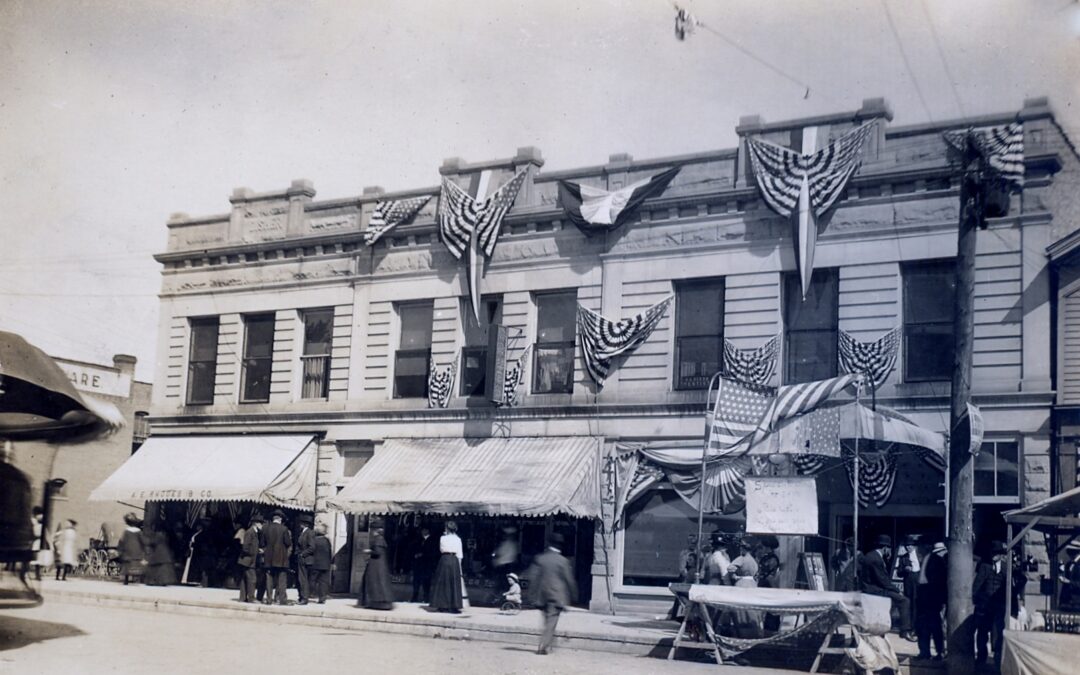
The subject of this article is the “Balcony Building” at 113-115 N. Michigan Street, now the home of Aldridge Diagnostic Medicine and the Wild Rose Moon. Since it was built in 1866, it has undergone some pretty drastic transformations.

This Italianate building was built with three floors, two store front bays and an iron balcony between the second and third floors. Thus, it became known as the “Balcony Building.” Ironically, it lost its balcony sometime during its early lifetime but held on to the moniker for a good many years.

First Occupants of the Balcony Building

Apparently, the north store front bay was first occupied by Freese & Behrens, a dry goods and notions store, with a grocery on the south side. The second floor housed business offices, a millinery (hat-making) shop and perhaps even a living quarters. The third floor housed Balcony Hall, a performance venue with a stage. The building was constructed according to the latest city ordinances requiring brick fire walls and the most modern lighting and heating systems, enacted after a catastrophic downtown fire destroyed most of the remaining wooden frame buildings earlier that year.

When Simon Becker, a subsequent long-term tenant, left for Argos in 1878 the building changed hands several more times, housing a “dry goods and fancy goods” store, a drug store, and a grocery store on the north side, and Bunnell & Son Furniture & Undertaking on the south.

Political Address Outside

Distinguished visitor William Jennings Bryant, known as the “American Commoner” and leader of the Democratic Party, spoke to a huge crowd in front of the Balcony Building in 1906. A platform was erected in the street and people from all over the county gathered to hear him speak for 40 minutes. According to reports, however, strong winds, crowd noise and no modern sound system made it hard for most people to even hear the speech.

William Jennings Bryan’s address, October 24, 1906.

Right around this time, the building became the property of Frank W. Bosworth and his wife Mabel. The couple’s two daughters, Esther and Muriel, eventually inherited the property, and that is how the building got passed down to its current owner, George Schricker. George is the great nephew of Esther and grandson of Muriel. You might have noticed the upper floor – now apartments – are named the William Jennings Bryan Suites.

Fire Devastates the Balcony Building

Then in 1927, Charles Glaub moved his ‘cash and carry’ grocery into the building. Before this innovation, grocery stores often operated a bit like warehouses – customers would choose items they wanted, employees would find and pack the items, and then the order would be delivered to the customer’s home or business with the bill being paid at the end of the month. A three-way partnership, consisting of Mrs. Anna Glaub & sons, Chuck & Walter, was formed in 1938 due to the death of Charles H. Glaub.

Interestingly, a few years after Mr. Bunnell moved across the street, the A&P Grocery & Meats moved into the south bay, creating side-by-side grocery stores in the same building. And that is the way it was at the time of the November 27, 1946 fire that engulfed the third floor of the building.

The Moose Lodge met on the third floor, G&G Grocery occupied the north bay, and A&P Grocery occupied the south. The Knights of Columbus also met upstairs. The theory about the fire was that a Moose left a cigar burning. (Now there is a word picture!) The third floor was a total loss and had to be removed. The demolition took with it the ornate Italianate cornice. It is a testimony to the brick structures that the neighboring buildings, and even the lower floors were not severely damaged. G&G remained in the building until they relocated in 1953. In 1954 Derf Jewelers moved into the north bay, and at about the same time Lord’s Dress Shop took over the south bay.

Moose Lodge fire ignites the balcony building, November 27, 1946.

Post-Fire

In subsequent years, several businesses moved in and out of the building, and it underwent significant renovation. Today it houses the Wild Rose Moon on the north side and Aldridge Diagnostic Medicine on the south side.

Are you curious about other buildings in the county? Let us know! We love doing research. If you are more interested in researching a topic of your own, the Marshall County Historical Society Research Library has LOTS of resources. Come in Tuesday – Saturday, 10 a.m. to 3:45 p.m. and our research specialists can get you pointed in the right direction.

Dredging the Yellow River

Dredging the Yellow River

In 1909, Supreme Court of Indiana had ruled in favor of the farmers and cleared the way for the Yellow river to be dredged. This article has been edited from the Plymouth Tribune, December 8, 1910.

Working Around the Clock

Progress on the work of dredging the Yellow river is being completed much faster than was anticipated, either by those who let the contract for the work, or by those who are executing the task. Slightly over one lineal mile of the river’s bed has already been completely dredged since the start of the work on November 9th. Approximately 41,300 cubic yards of earth have been taken from the bed of the river within this mile. An average excavation of seven feet in depth is made in the river’s bottom, extending to a width of fifty-five feet at the bottom. The dredge is located at a point slightly over seven miles east of Plymouth and at the rate of progress now being made, County Surveyor Percy J. Troyer estimates that the dredge will reach the city within eight months and will complete the entire route in fifteen months.

The fire under the boiler of the great dredge is never allowed to go out, and in order to cheat winter and the coming freeze of the river as much as possible, the large crane and bucket are never still. Day and night without pause the dredge and its gang is at work. The outfit has its own electrical plant that illuminates the surroundings sufficiently to carry on the work at night. A gang of twelve men is employed, six on each shift, working twelve hours each. The dredge is in charge of W. A. Schultz of Milwaukee, a member of the dredging firm that has the contract to widen, deepen and straighten the Yellow river for eleven miles of its course, from the point eight miles upstream to three miles below Plymouth. 

The Mill Dam in Plymouth prior to dredging the Yellow River and removing the dam, ca 1912

The Mechanism Behind Dredging a River

The first change in the course of the river will begin later part of this week. This cut is known as the Nunemaker Cut and will consist of diverting the course of the stream across the ends of a “U” shaped bend. Instead of flowing around the bend, the river will be made to cut across the ends. As a result, all of the land enclosed in the bend, besides the old bed of the river itself, will be reclaimed for farming proposes, as the old bed will be drained by the deeper bed in the new course. The Nunemaker Cut will consist of a lineal cut of 1200 feet, and will necessitate an enormous excavation of earth, as the new riverbed will be laid seven feet lower than the present bed, and as stated above, will be fifty-five feet wide at the bottom. It is estimated that this cut will require somewhat over two weeks. There are two or three more such cuts to be made in the course of the Yellow River dredge.

A wonderful sight might have been witnessed at the work site on Thanksgiving Day, when a feat of engineering skill was executed by the dredge. The sixty-five-foot steel bridge, weighing 12 tons, which spanned the river at that point, was lifted from its abutments, swung around, and deposited upon the bank of the river. The scene of the steel bridge in midair with several workmen standing on the structure to preserve its balance was a novel one, and served to show the power, size and effectiveness of the great dredge. The bridge was bound to the beam of the dredge by steel cables, men were stationed along the floor of the bridge and at the word, the beam was raised. The bridge had to be removed in order to let the dredge pass down the river. After the river had been widened to the required dimensions at this point, the dredge was found to be too short to span the river and the steel structure is still reposing on the bank of the river, seven miles east of town. This bridge is a familiar sight to the boys of the city, many of whom have boasted of skating up to the seven-mile bridge.

Missing Pieces

Of course, we now want to know when and how the bridge was replaced on its abutments, and did it have to be lengthened? Unfortunately, our records do not provide those answers, nor is there any further mention of the bridge sitting beside the river.

Spooky Marshall County

Spooky Marshall County

The following tales are just a taste of spooky Marshall County. Most of the stories are told as they were written long, long ago.


“The neighborhood two miles east of Lapaz is all stirred up over a ghost story, which is vouched for by a number of persons to be fact. Millian Crum and Nathan Crothers were passing the U.B. church in the Berger vicinity several nights ago, and a figure in a white shroud appeared in front of the church and waved its arms. The movement of the white object also frightened their horse, which ran some distance before the animal could be stopped. Charles Charleston who passed the church at an early hour in the morning also claims to have seen a ghost. The story has caused no little talk in the neighborhood. Samuel Thomas who is not afraid of ‘fire or brimstone’ proposes to investigate the affair and will visit the place with a party of men on Saturday night. Mr. Thomas is of the opinion it is a joke being played by some boys to create a sensation and will make an effort to capture the ghost.” From The Bremen Enquirer, May 11th, 1900.

The Higbee Corner Tavern maintained a good reputation. No doubt there was drinking there, and many intoxicated travelers stopped there, but that did not make a place tough in those days. However, the Thompson Tavern did not have a good reputation and was deserted by the time the Higbee Tavern became popular. It was then known as the “Haunted House.” The story is told that when this old tavern was deserted, cattle and pigs used to roam at will in and out of the open doors.  One stormy night the pigs had taken refuge in the old building. Two men were passing there that night, and the one who was the least drunk dared the other one to go into the “Haunted House.” With much bravado, increased by the stimulant which they had had, they reeled in through the open door and stumbled over the pigs. The disturbed pigs made so much noise that the intruders started to run, to get away from the “ghosts,” and never stopped until they reached the Higbee Tavern. Written in 1940 in a memoir by Francis Emerson.

The September 1, 1910, issue of The Plymouth Democrat reported that Henry Kelver had a “thrilling experience” on Dixon Lake. He was in the middle of the lake when he saw a dark looking object in the distance approaching his boat. “The water parted into waves on either side of the object as it came nearer…its head looked like that of a big black dog and its eyes snapped ferociously. Just below the blue water of the surface was a big black form, about the size of a wheelbarrow and there seemingly were a hundred pairs of legs wiggling and paddling beneath it. Within two or three rods of the boat the monster turned, dove and disappeared.”

“A terrible murder was committed two miles south of this place on Sunday night last. The circumstances that led to the horrible deed were about as follows: About 4 o’clock Sunday afternoon two men, aged about 30 years, called at the house of Mr. Mikel Hisey and requested to stay until after the rain, which was falling. After sitting in the house about an hour they started to leave. One of the men was of medium size and tolerably well dressed, and the other larger and very rugged. Mr. Hisey thought no more about them until in the morning in passing an old house used for a stable, he heard someone groaning, and going in and up on the loft, where he had some hay, he found the better dressed man with three gashes cut in his head through the skull, and the brains oozing out. The man had been stripped of pants and coat and left with nothing on but shirt, vest, and boots. The boots were both made for one foot. The instrument used to accomplish the deed was a cutter from a shovel plow. Medical aid was summoned, but nothing could be done for the man. He was beyond help, and, of course, could not speak to tell of the deed. He died during the day; nothing being left by which he could be identified. His companion no doubt had done the deed. It is supposed the murderer took the train at Argos, going south, as a man answering the description, with black pants too short by several inches, was seen getting on the train in the morning. Mr. Hisey thinks they were carrying a small bundle when at his house.  All possible steps are being taken to secure the arrest of the murderer.” From the October 2, 1873, Plymouth Democrat.


Accomplishments of WPA in Marshall County

Accomplishments of WPA in Marshall County

In our U.S. history classes most of us gained a passing acquaintance with President Franklin Delano Roosevelt and his Works Progress Administration program that helped Depression-era workers get back to earning a paycheck. The projects were wide ranging geographically as well as in type. Everything from buildings to bridges were constructed or improved. WPA workers built roads, dams and hatcheries, just to name a few. Below is an article published in the June 5, 1940, edition of the Culver Citizen about the impact the WPA had on Marshall County. It has been lightly edited to improve readability.

The Works Progress Administration constructed eight new buildings, reconstructed or improved five others and paved or improved 78.5 miles of highways, roads and streets, according to a survey released today by John K. Jennings, state administrator. Jennings said the survey was the first all-inclusive one to be made of WPA accomplishments in Marshall County. It includes all major projects since the start of the work-relief agency in August 1935. The survey said that a total of 729 Marshall County men and women who lost their jobs in private industry have been given WPA work-relief at one time or another.

Almost all the WPA roadwork centered on improving farm-to-market roads, of which 71.8 miles were bettered. In city street and alley work, the WPA improved a total of 4.1 miles. Of that, it laid new paving on 2.3 miles.

The WPA constructed a new warehouse for the Plymouth City Hall, a bathhouse at Culver, a hatchery clubhouse (Isaac Walton Leaugue), a barn at Magnetic Park in Plymouth and one other building at the same park (Conservation Clubhouse). In reconstruction and improvement work, the WPA bettered the Marshall County Courthouse, highway garage, jail and infirmary (Shady Rest Home). It improved the school at Inwood, Lincoln High School Athletic Field, Culver Park, Bremen Cemetery, and Huff Cemetery in German Township.

Isaac Walton League Clubhouse in Argos, IN.


In miscellaneous construction work, WPA employees built a dam at Plymouth having a storage of 300 acre-feet, the Magnetic Park fish hatchery which now has a capacity of 10,000 fingerlings, and the Argos Fish Hatchery with a capacity of 375,000 fingerlings annually. Magnetic Park, 17 acres, and Centennial Park, 35-acres, both in Plymouth, also received improvements.

Throughout Marshall County, WPA workers reconstructed or improved 26 steel bridges measuring 2,356 feet, improved 352 miles of roadside drainage, paved 4.8 miles of sidewalks and paths, laid 7.7 miles of curbs and seven-tenths of a mile of gutters.

In the utilities and sanitation field, the WPA laid 2.2 miles of water mains, aqueducts, and distribution lines, installed 5.8 miles of storm and sanitary sewers, made 19 sewerage connections and dug 221 manholes and catch basins. Nearly 1,200 sanitary privies were erected by the WPA. (These privies had concrete slabs and vaults and were considered more sanitary. They were nicknamed “Eleanors” due to Eleanor Roosevelt’s support for the program.)

More than 2,300 feet of retaining walls and revetments were constructed. One new airplane landing field was built on which runways totaling 5,280 feet were laid. In the professional and service division, WPA workers renovated 2,232 books, turned out 15,183 garments from sewing projects, and completed 5,490 items other than garments such as mattresses, quilts, etc. The sewing products were given to the needy.

The impact of the Works Progress Administration on Marshall County and its residents can hardly be overstated. If you want to know more about the WPA in Marshall County, come into the Marshall County Historical Society. Our research specialists will be happy to help! We are open from 10 a.m. to 4 p.m. Tuesday through Saturday.

The Liberty Bell Visits Plymouth

The Liberty Bell Visits Plymouth

We can’t show you the Liberty Bell, but don’t miss the opportunity to stop in at the Marshall County Museum between October 14 – 25 to visit The American Revolution Experience, a special exhibit sponsored by the National Society Daughters of the American Revolution and the American Battlefield Trust. Stop in any time from 10 a.m. to 4 p.m.

A Tour Around the Country

Most Americans love the icons that represent our country. The Washington Monument, the Lincoln Memorial, the Statue of Liberty – and the Liberty Bell. Many of those famous symbols cannot come to visit us, but the Liberty Bell could and did!

The Liberty Bell had always been popular, but its national tour around the country in the summer of 1915 really vaulted it into the consciousness of the American people. In 1915 the United States was on the verge of entering World War I and the powers that be in Washington, D.C. felt that some symbol to unite the country was needed before they announced any decision about entering the war.

The Panama-Pacific International Exposition in San Francisco was being planned to celebrate the completion of the Panama Canal. It would be the first World’s Fair to be held on the West Coast. San Francisco’s mayor, James “Sunny Jim” Rolph, got the idea to have the Liberty Bell brought out to San Francisco for the fair. He was joined by many others, including publisher William Randolph Hearst. The Liberty Bell had been exhibited from time to time in various places, including the 1893 Columbian Exhibition (World’s Fair) in Chicago, but had never been west of St. Louis.


Liberty Bell as it rolls into Chicago ca. 1893.

The idea was that if the Liberty Bell came to California, it would help connect the newer western part of the United States with the older eastern area and help westerners identify with their country’s early colonial history. When the idea was first proposed, Philadelphia mayor Rudolph Blankenburg was all for it, but it was opposed by other politicians.  However, when the ship Lusitania was sunk on May 7, 1915, with the loss of 128 American lives before we even entered the war, the resulting cry of outrage helped the City of Philadelphia decide not only to let the Liberty Bell go to San Francisco, but also to make a whistle stop tour of America.

The Pennsylvania Railroad put together a designated train for the tour, the Liberty Bell Special. The railroad constructed the best cushioned rail car in history with the biggest springs ever used. On July 5, 1915, after a local celebration at Independence Hall, the train pulled out of Philadelphia with the Liberty Bell riding on its custom car.

Getting the Bell to Plymouth

Plymouth Mayor Whitsell and Col. Thomas Twomey persuaded Philadelphia’s Mayor Blankenburg to rearrange the tour schedule to include a stop in Plymouth. Col. Twomey showed Mayor Blankenburg that Plymouth was the central point between the Fort Wayne and Gary stops and convinced him that the train could stop in Plymouth and break its long run across the state.

Among the places the Liberty Bell would visit on its northern route to San Francisco were Pittsburgh, Chicago, Kansas City, Denver, Seattle and, of course, Plymouth. Coming back to Philadelphia, its southern route went through Los Angeles, Tucson, Fort Worth, Dallas, New Orleans, Memphis, Louisville, Cincinnati and Cleveland. The train encountered a huge number of people at every stop. They were thrilled and excited, and they wanted to see and touch the Liberty Bell. One man in Kansas City who touched it was a former slave, now 100 years old.

The Liberty Bell arrived in San Francisco on July 17 and was on exhibit for four months at the fair, displayed on a 400-year-old Persian carpet. Each evening, guards removed it from the platform and placed it in an earthquake-proof vault. It was the biggest draw at the fair and actually made the San Francisco fair a success. Politically, the Liberty Bell also united the American people behind the resolve to enter World War I.

The Liberty Bell arrived in Plymouth on July 6, 1915, at 2:53 p.m. for five minutes, moving on at 2:58 p.m. And what a five minutes it was. More than 4,000 people came to see the bell at the Plymouth Pennsylvania station. The crowd was orderly, and everyone got a good view of the railroad car and the bell, including the famous crack. A local newspaper said, “It was history reanimated into life.” The Bremen town band was playing when the train pulled into the station and gave a concert in the evening.

Liberty Bell in Plymouth, 1915.