Small Statue of Liberty Replica
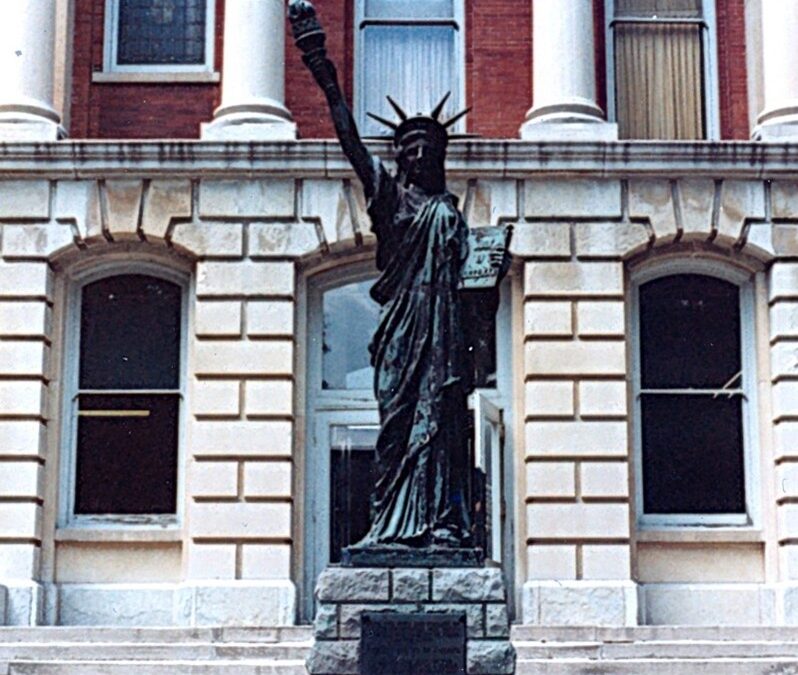
Small Statue of Libery replica in front of the Marshall County Courthouse in Plymouth, IN.
A gift of friendship from the people of France to the United States, the “Statue of Liberty Enlightening the World” was dedicated by President Grover Cleveland on October 28, 1886. It has a fascinating history that is well worth researching. But did you know that Marshall County has a small replica of the Statue of Liberty? It sits on the courthouse lawn in Plymouth, and it has a story as well.
In 1949, to celebrate its fortieth anniversary, the Boy Scouts of American initiated a program entitled, “Strengthening the Arm of Liberty.” Each local scout troop across the country was tasked with raising $300 to $350 to purchase a “Little Sister of Liberty.” The troops donated the replicas, which are eight feet four inches tall and made of copper plating, to their communities for prominent display. Almost 200 of these replicas were installed throughout the country between 1949 and 1952. Other Little Sisters known to exist in Indiana are in Gary, Madison, Peru and South Bend. Most are in front of courthouses, like ours in Plymouth and the one in South Bend.
The statues were mass produced. Plymouth’s Little Sister was shipped by express on February 13, 1951, from the Friedley Voshardt Company in Chicago. The company made stamped architectural sheet metal ornaments of aluminum, bronze, copper, lead and zinc.
The dedication of Plymouth’s Little Sister was, predictably, on July 4, 1951, with about 350 people in attendance. One side of the statue features a plaque with an inscription on it, and it stands on a 15-foot base. The base was not purchased by the Scouts but paid for with contributions.
The dedication ceremony started with the junior high school band marching up Garro Street to Center Street and north to the courthouse. The band played “America.” The colors were presented, and the invocation given. Plymouth’s first scoutmaster, Judge Alvin Marsh, recalled the founding of the local troop on August 19, 1912. Coincidentally, that group met on the corner of the courthouse lawn.
At 10:18 a.m. four Scouts slowly untied the string that held the veil covering the statue and presented it to the county commissioners. (Surely there couldn’t have been much anticipation about what it would look like.)
Governor Henry Schricker was the main speaker. In his speech he mentioned the three references to God in the Constitution and noted that there could be no democracy without religion. He also praised the Boy Scouts of America, declaring the program invaluable in the building of citizenship.
After the governor’s speech, Vance Zartman sang a verse of “America the Beautiful” and a closing prayer was offered.
Scouts participating in the background display stood at parade rest throughout the ceremony. Represented at the ceremony were Plymouth Pack 71 and Troop 6, Argos Troop 55, Bremen Troop 56 and Lakeville Pack and Troop 47.
The text on the marker reads, “With the faith and courage of their forefathers, who made possible the freedom of these United States, the Boy Scouts of America dedicate this copy of the Statue of Liberty as a pledge of everlasting fidelity and loyalty to the crusade to strengthen liberty. 1951.”
Over fifty years passed, and the question arose – what had happened to all the Little Sisters around the country? A national search was undertaken in 2007 to find the Little Sisters of the Statue of Liberty. At that time, about 100 were accounted for, about half of those that were supposed to have been placed. Weather and vandalism had claimed some. Others were stashed in storage. Still others had been sold for scrap.
Local Scout Tim Jeffirs decided to do something about the condition Plymouth’s Little Sister had gotten into. He spearheaded a campaign to clean the miniature statue as part of his Eagle Scout project.
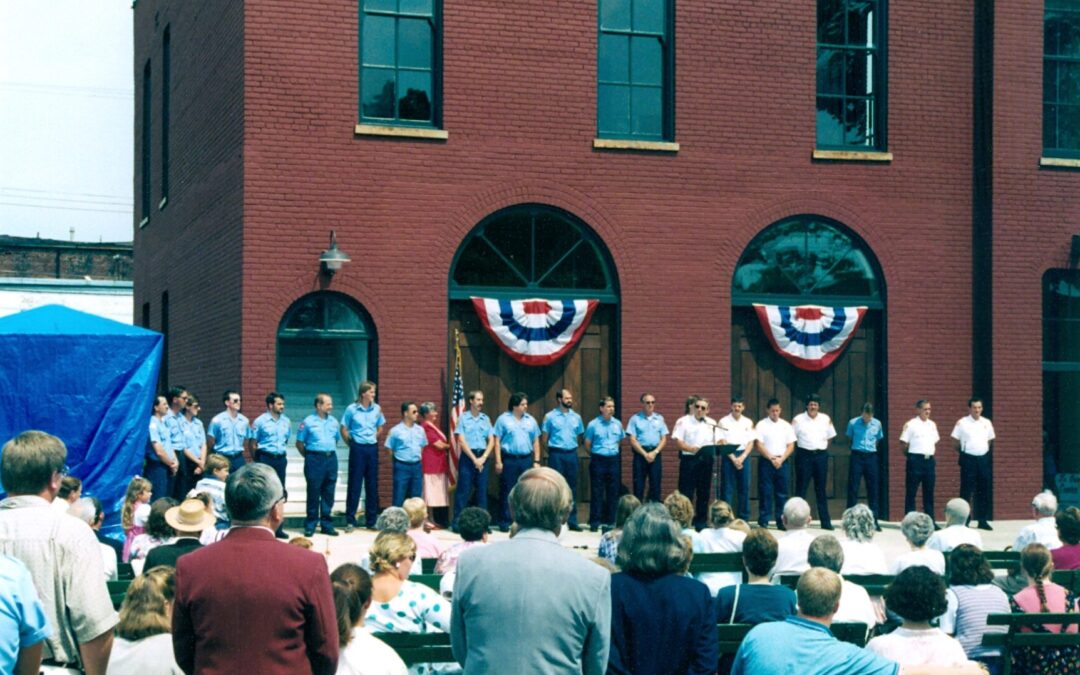
On July 4, 2007, a rededication ceremony for the refurbished Marshall County Statue of Liberty took place. The American Legion Post #27 Color Guard presented arms. Troops 251 and 257 and Pack 222 presented the colors. Abigail Jeffirs sang “On the Banks of the Wabash,” Tim Jeffirs explained his project, and Nathaniel Jeffirs performed the “Star Spangled Banner.” Sounds like quite a family project. Prayer was offered at the beginning and end of the program.
Several years have passed since that rededication ceremony, and the statue is beginning to look a little worse for wear. It is about time for the statue to be spruced up again, and then Marshall County can be proud of her Little Sister once more. Any BSA troops looking for a project?
The Marshall County Historical Society and Museum is located at 123 N. Michigan St., Plymouth. We are open Tuesday through Saturday from 10 until 4. We have an unlimited supply of great stories and pictures in our archives!