Long before the entertainment overload of today, Marshall County youth had some interesting ways of creating their own fun. They did have theaters, but much of the time, they relied on simple things dictated by what was at hand, our location and the weather. The following collection is from oral histories in our archives.
Performing Arts
“The Orpheum Theater cost a nickel. It was on, oh, just a little way north of Washington Street on Michigan, where the old Orpheum was. They’d have Saturday afternoon matinees for a nickel. And there were shows, there were some outside shows, tent shows, down on, in the area where the fire station parking lot is now, on the corner of LaPorte and Center Street, just a block south of the library.” Stanley Brown
The Orpheum Theatre in Plymouth, Indiana.
“About playing piano for the silent movies in Plymouth – When I played, I played for the big sum of $3.00 a week, and six nights a week, 7:00 to 10:00 on the weekdays. On Saturday nights it was seven ‘til 11:00, and it was nickel shows, you know, every night, and we had songs. They used to have sing-a-song, you know, and the words, and the little ball would bounce up. And I’d play for that, and that song came along with the film. We had a girl or boy, a singer, and that was all they done, was sing that song at every show.” Etta Steiner
“We had travelling stage shows quite often. They would come and book a week’s time at the opera house.” Beatrice Pickerl
Seasonal Fun
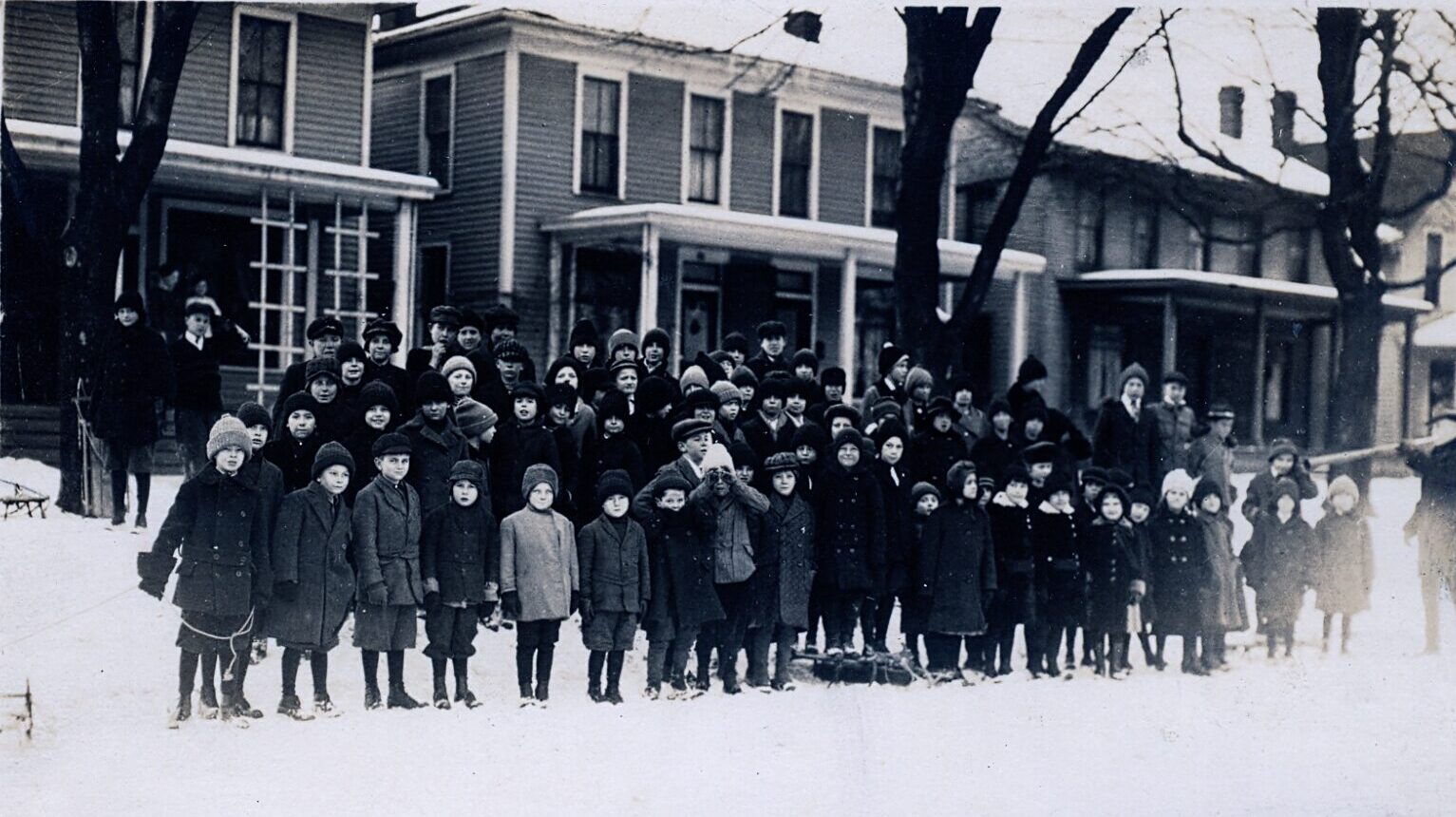
“We had sleigh ride parties and bobsled parties. And on the bobsled parties whenever you went under a streetlight, you got to kiss the girl that you were with. There were not very many streetlights in those days.” Morris Cressner
Sleighing party for city kids, 1916.
“You’d listen the first morning of cold weather, the first snowy, icy morning, see if you could hear Uncle J. T.’s sleigh bells. Uncle J. lived north of town (Argos), probably a mile and a half, might be two miles. And Uncle J. always had his sleigh out first, and he was the only person that the children of the town, that I knew best, could go riding with without running home and asking their parents. But if Uncle J. had his sleigh, we would go with him, and he’d take us a very nice fast ride down to the Nickel Plate Railroad.” Beatrice Pickerl
The Joy In the Everyday
“Used to be a train come in and my brother and different ones would walk over to Tyner to see it come in, and I believe every Friday or Saturday night from South Bend. That was a big thing. It was called the Cannonball. It would come in at 10:00. And the depot was right below our house here. That was their entertainment, was to come and watch the Cannonball.” Ray Jacobson
“They had the old [gas] street lights in Plymouth, and a man had to go around with a long pole and pull them down and light them by hand. He’d put a match to them and put them back up. Kids at night, after they got that light lit – one of our forms of fun was catching bats. There used to be a lot of bats around. They’d fly around those lights. We’d throw our caps up and every once in a while, we’d get a bat in them.” Stanley Brown
Bourbon street scene with gas street light.
Social Get-Togethers
“What progressed into hockey we called shinny. We used sticks and tin cans.” Homer Riddle
“We used to have spelling bees at the school house. And we’d spell, and the old people as well as the young would be in that, don’t you know. They’d all stand up and then when you missed a word, you sit down, and then the last one that stayed up got a prize.” Alta Listenberger
“We used to have box socials. The girls would take a box of food and then they’d auction it off and the boy that bought it, he wouldn’t know whose he’s buying, don’t you know, because they’d decorate these boxes up beautiful. And then the boy that bought them would eat with the girl. He wouldn’t know ‘til he got the box unless she’d tell him or, you know, the girl he liked would tell him which was her box. But otherwise they kept that a secret. Sometimes you’d eat with an old man. I’ve ate with old men, you know, some old farmer, instead of eating with the boy I wanted to eat with because he paid the most for the box.” Alta Listenberger
Learn more about everyday life in Marshall County by visiting our Museum!
Marshall County has the dubious distinction of being the starting point of the Trail of Death in 1838. The Trail of Death was the forced removal of 859 Potawatomi Indians from Indiana to Kansas. The Trail of Death is not the same as the Trail of Tears, which was the removal of the Cherokee Indians in the southeast United States. Both removals took place the same year in response to the passage of the Indian Removal Act of 1830, which provided legal authority to exchangeIndian lands for lands west of the Mississippi River.
A series of three treaties were negotiated with the Potawatomi at the Tippecanoe River on October 26, 1832. Potawatomi land in Illinois, part of Michigan and most of their remaining lands in northwestern and north central Indiana were relinquished to the federal government. In exchange, the bands received small reservation lands for tribal use. This included a joint grant of 22 sections (14,080 acres) of reservation land in the Yellow River area in Marshall County.
The land was given to four Indian chiefs, No-taw-kah, Pep-i-na-wah, Mac-ka-tah-moah, and Menominee. In the spring of 1836, a treaty was negotiated with the first three chiefs for the sale of their land, but Menominee refused to sell. He said the treaty was fraudulent since the reservation land had originally been awarded to all four chiefs.
Before and After Settlements
The land prior to the organization of the county belonged to the Potawatomi Indians. In 1832 there was a Menominee reservation near Twin Lakes. There were also several other reservations in this part of the country. During that year, the government began offering some of the land they had obtained from the Indians. White settlers began coming in and buying these lands. It was not long until these settlers insisted that the Indians be taken out of the county.
Treaties and Negotiations
The Treaty of Yellow River was made on August 5, 1836 and ultimately led to the forced removal of Menominee’s band from Twin Lakes. Under its terms the Potawatomi ceded all the reservation land that was granted to them under the Treaty of Tippecanoeto the federal government. The Potawatomi who signed the Yellow River treaty also agreed to remove west of the Mississippi River within two years. Menominee and 17 of the Yellow River band did not take part in the negotiations and refused to recognize the treaty’s authority over their land.
On February 11, 1837, the signers reconfirmed the Potawatomi land cessions in Indiana from the treaties of August and September of 1836. They agreed to remove to reservation land on the Osage River, southwest of the Missouri River in present-day Kansas. Again, Menominee refused to sign.
When the August 5, 1838 deadline arrived for the removal of Menominee and his band from Indiana, most of the Potawatomi had already left. Menominee’s group still refused to leave their village. On August 6, the day after the deadline for removal, the Potawatomi were told that they had relinquished their land in Indiana under treaties previously signed and ratified by the United States Senate. The Potawatomi were given no option. The land now belonged to the federal government and the Potawatomi had to remove.
Forced Removal
Indiana governor David Wallace authorized General John Tipton to mobilize a local militia of 100 volunteers to forcibly remove the Potawatomi from their reservation lands. On August 29, 1838 General Tipton and his militia surrounded the village at Twin Lakes. A meeting was called at the village chapel, where the militia took Menominee and the other Potawatomi chiefs into custody. Between August 30 and September 3, Tipton and his men gathered the Potawatomi still living on reservation lands and began preparations for their removal from Indiana.
Huts and wigwams were destroyed. Indians were brought to the village from northern Indiana and southern Michigan to be removed. Soldiers burned crops and destroyed approximately 100 structures to discourage the Potawatomi from returning. The last thing they were permitted to do was to visit the graves of their people, a short distance north of the village.
On September 4, 1838, soldiers started moving the entire band south along the Michigan Road and then west.The forced march became known as the Potawatomi Trail of Death, the single largest Indian removal in the state. A few people were placed in wagons and those who had ponies were allowed to ride, but most walked, often hustled along by the soldiers. Menominee’s Yellow River band were among those who were force marched from Twin Lakes to Osawatomie, Kansas. Six chiefs, including Menominee, were treated as prisoners and forced to ride in a wagon under armed guard.
Wigwam replica on display in the Marshall County Museum. It is 3/4 size of a true wigwam.
The Trail of Death
The Trail of Death ran from Marshall County near through Rochester, down the Wabash River, and out of the state south of Covington.
The difficult journey covered 665 miles over 61 days in unseasonably hot weather. The caravan included 286 horses and 26 wagons. Water was scarce along much of the trail. The quality of the food supplied was so poor that the volunteer militia refused to eat it and demanded funds to buy their own rations. Of the 859 who began the journey, 756 Potawatomi survived (including Menominee); 42 were recorded as having died, 28 of them children, and the remainder escaped. The Indians were left on a barren plain west of the Mississippi.
Not all the Potawatomi from Indiana removed to the western United States. Many Potawatomi found ways to remain, primarily those in Michigan. Some remained in the east, while others fled to Michigan, where they became part of the Huron and Pokagon Potawatomi bands. A small group joined an estimated 2,500 Potawatomi in Canada. Others fled to their Odawa neighbors. Anthony Nigo was allowed to stay in Marshall County because his mother was a Miami Indian. By tribal custom a child belonged to his mother’s tribe, and so, even though his father was a Potawatomi, Anthony did not have to go on the Trail of Death. He became known as the “last Indian in Marshall County.” He lived the rest of his life here and is buried in St. Michael’s Cemetery.
New Treaties
In 1861 the Potawatomi of the Woods Mission Band were offered a new treaty which gave them land in Oklahoma. Those who signed the treaty became the Citizen Band Potawatomi because they were given U.S. citizenship. Their headquarters today are in Shawnee, Oklahoma.After the Civil War, the Potawatomi scattered; many moved to other reservations in Kansas and Oklahoma. A reservation for the Prairie Band Potawatomi is located in Mayetta, Kansas.
Historical Marker for Trail of Death.
A Lucky Find
A state historical marker was erected on 12th Road at the intersection of State Road 17. It is located a couple of miles away from Twin Lakes where the Indians were assembled for the Trail of Death march. The marker was erected by the Indiana Historical Society in 1949. The marker is metal, mounted on a metal pole, and reads:
“Trail of Death. Two miles east, on north bank of Twin Lakes, some 800 Potawatomi Indians were collected in August 1838 and forced to begin their long march to new homes in the west. Many perished on the way. 1949.”
In May 1973 it was discovered that the marker had been stolen. The following April it was found in a vacant apartment in Chicago. It was returned through the efforts of Bertha Stalbaum, curator of the Porter County Museum. Her uncle, John Wohlenberg, had found the plaque as he was cleaning the apartment. It was thought that tenants had moved out, leaving behind evidence of some vandalism sprees, including the marker. The marker was returned to its spot and rededicated on September 16, 1974. Both John Wohlenberg and Bertha Stalbaum were present at that rededication ceremony, along with Paul Hamilton, great-great grandson of Chief Leopold Pokagan.
The marker, as well as the statue of Chief Menominee, can be seen today south of Plymouth. To learn more, you can visit the Museum and see our Historic Crossroads Center.
Unveiling monument of Chief Menominee with his granddaughter present.
In 1892, Plymouth was a stop for an “orphan train” that transported thousands of children. They came from the streets of New York and New England to new homes in the Midwest. From 1854-1929, nearly 4,000 orphans, ranging from ages 1 to 12 were brought to Indiana. All together almost 250,000 “little waifs” climbed aboard the orphan trains and headed west in search of a family. They got off the train with name cards pinned to their clothing. Many were orphaned not only by the death of a parent, but because of poverty and neglect, and would have died on the streets. The image above features the New England Home for Little Wanderers of Boston. Rev. H.S. Kimball, an agent of the home, preaches at the M.E. Church in Argos.
Who Took In Travelers from the Orphan Train?
Children from the orphan trains were placed in homes depending on the needs of prospective adoptive parents. Sometimes their own child had died and they were seeking to expand their family. Some older couples needed someone to look after them, or a farm family needed an extra pair of hands to help with the chores. Some of the agricultural families believed the abandoned children should work to “earn their keep.” Sadly, some siblings went to different homes. The orphans were at the mercy of their adoptive families.
Locally, 26 orphans found permanent homes in Marshall County from the New England Orphan’s Home, although the supply didn’t meet the demand for these kids. “The children were the objects of considerable attention,” according to an edition of the June 1892 Plymouth Democrat. The orphans, gathered at the Methodist church in Plymouth, hoped to win the hearts of a new family. The would-be foster parents could specify exactly what they wanted. For instance, a blue-eyed blonde female, or a sturdy red-headed male. Some orphans were luckier than others. Many were placed loving homes with caring families, but others lived a life of hard farm labor. It seemed a bit callous, but “beggars couldn’t be choosers.” Although every situation was unique, adoption was perceived as better than life on the streets.
The Good and the Bad of Adoption
One of the grown-up orphans that made her home in another state, Jesse Martin, said that being an orphan train rider taught her to have more understanding of people’s pain. She never felt like she fit in. She said the children at school would say, “No one cares for you, not even your own mother!” She says she simply became grateful for the kind people along the way.
Not all these little wanderers had such an unhappy experience. Many found good homes and received the best of care. One particular child caught the eye of a new parent that was grieving from the loss of their own. According to an article from the 1990 Herald Banner, (Greenville, Texas) Helen Hale Vaughn said that her mother would become very angry at anyone who referred to her as their “adoptive” daughter. Whenever Helen would come home broken-hearted, her mother would embrace her and say, “You just remember, we chose you, and they were born to their parents, so they had to have ’em!”
The Legacy of the Orphan Train and Its Travelers
Some of the orphans given an opportunity for a new life prospered and flourished in their new environment. Many orphan train children went on to live long productive lives and were able to enjoy their grandchildren, and many times great-grandchildren. They weren’t looking for fame and fortune, but a better life and “to love and be loved!” The orphan train provided a means for these children to have the will to go on and made survivors out of them.
For more specific information on the local impact of the orphan train, visit the Marshall County Museum and enjoy the research done by Christopher Chalko who spent time collecting data, newspaper articles and personal letters of people that actually rode the orphan train. It’s interesting reading material that is a part of our history in Marshall County and across the United States.
Quite often something really interesting surfaces as we go about our preservation and archiving efforts. A paper turned up recently with hand-written remedies (and gardening advice), mixed with a couple of newspaper clippings from 1912. There is also a recipe for apple butter! I have included it, but don’t count on it for a cure for anything but dry toast. Please note that these recipes are written as found.
Cure for pneumonia or lung fever: Chopped onion. Vinegar and graham flour. Put on stove and heat.
Rheumatism cure: Aunt Clara Barlow. Iodide of potassium 15ç worth in ½ pint water. Take 1 tablespoon before meals.
Rheumatism bladder trouble: Fluid extract dandelion ½ oz. Compound Kargon (a commercial prescription) 1 oz. Compound syrup of sarsaparilla 3 oz. Take 1 teaspoon after each meal and at bedtime. “Is all right for I have taken it.”
Yellow jaundice: Go and get south running water and take one egg.
First day dose: Take one part of the white of the egg, beat it up with 3 tablespoons of the water and drink it.
Second day dose: Take another part of the egg white and beat it up with 3 tablespoon of the water and drink.
Third day dose: Take the last part of the egg white and beat it up with 3 tablespoon of the water.
Use the same egg each day. The white is in three parts. And take one part each day. Sure cure. 1912.
To keep bugs from melons and pickles: Take a moth ball and break in two and put in bottle around hill. Or also plant an onion in hill.
To make good apple butter: Boil 30-gallon cider down to 12 or 13 gallons. Put in 16 gallons sliced apples, few at a time, until all in, and then boil 3 or 4 hours down to about 9 or 10 gallons. Add 12 ½ lbs. granulated sugar. Cook until sugar is thoroughly dissolved.
Here is cure for poison ivy that never fails: boil one-half pint of shelled oats in water until the water is real dark. Then wash the poisoned parts with the water. It does the work without any pain. M. L. B., Clark Co., Ind.
Sand and sawdust make a good bed for flowers like the rhododendron, which require an acid soil.
My Coal-Oil Cure-All by S. E. Bandy.
Coal oil (kerosene) is a commodity found in every farm home, yet its many uses and benefits are known only to a few people. I have saved many a fine watermelon patch from destruction by the striped beetle by mixing coal oil and wood ashes – one part coal oil, by measure, to twenty parts ashes – and putting it on the hills around the roots of the melons.
The coal oil must not touch the vines, and one large spoonful to a hill is sufficient. The bugs will depart immediately. It should be repeated after each rain.
A handful of coal oil and salt mixed and dropped into each mole run will cause them to change their location. A peck of lime thoroughly mixed with a gill (one quarter of a pint, or four ounces) of coal oil and spread lightly around the early cabbage plants will prevent the cutworms from destroying them. When it is hoed in later, it seems to act as a fertilizer.
With coal oil I cure scaly leg in chickens by applying it directly with a feather. I also find a mixture of coal and lime used generously around over the chicken house will prevent mites.
We do not recommend trying these remedies at home, but as always, we find that our ancestors were hardy and ingenious people. Our archives are full of the stories of incredible people, and we love to share. Stop by the Museum anytime! Our hours are Tuesday through Saturday from 10 until 4.
The archives here at the Marshall County Historical Society and Museum are full of stories of people living their daily lives, throughout our history. This article, first published in the Marshall County Independent, on February 4, 1898, on page one, shows the interest locals felt in the gold exploration in far-off Alaska. The headline was “Frank Thomas Writes Home,” and we have lightly edited for clarification.
SKAGWAY, ALASKA, January 7, ’98
John W. Thomas, Plymouth IN
Dear Parents,
Well here it is 1898, and I am 3,500 miles from home, my people and friends at Plymouth, though that does not count much in a fast-going age as this. Everything passed off here during the holidays as usual. Just as it did at home perhaps, only that outside appearances here recognize no holidays, or Sunday, all days are alike to this surging throng. Everybody is hurrying hither and thither as if they had lost something and were trying to find it, possibly lost a dog. There are so many dogs here it would be hard to find one unless he had a special mark, and they all have special marks. There are dogs everywhere here, and I never thought that a dog was as useful an animal for drafting as they are. Dogs are worth money here now; a good dog can pull from 100 to 500 pounds on a sled depending on the condition of the roads and the dog of course. They usually work them six in a team single file, and they go on a trot most of the time. They are using all kinds of dogs, but the big long-haired fellows are the best. Except for perhaps the native dog, Friskies as they call them, are the best of all as they can stand more hard knocks and go longer without feed. They look just like gray wolves and are fighting half their time at work or play.
The weather is fine here; there is just a little snow, hardly enough for good sledding, but I see they are using bob sleds instead of wagons. They are now sledding up along the river with small hand sleds and are using the ever indispensable and useful dog, as well as horses to sled over the summit. People are coming in on every boat. There has been a number of boat loads landed here within the last two or three weeks. Three, the Elder, the Seattle and Topeka boats brought over 1,500 people for Skagway and Dyea, and the rush has not commenced either. Two more steamers are now due, and they will be crowded to full capacity. They say that nearly all the boats on the Pacific coast are going to run up here next summer, and a number are coming around Cape Horn and some from Europe. If there are 500,000 people coming to Alaska and the Northwest Territory this next summer. Four out of five will land at Skagway, which is an assured fact according to estimates made here, and if that does not mean a boom for Skagway, then it does for Alaska. There are a number of people coming out from Dawson every few days. I have seen men who I knew on the trail this fall and most of them give very flattering reports about the weather down the lakes and river. They say it is very cold but dry. Not very much wind, especially where they are sheltered by the mountains. They report also that provisions are very scarce and that many more will have to come out of the country before spring. These men came all the way on ice. Some of them have dogs to pull their grub and blankets and have to pull enough to last them out. They all agree that it is a tough proposition and further say that it is an absolute impossibility for anyone to move an outfit down on the ice. As it is all one can do to move as much as it takes to last them while they are coming out. So, I think the best and safest thing anyone can do is to wait until the ice breaks up in April or May and go down in a boat which will be much the quickest and the cheapest. You wrote me that there were a number of people coming from Plymouth and vicinity. I shall be ever so glad to give them all the information concerning the trail and country that I can. Many will go via St. Michaels, that is much the easiest way, but it is much the costliest as well as much the longest. Those who go down by the lakes as soon as the ice breaks up will reach the gold fields fully a month earlier that any steamers can get up from St. Michaels. In the spring it will be comparatively easy to reach the lakes with an outfit from here (Skagway) as the wagon road will be completed to the summit and from there one can sled for 15 miles on Summit Middle and Shallow Lakes and from there to Lake Bennett. There is now no good sled trail.
People are now moving goods over at one tenth the expense that it cost us last fall. To say nothing of the labor and exposure, as well as the risk of life that we were subjected to. No doubt we ought to be whipped for being so crazy and foolish to attempt to cross a trail as this Skagway trail when we went in, but how could we know until we had gone beyond a return limit. I wonder now that men could endure the hardships we were compelled to undergo. Horses died by the thousands from the effects of incessant, chilling rains, exposure and lack of rough forage, as it was impossible to carry hay along. Usually when a horse went down in the mud he had either given out or had a broken leg and had to be shot. It rained about 21 days out of 30 while we were in the Pass. Our outfit consisted of eight horses, about 6,000 pounds provisions, tent, tools and clothing for four men, but now it is different. That amount can be moved over the summit in possibly five days on the wagon road now nearing completion.
But please don’t understand me as advising anybody to come who has not already made arrangements to come. It is all a gamble, with the great majority of people who go in, and anybody intending to come must consider that there are many chances to lose as well as win. They will have to take even chances with possibly 500,000 people who will go down the Yukon either ahead or to follow after, all in the next spring and summer.
Father, I wrote the foregoing thinking you might want to publish a little. I did not want to write much to the papers concerning this country, nothing flattering in the least. I don’t want to influence anyone who would not come otherwise. It will be a lottery with everybody, especially the tender foot with small or insufficient means who have many more chances to lose than to win.
I am sure there will be plenty of work here in Skagway this summer, wages depending entirely on the amount of laborers coming in. Common labor $1.50 and board, skilled labor $4 and $5. Now don’t have any fears, Mother, about robbers and foot-pads (robbers in foot) bothering here; they have to lay low and nearly everybody carries a revolver, and grafters are afraid to act. As long as I have been in the country, I have never seen a quarrel or a fight. Well, goodbye from your loving son, Frank L. Thomas.
Money was hard to come by in 1924 when Fred and Etta Jane (Berkeypile) Brugh were raising their young family in a remodeled log cabin two blocks northwest of the Marshall County Courthouse in Plymouth. He worked for the Pennsylvania Railroad, then the Plymouth Radio Company, while she cared for their four daughters. Frugality necessitated handmade then hand-me-down clothes for Myrtle, Goldie, Hazel and baby Helen.
Fortunately, Etta Jane was a skilled seamstress who could sew, knit, crochet and tat—the nearly lost art of making delicate lace from thread. She even saved the cloth bags flour came in, dyed the rough material and transformed the bags into tiny dresses decorated with embroidery.
Three-year-old Hazel wore a brown sack-cloth dress that miraculously has survived for nearly a century, and now fits her great-great-granddaughter and namesake, Hazel Jane Seltenright of Plymouth. She was photographed wearing the dress on August 12th before it was donated to the Marshall County Historical Society and Museum with a vintage basket of wooden blocks.
Two little girls named Hazel wearing the same dress nearly a century apart are a wonderful testament to Etta Jane’s handiwork. Amazingly, the 98-year-old brown flour sack cloth dress stitched together with love by Hazel’s great-great-great-grandmother doesn’t even look old.
This sweet dress is a wonderful addition to our clothing collection. The tiny hand stitching and embroidery tell the story of a mother’s love for her children, and her determination to be resourceful during difficult times. These are the types of stories we record at the Marshall County Historical Society and Museum. In time, we’ll be telling today’s stories too. Come in soon and enjoy the history of this special place.
Mary Ann (Travis) Wyand Garber is Hazel Brugh’s daughter. She grew up in Plymouth, worked for The Pilot-News in the mid-1970s and now lives in Lebanon.