Dredging the Yellow River

Dredging the Yellow River

In 1909, Supreme Court of Indiana had ruled in favor of the farmers and cleared the way for the Yellow river to be dredged. This article has been edited from the Plymouth Tribune, December 8, 1910.

Working Around the Clock

Progress on the work of dredging the Yellow river is being completed much faster than was anticipated, either by those who let the contract for the work, or by those who are executing the task. Slightly over one lineal mile of the river’s bed has already been completely dredged since the start of the work on November 9th. Approximately 41,300 cubic yards of earth have been taken from the bed of the river within this mile. An average excavation of seven feet in depth is made in the river’s bottom, extending to a width of fifty-five feet at the bottom. The dredge is located at a point slightly over seven miles east of Plymouth and at the rate of progress now being made, County Surveyor Percy J. Troyer estimates that the dredge will reach the city within eight months and will complete the entire route in fifteen months.

The fire under the boiler of the great dredge is never allowed to go out, and in order to cheat winter and the coming freeze of the river as much as possible, the large crane and bucket are never still. Day and night without pause the dredge and its gang is at work. The outfit has its own electrical plant that illuminates the surroundings sufficiently to carry on the work at night. A gang of twelve men is employed, six on each shift, working twelve hours each. The dredge is in charge of W. A. Schultz of Milwaukee, a member of the dredging firm that has the contract to widen, deepen and straighten the Yellow river for eleven miles of its course, from the point eight miles upstream to three miles below Plymouth. 

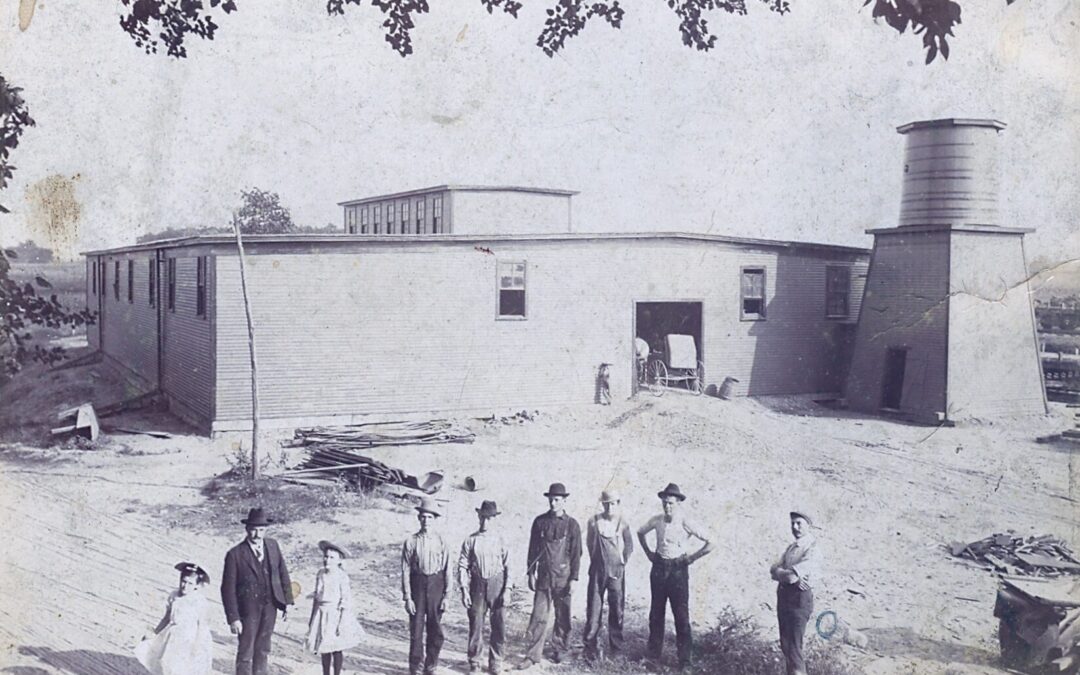
The Mill Dam in Plymouth prior to dredging the Yellow River and removing the dam, ca 1912

The Mechanism Behind Dredging a River

The first change in the course of the river will begin later part of this week. This cut is known as the Nunemaker Cut and will consist of diverting the course of the stream across the ends of a “U” shaped bend. Instead of flowing around the bend, the river will be made to cut across the ends. As a result, all of the land enclosed in the bend, besides the old bed of the river itself, will be reclaimed for farming proposes, as the old bed will be drained by the deeper bed in the new course. The Nunemaker Cut will consist of a lineal cut of 1200 feet, and will necessitate an enormous excavation of earth, as the new riverbed will be laid seven feet lower than the present bed, and as stated above, will be fifty-five feet wide at the bottom. It is estimated that this cut will require somewhat over two weeks. There are two or three more such cuts to be made in the course of the Yellow River dredge.

A wonderful sight might have been witnessed at the work site on Thanksgiving Day, when a feat of engineering skill was executed by the dredge. The sixty-five-foot steel bridge, weighing 12 tons, which spanned the river at that point, was lifted from its abutments, swung around, and deposited upon the bank of the river. The scene of the steel bridge in midair with several workmen standing on the structure to preserve its balance was a novel one, and served to show the power, size and effectiveness of the great dredge. The bridge was bound to the beam of the dredge by steel cables, men were stationed along the floor of the bridge and at the word, the beam was raised. The bridge had to be removed in order to let the dredge pass down the river. After the river had been widened to the required dimensions at this point, the dredge was found to be too short to span the river and the steel structure is still reposing on the bank of the river, seven miles east of town. This bridge is a familiar sight to the boys of the city, many of whom have boasted of skating up to the seven-mile bridge.

Missing Pieces

Of course, we now want to know when and how the bridge was replaced on its abutments, and did it have to be lengthened? Unfortunately, our records do not provide those answers, nor is there any further mention of the bridge sitting beside the river.

Fatal 1911 Accident at Tippecanoe

Fatal 1911 Accident at Tippecanoe

We have quoted verbatim from the Argos Reflector newspaper of November 9th, so please excuse the fact that reporters of that era did not miss the opportunity to create great drama when writing the news.

“Last Thursday evening the people of our neighboring community of Tippecanoe, seven miles east of here, were shocked to learn of a distressing accident that happened at the crossing of the Nickel Plate tracks near the depot. Daniel Fawley, a farmer living east of Tippecanoe, was struck by the westbound passenger train and his lifeless body was hurled against Agent Elliott with a violence that resulted in the latter’s death Sunday evening. It seems that Mr. Fawley, having alighted from the eastbound passenger train that arrives there about six o’clock, started to cross the main track to go uptown. Now, the fatal defect in the railroad company’s system of taking on and leaving off passengers at this place is that the eastbound train takes the siding which compels passengers to board from and alight upon the main track. This brazen disregard for the safety of human life is much emphasized by the fact that the westbound passenger train is due to pass here at the same time. When Mr. Fawley started across the tracks, unconscious of the approach of the train from the east, he heard a warning cry from W.C. Elliott, the veteran agent at this station. Just as he turned his head the locomotive struck him with the results above mentioned. The body of Mr. Fawley was badly mangled, being hurled 25 feet or more and death was practically instantaneous.

W.C. Elliott had been in the service of the Nickel Plate as agent for nearly 30 years, or since the completion of the road, and had come to be regarded as a landmark of the place and had won the respect and regard of all who knew him. His life hung in the balance of uncertainty til Sunday evening when the soul of this faithful servant left its earthly tenement. Mr. Fawley lived alone on his farm. He leaves one child, Mrs. Clyde Stockberger. Mr. Elliott was about 70, a soldier of the civil war and a Mason. His body was taken to Indianapolis for burial. In the unequal struggle between Duty and Dividends the latter has scored another point. But it shall not ever be thus. The awakening conscience of the people will assert itself and such death traps as this one will be relegated to the junk pile of oblivion.”

To learn more about trains in Marshall County, visit our museum from 10 a.m. to 4 p.m. Tuesdays through Saturdays. To see our model trains run, visit our train room from 11 a.m. to 1 p.m. on Saturdays!


Ghosts: How They Live, Move, and Have Their Being

Ghosts: How They Live, Move, and Have Their Being

Excerpted from the 1881 History of Marshall County

By Daniel McDonald

By modern standards, early Marshall County Historian Daniel McDonald (1833-1916) was a man of contradictions. A believer in Spiritualism with a deep confidence in seances, he didn’t have any patience with those who believed in “witches, goblins, ghosts and haunted houses.” The following article appears in his 1881 History of Marshall County. Although he doesn’t explicitly say so until later in the article, he definitely gives the impression that he thinks the whole thing is ridiculous. It is lightly edited for length and clarity.

“Many of the “newcomers” of the early days brought with them stories of witches, goblins, ghosts and haunted houses, and believed that supernatural spooks were accustomed to roam abroad at the bewitching hour of night when graveyards are supposed to yawn. That there are plenty of ghosts, in the minds of many, does not admit of a doubt. Hundreds of people have seen them and are able to describe them even to the texture of their hair and the color of their eyes.

“None of these supernatural beings, however, have ever been seen in the daytime. They invariably cavort around at night and are generally found by timid people along some lonely path in the woods, in a graveyard or in some deserted house or barn where some awful tragedy was supposed to have occurred. These spooks have never been known to cause anyone bodily injury. In fact, no one has ever approached near enough to lay violent hands upon them, had they felt so inclined. Upon first sight of a ghost, one’s hair is inclined to stand erect on his cranium, and his courage oozes out of the ends of his fingers. His natural inclination is to get out of the way as rapidly as the nature of the case will admit and allow these midnight disturbers of late travelers to have things all their own way.

“Ghosts are not all alike by any means. In fact, no two have ever been seen whose description is the same. They are almost invariably enrobed in a white sheet and float around buildings, glide along roads and vanish away without any perceptible effort, and dissolve into thin air in the most unaccountable sort of way. Some of them ride great white horses, carrying immense flashing swords, and out of their mouths streams of fire and smoke have been seen to issue like the belching forth of a miniature volcano. Sometimes they ride through the air on great chariots, and sometimes they fly about with wings like sprites from Fairy Land. They never talk – that is – hardly ever. Sometimes low, guttural sounds have been heard to issue from where ghosts were supposed to be, but on examination and full investigation, no definite conclusion could be reached.

“So far as is known, ghosts live entirely without eating, at least they have never been known to eat anything. They don’t use tobacco either; at any rate they have never been seen smoking a pipe or cigar. They are presumed to not wear clothes, but they usually have modesty enough about them to cover their nudity with a clean white sheet. Just exactly what they are, and what in the name of the Old Nick they prowl around for, no one, however well posted in ghostology, has ever yet been able to tell.

“People who believe in ghosts, however, assert that they are the departed spirits of dead persons who had committed some awful crime while living. In some of the places where ghosts are supposed to hover about, it has been conjectured that vast treasure might have been stolen and buried, and these ghosts are the guardian angels, so to speak, sent to protect the valuables from being discovered and carried away.

“Of course, all this ghost business, in this enlightened day and age, is the merest nonsense, and no one endowed with a grain of common sense believes there is such a thing as a ghost, or that the spirits of dead men ever return to this mundane sphere after they have “shuffled off this mortal coil.”

“All of the preceding has been written simply for the purpose of enabling the writer to speak of a building that is said to have been, in days gone by, a favorite resort for all sorts of spooks and goblins and ghosts, albeit it has long since ceased to attract attention as having been haunted.

“On the place then owned by Charles Ousterhaut, one mile south of Plymouth (just south of Oakhill Cemetery), some thirty and five years ago, there was a barn in which, according to tradition, a man hanged himself with a rope fastened to one of the rafters. Whether this story is true or not cannot be definitely stated, owing to the lack of reliable data. But that is neither here nor there for the present purpose. The story got abroad that the ghost of the dead man had taken up its abode in and about the barn, and numerous passers that way late of nights averred in the most positive manner that the place was haunted, and that his ghost or some unknown apparition answering the same purpose, had been frequently seen flitting around the corners, peeping over the comb of the building, and cutting up all sorts of ghostly didos (mischievous tricks or pranks).

“Many were the stories that timid men and boys told of the remarkable sights that they had there seen with their own eyes, and for many years almost everyone passing that way looked upon the building and surroundings with “fear and trembling.”

“Of course, there were no ghosts there, but the disordered imagination of timid men, women and children, based on the story of a man who had met an untimely end there, was sufficient to produce any quantity of unearthly creatures, and so it took the name of the ‘haunted barn.’”

Marshall County history is full of the tales of the supernatural. We’re open Tuesday – Saturday 10 a.m. to 4 p.m. to find other spine-tingling stories from the past.

Spooky Marshall County

Spooky Marshall County

The following tales are just a taste of spooky Marshall County. Most of the stories are told as they were written long, long ago.


“The neighborhood two miles east of Lapaz is all stirred up over a ghost story, which is vouched for by a number of persons to be fact. Millian Crum and Nathan Crothers were passing the U.B. church in the Berger vicinity several nights ago, and a figure in a white shroud appeared in front of the church and waved its arms. The movement of the white object also frightened their horse, which ran some distance before the animal could be stopped. Charles Charleston who passed the church at an early hour in the morning also claims to have seen a ghost. The story has caused no little talk in the neighborhood. Samuel Thomas who is not afraid of ‘fire or brimstone’ proposes to investigate the affair and will visit the place with a party of men on Saturday night. Mr. Thomas is of the opinion it is a joke being played by some boys to create a sensation and will make an effort to capture the ghost.” From The Bremen Enquirer, May 11th, 1900.

The Higbee Corner Tavern maintained a good reputation. No doubt there was drinking there, and many intoxicated travelers stopped there, but that did not make a place tough in those days. However, the Thompson Tavern did not have a good reputation and was deserted by the time the Higbee Tavern became popular. It was then known as the “Haunted House.” The story is told that when this old tavern was deserted, cattle and pigs used to roam at will in and out of the open doors.  One stormy night the pigs had taken refuge in the old building. Two men were passing there that night, and the one who was the least drunk dared the other one to go into the “Haunted House.” With much bravado, increased by the stimulant which they had had, they reeled in through the open door and stumbled over the pigs. The disturbed pigs made so much noise that the intruders started to run, to get away from the “ghosts,” and never stopped until they reached the Higbee Tavern. Written in 1940 in a memoir by Francis Emerson.

The September 1, 1910, issue of The Plymouth Democrat reported that Henry Kelver had a “thrilling experience” on Dixon Lake. He was in the middle of the lake when he saw a dark looking object in the distance approaching his boat. “The water parted into waves on either side of the object as it came nearer…its head looked like that of a big black dog and its eyes snapped ferociously. Just below the blue water of the surface was a big black form, about the size of a wheelbarrow and there seemingly were a hundred pairs of legs wiggling and paddling beneath it. Within two or three rods of the boat the monster turned, dove and disappeared.”

“A terrible murder was committed two miles south of this place on Sunday night last. The circumstances that led to the horrible deed were about as follows: About 4 o’clock Sunday afternoon two men, aged about 30 years, called at the house of Mr. Mikel Hisey and requested to stay until after the rain, which was falling. After sitting in the house about an hour they started to leave. One of the men was of medium size and tolerably well dressed, and the other larger and very rugged. Mr. Hisey thought no more about them until in the morning in passing an old house used for a stable, he heard someone groaning, and going in and up on the loft, where he had some hay, he found the better dressed man with three gashes cut in his head through the skull, and the brains oozing out. The man had been stripped of pants and coat and left with nothing on but shirt, vest, and boots. The boots were both made for one foot. The instrument used to accomplish the deed was a cutter from a shovel plow. Medical aid was summoned, but nothing could be done for the man. He was beyond help, and, of course, could not speak to tell of the deed. He died during the day; nothing being left by which he could be identified. His companion no doubt had done the deed. It is supposed the murderer took the train at Argos, going south, as a man answering the description, with black pants too short by several inches, was seen getting on the train in the morning. Mr. Hisey thinks they were carrying a small bundle when at his house.  All possible steps are being taken to secure the arrest of the murderer.” From the October 2, 1873, Plymouth Democrat.


Accomplishments of WPA in Marshall County

Accomplishments of WPA in Marshall County

In our U.S. history classes most of us gained a passing acquaintance with President Franklin Delano Roosevelt and his Works Progress Administration program that helped Depression-era workers get back to earning a paycheck. The projects were wide ranging geographically as well as in type. Everything from buildings to bridges were constructed or improved. WPA workers built roads, dams and hatcheries, just to name a few. Below is an article published in the June 5, 1940, edition of the Culver Citizen about the impact the WPA had on Marshall County. It has been lightly edited to improve readability.

The Works Progress Administration constructed eight new buildings, reconstructed or improved five others and paved or improved 78.5 miles of highways, roads and streets, according to a survey released today by John K. Jennings, state administrator. Jennings said the survey was the first all-inclusive one to be made of WPA accomplishments in Marshall County. It includes all major projects since the start of the work-relief agency in August 1935. The survey said that a total of 729 Marshall County men and women who lost their jobs in private industry have been given WPA work-relief at one time or another.

Almost all the WPA roadwork centered on improving farm-to-market roads, of which 71.8 miles were bettered. In city street and alley work, the WPA improved a total of 4.1 miles. Of that, it laid new paving on 2.3 miles.

The WPA constructed a new warehouse for the Plymouth City Hall, a bathhouse at Culver, a hatchery clubhouse (Isaac Walton Leaugue), a barn at Magnetic Park in Plymouth and one other building at the same park (Conservation Clubhouse). In reconstruction and improvement work, the WPA bettered the Marshall County Courthouse, highway garage, jail and infirmary (Shady Rest Home). It improved the school at Inwood, Lincoln High School Athletic Field, Culver Park, Bremen Cemetery, and Huff Cemetery in German Township.

Isaac Walton League Clubhouse in Argos, IN.


In miscellaneous construction work, WPA employees built a dam at Plymouth having a storage of 300 acre-feet, the Magnetic Park fish hatchery which now has a capacity of 10,000 fingerlings, and the Argos Fish Hatchery with a capacity of 375,000 fingerlings annually. Magnetic Park, 17 acres, and Centennial Park, 35-acres, both in Plymouth, also received improvements.

Throughout Marshall County, WPA workers reconstructed or improved 26 steel bridges measuring 2,356 feet, improved 352 miles of roadside drainage, paved 4.8 miles of sidewalks and paths, laid 7.7 miles of curbs and seven-tenths of a mile of gutters.

In the utilities and sanitation field, the WPA laid 2.2 miles of water mains, aqueducts, and distribution lines, installed 5.8 miles of storm and sanitary sewers, made 19 sewerage connections and dug 221 manholes and catch basins. Nearly 1,200 sanitary privies were erected by the WPA. (These privies had concrete slabs and vaults and were considered more sanitary. They were nicknamed “Eleanors” due to Eleanor Roosevelt’s support for the program.)

More than 2,300 feet of retaining walls and revetments were constructed. One new airplane landing field was built on which runways totaling 5,280 feet were laid. In the professional and service division, WPA workers renovated 2,232 books, turned out 15,183 garments from sewing projects, and completed 5,490 items other than garments such as mattresses, quilts, etc. The sewing products were given to the needy.

The impact of the Works Progress Administration on Marshall County and its residents can hardly be overstated. If you want to know more about the WPA in Marshall County, come into the Marshall County Historical Society. Our research specialists will be happy to help! We are open from 10 a.m. to 4 p.m. Tuesday through Saturday.