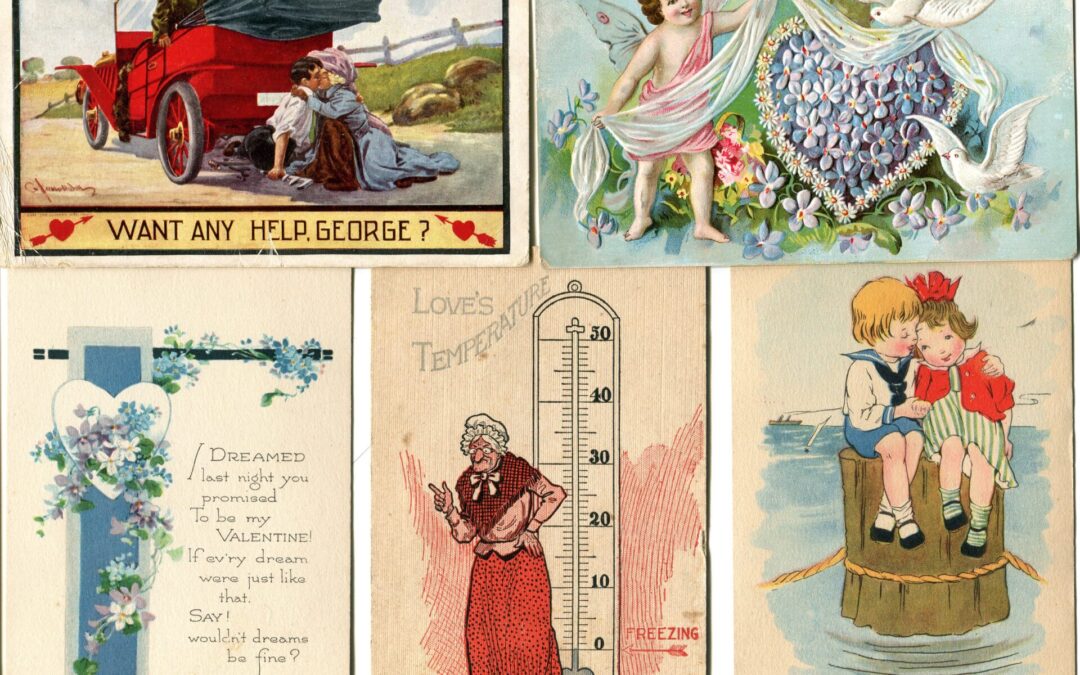
History of Christmas Cards

History of Christmas Cards

The very first Christmas card was printed in Victorian England in 1843. Sir Henry Cole, who is known for founding the Victoria and Albert Museum in London, had a problem. It was customary at the time to send letters at Christmas to all one’s friends. Because it was considered impolite not to answer a letter, someone with a lot of friends could have a correspondence crisis every December. Sir Cole approached an artist friend, J.C. Horsley, and asked him to sketch out an idea he had in his mind to solve his problem.

Cole took Horsley’s illustration and had 1,000 copies made by a London printer. The image was printed on a piece of stiff cardboard, 5-1/8” X 3-1/4” in size. He included “TO:_____,” allowing Cole to personalize his responses. The card said “A Merry Christmas and A Happy New Year To You,” and showed a family celebrating a holiday meal, flanked by two images of people helping those in need. It was the first Christmas card. Eventually, several in Cole’s circle recognized the value of his creation and started sending their own cards at Christmas.

First American Christmas Card

Louis Prang, a Prussian immigrant with a print shop near Boston, is credited with printing the first American Christmas Card in 1875. Unlike Cole and Horsley’s holiday inspired design, the first card had a picture of a flower with the greeting “Merry Christmas.” First-generation American card designs were mostly drawn from nature. Animals, flowers, and landscapes were common.

In the late 1800s, collecting Christmas cards became so popular that the new crop each season were reviewed in the newspaper, much like a film today. And of course, they became more creative and elaborate.

Modern Christmas Cards

The modern Christmas card industry began in 1915 when a Kansas City-based postcard printer named Joyce Hall published his first holiday card. Hall, later joined by his brothers Rollie and William, founded the Hall Brothers Company. Ten years later, the company changed its name to Hallmark. They set the industry standard of cheerful sentiments and holiday-inspired images on a booklet style card of 4” X 6,” which was then inserted in an envelope.

This new-style card became enormously popular from the 1930 to the 1950s. As demand for cards grew, Hallmark and its competitors reached out for new ideas to sell them. Commissioning famous artists to design them was one way. Salvador Dali, Grandma Moses and Norman Rockwell all designed Christmas cards for Hallmark.

Stamps & Other Designs

The U.S. Post Office printed their first dedicated Christmas stamp in 1962. It featured a wreath, 2 candles and the words “Christmas, 1962.” They ordered the printing of 350 million of the 4-cent, green and white stamps. They had wildly miscalculated the demand and had to reprint. Unfortunately, they did not have more of the original size paper for a 100-stamp sheet, so the remainder were printed on sheets of 90. Eventually, a total of one billion 1962 Christmas stamps were printed and distributed by the end of the year.

Today, more innovative designs and concepts are coming from niche publishers. As the digital age has exploded, greetings come in many forms like audio and video, as well as on paper. As always though, it is big business!

We have a wonderful selection of Christmas and holiday cards at the MCHS Museum. Stop in soon!

Thanksgiving in World War II

Thanksgiving in World War II

After celebrating Veteran’s Day, and as we get ready to celebrate Thanksgiving, it’s a good time to look back to wartime holiday celebrations, particularly during World War II. So many of the things we take for granted were adversely affected by Word War II, even the emotions of Americans. In 1944, Thanksgiving headlines were “50,000 Nazis Trapped on Rhine” and “Germans Fire Rocket Bombs at U.S. Army.”

Not all Americans celebrated Thanksgiving on the same day either. In 1941, federal legislation changed the date from the fourth Thursday of November to the third, but a few states were still celebrating on the later date.  Favorite holiday traditions were suspended during the war. The famous Macy’s Thanksgiving Parade had not been held since 1941, as the company donated the rubber used in their balloons to the war effort. The Detroit Lions, who had hosted an annual Thanksgiving game since 1934, put this tradition on hold from 1939-1944.

Kindness & Gratitude During Thanksgiving

Many hospitable families filled empty spaces at their own Thanksgiving tables with servicemen and women stationed nearby. Because of the ongoing war effort, many people were employed in defense- related industries. Production never stopped, so families had to schedule family time around shift schedules. Travel was difficult because of gas and tire rationing. Americans were encouraged to leave empty bus or train seats available for servicemen and women on furlough.

The war directly influenced food choices, again due to rationing. Imported foods like coffee and sugar, foods that needed to be shipped long distance, processed foods like cheese, butter, margarine and canned fruit were rationed. By 1944, there was great reason to be thankful though, because red meat was available again.

Planning Ahead During WWII

Rationing required a lot of advance planning. People saved rations for the big day! Newspapers published rationing calendars that listed which rationing stamps could be used and when for what products. Cooks could save their stamps to purchase food when available. Families that kept Victory Gardens generally had canned and preserved food to serve.

Newspapers also published articles about the local availability of items for Thanksgiving during World War II. The adverse effect of gas rationing affected trucking, with government demand for turkeys for troops, made even this dinner centerpiece unavailable in many areas. There was a black market for rationed or rare items if one wanted something bad enough. By 1944, lard, shortening, processed foods and coffee were no longer rationed in the U.S.

Rations Ad in World War II

Rations ad during World War II.

Even with hardships, people were generally willing to sacrifice for the war effort, but by 1944, the end of World War II could not come fast enough!

Hunting Tales

Hunting Tales

With the annual hunting season in full swing, it’s time to look at hunting tales from long ago from the archives at the Marshall County Historical Society. Documents tell us: “The tradition of the last bear that was shot in Marshall County, comes from the lips of John Thomas, who is as familiar with the unwritten history hereabouts for the last 40 years as a draft horse is with the four corners of his feed box.” said John Thomas.

“In the winter of 1865,” says Thomas, “a number of bears wandered down from the woods of Wisconsin and terrified cattle and farmers throughout Northern Indiana.  This particular bear was a huge black fellow and had been seen in various parts of the county before he met his doom.  I had just come home from town when the women folks ran to meet me and said they had seen the much-dreaded animal run across a field.  I rushed to the house but found the hired man had taken the gun before me and started in pursuit.  Going to the neighbors, I borrowed another gun, mounted my horse and galloped away on the trail.  When I came up to the Whaley place on the Wolf Creek Road, I found the two boys in a very excited mood.  They had just shot the bear.  They told me that their father had gone to town, and they had been left at home to feed the pigs.  Suddenly one of the yelled, ‘See that pig on the fence!’  The other one looked.  Sure enough there was a pig on the fence.  But a pig on the fence was absurd.  When they took a better look, they saw the supposed pig was a bear.  A gun was brought from the house and inside of two minutes the big brute lay dead upon the ground.  Many hunters arrived in time to help gloat over the victory.  The hide was sold to Jepeth Disher, who paid $8 for it.  It was afterward worked up into a fine robe.” Plymouth Democrat – July 31, 1902

“The latest diversion of Bourbon men of affairs is that of racoon hunting.  The town, that is the sporting part, is now in the throes of a revival of the art of hunting the animals, that in the early days was a favorite pastime.  Whether it is a case of heredity, just now cropping out of the fourth generation, we have no means of knowing, but there is one thing certain, the craze has hit the town hard.  As far as we have been able to learn Jonas Rettinger is the only one who has, in the years past, kept up the sport enough to not forget its requirements.  Later Samuel Lemlar, Phillip Steinman and Arch Myers formed a company (limited) and purchased a hound after they had sold the one Sam had owned to Rettinger.  Lemler then purchased another hound and his deep sonorous voice had been sending cold chills up and down Mr. Racoon’s spine with painful regularity.  When Harl Stewart got the fever, he purchased another dog, and the old days of gentlemen following the hounds is returning.  Lemler, Myers & Steinman gave a racoon feast at the Vernette & Fretz restaurant Wednesday evening, and the smacking of lips told the tale, as their friends passed in and out.  Harl Stewart and Otis Thacker went Friday night and so far, hold the palm of good catches.  They secured three large, fat young racoons and a skunk.  And the beauty of the whole thing is that the skunk wasn’t quick enough to use his defense.” Bourbon News-Mirror – November 28, 1907

The Town of Donaldson

The Town of Donaldson

This article was published on November 30, 1911, in the Weekly Republican newspaper. It’s interesting to get a look at the Town of Donaldson, back when it was a truly bustling community. Note that the location is described according to which railroad the town was adjacent to, as opposed to roads. I have edited very lightly for readability.

“One of the interesting centers of Marshall County is the town of Donaldson, eight miles west of Plymouth on the Pennsylvania railway. This is an energetic little town and a good business center. The two institutions which make the place of more than ordinary interest, and more than an ordinary trading point, is the presence of Schlosser Bros. creamery station and of the Heinz salting plant. These two industries bring a large amount of money into the community every year. Milk, pickles and onions are the special crops which make Donaldson a prosperous center. By far the most important of these is the creamery. Its steady stream of money in return for the steady stream of milk and cream furnishes the big part of the “life blood” of the business. Onion and pickle raising are good sources of income also, but their returns come in bunches in the fall.

This goodly community has two good general stores, a blacksmith shop, meat market, a post office with a rural route, a railway station, hotel and livery, telephone exchange, United Brethren church and multi-graded schools. Donaldson needs a good physician. A large amount of veal, chickens and turkeys are shipped annually from Donaldson to Chicago. It is no uncommon sight to see two trucks full ready for shipment. It is estimated that about 500 dressed veal are shipped from here annually.

From 12 to 14 carloads of onions are shipped from Donaldson each fall, and this industry is increasing, as there is much land in this vicinity adapted to that kind of crop. The largest onion growers here are Nils Pearson, Lewis Seibert and Victor Newburg.

The largest pickle growers are Victor Newburg, who from 2 1/2 acres this year received $523.34: John Lavine, who got $195.01 from 1 1/2 acres; Andrew Bergstedt, who got $173.81 from l 1/4 acre and John Anderson, who received $126.98 from one acre.

Donaldson may congratulate itself that it has a very fine blacksmith shop. Mr. C. T. Danielson erected last summer a new building, 24 feet X 50 feet, and it is well equipped for the trade. It has a cement and wood floor combined. He learned his trade thoroughly when he learned it many years ago, and one will get here only the best of work. He makes a specialty of horseshoeing and knows that work in all its details. He is also equipped for and does all kinds of wagon work. Owing to the excellent character of his work, he draws trade from far to the north, from the south and from miles into Starke County.

In 1905 Mr. J. D. Garrison erected a splendid and well-equipped storeroom about a block north of the railway and opened a first-class general store. Here in neat arrangement, one may find those wares in the line of groceries, dry goods, clothing, rubbers and shoes, hardware, tinware, flour, horse blankets and saddlery goods, school supplies, etc., etc., which are the necessities of a country community. On entering this store, one is impressed with its cleanliness and neatness, and with the unusually large stock of all goods carried for the benefit of the community. Mr. Garrison is a careful and accommodating businessman and has built up a large and lucrative business which is still growing at a rate pleasing to the owner.

  1. J. Burgener has conducted a general store at Donaldson for 23 years and there is no one within a radius of miles who does not know him and his store. This wide acquaintance, coupled with fair dealing with all customers, has made his a large and constant business. About two years ago Mr. Burgener decided to move to Chicago, and in order to continue the business in the same good way he associated with him Mr. Albert Baum, a well-known young man of the community who has since been in active charge of the store. Mr. Baum is also acting agent for the Adams Express Co. and looks after the large express business connected with this trade center.

Mr. Burgener is also president of the Donaldson telephone company and was with others instrumental in forming this valuable local system, which not only gives the community good local service but allows them to reach without extra charge all the patrons of the Winona Telephone company in Plymouth. Mr. Hayes Munn is secretary of the company, E. R. Day treasurer, and F. H. Bollinger a director.”

The MCHS archives contain microfilm of all of the county newspapers. If you need to research a place or an event, we have the information and the way to read it efficiently. Stop by between 10:00 and 4:00 from Tuesday through Saturday at 123 N. Michigan St. and let us help you research your favorite topic! Call us at 574-936-2306.

Introducing the Balcony Building

Introducing the Balcony Building

Some of the buildings in Marshall County’s cities and towns have quite an interesting history. They have changed ownership, of course, but some have even changed size and shape! A good example we have covered previously is the REES Theatre. It went from a three-story, three-bay Italianate structure to a two-story, two-bay Art Deco one.

The subject of this article is the “Balcony Building” at 113-115 N. Michigan Street, now the home of Aldridge Diagnostic Medicine and the Wild Rose Moon. Since it was built in 1866, it has undergone some pretty drastic transformations.

This Italianate building was built with three floors, two store front bays and an iron balcony between the second and third floors. Thus, it became known as the “Balcony Building.” Ironically, it lost its balcony sometime during its early lifetime but held on to the moniker for a good many years.

First Occupants of the Balcony Building

Apparently, the north store front bay was first occupied by Freese & Behrens, a dry goods and notions store, with a grocery on the south side. The second floor housed business offices, a millinery (hat-making) shop and perhaps even a living quarters. The third floor housed Balcony Hall, a performance venue with a stage. The building was constructed according to the latest city ordinances requiring brick fire walls and the most modern lighting and heating systems, enacted after a catastrophic downtown fire destroyed most of the remaining wooden frame buildings earlier that year.

When Simon Becker, a subsequent long-term tenant, left for Argos in 1878 the building changed hands several more times, housing a “dry goods and fancy goods” store, a drug store, and a grocery store on the north side, and Bunnell & Son Furniture & Undertaking on the south.

Political Address Outside

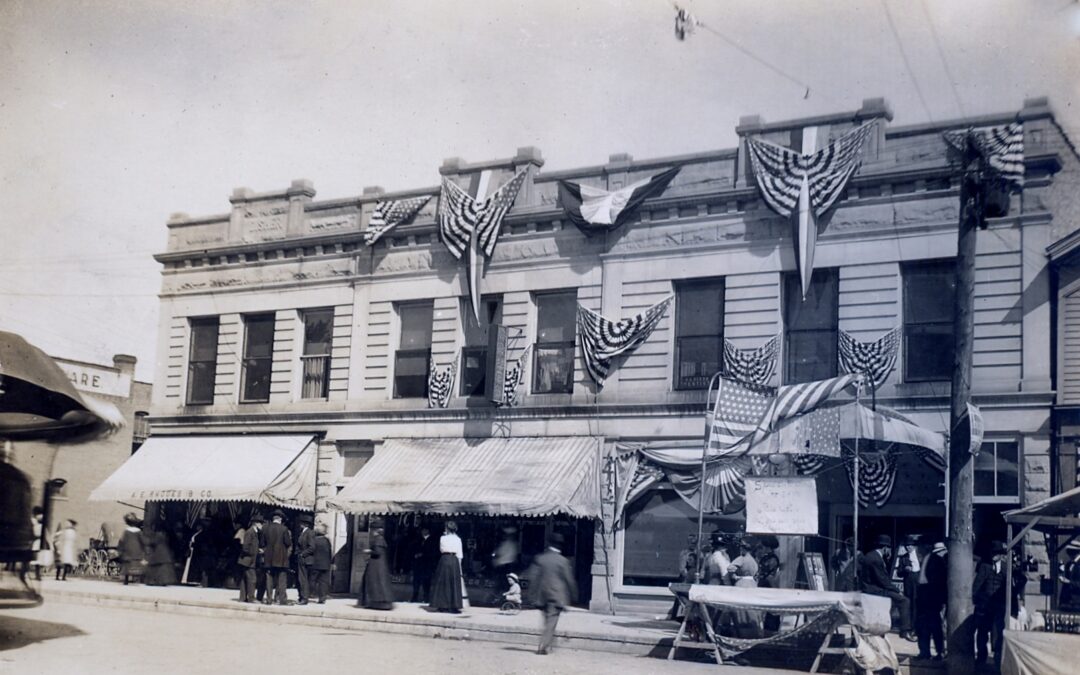
Distinguished visitor William Jennings Bryant, known as the “American Commoner” and leader of the Democratic Party, spoke to a huge crowd in front of the Balcony Building in 1906. A platform was erected in the street and people from all over the county gathered to hear him speak for 40 minutes. According to reports, however, strong winds, crowd noise and no modern sound system made it hard for most people to even hear the speech.

William Jennings Bryan’s address, October 24, 1906.

Right around this time, the building became the property of Frank W. Bosworth and his wife Mabel. The couple’s two daughters, Esther and Muriel, eventually inherited the property, and that is how the building got passed down to its current owner, George Schricker. George is the great nephew of Esther and grandson of Muriel. You might have noticed the upper floor – now apartments – are named the William Jennings Bryan Suites.

Fire Devastates the Balcony Building

Then in 1927, Charles Glaub moved his ‘cash and carry’ grocery into the building. Before this innovation, grocery stores often operated a bit like warehouses – customers would choose items they wanted, employees would find and pack the items, and then the order would be delivered to the customer’s home or business with the bill being paid at the end of the month. A three-way partnership, consisting of Mrs. Anna Glaub & sons, Chuck & Walter, was formed in 1938 due to the death of Charles H. Glaub.

Interestingly, a few years after Mr. Bunnell moved across the street, the A&P Grocery & Meats moved into the south bay, creating side-by-side grocery stores in the same building. And that is the way it was at the time of the November 27, 1946 fire that engulfed the third floor of the building.

The Moose Lodge met on the third floor, G&G Grocery occupied the north bay, and A&P Grocery occupied the south. The Knights of Columbus also met upstairs. The theory about the fire was that a Moose left a cigar burning. (Now there is a word picture!) The third floor was a total loss and had to be removed. The demolition took with it the ornate Italianate cornice. It is a testimony to the brick structures that the neighboring buildings, and even the lower floors were not severely damaged. G&G remained in the building until they relocated in 1953. In 1954 Derf Jewelers moved into the north bay, and at about the same time Lord’s Dress Shop took over the south bay.

Moose Lodge fire ignites the balcony building, November 27, 1946.

Post-Fire

In subsequent years, several businesses moved in and out of the building, and it underwent significant renovation. Today it houses the Wild Rose Moon on the north side and Aldridge Diagnostic Medicine on the south side.

Are you curious about other buildings in the county? Let us know! We love doing research. If you are more interested in researching a topic of your own, the Marshall County Historical Society Research Library has LOTS of resources. Come in Tuesday – Saturday, 10 a.m. to 3:45 p.m. and our research specialists can get you pointed in the right direction.