Small Statue of Liberty Replica

Small Statue of Liberty Replica

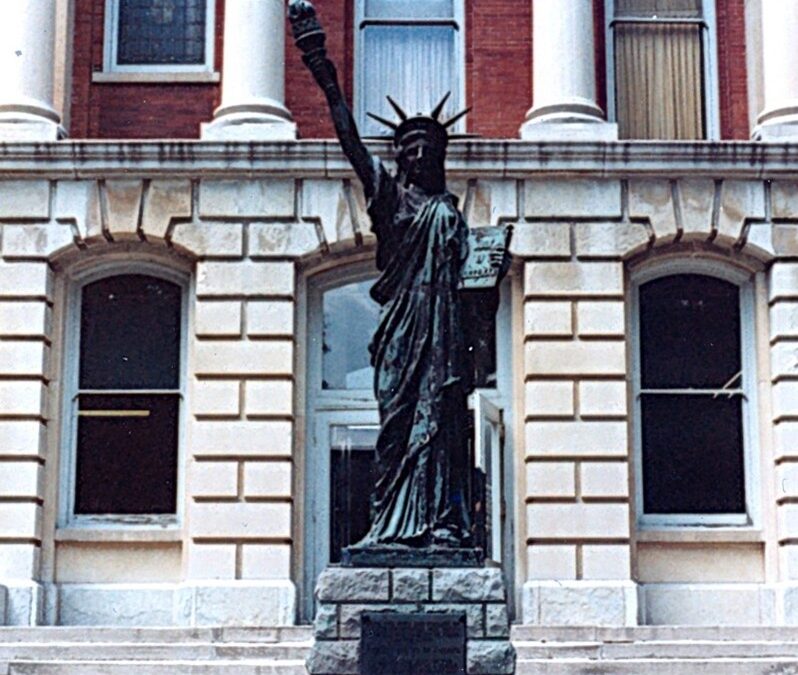
Small Statue of Libery replica in front of the Marshall County Courthouse in Plymouth, IN.

A gift of friendship from the people of France to the United States, the “Statue of Liberty Enlightening the World” was dedicated by President Grover Cleveland on October 28, 1886. It has a fascinating history that is well worth researching. But did you know that Marshall County has a small replica of the Statue of Liberty? It sits on the courthouse lawn in Plymouth, and it has a story as well.

In 1949, to celebrate its fortieth anniversary, the Boy Scouts of American initiated a program entitled, “Strengthening the Arm of Liberty.” Each local scout troop across the country was tasked with raising $300 to $350 to purchase a “Little Sister of Liberty.” The troops donated the replicas, which are eight feet four inches tall and made of copper plating, to their communities for prominent display. Almost 200 of these replicas were installed throughout the country between 1949 and 1952. Other Little Sisters known to exist in Indiana are in Gary, Madison, Peru and South Bend. Most are in front of courthouses, like ours in Plymouth and the one in South Bend.

The statues were mass produced. Plymouth’s Little Sister was shipped by express on February 13, 1951, from the Friedley Voshardt Company in Chicago. The company made stamped architectural sheet metal ornaments of aluminum, bronze, copper, lead and zinc.

The dedication of Plymouth’s Little Sister was, predictably, on July 4, 1951, with about 350 people in attendance. One side of the statue features a plaque with an inscription on it, and it stands on a 15-foot base. The base was not purchased by the Scouts but paid for with contributions.

The dedication ceremony started with the junior high school band marching up Garro Street to Center Street and north to the courthouse. The band played “America.” The colors were presented, and the invocation given. Plymouth’s first scoutmaster, Judge Alvin Marsh, recalled the founding of the local troop on August 19, 1912. Coincidentally, that group met on the corner of the courthouse lawn.

At 10:18 a.m. four Scouts slowly untied the string that held the veil covering the statue and presented it to the county commissioners. (Surely there couldn’t have been much anticipation about what it would look like.)

Governor Henry Schricker was the main speaker. In his speech he mentioned the three references to God in the Constitution and noted that there could be no democracy without religion. He also praised the Boy Scouts of America, declaring the program invaluable in the building of citizenship.

After the governor’s speech, Vance Zartman sang a verse of “America the Beautiful” and a closing prayer was offered.

Scouts participating in the background display stood at parade rest throughout the ceremony. Represented at the ceremony were Plymouth Pack 71 and Troop 6, Argos Troop 55, Bremen Troop 56 and Lakeville Pack and Troop 47.

The text on the marker reads, “With the faith and courage of their forefathers, who made possible the freedom of these United States, the Boy Scouts of America dedicate this copy of the Statue of Liberty as a pledge of everlasting fidelity and loyalty to the crusade to strengthen liberty. 1951.”

Over fifty years passed, and the question arose – what had happened to all the Little Sisters around the country? A national search was undertaken in 2007 to find the Little Sisters of the Statue of Liberty. At that time, about 100 were accounted for, about half of those that were supposed to have been placed. Weather and vandalism had claimed some. Others were stashed in storage. Still others had been sold for scrap.

Local Scout Tim Jeffirs decided to do something about the condition Plymouth’s Little Sister had gotten into. He spearheaded a campaign to clean the miniature statue as part of his Eagle Scout project.

On July 4, 2007, a rededication ceremony for the refurbished Marshall County Statue of Liberty took place. The American Legion Post #27 Color Guard presented arms. Troops 251 and 257 and Pack 222 presented the colors. Abigail Jeffirs sang “On the Banks of the Wabash,” Tim Jeffirs explained his project, and Nathaniel Jeffirs performed the “Star Spangled Banner.” Sounds like quite a family project. Prayer was offered at the beginning and end of the program.

Several years have passed since that rededication ceremony, and the statue is beginning to look a little worse for wear. It is about time for the statue to be spruced up again, and then Marshall County can be proud of her Little Sister once more. Any BSA troops looking for a project?

The Marshall County Historical Society and Museum is located at 123 N. Michigan St., Plymouth. We are open Tuesday through Saturday from 10 until 4. We have an unlimited supply of great stories and pictures in our archives!
George Switzer – Plymouth to Paris

George Switzer – Plymouth to Paris

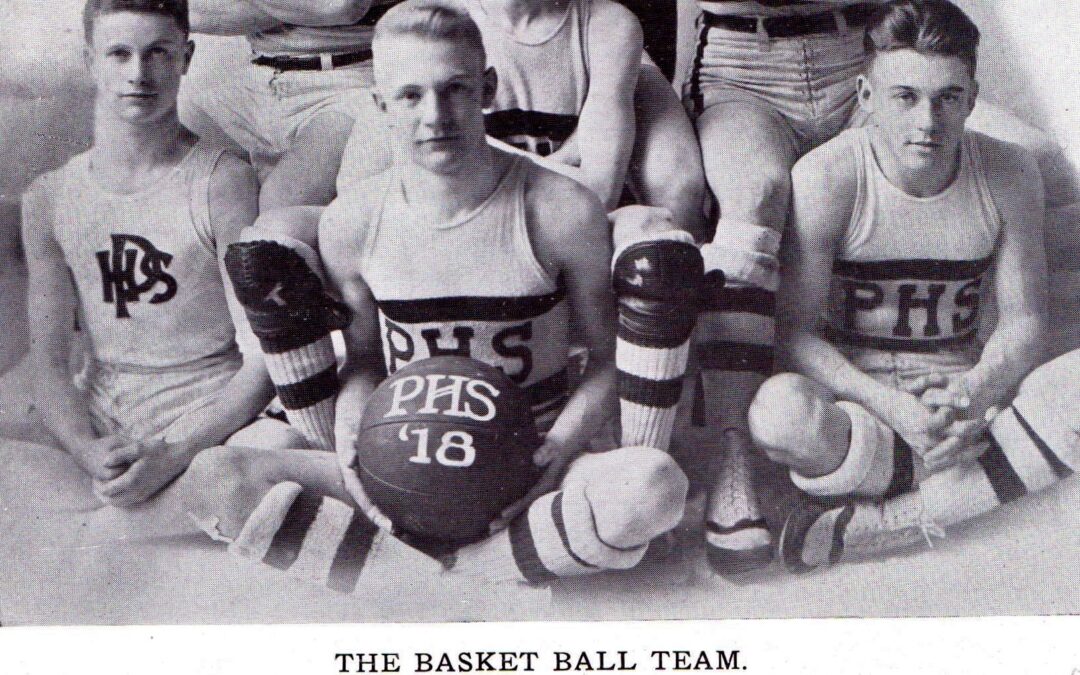
1918 Plymouth High School Basketball Team, Switzer on left.

George Switzer was born in Plymouth in 1900. He was a talented artist and at age 16 was chosen to illustrate the book, Centennial History of Indiana, by Judge John Kitch. George went on to graduate as the president of his class and studied psychology at the University of Illinois. He distinguished himself there as president of the arts and psychology fraternities, and as art director of campus publications. His first design business was launched when he successfully bid against Chicago firms for the decorations used in the college dances.

From college, George worked as a Bible salesman, where again, he excelled by doubling the business in 16 months. His desire to work in an artistic way led him to accept a job as an industrial designer. His work in Chicago led to an offer from an advertising firm in New York where he designed everything from envelope stickers to messengers’ uniforms and delivery trucks. Having made his name, Switzer opened his own office in 1929 as a designer and consultant. He subsequently worked for 65 American companies, and shortly opened an office in Paris, France. He designed a variety of things including letterhead, sausage labels and a Rolls-Royce automobile body. Switzer was instrumental in organizing the 1937 Exhibitions on Modern Packaging and Materials show in New York. He also promoted packaging shows in the U.S. and France. He won several awards for his designs internationally as well as stateside.

George passed away in 1940 following surgery for mastoiditis. His funeral was conducted in the Presbyterian church, and he is buried at Oakhill Cemetery. The print obituaries in the Museum’s archive summarize his life well, but it is the extra artifacts in the file that tell the real story. An article from a New York newspaper shares several nuggets about George:

“He still drawls, he still says mebbe for maybe. He might have been a farmer, except for one summer when he was nine years old, he ‘rented a piece of land from grandfather. I hoed and planted and watered all summer. The other kids were playing baseball or swimmin’. I kept careful books and at the end of the summer I had made 37 cents for four month’s work. I never wanted to be a farmer after that…’

“His interests range all over the earth: from re-designing ocean liners ‘so that folks will feel more like they are out on the seas that pirates used to roam over, instead of safe and sound in an apartment hotel…’ From that field, his interests range to ‘working out an art program for high schools…I am experimenting with it back in my hometown sort of…it’s based on a pretty simple idea that sounds sort of screwy when I say it, but here it is: Just teach kids that every place they leave, ought to be made more beautiful for their having been there.’”


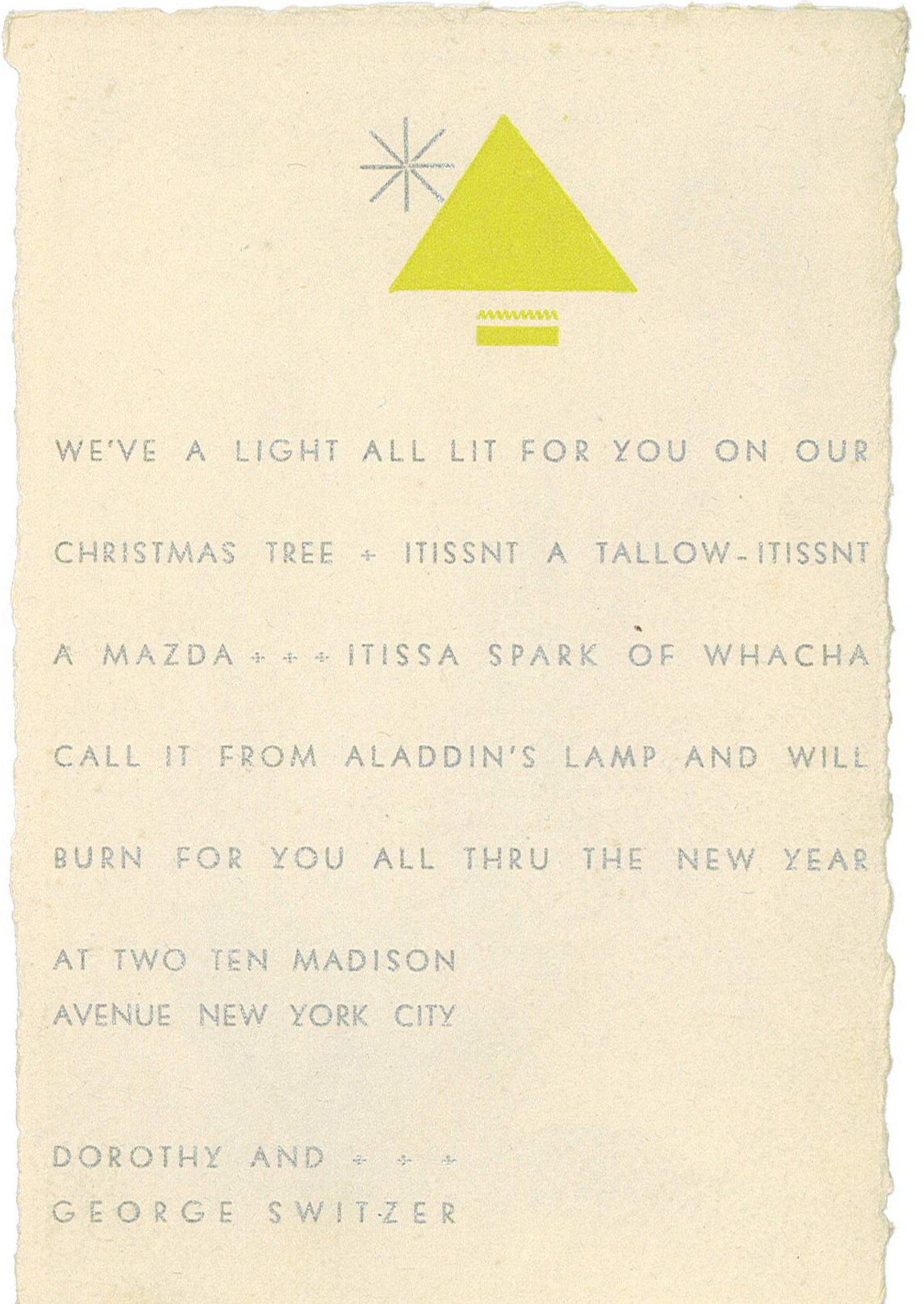
Christmas Card by George Switzer.

George never forgot his hometown and remained close to his Plymouth family throughout his life. Our archive includes letters to his aunts and an amazing collection of hand-made Christmas cards. His designs are as imaginative and fresh now as they were when created in the 1920s and ‘30s. Each year George created a sophisticated work of art, very much in the art deco style of the day. He used metallic papers and inks, embossed detail, intricate folds and handwritten verse. In these days of digital greetings, these pieces of art are all the more charming.

This is just one file in the Marshall County Museum’s archives, and one more story of a life that made an impact. We are privileged to preserve these items to tell our collective story! Come visit this holiday season. The Museum is open located at 123 N. Michigan St., Plymouth, and open Tuesday – Saturday, 10-4.

One-Room Jail in the Fire House

One-Room Jail in the Fire House

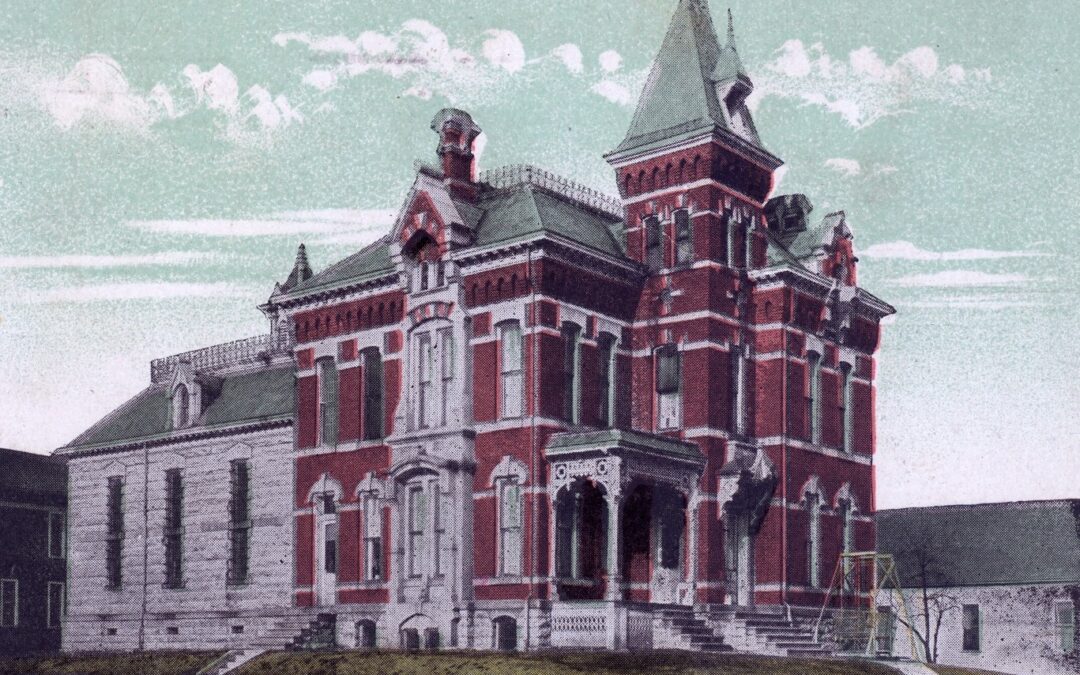
Feature Image. Old Marshall County Jail and sheriff’s residence, postmarked 1911.

A “calaboose” was usually a one-room jail used to house transients and drunks overnight, before sending them on their way. The following un-edited articles were found in a couple of our early newspapers.

Dealing With Crime

According to the Marshall County Independent of November 23, 1894, “Every day a number of tramps drift into Plymouth and enjoy the luxuriant sleeping accommodations of the city calaboose. It is due to the efforts of Marshalls Meyers and Mead that these gentlemen of indolent leisure are induced to continue their weary wanderings after only partaking of Plymouth hospitality for a few hours. Unless this class of citizens is watched closely by the police everywhere, and more especially in the smaller cities, they quickly become a nuisance. The way to treat them is to give them some place to sleep at night and then send them on their way.”

The Independent of December 2, 1898, said “A report made by the committee on police, heartily recommended that a new calaboose be built, and more, that it be built on the city’s property now occupied partially by the waterworks plant. It was deemed advisable to heat the structure with the waste steam from the exhaust pipe of the pumping engine. The facts which seem to argue strongest for erecting the new calaboose are, first, that the old one is uninhabitable and unsafe. Second, $12 a year rent must be paid for the old one, and the fuel costs much more. The matter of locating and constructing the building has been left in the hands of a committee who will report at the next meeting.

A New Calaboose

Apparently, the new calaboose was built, because the Independent of April 20, 1900, stated” The new calaboose has already been put to a very good use. For several nights it has been filled with those knights of idleness commonly called hobos and others of a more degenerative order.”

Interestingly, Plymouth’s last “calaboose” was located inside the old Fire House. The headline of the Weekly Republican of October 13, 1910, was “Hobos in Fire House.” The article went on to say “The old calaboose in which many a “weary willie” has been sheltered from the icy blasts of a cold night in Plymouth, is soon to be effaced from the landscape of Plymouth. In its place, a cell is to be fitted up in the fire house, which will harbor the unfortunates during the winter months. The abandonment of the calaboose was made necessary because of the impossibility of heating the little house, as before. The council last evening voted to fix up a cell in the fire house.”

Using the Calaboose

The new calaboose was put to good use according to the Weekly Republican of September 21, 1911. “A well-dressed young man who was decidedly under the weather, made his appearance on Michigan St. Saturday at a little past 7:30. Being unable to keep the sidewalk, officer Jacoby was called to his assistance, and placed him in the cage at the fire house.

The man was well dressed and offered practically no resistance to being locked up. Officer Jacoby states he is from Fort Wayne.”

If you love trivia about history, check out the newspaper files in the Historical Society & Museum archives. We are open from 10:00 until 4:00, Tuesday through Saturday.

Mildred Bovee (1909-1979)

Mildred Bovee (1909-1979)

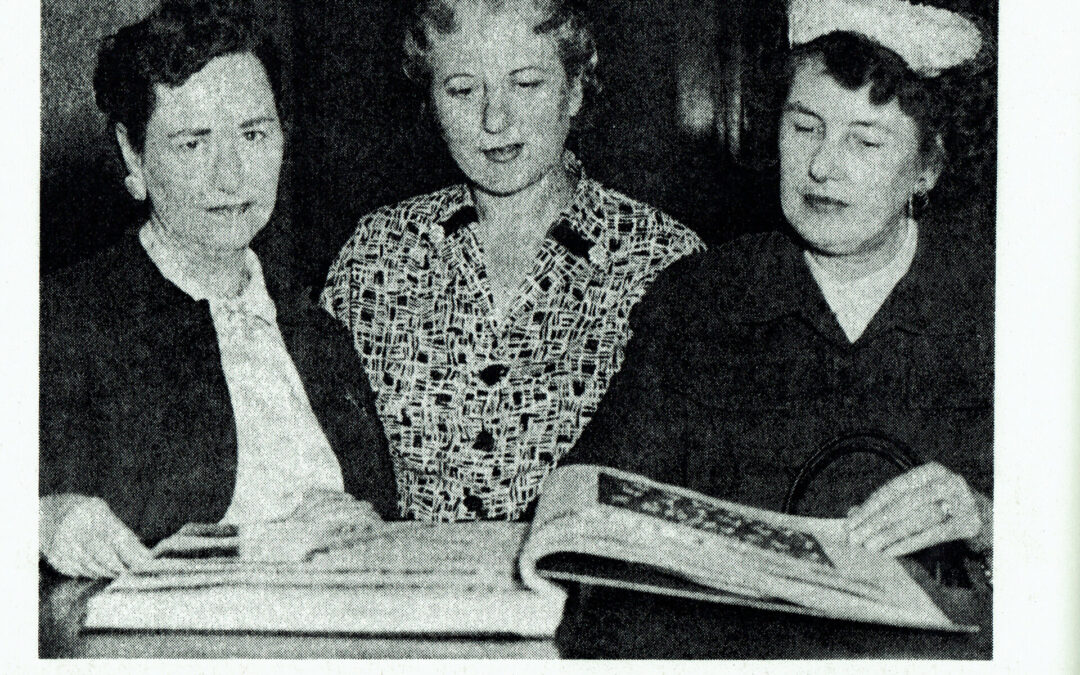
Feature Image. Image of Esther Badiac, Mildred Bovee and Berniece Strang, ca 1958.

To celebrate Women’s History Month, we are highlighting some of the remarkable women who have improved the quality of life in Marshall County and beyond, not just for women, but for all of us. The following is a lightly edited story written in the 1980s by Betha Haag.

A Portrait of Mildred Bovee in Words

Some people do big things and some little

Some succeed each time – some fail

Some become famous and some never do,

And some put their fingers in so many pies

nothing comes through

But this lady with hair turning grey, blue eyes sparkling bright and a gracious smile to greet friend or foe, finds that in the end the foe always becomes a friend.  She meets each challenge that comes her way with courage and wisdom, and never quits a task until completed  and completed successfully.

This blue-eyed, eager, busy woman was born February 28, 1909 in the city of Chicago, the oldest of eight children.  She was born under the sign of Pisces, and is intelligent, brave and outgoing.  She has all these traits, and with her love of others she has a deep wish to make the world better, beginning with her own community and spreading out from there.

After high school, Mildred graduated from Trooks Commercial College in Chicago, and always worked in real estate and the building and loan field in the city.

In 1931, she married Carl Bovee in Chicago.  They are proud of their two sons, Kenneth and Curtis, and their five grandchildren.  But God works in a mysterious way “His wonders to perform”.  Both boys developed an asthmatic condition when small, and the doctor suggested they get the boys out of the south Chicago air into some area where the air was clean and pure.  Now where could anybody find better or purer air than in Marshall County?  Not only is the air purer, but many other things are better about this locale.

They were impressed with Plymouth, and because of Carl’s previous business dealings with Allen Rudd, selected the Plymouth area.  They moved here in 1947 and began operating a motel.  The boys were never again bothered with any serious asthmatic attack after coming to Indiana.

Mildred Bovee will be remembered by many mothers and fathers, for she arranged for them to talk to their soldiering sons via ham radio.  Through her kindness and thoughtfulness, happiness was given and lonely hours became perfect hours – not only between parents and soldiers, but between friends and relatives when sorrow struck, or when “Merry Christmas” was sent across the air waves to a daughter far away from home or an ill aunt.  American Field Service students were thrilled to talk to their families, even though an ocean might separate them.

Mildred aided in all Civil Defense work when needed.  She could never sit with idle hands when there were tasks to be done – especially if those tasks would help others.

Having started the motel business in West township, she became interested in the community and the 4-H programs.  She became a 4-H leader and West township was the first to have an electric project, which Mildred instructed and directed.  She was also active in the Parkview hospital auxiliary and in the work of the First Methodist Church.  She also found time to manage the family business.

Her ham radio experience proved invaluable to the Civil Defense, and it served as a wonderful basis for 4-H leadership.

Mildred has served on many county boards, providing constructive ideas and suggestions to improve and implement programs for the community and the organizations.  These organizations include the American Red Cross, the County Mental Health Association, Parkview hospital board of trustees and the Civil Defense board.  Mildred was a member of the Parkview hospital board for 11 years.

As a member of the public relations committee of the Plymouth Business & Professional Women’s Club in 1958 with chairperson Bernice Strang, a survey of Plymouth industries and their products was conducted.  Employment and potential expansion plans were also part of the survey.

With the cooperation of Plymouth industries and “The Pilot-News”, a week was designated as “Salute to Plymouth’s Industries”, with articles and pictures highlighting each industry.  There were articles about this project in the “National Businesswoman”.  One of the industries featured was Lemert Engineering, and the head of the business, Mrs. Eva Lemert, was then a member of BPW.  Her firm had produced an invention that marked a great forward stride in the aircraft manufacturing industry.  Eva Lemert and her firm’s invention were written up in two trade publications with a national distribution.  An article also appeared in the “Independent Women Magazine” of Washington, D. C., and the 1961 issue of “Who’s Who in American Women” included her in their publication.

To this day, the members of the committee that promoted this project are convinced that their studies and actions were the inspiration to the Plymouth Chamber of Commerce when they later formed the Plymouth Industrial Development Corporation.  This committee, Mrs. Bovee believes, convinced PIDCO that a woman should be on their board, whereupon BPW member Rosetta Beiter Casbon served as the secretary-treasurer for several years, serving with distinction.

Mildred has always had many hobbies.  Besides her pet hobby, that of being a ham radio operator, was the making of lovely arrangements of everything from the most beautiful flowers to the lowliest weed.  All through spring, summer and fall she gathered these items, and her completed arrangements would end up in the hospital, nursing homes, some sick room, or anywhere that they might add a little sunshine.

Her latest hobbies are macrame and lapidary.  She and her husband Carl especially enjoy making lovely gems from just simple rocks.  They have ordered their own equipment so that they may make them at home at their leisure, instead of using the club house equipment.  They give away almost all the items they make.

Eight years after the Bovees moved to Marshall County, Mildred became a member of the Plymouth Business & Professional Women’s Club, and in 1958-1960 she served as president, when the membership reached 148.  She gives the entire credit for her later attitudes, ambitions and achievements to the wonderful women she worked with through the years.  Without the leadership abilities that she acquired through her BPW responsibilities, she would never have attempted to be active in politics on a local or county level or served on the various county boards.

In her new community of Hawthorne (a Leesburg, Florida suburb) she recently has become the editor of their community newsletter, “Penn-Notes”.  It is just two years old, beginning with four pages and growing to the present eight pages.  Last year she helped organize a tax aide service.  She and 11 other qualified residents attended a two-day training session and twice a week they counsel any senior citizen in the county.  These counseling sessions are held at Mildred’s church, the Methodist church, where she is also active in the Methodist Women’s group.  Missing her hospital auxiliary work back here in Marshall County, she recently signed up for service at her local county hospital in Florida.

Mildred is in excellent physical health and keeps it that way by hiking, along with her husband, two and three miles a day.  The rest of their waking hours are spent outdoors as well, swimming, golfing, playing shuffleboard and enjoying archery, the consumption of citrus fruits and the Florida sunshine.

Of her years as a member of the Plymouth BPW, Mildred has this to say: “We have had some great leadership in the club and the district, and I am certain that the newer women are availing themselves of all that the BPW Club has to offer its members.”

I will close this biography of a very wonderful person, one whom Marshall County hated to lose and one who hated to leave us, too.  We close with her own philosophy of life, and I quote: “I feel that you are what you make of yourself or – we are our own destiny.  As you well know, we are happiest when we are serving others.”

This is just one example of the personal stories and biographies contained in our archives. We welcome researchers to our library. The Museum is open from 10:00 until 4:00 from Tuesday through Saturday. Located at 123 N. Michigan St. in Plymouth, and our staff is always willing to help. For more information, call us at 574-936-2306. Check out our website at www.mchistoricalsociety.org.

Dedication of the Historic Firehouse

Dedication of the Historic Firehouse

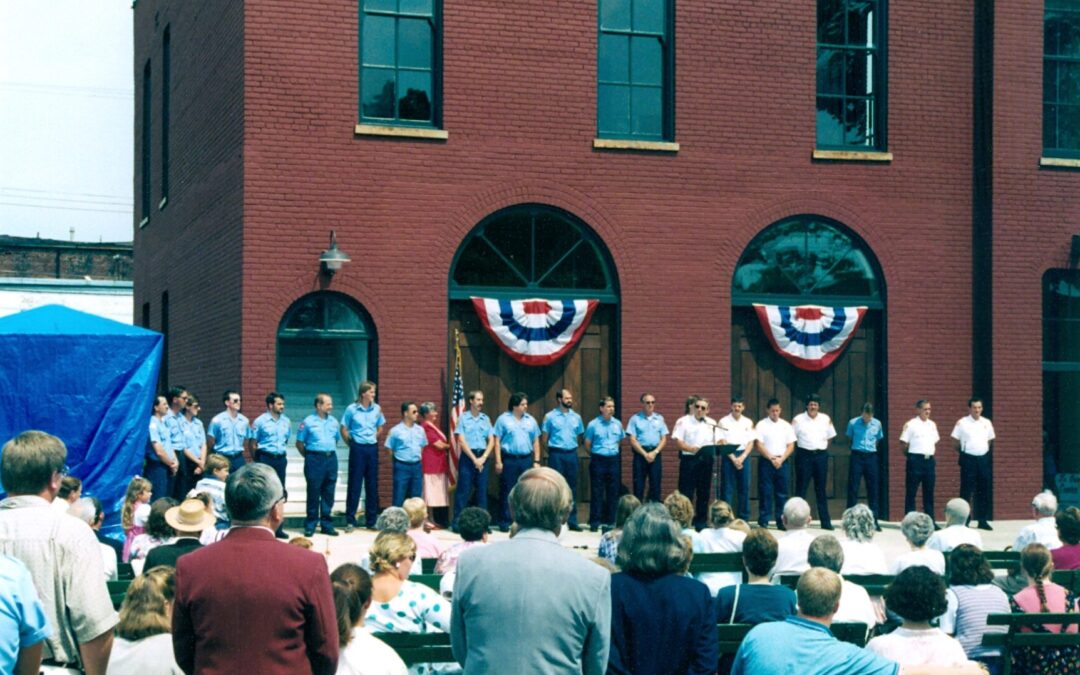
Feature Image. Fire House dedication, firemen standing in front of old firehouse, ca 1995.

The following article was written in the MCHS Quarterly on July 3, 1976, and the original firehouse was still in use after 100 years.

An Early City Hall and Engine Building

The City Hall and Engine Building, now housing our present fire department, was completed late in 1875. Built by Robert McCance and W.P. Beaton as contractors, the building cost $4,200. Alfred Morrison, Platt McDonald and W.D. Thompson supervised the construction for the city. The original building was 34 feet wide and fifty feet long, with brick walls 35 feet high and 18 inches thick to the second story with 12-inch-thick walls from there to the roof. The hose and bell tower was nine feet square and 59 feet high.

The first floor consisted of one large room in which the firefighting equipment was kept. Listed as the equipment owned by the department at that time was one hand engine, one hose cart, hose and hooks and ladders.

Upgrading Equipment

The first fire engine was purchased sometime between 1863 and 1868 and was, from all indications, a “sidestroke” engine. Five or six men to a side, pumping up and down vigorously, were able to produce a respectable, pulsating stream of water, procured from a cistern or the river. “Hooks” were long pike poles, usually with a pointed end as well as a hooked end. They were used for pulling down buildings in an attempt to smother fire and keep it from spreading.

The upper story of the new building had two rooms, one for the use of the fire department and the other used as a city council chamber and Mayor’s office. The building was described as being “large enough for the city to use for many years to come”, and so it has been.

Funding the Building

Possession of the building was taken by the city on February 21, 1876, and the dedication was marked with a grand ball, proceeds of which were $165.00. The volunteers had been staging balls for some time prior to this dedication ball for an earlier reference to one in January of 1868 noted receipts of $80.40. The annual Fireman’s Ball continues, each year being held in February, for the benefit of the Fire Department.

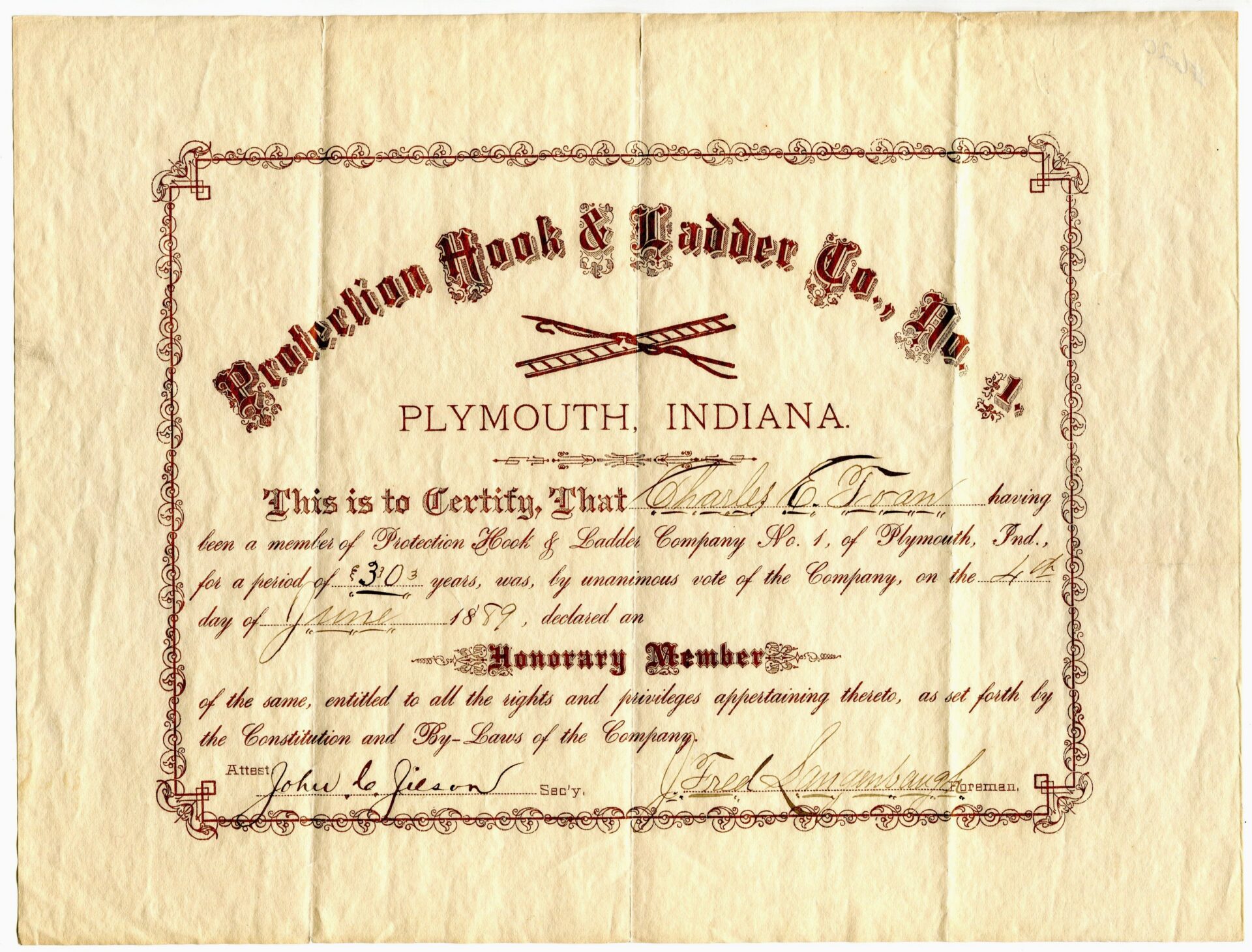
Honorary Member Certificate.

This is just one of many resources available at the Marshall County Historical Society & Museum, located at 123 N. Michigan St. in Plymouth. Call us at 574-936-2306.