A History of Post Offices In Marshall County

A History of Post Offices In Marshall County

In our modern society, we have many choices for communicating. We can access most of those choices simply by reaching into our pockets or purses for our cellphones. On rare occasions, we might send something through the mail, but even then, we have choices. The U.S. Postal Service is only one way -UPS, Federal Express, and Amazon are just a few more.

Have you given thought recently to how communicating with friends and acquaintances might have been just a few decades ago? People sent letters, written on paper, with fountain pens, and it took days and sometimes weeks for the missiles to reach the intended recipient. The first post office in Marshall County was established in Plymouth on October 17, 1836, and by 1883 there were eighteen post offices in Marshall County:  Argos, Berlinton, Bourbon, Bremen, Cavender, Donaldson, Inwood, Ilion, LaPaz, Marmont, Maxinkuckee, Oakington, Plymouth, Tyner City, Teegarden, Tippecanoetown, Wolf Creek and Walnut.

Sending Mail In the Past

In his HISTORY OF MARSHALL COUNTY, Daniel McDonald described how the business of the post office had changed over the years. There were no stamps until the late 1850s. Letter postage was 5 cents per half ounce, and the sender did not buy it. The receiver of the letter paid when he claimed it from the postmaster. He could simply refuse it, leading to a lot of mail ending up in the dead letter office. This system cost the government enough money that eventually the sender paid for stamps that had to be affixed to the envelope, and the cost actually went DOWN from 5 cents to 3 cents.

In the early days, mail arrived at the post office by stagecoach three times each week. Individuals would have to go to the post office to pick it up. By 1851 Plymouth had three local mail deliveries daily and once each week from places farther away. By 1875 the Post Office opened at 7:00 a.m. and closed at 8:00 p.m.

Rural Mail Deliveries

Rural mail delivery started in Marshall County in 1900. Calvin Switzer held the contract at $400 per year and the distance of the route was approximately 25 miles. Forty-five mailboxes had been put up and it was expected that there would be as many as 75 by the end of the first week. Before that, Robert McFarland delivered mail to his neighbors. According to an article in the Plymouth Democrat, he walked from his home to Maxinkuckee (a distance of about three miles) on Fridays to pick up any mail and deliver it to his neighbors as he passed their homes. He chose Friday because the newspaper would be in that mail. He received no money for his efforts and considered it a pleasure. In 1910 the Post Office Appropriation Bill contained a provision which required a suitable mailbox conveniently placed on the outside to receive it.

Various Town Post Offices

Argos Post Office

The (Sydney) Argos Post Office was established in 1844 with Mr. Smith as postmaster.  Following the election of President Polk, Mr. Smith was removed, and Mr. Downes was appointed postmaster.  Mr. Downes moved the post office three or four miles south of Sydney.  When Schuyler Colfax was elected to Congress, the people petitioned him to use his influence in securing the return of the post office to its original place.  Since the Post Office Department refused to take any action in the matter, Mr. Colfax suggested that they petition for a new post office to be located on the old Sydney plat.  They sent a petition to Mr. Colfax as a member of the committee on postal matters, and he soon notified the petitioners that their request had been granted.  It was necessary to change the name of the post office, and Mr. Colfax chose ‘Argos.’  In 1928 the Argos Post Office was moved to a new location.  Postmaster L. E. Hoffman was highly pleased with the improved facilities.  

Berlinton Post Office

The Berlinton Post Office was located between Bremen and Nappanee in Marshall County.  John Walters was the postmaster.  It had been rumored that the post office would be closed.  In November 1895 the post office was discontinued and supplies turned over to the Bremen Post Office.  The April 30, 1897 issue of the Bremen Enquirer then reported that “The new postoffice [sic] has been opened at Ayr, this county, with Wm. Clindaniel as postmaster.  The postoffice [sic] was formerly known as Berlinton.”  In March 1901 John W. Lehr was appointed postmaster and his store became the new post office location. 

Bourbon Post Office

The Bourbon Post Office was established in 1839, with Dr. John F. Parks as the first postmaster.  Rural delivery was instituted in July 1902.  In the 1920s and early 30s, the Bourbon post office was located on the east side of Main Street.  Willard Minard was the postmaster.  He was succeeded by Charles Elkins and then Lawrence Slough.  Marion Sharpe hung the mail bags for pickup by the Pennsy trains that no longer stopped, but simply had a man grab them as the train rushed by.  Scuddy LaRue held this job in later years until the railway post office was discontinued.

Although there was no home delivery, there was rural delivery.  Robert R. Wood was the first rural carrier with Henry Wood, his brother, as substitute.  Later Earl Logan and Walter Senour were the rural carriers.  City delivery did not begin until August 1958.

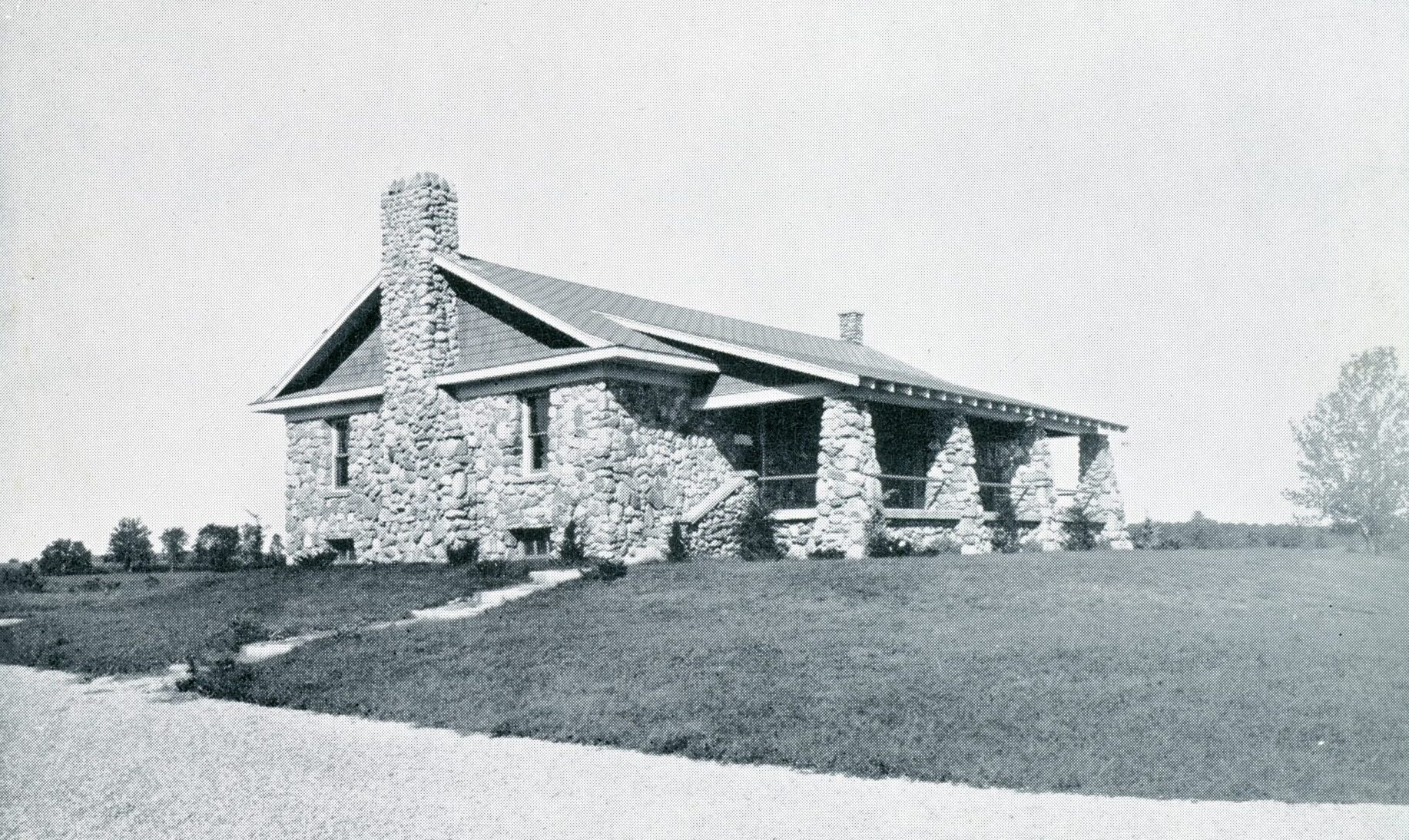
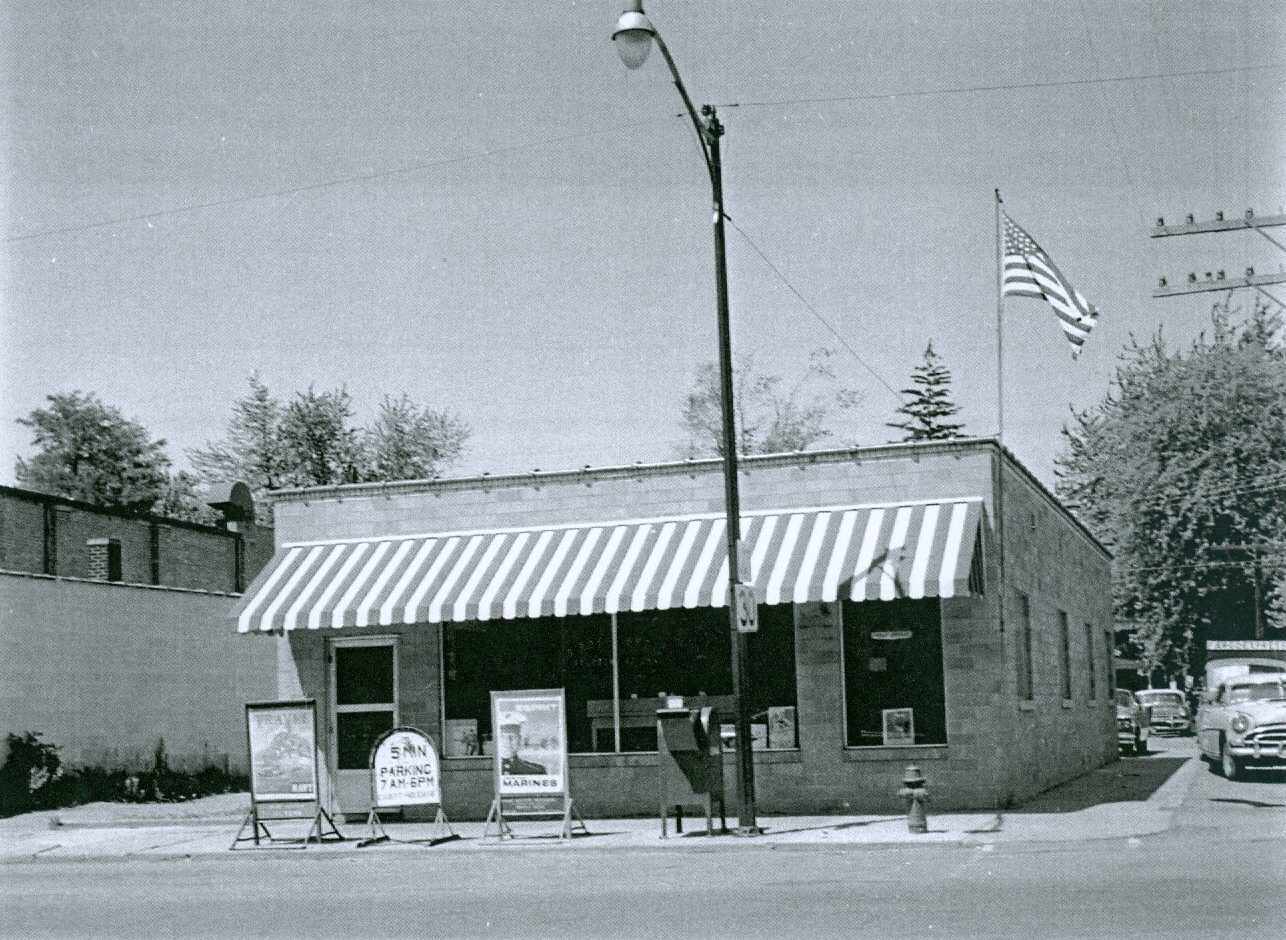
In 1951 a new Bourbon Post Office was built by Burt Construction Company and had about 1,600 square feet of floor space.  Due to the growing industries in Bourbon, a larger post office was needed, and the one pictured became the home of United Auto Supply.  The current Bourbon Post Office was dedicated in 1963.

The Bourbon Post Office in the 1950s and 1960s was located on the southwest corner of Main and North Streets.

Bremen Post Office

The Bremen Post Office was established in 1847 with George Pomeroy as the first postmaster.  The post office was made a money order office in 1877.  In 1905 Postmaster Ranstead built a new post office and leased it to the government for ten years. At that time, the post office supported six rural mail routes.  In May 1960, Sen. Homer Capehart was notified that an option had been taken on a new post office site at the corner of Center and North Streets.  

George Kipfer was a rural mail delivery man in Bremen.

Burr Oak Post Office

The Burr Oak Post Office was housed in Currens’ General Store for many years.  Goldie Currens was the postmistress for 40 years.  After the general store closed in 1984, the post office equipment was donated to the Marshall County Museum and can be seen there today.  The October 2, 1935 issue of the Culver Citizen reported that the store and post office were robbed of $15 and merchandise including cigarettes and food.  It was believed that the thieves were vagrants who were seen near Bass Lake carrying a sugar sack.  Police were notified but no further trace of the men was found. 

Culver Post Office

The Culver Post Office has had a number of different names.  It was believed that Onondaga (later known as Sligo) was the first post office to serve Culver.  Onondaga was the second post office established in the county.  Timothy Barber was the postmaster.  The post office existed for about four years.  About the time Onondaga closed, Benjamin F. Kendall established a post office known as the Yellow River Post Office which was located near Burr Oak.  This post office was discontinued circa 1856 and was succeeded by Union Town Post Office, later known as Marmont and then Culver in 1897.

The November 13, 1902 issue of the Argos Reflector reported that “burglars blew the post office safe at Culver and got away with $1,000 worth of stamps.  There were three explosions of dynamite and the safe door was blown through the side of the building.  The robbers escaped.”  The Culver City Herald reported that no clue to the robbery had been obtained as of November 14th.  “The desperadoes connected with the affair, did their work well and covered their trail completely.”  In January 1908 a new post office was opened in Culver in the new bank building.  The January 9th issue of the Culver Citizen gives a detailed description of the new facility.

Fletcher T. Strang became the postmaster in July of 1934.  He succeeded Clyde Shively who had served four years.  In August 1934, bids were submitted for a new post office to be located on the southeast corner of Jefferson and Ohio Streets. The  James I. Barnes Company of Culver won the contract.  The building was erected at a total cost of $37,466, which included $5,800 for the purchase of the land.  Postmaster Strang turned the first shovel of dirt on March 13, 1935.  The corner stone was laid on September 16thand Russell Easterday, manager of the Barnes Company, sent a notice of completion on November 5th.  The December 4th issue of the Culver Citizen gave a complete description of the post office. 

In 1938 Jessie Hull Mayer was commissioned to paint murals in the Culver Post Office through the Works Progress Administration.   Culver has the only WPA post office murals in Marshall County.

Donaldson Post Office

The Town of Donaldson was platted in 187, three years after George Uncapher built his store there.  Gideon Short was the first postmaster.  In November 1963, a new post office was dedicated with Mrs. Bradfield as postmistress.  The dedication was at Divine Heart Seminary with an open house following at the post office.

Fairmount Post Office

A post office was established at Fairmount in 1853.  Casper Fox was the postmaster.  The area was also known as Higby Corners. In January 1902, a post office was established in Hibbard at the crossing of the Vandalia and Nickel Plate Railroads.  Wm. Shepherd was the postmaster.  The post office at Lycurgus on the Leesburg Road was discontinued in 1853. 

Inwood Post Office

John Rush resigned the position of postmaster at Inwood after many years.  Mrs. Frank Listenfelt took his place but died a few months later.  Mrs. Warnacutt then assumed the duties until Mrs. Lawrence Davidson took over in 1941 and moved the office into the Davidson store.  Modern boxes and equipment were being sought at the time, as the present ones had been in service since 1854.  In 1966, Mrs. Don Davidson was named the new postmistress succeeding Mrs. Hallett who served as postmistress for almost eight years.

LaPaz Post Office

The LaPaz Post Office, which was located in Wiegand’s Store, was damaged by fire on October 29, 1946.  Postmaster Arthur Welch was able to save all the mail except for a few letters and papers placed in lock boxes.  Stamps were water soaked, and books and forms were completely destroyed. Firefighters from LaPaz, Bremen, Plymouth, Lakeville, Walkerton and North Liberty fought the blaze for over an hour. 

Linkville Post Office

The post office at Linkville was established in 1884.  In 1889, it was moved to Harris Station on the Vandalia Railroad.  Some of the residents were so upset, they ordered their mail to be sent to the Plymouth Post Office.  On December 1, 1903, the post office was discontinued and the town started getting its mail from the rural route #1 carrier.

Plymouth Post Office

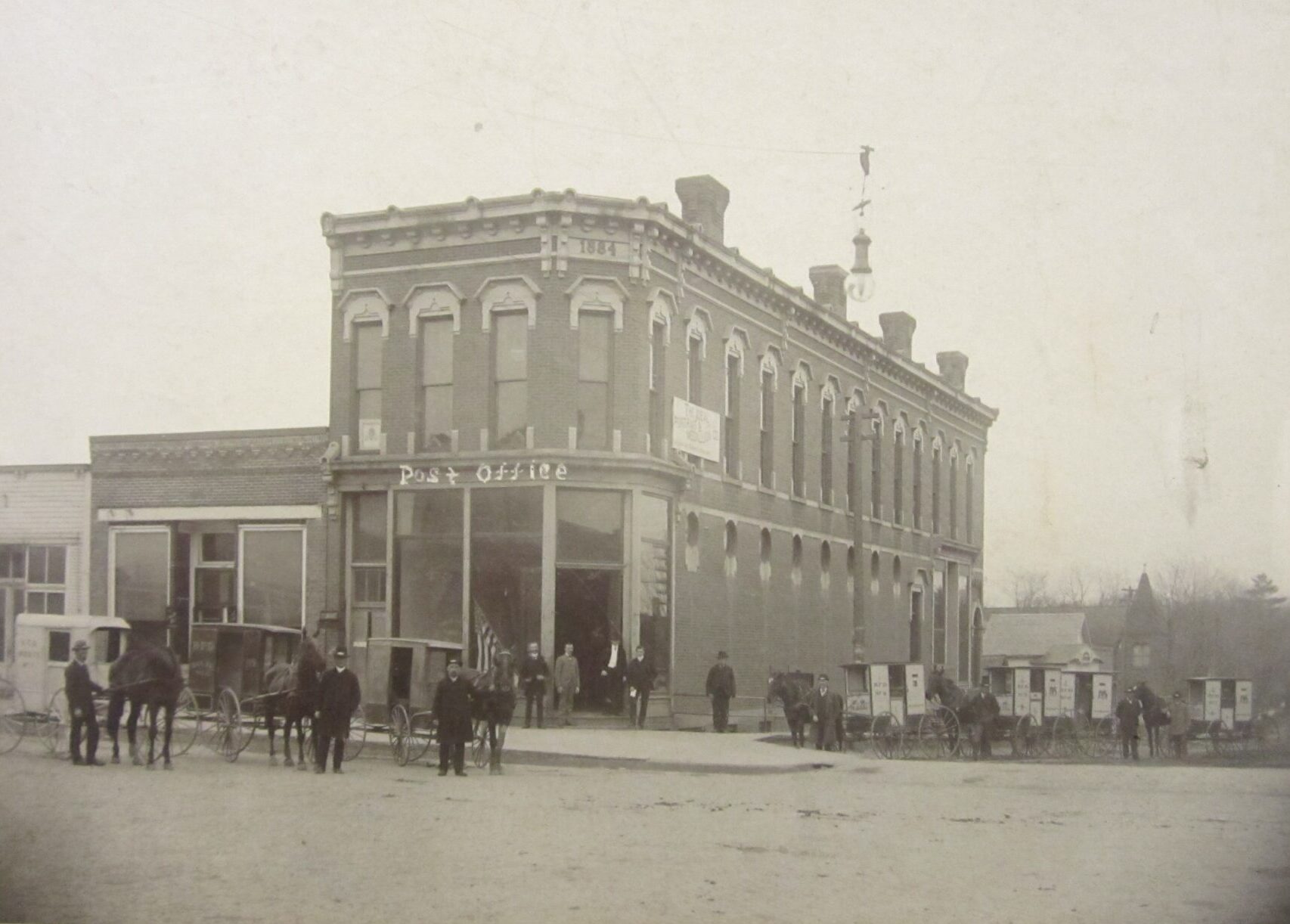
The Plymouth Post Office opened in October 1836, with Wm. G. Pomeroy as postmaster.  He served until January 3, 1838 and again from January 11, 1841 to December 1844.  The post office was opened in his father’s house, which was known as the Yellow River Hotel.  Each successor moved the post office to his place of business or in some other business establishment.  McDonald’s HISTORY OF MARSHALL COUNTY lists all the Plymouth postmasters from Mr. Pomeroy to J. A. Yockey in 1901. 

The Plymouth Post Office as it was on Michigan Street.

In 1909, Postmaster Yockey was able to institute city delivery.  The law requires that a post office must do $10,000 worth of business in order to qualify for city delivery.  The total business for fiscal year April 1908 to April 1909 was $12,189.

Robert Head, Hubert Tanner, and Walter Lindquist delivered the mail to the citizens of Plymouth for the first time on June 15th.  Raymond Glen Seybold was appointed substitute carrier.

With the start of city delivery, the entire post office force, with the exception of the postmaster, was placed under civil service.  In February 1912 the Post Office Department in Washington, D.C. leased a vacant room on LaPorte Street for a period of ten years from Bondurant and Stevens.  This new location was considered to be much better than the previous location.

The Plymouth Post Office in its LaPorte Street location.

In May 1913 an attempt was made to blow the post office safe.  When Louis Jones unlocked the front door and threw in the mail sack that came in on the Lake Erie Railroad, he thought he heard something but hesitated to call the postmaster.  He was convinced to make the call by Joseph Mead and Mitt McKinney.  They went back to the post office and discovered that the lighting wires had been cut.  The officers left Charley Glaub and Ralph Bowell to guard the back door while they checked the train station.  Glaub and Bowell were armed and saw a shadow approaching.  Glaub ordered him to put his hands up.  Although he claimed he acted alone, it was obvious that this was not true.  The safe’s iron door was blown open, the lock combinations and the inside lining of steel plate were blown to bits.  The inside door, which opened to the money and other valuables, had not been broken open so the loss was limited to the amount of money and stamps left there overnight.

Many improvements designed to aid the post office in handling Christmas rush were instituted in November 1929.  Included were a new safe with four interchangeable drawers for use at the General Delivery and a stamp window.   The incoming parcel post received for delivery the week before Christmas required more space than at any other time of the year.  The rural carriers had been moved up from the basement, which left that space available.   Parcel post was delivered to the rear door of the basement, sorted and then delivered by automobiles from the rear entrance.  Postmaster Tanner thought that this would improve the service.  Several sections of Plymouth did not have sidewalks, house numbers, street signs, or mail boxes on the house.  This made it impossible to receive city delivery.  Permission was obtained to permit those patrons to erect rural mail boxes on the line of travel of the carrier and receive mail. 

Sorenson-Gross Construction Co. of Flint, Michigan was awarded the contract in 1934 for the new Plymouth Post Office at a cost of $29,834.  The total, which includes the site, the building and some equipment, was $68,000.  Roy Treesh of Milford secured the sub-contract for the excavation needed for the basement of the building.

The May 28, 1935 issue of The Pilot carried an architect’s drawing of the planned building.  In September the cornerstone for the new Plymouth Post Office was laid.  The contents of the cornerstone included a copy of the Constitution of the United States, a Holy Bible, a copy of The Daily Pilot and Daily News of Sept. 12, 1935, and other documents containing the names and addresses of officers and members of various organizations in the city, city officers, and county officers.  The grand lodge officials of Free and Accepted Masons of Indiana were in charge of the ceremony.


The Plymouth Post Office on Garro Street before additions and remodeling.

In July 1964 a modernization and expansion of the Plymouth Post Office was planned.  The plans included adding 2,619 square feet to the workroom; 3,125 square feet to the platform; 8,448 square feet to the parking and maneuvering area; and 1,000 square feet for lobby space, mail vestibule and other employee facilities.  In addition, air conditioning was installed.  Omer Bixel was appointed Plymouth postmaster in August 1964.  The October 20, 1964 issue of The Plymouth Pilot reported that the architectural and engineering contract for the extension and remodeling of the post office was awarded to Maurer and Maurer, South Bend.  The drawings were completed by August 1965, and the estimated cost was $250,000. 

Rutland Post Office

The Plymouth Democrat carried the history of Rutland in its March 19, 1903 issue.  Once called Cross Lanes, the name was changed to Glendale and then to Cavender.  A post office was obtained around 1881, but it came with the name Rutland.  Rather than “fight city hall,” the name was accepted.  Frank Shepherd was postmaster until he was promoted to rural carrier for Plymouth.  It was assumed that Sol Cavender would succeed him.  The Rutland Post Office was discontinued December 14, 1917, as Plymouth Route #4 began covering the territory, with Frank Shepherd as carrier.

Teegarden Post Office

A post office was established at Teegarden in March 1874.  J.D. Johnson was appointed postmaster.   The office was in a combination of Mr. Johnson’s home and general store.  In the early 1920s the Plymouth, Walkerton and North Liberty rural routes were extended to serve other rural areas.  The Walkerton route went through Teegarden to serve people to the north and east.  This led to a decrease in the number of box holders.  Millard Lemert was postmaster at the time.  His father, C.A. Lemert, was postmaster for 20 years in connection with his general store.  Gideon Logan, Jesse Beldon, D.W. Titus, Andrew Peterson, J.O. Kessler, Richard Thompson, C. Robinson, Mrs. Loneta Aldrich Bowers, and Mrs. Carol Pontius were all postmasters.

Tippecanoe Post Office

The Tippecanoe Post Office has had many locations.  The first location in 1851 was in Old Tippecanoe Town on the Tippecanoe River one mile north of the present town.  The August 17, 1865 issue of The Plymouth Democrat reported that the post office at Tippecanoetown had been discontinued.  In 1884 the post office was established at the railroad station, then called Ilion.  The first postmaster at Ilion was W.A. Hardesty.  Other postmasters included Wilson Roberts, David Harrington and Dr. L.D. Eley.  During Dr. Eley’s time as postmaster, the name was changed to Tippecanoe.  Arnold Rhodes served as postmaster from 1923 until he retired in July 1958.

In December 1939 the post office building which had been moved from near the railroad to the center of town was destroyed by fire.   The post office was then moved into the property of Mrs. Callie Dawson.  In 1963 Postmaster Dale Blackford built a new post office about a block north of 18B Road on the east side of State Road 331.  The dedication of the post office was April 21, 1963.  Edwin Kain of Plymouth was the rural carrier.  Hours of operation were 7 a.m. to 5 p.m. and the lobby was open during the noon hour. 

Large group of people standing around statue of Chief Menominee

Attending the dedication of the Tippecanoe Post Office are (l-r) Phil Fretz, Ron Plank, Vance Hartke, John Brademas, and Postmaster Dale Blackford.

Twin Lakes Post Office

The November 10, 1887 issue of The Plymouth Democrat reported that a post office had been established at Twin Lakes on the Vandalia Railroad.  It was discontinued on January 2, 1907.  All mail after that date was to be addressed to Plymouth. 

Tyner Post Office

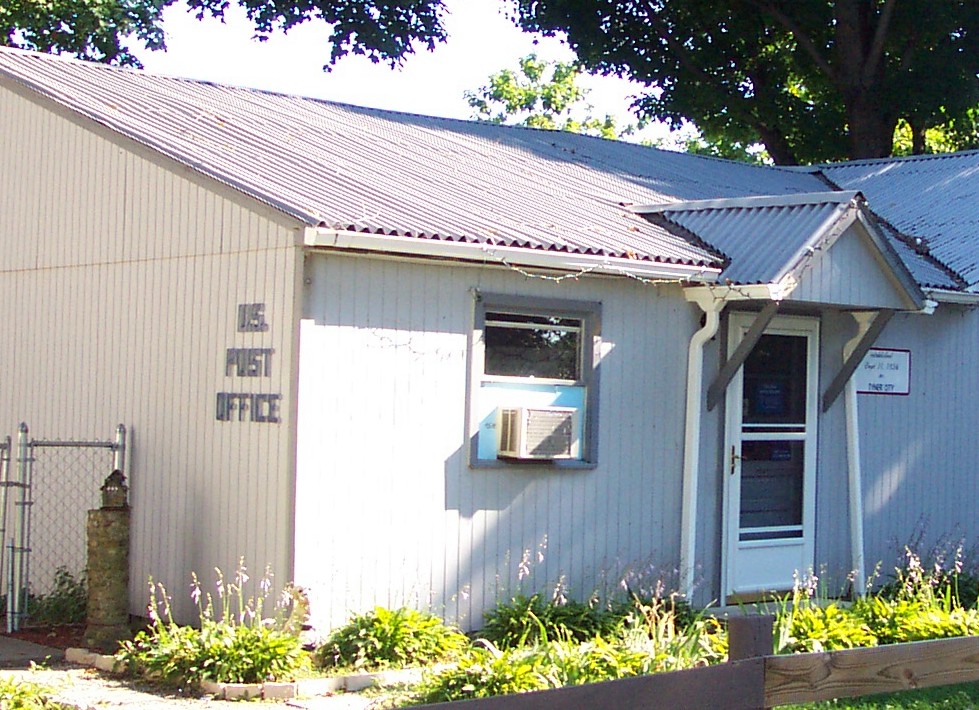
Consider Cushman was the first Tyner postmaster, starting September 11, 1856.  J.C. Cushman succeeded him in 1860.  Henry Falconbury succeeded him on March 9, 1861.  He only served until J.W. Falconbury took the position April 30, 1861.  In 1996 Tyner celebrated 140 years of service.  Over the years, the Tyner Post Office has moved several times.  It was located in Postmaster Alan Burkholder’s garage from December 3, 1977 until his retirement in March 2002.  The inside has been decorated with murals by Marge Burkholder.

Large group of people standing around statue of Chief Menominee

The Tyner Post Office was located in the Oddfellows Lodge.

If you were a resident of Tyner when Mr. Burkholder was postmaster, you could receive your mail by carrier from Plymouth, or you could pick it up at the post office.  If you opted for carrier, your address was Plymouth, and if you picked up your mail, your address was Tyner.  Your address could be Main Street, Plymouth but you lived in Tyner.  Most recently, the post office was located on Miller Street just north of French Street.  Christine M. Pinder succeeded Burkholder but resigned in June 2011.  Tyner folks lobbied to keep its post office and thought they’d held off the closing, but the Indianapolis Division opted to close it.

Large group of people standing around statue of Chief Menominee

The last home of the Tyner Post Office was a converted garage.

Walnut Post Office

After more than forty years the post office in the town of Walnut in the south part of Walnut Township was ordered to be closed December 15, 1905.  Postmaster Alva Colwell, resigned and there was no applicant for the position.  It was reported that Argos Rural Route #11 went directly through Walnut and would probably serve the area, but residents of the town felt that they had not been dealt with fairly.  The December 14, 1905 issue of The Argos Reflector reported that the order to discontinue the Walnut post office had been rescinded.  A.B. Town was appointed and would take charge of the office.  The Plymouth Tribune of March 15, 1906 reported “The post office at Walnut will be closed March 15 by order of the post office department (sic).  Patrons of the office will get their mail from Argos by rural route.”

Pumpkin Pie Spice

Pumpkin Pie Spice

It’s that time of year again. From Pumpkin Spice Lattes to sweet potato pie, everything is flavored with the iconic Pumpkin Pie Spice blend. Mixing up to nine spices, most blends contain nutmeg, cinnamon, ginger, allspice and cloves.

The Spice Trade

By the 1300s, traders traveled to the Banda Islands—which were among the so-called “Spice Islands”—because they were the only place nutmeg was known to grow. “At one point in the 1300s, when tariffs were at their highest, a pound of nutmeg in Europe cost seven fattened oxen and was a more valuable commodity than gold,” wrote the late John Munro, an economics professor emeritus at the University of Toronto.

A desire for spice is part of what drove European seafaring and eventual contact with the Americas. In fact, the Dutch were so hungry for nutmeg that in the late 1600s they traded their colony of New Amsterdam to Britain in exchange for Pulau Run, a nutmeg-producing Banda Island over which Britain claimed control. The British renamed the colony “New York.”  Pulau Run remained part of the Netherlands’ colonies until the mid-20th century, when it became part of the new, independent nation of Indonesia.

Where Did Pumpkin Spice Originate?

In 18th century America, spices were available and being used in cooking and baking. A newspaper recipe for “soft cakes” from 1825 New York confirms that spices (nutmeg and cinnamon in this case) were used in early American baking. But when did this traditional spice combination become known as “pumpkin spice”?

In 1930, a spice company called Thompson & Taylor (T&T) from Chicago introduced what they called “Pumpkin Pie Spice,” which combined all the spices a home baker needed to make pumpkin pie. Now, as the ads claimed, making pumpkin pies at home was more convenient and the pies themselves would be more consistent in flavor.

1933 ad for T&T Pumpkin Pie Spice (St. Louis Post-Dispatch, 10.20.1933)

Pre-Mixed Spices

The idea of selling a pre-mixed pie spice caught on, and over the next few years more and more companies introduced their own pumpkin pie spices. The mix best-known today, by McCormick, went on the market in 1934.

With pre-mixed pie spices now readily available and convenient, it was easy for creative home cooks in the 1930s and beyond to add it to other foods, from soufflés to cookies to gingerbread. McCormick even briefly marketed a “Pumpkin Pie & Ginger Bread Spice” in the mid-1930s.

Around this same time, “pumpkin spice” began appearing in the names of recipes published in newspapers. For instance, based on the papers currently on Newspapers.com, recipes for “Pumpkin Spice Cake” began showing up in newspapers around 1935. From this time on, ads and recipes for “pumpkin spice” flavored foods appeared with increasing frequency in newspapers, and it became well-established as its own flavor in the decades that followed.

Modern Use

But, of course, despite pumpkin spice’s long history, the current flood of pumpkin-spice products can largely be traced back to Starbucks, which first introduced its popular Pumpkin Spice Latte in 2003. Spiced coffee has its own extensive history, but Starbucks’ branding of its new beverage as “pumpkin spice” kicked off a trend that seems to have taken over the autumn season. Whether you like it or not.

This holiday season, we are grateful for another busy year at the Museum serving our community. We hear the words “Pumpkin Pie Spice”, and it brings memories of home and family gatherings (and great pies!) At the Museum, we strive to create an experience of place and belonging for our residents and visitors alike with stories about our ancestors and a way of life in a special place.

The Town of Bourbon: 1911

The Town of Bourbon: 1911

This article about the Town of Bourbon appeared in the Weekly Republican on November 30, 1911.

Weekly Republican, 30 Nov 1911, pg 28 cols 3 & 4

Farm and Industry

Bourbon is one of the larger towns in Marshall County, its population according to the last census is 1,163. It is the center of what is considered the best farming lands in the county. While there are good lands all over the county, the Government geological survey shows that the best of them lie in the eastern third of the county.

Surrounded by such rich farming lands, Bourbon is a very prosperous town. Here the E. E. Delp Grain Co., does an elevator business of from $30,000 to $40,000 monthly. There are extensive coal and lumber yards, sawmill, cooperative creamery, two banks, many stores, three churches, Presbyterian, U. B. and Methodist, fraternal societies of Masons, I. O. O. F., Red Men and Knights of Pythias. A good newspaper, the News-Mirror, upholds the best in and for the community.

Some of the best of the Bourbon institutions are represented in this edition, which shows how enterprising and up-to-date they are. The Bourbon Fair, held every fall, is one of the greatest attractions of northern Indiana. On the biggest days the attendance usually reaches eight or ten thousand. Fruit growing, which is given much attention in this vicinity, is always well represented at these fairs.

The Heinz company has a salting station here also and many pickles are grown. Four of the chief growers are Otto Ames, who from a half-acre cleaned up $94.87; Conrad Hand, who made $136.82 on one acre; Jos. Hurford, who had out 1 1-2 acre and got $149.76 from it; and Fred Lemler, who took in $227.89 from two acres.

That Bourbon is a good center for farming and livestock raising, is evident from the large number of farmers in the district who feed and ship their own cattle and hogs. It is a fact that more livestock is shipped by rail out of Bourbon than is the case at any point between Ft. Wayne and Chicago.

The following figures showing the number of cars of livestock that have left Bourbon during the past eight years will be of interest: 1903: 105 Cars; 1904: 122 cars; 1905: 135 cars; 1906: 194 cars; 1907: 192 cars; 1908: 243 cars; 1909: 182 cars; 1910: 126 cars.

The figures for this year are, of course, incomplete, but the railway officials at Bourbon expect them to equal those of 1909.

Onion Growing in Bourbon

The onion crop in the vicinity of Bourbon is cultivated to a considerable extent, and with a success which is surprising especially to the layman. The industry has grown amazingly in this part of Marshall County and provides something more than a good living to those in the business. The soil in these parts is peculiarly adapted to the successful raising of this onions.

Over 200 acres around Bourbon, are yearly planted out, and usually the yield is good and pays the farmer well. This year, however, it was only 60 per cent of the normal yield.

It is five years since the industry was started around Bourbon, and, during that time it has assumed large proportions. A considerable number of men are employed, especially in the weeding season. The onions from Bourbon are shipped to all parts of the country, Boston taking large quantities for export purposes. Quantities are also sent to New Orleans for export to Panama. Most of the crop, however, is sent to the south and southwest.  F. F. Fribley, who is one of the pioneers in the business, and who has made a success of it from the very start, owns two large storage houses in Bourbon, from which he ships.

In conversation with a representative of the Republican he instanced the case of George Gouchenour who owns five acres of onion soil, and who, this year, made a net profit of $1000. Another man cleaned up $125 on one acre this year, while still another, Emanuel Coon, with 12 acres, had a net profit of $1920.

As showing how the value of onion lands has increased, it may be mentioned that a very few years ago, they were considered almost worthless, and went begging at from $5 to $10 per acre. Today these same lands are held firmly at from $100 to $125 an acre with improvements. Mr. F. F. Fribley is an enthusiast of onion raising and has done well in the business. He is of the opinion that the industry will soon develop into one of the most important and remunerative in the county.

Magnetic Park

Magnetic Park

Plymouth’s Magnetic Park should be a top stop on a tour of Marshall County. Located along the Yellow River, Magnetic Park has a fascinating history.

Creating the Well

Magnetic Park gets its name from the flowing well of magnetic water. It is 11 inches in diameter and 38 feet deep, with a pipe that is 12 inches in diameter.

The well was driven in 1875 by Bailey & Capron, the owners of the Plymouth Water Mills. A horsepower tread was used to operate the drive hammer. The well was dug with the idea that an underground river would be found, into which the water from the mill race could be drained, giving more power to the water turbine. Instead, a gushing stream of water spouted eight feet high above the top of the well.  Mr. Bailey commented, “Of all the wells I’ve driven this is the first one I wanted the water to run into and here the water is running out.”

A Magnetic Discovery

In 1876 Holland’s City Directory was talking about how clear and cold the water was. At first no one knew about the well’s magnetic properties, but it was shortly to be discovered. The directory stated that recent tests showed that the water was highly charged with magnetism and was possessed of medicinal and curative properties in an eminent degree. It stated, “It is without doubt the largest and finest flow of magnetic water in the world!”

Magnetic wells appear in area where the ground has a lot of iron. Soil can also be slightly magnetic. This is true of Marshall County. At one time, we had a place called Sligo where bog iron was processed. We will share an article about Sligo soon. To be fair, some believe that a magnetic water is not possible, but that the iron oxide that gathered around the mouth of the well dictated the name “magnetic” at that time.

Magnetic Well flowing into drain.

Healing Properties and Pastimes

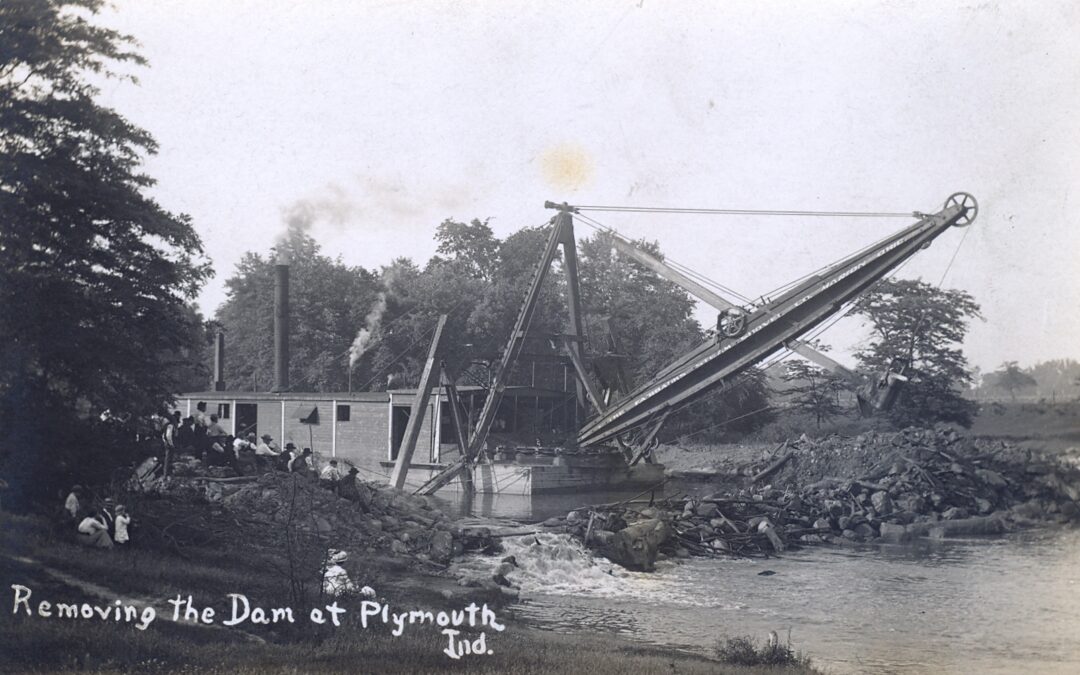
The writer of the article in the directory said the volume of water discharged was enormous, 500 gallons per minute, or 30,000 gallons per hour, and 720 gallons a day. It said that people suffering with rheumatic and dyspeptic complaints greatly benefitted by drinking the water, even before they imagined it was anything more than pure spring water. It was thought that Plymouth could become the Bethesda of the west. The reference was to the pool of Bethesda in Jerusalem, where Jesus healed the paralyzed man. After the removal of the old dam, the flow of water was decreased considerably.

The alleged healing properties were not the only reason people came to the well. A popular pastime was to suspend a metallic object into the well and let it remain for several hours.  Due to the unique properties of the water, the object would become magnetized. Knives, shears, scissors, hooks and small bars of steel became magnetized by being placed in the water. A compass was said to be under its control at a distance of two feet.

Community Renovations

An 1878 newspaper article said that a movement was underway to improve the grounds at the flowing well. The place was called “Magnetic Park” in quotations. They planned to build a bridge across the race and an arbor over the “magnetic flowing well” and to clear and beautify the grounds.  Bailey & Capron agreed to allow the free use of the grounds for the benefit of the public.

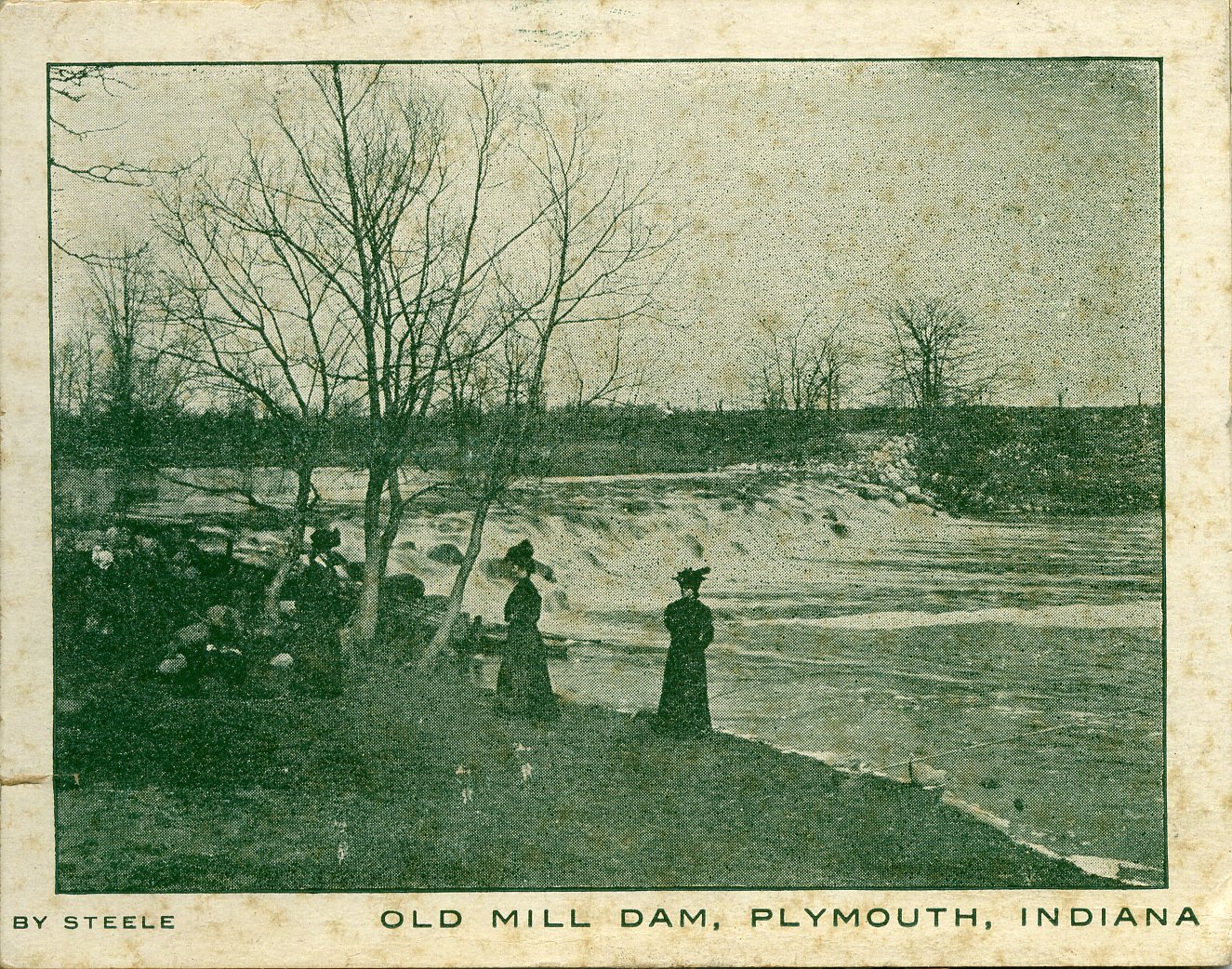
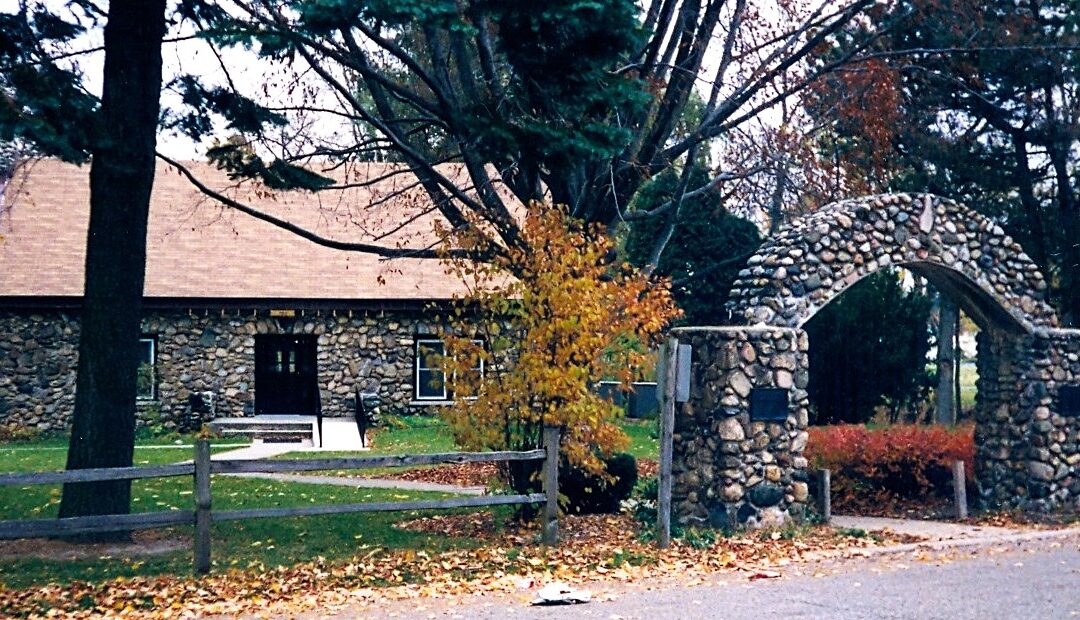
In 1914 a postcard pictured a small wooden shelter around the well, with two ladies in front of it.  Later it was rebuilt with stone and has two identical markers on opposite sides of the structure.  The markers are metal, one foot x two feet. Both markers read: “This shelter house – made possible – by the donations of – Mr. and Mrs. Jacob Price – of – ‘Price’s Steak House’ – erected in 1937 – for the public.”

Two women at the “Old Flowing Well” ca. 1908.

Additional historical markers are located at the park, which is at 700 N. Water St. in Plymouth. Try to find them when you walk through this gem of a park along the Yellow River!

Curious Findings

A 1935 newspaper article discussed the articles found when the WPA cleaned out what was then called the “Old Flowing Well.” The workers reached the bottom of the well and the “relics” were recovered were put on display in the show window of the Eagle building, one door north of the Ball Store, which was at 116 N. Michigan Street.

There were more than 200 items. Among them was a bayonet from an old army musket, thought to be used on a gun during the War of 1812. There are War of 1812 soldiers buried in Marshall County, among them Benjamin Cruzan. Other articles included a gold locket, a silver spoon engraved E.M.E., an unbroken glass goblet and a boy’s pewter whistle which still blew loudly. Of course, there were the usual items like old whiskey bottles. A drive shaft of an automobile was recovered.

Entertainment in the Good Old Days

Entertainment in the Good Old Days

Long before the entertainment overload of today, Marshall County youth had some interesting ways of creating their own fun. They did have theaters, but much of the time, they relied on simple things dictated by what was at hand, our location and the weather. The following collection is from oral histories in our archives.

Performing Arts

“The Orpheum Theater cost a nickel. It was on, oh, just a little way north of Washington Street on Michigan, where the old Orpheum was. They’d have Saturday afternoon matinees for a nickel.  And there were shows, there were some outside shows, tent shows, down on, in the area where the fire station parking lot is now, on the corner of LaPorte and Center Street, just a block south of the library.”  Stanley Brown

Large group of children posing for image on snowy day

The Orpheum Theatre in Plymouth, Indiana.

“About playing piano for the silent movies in Plymouth – When I played, I played for the big sum of $3.00 a week, and six nights a week, 7:00 to 10:00 on the weekdays. On Saturday nights it was seven ‘til 11:00, and it was nickel shows, you know, every night, and we had songs. They used to have sing-a-song, you know, and the words, and the little ball would bounce up. And I’d play for that, and that song came along with the film. We had a girl or boy, a singer, and that was all they done, was sing that song at every show.”  Etta Steiner

 “We had travelling stage shows quite often. They would come and book a week’s time at the opera house.”  Beatrice Pickerl

Seasonal Fun

“We had sleigh ride parties and bobsled parties.  And on the bobsled parties whenever you went under a streetlight, you got to kiss the girl that you were with.  There were not very many streetlights in those days.”  Morris Cressner

Large group of children posing for image on snowy day

Sleighing party for city kids, 1916.

“You’d listen the first morning of cold weather, the first snowy, icy morning, see if you could hear Uncle J. T.’s sleigh bells. Uncle J. lived north of town (Argos), probably a mile and a half, might be two miles. And Uncle J. always had his sleigh out first, and he was the only person that the children of the town, that I knew best, could go riding with without running home and asking their parents. But if Uncle J. had his sleigh, we would go with him, and he’d take us a very nice fast ride down to the Nickel Plate Railroad.”  Beatrice Pickerl

The Joy In the Everyday

“Used to be a train come in and my brother and different ones would walk over to Tyner to see it come in, and I believe every Friday or Saturday night from South Bend. That was a big thing.  It was called the Cannonball. It would come in at 10:00.  And the depot was right below our house here. That was their entertainment, was to come and watch the Cannonball.”  Ray Jacobson

“They had the old [gas] street lights in Plymouth, and a man had to go around with a long pole and pull them down and light them by hand. He’d put a match to them and put them back up.  Kids at night, after they got that light lit – one of our forms of fun was catching bats. There used to be a lot of bats around. They’d fly around those lights. We’d throw our caps up and every once in a while, we’d get a bat in them.”  Stanley Brown

Black and white image of street corner with three story building and a few people walking by. In the forefront, there is a gas lamp hanging from a wire.

Bourbon street scene with gas street light.

Social Get-Togethers

“What progressed into hockey we called shinny. We used sticks and tin cans.”  Homer Riddle

“We used to have spelling bees at the school house. And we’d spell, and the old people as well as the young would be in that, don’t you know. They’d all stand up and then when you missed a word, you sit down, and then the last one that stayed up got a prize.”  Alta Listenberger

“We used to have box socials. The girls would take a box of food and then they’d auction it off and the boy that bought it, he wouldn’t know whose he’s buying, don’t you know, because they’d decorate these boxes up beautiful. And then the boy that bought them would eat with the girl. He wouldn’t know ‘til he got the box unless she’d tell him or, you know, the girl he liked would tell him which was her box. But otherwise they kept that a secret. Sometimes you’d eat with an old man. I’ve ate with old men, you know, some old farmer, instead of eating with the boy I wanted to eat with because he paid the most for the box.”  Alta Listenberger

Learn more about everyday life in Marshall County by visiting our Museum!

The Trail of Death

The Trail of Death

Marshall County has the dubious distinction of being the starting point of the Trail of Death in 1838. The Trail of Death was the forced removal of 859 Potawatomi Indians from Indiana to Kansas. The Trail of Death is not the same as the Trail of Tears, which was the removal of the Cherokee Indians in the southeast United States. Both removals took place the same year in response to the passage of the Indian Removal Act of 1830, which provided legal authority to exchange Indian lands for lands west of the Mississippi River.

A series of three treaties were negotiated with the Potawatomi at the Tippecanoe River on October 26, 1832. Potawatomi land in Illinois, part of Michigan and most of their remaining lands in northwestern and north central Indiana were relinquished to the federal government. In exchange, the bands received small reservation lands for tribal use. This included a joint grant of 22 sections (14,080 acres) of reservation land in the Yellow River area in Marshall County. 

The land was given to four Indian chiefs, No-taw-kah, Pep-i-na-wah, Mac-ka-tah-moah, and Menominee. In the spring of 1836, a treaty was negotiated with the first three chiefs for the sale of their land, but Menominee refused to sell. He said the treaty was fraudulent since the reservation land had originally been awarded to all four chiefs.

Before and After Settlements

The land prior to the organization of the county belonged to the Potawatomi Indians. In 1832 there was a Menominee reservation near Twin Lakes. There were also several other reservations in this part of the country. During that year, the government began offering some of the land they had obtained from the Indians. White settlers began coming in and buying these lands. It was not long until these settlers insisted that the Indians be taken out of the county.

Treaties and Negotiations

The Treaty of Yellow River was made on August 5, 1836 and ultimately led to the forced removal of Menominee’s band from Twin Lakes. Under its terms the Potawatomi ceded all the reservation land that was granted to them under the Treaty of Tippecanoe to the federal government. The Potawatomi who signed the Yellow River treaty also agreed to remove west of the Mississippi River within two years. Menominee and 17 of the Yellow River band did not take part in the negotiations and refused to recognize the treaty’s authority over their land.

On February 11, 1837, the signers reconfirmed the Potawatomi land cessions in Indiana from the treaties of August and September of 1836. They agreed to remove to reservation land on the Osage River, southwest of the Missouri River in present-day Kansas. Again, Menominee refused to sign.

When the August 5, 1838 deadline arrived for the removal of Menominee and his band from Indiana, most of the Potawatomi had already left. Menominee’s group still refused to leave their village. On August 6, the day after the deadline for removal, the Potawatomi were told that they had relinquished their land in Indiana under treaties previously signed and ratified by the United States Senate. The Potawatomi were given no option. The land now belonged to the federal government and the Potawatomi had to remove.

Forced Removal

Indiana governor David Wallace authorized General John Tipton to mobilize a local militia of 100 volunteers to forcibly remove the Potawatomi from their reservation lands. On August 29, 1838 General Tipton and his militia surrounded the village at Twin Lakes. A meeting was called at the village chapel, where the militia took Menominee and the other Potawatomi chiefs into custody. Between August 30 and September 3, Tipton and his men gathered the Potawatomi still living on reservation lands and began preparations for their removal from Indiana.

Huts and wigwams were destroyed. Indians were brought to the village from northern Indiana and southern Michigan to be removed. Soldiers burned crops and destroyed approximately 100 structures to discourage the Potawatomi from returning. The last thing they were permitted to do was to visit the graves of their people, a short distance north of the village.

On September 4, 1838, soldiers started moving the entire band south along the Michigan Road and then west. The forced march became known as the Potawatomi Trail of Death, the single largest Indian removal in the state.  A few people were placed in wagons and those who had ponies were allowed to ride, but most walked, often hustled along by the soldiers. Menominee’s Yellow River band were among those who were force marched from Twin Lakes to Osawatomie, Kansas. Six chiefs, including Menominee, were treated as prisoners and forced to ride in a wagon under armed guard.

Wigwam replica on display in the Marshall County Museum. It is 3/4 size of a true wigwam.

The Trail of Death

The Trail of Death ran from Marshall County near through Rochester, down the Wabash River, and out of the state south of Covington.

The difficult journey covered 665 miles over 61 days in unseasonably hot weather. The caravan included 286 horses and 26 wagons. Water was scarce along much of the trail. The quality of the food supplied was so poor that the volunteer militia refused to eat it and demanded funds to buy their own rations. Of the 859 who began the journey, 756 Potawatomi survived (including Menominee); 42 were recorded as having died, 28 of them children, and the remainder escaped. The Indians were left on a barren plain west of the Mississippi. 

Not all the Potawatomi from Indiana removed to the western United States. Many Potawatomi found ways to remain, primarily those in Michigan. Some remained in the east, while others fled to Michigan, where they became part of the Huron and Pokagon Potawatomi bands. A small group joined an estimated 2,500 Potawatomi in Canada. Others fled to their Odawa neighbors. Anthony Nigo was allowed to stay in Marshall County because his mother was a Miami Indian.  By tribal custom a child belonged to his mother’s tribe, and so, even though his father was a Potawatomi, Anthony did not have to go on the Trail of Death. He became known as the “last Indian in Marshall County.” He lived the rest of his life here and is buried in St. Michael’s Cemetery.

New Treaties

In 1861 the Potawatomi of the Woods Mission Band were offered a new treaty which gave them land in Oklahoma. Those who signed the treaty became the Citizen Band Potawatomi because they were given U.S. citizenship. Their headquarters today are in Shawnee, Oklahoma. After the Civil War, the Potawatomi scattered; many moved to other reservations in Kansas and Oklahoma. A reservation for the Prairie Band Potawatomi is located in Mayetta, Kansas.

Historical Marker for Trail of Death.

A Lucky Find

A state historical marker was erected on 12th Road at the intersection of State Road 17. It is located a couple of miles away from Twin Lakes where the Indians were assembled for the Trail of Death march. The marker was erected by the Indiana Historical Society in 1949. The marker is metal, mounted on a metal pole, and reads:

“Trail of Death. Two miles east, on north bank of Twin Lakes, some 800 Potawatomi Indians were collected in August 1838 and forced to begin their long march to new homes in the west. Many perished on the way. 1949.”

In May 1973 it was discovered that the marker had been stolen. The following April it was found in a vacant apartment in Chicago. It was returned through the efforts of Bertha Stalbaum, curator of the Porter County Museum. Her uncle, John Wohlenberg, had found the plaque as he was cleaning the apartment. It was thought that tenants had moved out, leaving behind evidence of some vandalism sprees, including the marker. The marker was returned to its spot and rededicated on September 16, 1974. Both John Wohlenberg and Bertha Stalbaum were present at that rededication ceremony, along with Paul Hamilton, great-great grandson of Chief Leopold Pokagan.

The marker, as well as the statue of Chief Menominee, can be seen today south of Plymouth. To learn more, you can visit the Museum and see our Historic Crossroads Center.


Large group of people standing around statue of Chief Menominee

Unveiling monument of Chief Menominee with his granddaughter present.