
The Edgerton Basket Factory

The Edgerton Basket Factory

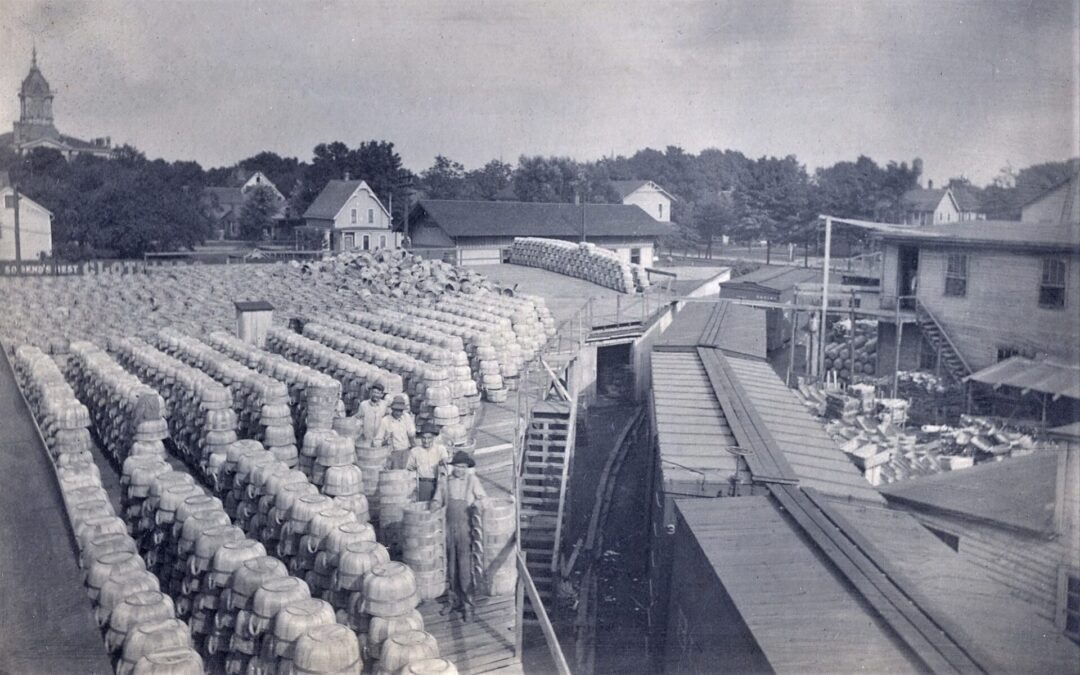
One of the most successful early businesses in Marshall County was the Edgerton Basket Factory. Ease of transportation is critical for growth of trade. And Marshall County, being a crossroads, was attractive to businesses looking for a home. One such was Edgerton Manufacturing, which grew to become the LARGEST BASKET FACTORY in the entire country. Baskets were crucial shipping containers for agricultural products, and Edgerton Baskets were the gold standard.

Peak Volume in 1910

In 1910 alone, 1,632,892 baskets were created. That’s enough baskets to line the road from Niles, MI, to Bloomington, IN, ROUND-TRIP, and still have 45 miles of baskets left over.

At one time, Edgerton offered thirty-nine grades of baskets in 178 different sizes!  Some of these sold as low as thirty cents per dozen, and others as high as $106 per dozen.  This translates to $9.23 to $3,621. per dozen today. There were shipping baskets for fruits, vegetables, crackers, candy and coffee; carrying baskets for coal, lime and cement; round baskets for feeding and cotton picking; reed, splint and diamond weave baskets for clothes; bamboo, splint and diamond weave baskets for delivery, market, display, crockery, satchels or lunch, fancy waste hampers, and all kinds of laundry baskets.
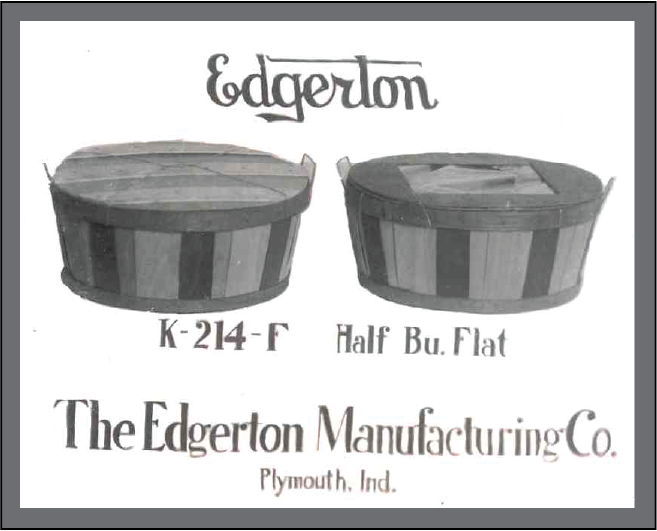
Advertisement for Edgerton Baskets

Local and Imported Woods

The wood varieties used included oak, elm, beech, maple sugar, basswood, poplar, cottonwood, gum, sycamore, ash, hickory and other kinds.  The company imported 55,900 pounds of rattan from Germany at a cost of five cents per pound. Sadly, Edgerton Basket Factory closed their doors in 1939.
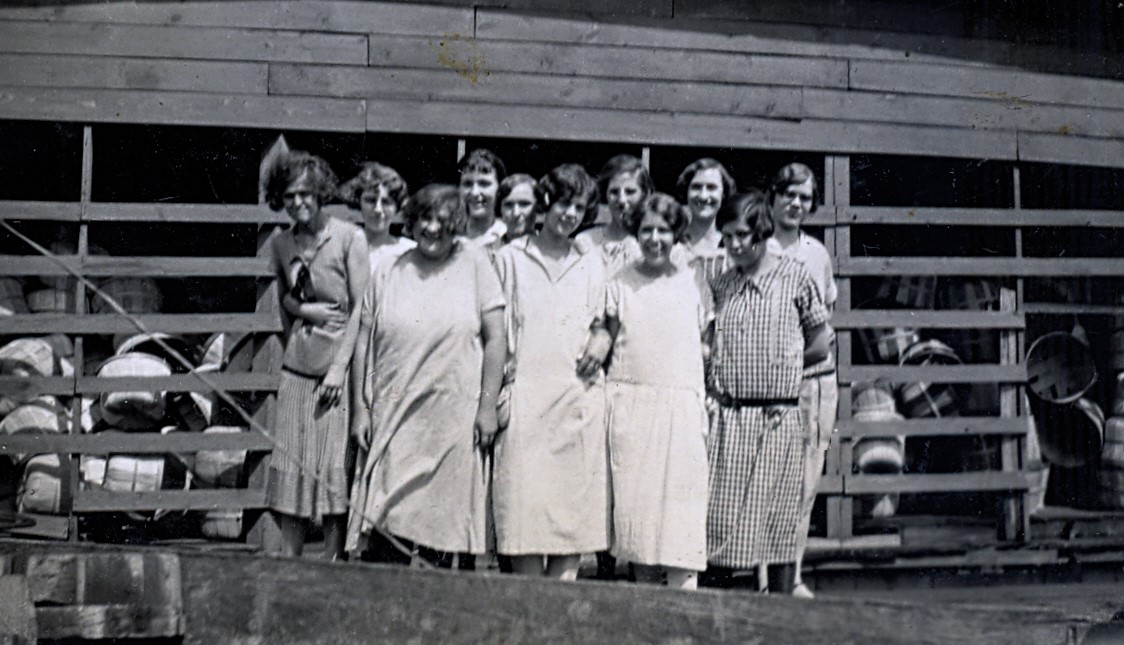
Women employed at Edgerton Basket Company

Ahead of Their Time

Edgerton was unusual for its day in that they actively recruited and employed women and offered insurance as an employment benefit. Just one example of some forward thinking by county residents. A child labor law was passed in 1897 and in May Edgerton discharged all those under the age of fourteen.  It was reported that there were less than a dozen under that age.

At the Marshall County Historical Society Museum, we have the “warning whistle” which was sounded before the startup of the main engine so that anyone working on the line-shafting had time to get down safely.  We also have several beautiful examples of Edgerton baskets. Stop at the front desk the next time you visit and ask to see them.
Home Made Remedies

Home Made Remedies

Quite often something really interesting surfaces as we go about our preservation and archiving efforts. A paper turned up recently with hand-written remedies (and gardening advice), mixed with a couple of newspaper clippings from 1912. There is also a recipe for apple butter! I have included it, but don’t count on it for a cure for anything but dry toast. Please note that these recipes are written as found.

  1. Cure for pneumonia or lung fever: Chopped onion.  Vinegar and graham flour.  Put on stove and heat.
  1. Rheumatism cure: Aunt Clara Barlow.  Iodide of potassium 15ç worth in ½ pint water.  Take 1 tablespoon before meals.
  1. Rheumatism bladder trouble: Fluid extract dandelion ½ oz.  Compound Kargon (a commercial prescription) 1 oz.  Compound syrup of sarsaparilla 3 oz.  Take 1 teaspoon after each meal and at bedtime.  “Is all right for I have taken it.”
  1. Yellow jaundice: Go and get south running water and take one egg.

First day dose:  Take one part of the white of the egg, beat it up with 3 tablespoons of the water and drink it.

Second day dose:  Take another part of the egg white and beat it up with 3 tablespoon of the water and drink.

Third day dose:  Take the last part of the egg white and beat it up with 3 tablespoon of the water.

Use the same egg each day.  The white is in three parts.  And take one part each day.  Sure cure.  1912.

  1. Sore throat cure: Strep throat:  1 qt. hot water.  1 tea. soda.  1 tea. salt.  ¼ tea. carbolic acid.
  1. To keep bugs from melons and pickles: Take a moth ball and break in two and put in bottle around hill.  Or also plant an onion in hill.
  1. To make good apple butter: Boil 30-gallon cider down to 12 or 13 gallons.  Put in 16 gallons sliced apples, few at a time, until all in, and then boil 3 or 4 hours down to about 9 or 10 gallons.  Add 12 ½ lbs. granulated sugar.  Cook until sugar is thoroughly dissolved.

Here is cure for poison ivy that never fails: boil one-half pint of shelled oats in water until the water is real dark.  Then wash the poisoned parts with the water.  It does the work without any pain.  M. L. B., Clark Co., Ind.

Sand and sawdust make a good bed for flowers like the rhododendron, which require an acid soil.

My Coal-Oil Cure-All by S. E. Bandy.

Coal oil (kerosene) is a commodity found in every farm home, yet its many uses and benefits are known only to a few people.  I have saved many a fine watermelon patch from destruction by the striped beetle by mixing coal oil and wood ashes – one part coal oil, by measure, to twenty parts ashes – and putting it on the hills around the roots of the melons.

The coal oil must not touch the vines, and one large spoonful to a hill is sufficient.  The bugs will depart immediately.  It should be repeated after each rain.

A handful of coal oil and salt mixed and dropped into each mole run will cause them to change their location.  A peck of lime thoroughly mixed with a gill (one quarter of a pint, or four ounces) of coal oil and spread lightly around the early cabbage plants will prevent the cutworms from destroying them.  When it is hoed in later, it seems to act as a fertilizer.

With coal oil I cure scaly leg in chickens by applying it directly with a feather.  I also find a mixture of coal and lime used generously around over the chicken house will prevent mites.

We do not recommend trying these remedies at home, but as always, we find that our ancestors were hardy and ingenious people. Our archives are full of the stories of incredible people, and we love to share. Stop by the Museum anytime! Our hours are Tuesday through Saturday from 10 until 4.