
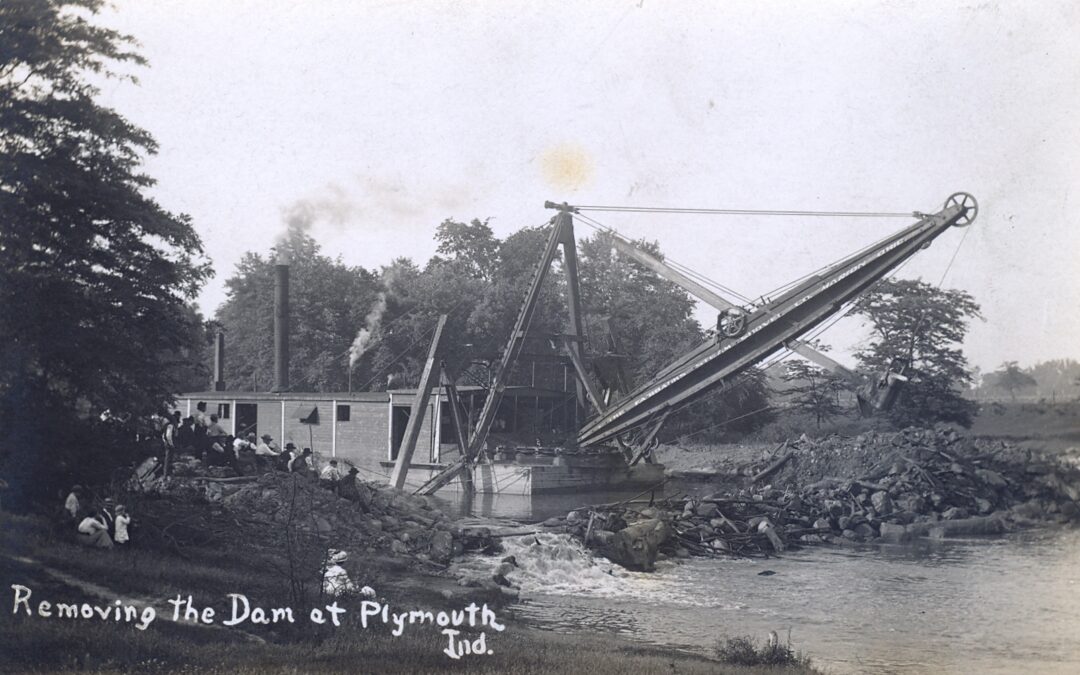
In 1909, Supreme Court of Indiana had ruled in favor of the farmers and cleared the way for the Yellow river to be dredged. This article has been edited from the Plymouth Tribune, December 8, 1910.
Working Around the Clock
Progress on the work of dredging the Yellow river is being completed much faster than was anticipated, either by those who let the contract for the work, or by those who are executing the task. Slightly over one lineal mile of the river’s bed has already been completely dredged since the start of the work on November 9th. Approximately 41,300 cubic yards of earth have been taken from the bed of the river within this mile. An average excavation of seven feet in depth is made in the river’s bottom, extending to a width of fifty-five feet at the bottom. The dredge is located at a point slightly over seven miles east of Plymouth and at the rate of progress now being made, County Surveyor Percy J. Troyer estimates that the dredge will reach the city within eight months and will complete the entire route in fifteen months.
The fire under the boiler of the great dredge is never allowed to go out, and in order to cheat winter and the coming freeze of the river as much as possible, the large crane and bucket are never still. Day and night without pause the dredge and its gang is at work. The outfit has its own electrical plant that illuminates the surroundings sufficiently to carry on the work at night. A gang of twelve men is employed, six on each shift, working twelve hours each. The dredge is in charge of W. A. Schultz of Milwaukee, a member of the dredging firm that has the contract to widen, deepen and straighten the Yellow river for eleven miles of its course, from the point eight miles upstream to three miles below Plymouth.
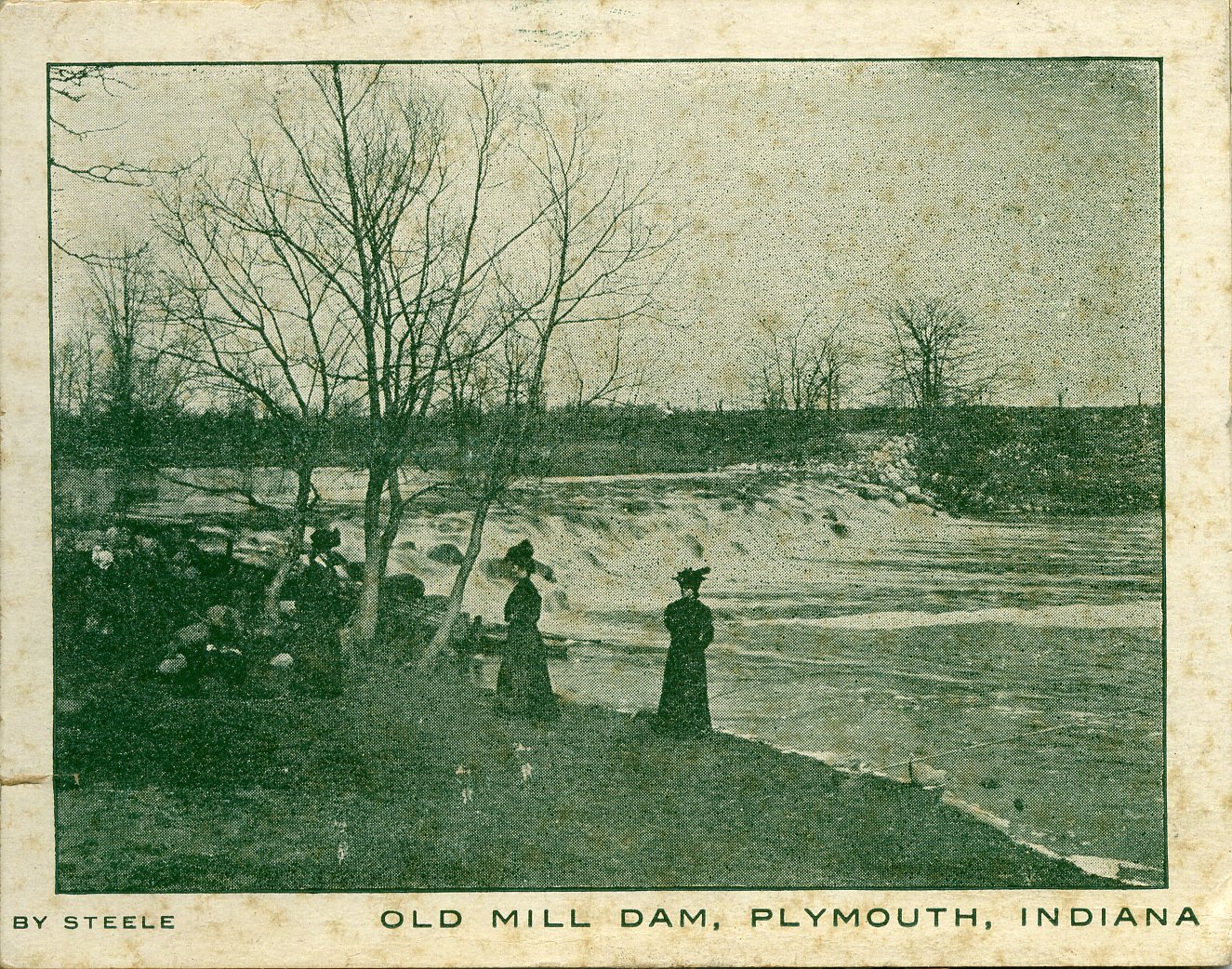
The Mill Dam in Plymouth prior to dredging the Yellow River and removing the dam, ca 1912
The Mechanism Behind Dredging a River
The first change in the course of the river will begin later part of this week. This cut is known as the Nunemaker Cut and will consist of diverting the course of the stream across the ends of a “U” shaped bend. Instead of flowing around the bend, the river will be made to cut across the ends. As a result, all of the land enclosed in the bend, besides the old bed of the river itself, will be reclaimed for farming proposes, as the old bed will be drained by the deeper bed in the new course. The Nunemaker Cut will consist of a lineal cut of 1200 feet, and will necessitate an enormous excavation of earth, as the new riverbed will be laid seven feet lower than the present bed, and as stated above, will be fifty-five feet wide at the bottom. It is estimated that this cut will require somewhat over two weeks. There are two or three more such cuts to be made in the course of the Yellow River dredge.
A wonderful sight might have been witnessed at the work site on Thanksgiving Day, when a feat of engineering skill was executed by the dredge. The sixty-five-foot steel bridge, weighing 12 tons, which spanned the river at that point, was lifted from its abutments, swung around, and deposited upon the bank of the river. The scene of the steel bridge in midair with several workmen standing on the structure to preserve its balance was a novel one, and served to show the power, size and effectiveness of the great dredge. The bridge was bound to the beam of the dredge by steel cables, men were stationed along the floor of the bridge and at the word, the beam was raised. The bridge had to be removed in order to let the dredge pass down the river. After the river had been widened to the required dimensions at this point, the dredge was found to be too short to span the river and the steel structure is still reposing on the bank of the river, seven miles east of town. This bridge is a familiar sight to the boys of the city, many of whom have boasted of skating up to the seven-mile bridge.
Missing Pieces
Of course, we now want to know when and how the bridge was replaced on its abutments, and did it have to be lengthened? Unfortunately, our records do not provide those answers, nor is there any further mention of the bridge sitting beside the river.