
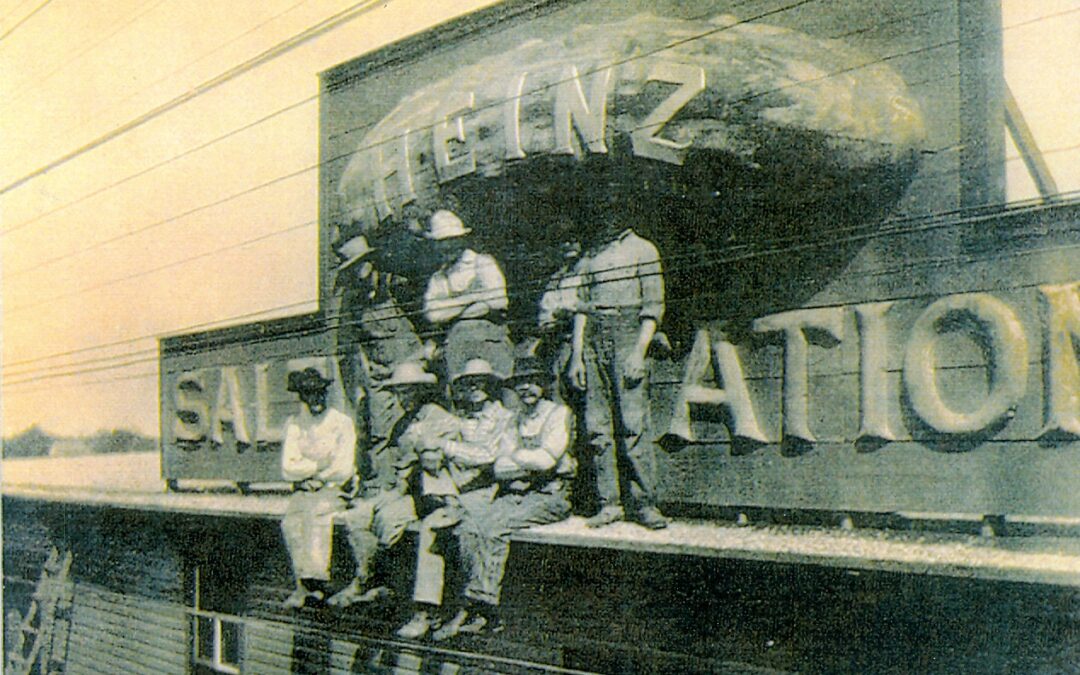
Heinz Tippecanoe workers, undated.
By Dr. Don S. Balka, Board Treasurer
The Marshall County Museum is the repository for old county road tax records. These large legal-size journals contain handwritten listings of property owners, lot numbers, acreages and road taxes. Over the last few years, volunteers have transcribed the holdings for three townships (North, Tippecanoe and West). One interesting property owner appears in journals for these townships in the county, the H. J. Heinz Company of Pittsburgh, PA. Henry John Heinz was the oldest of nine children and grew up in Sharpsburg, PA. Heinz and his cousin Frederick formed F. & J. Heinz Company to produce condiments, pickles, and other prepared food. The well-known ketchup brand was added in 1876 when the new company was formed. In 1888, Henry gained control of the company, renamed the company as H. J. Heinz, and was soon known as the “pickle king.” The phrase that we often see and hear, “57 Varieties,” was added to the brand in 1892. H. J. Heinz died in 1919 at the age of 75. His son Howard took control of the company until 1941, when H. J. Heinz II (Jack) took the reins. This family member began his career with the company at the Plymouth plant as a pickle-salter for $1 per day.
According to Flickr, a Heinz salting operation began in LaPaz in 1897, on the north side of the B & O train tracks across from the train depot and on the east side of Michigan Road. Road taxes are listed in the North Township ledger for 1898. Other properties in the township with their taxes are listed for 1900, 1901, 1902 and 1904. The postcard views shown below are from Hoosier Recollections.
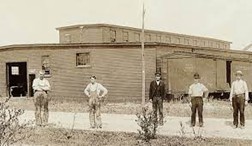
Postcard from Hoosier Recollections.
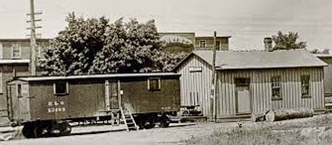
Postcard from Hoosier Recollections.
For Tippecanoe Township, the earliest listing was 1905, stopping in 1918, with several missing years in between. The earliest journal listing for West Township was 1902, with yearly entries through 1914. Although lot numbers are provided in the journals, the exact locations of the properties are difficult to determine. Cucumbers and tomatoes were the crops. Acreages for the fifty-nine lots (with duplications) listed in the ledgers for the three townships were all one acre or less.
Based on the following information, county farmers contracted to raise cucumbers and tomatoes on their own farms. The Plymouth Tribune (March 24, 1904) printed an ad for the company: “Persons in Marshall county desiring contracts to supply the H.J. Heinz Co. with pickles the coming season may obtain them at the store of Haag Brothers, Plymouth, Ind.”
The Indian Historical Bureau provides a publication entitled Untold Indiana. It contains stories about the H. J. Heinz Company from the Argos Reflector and the Bremen Inquirer. In May 1944, the Argos Reflector reported that H. J. Heinz Co. had leased a 300-acre farm north of Argos in Marshall County, “as part of their program to insure delivery of war time food commitments.” According to the Reflector, this was the company’s “largest venture in the country.” Cucumbers were planted on 114 acres of the farm, “one of the largest items of the company’s list of 57 processed foods.” The article reported that the company produced “about half” of the cucumbers provided to the U. S. Navy where “pickles are an everyday part of the sailor’s menu.”
The Reflector reported that the company was constructing forty “bunk houses” for “an estimated 200 Mexican field laborers.” The workers would harvest the cucumber crop and then would be offered jobs “in the tomato fields.” The newspaper article described the laborers both as “Mexicans” and “migrant workers,” However, the fact that the company was building housing meant that they were fulfilling the contract requirements for government-placed Bracero workers. The Bracero Program was a government-sponsored program that imported seasonal farm workers (Braceros) into the United States between the years 1942 and 1964. The program was designed to fill agriculture shortages that started during World War II. According to an Indianapolis Star article, these field workers made $3.10 to $3.50 per day. The poster below “Bittersweet Harvest: The Bracero Program 1942-1964,” is from the National Museum of American History in Washington, DC.
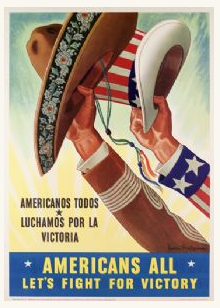
“Bittersweet Harvest: The Bracero Program 1942-1964,” from the National Museum of American History.
The Bremen Enquirer reported additional Bracero Program information on living conditions, noting that employers must guarantee “adequate housing, health and sanitary facilities.” This meant only three workers, or a four-person family, could live in a 12 by 14-foot space with “facilities for cooking, sleeping, laundry, bathing and adequate sanitary toilets and means of waste disposal.”
Interesting aspects of Marshall County history are available to you at the Museum. Visit us Tuesday through Saturday from 10 to 4. Remember how, once upon a time, those H. J. Heinz pickles and ketchup products came from your county.