
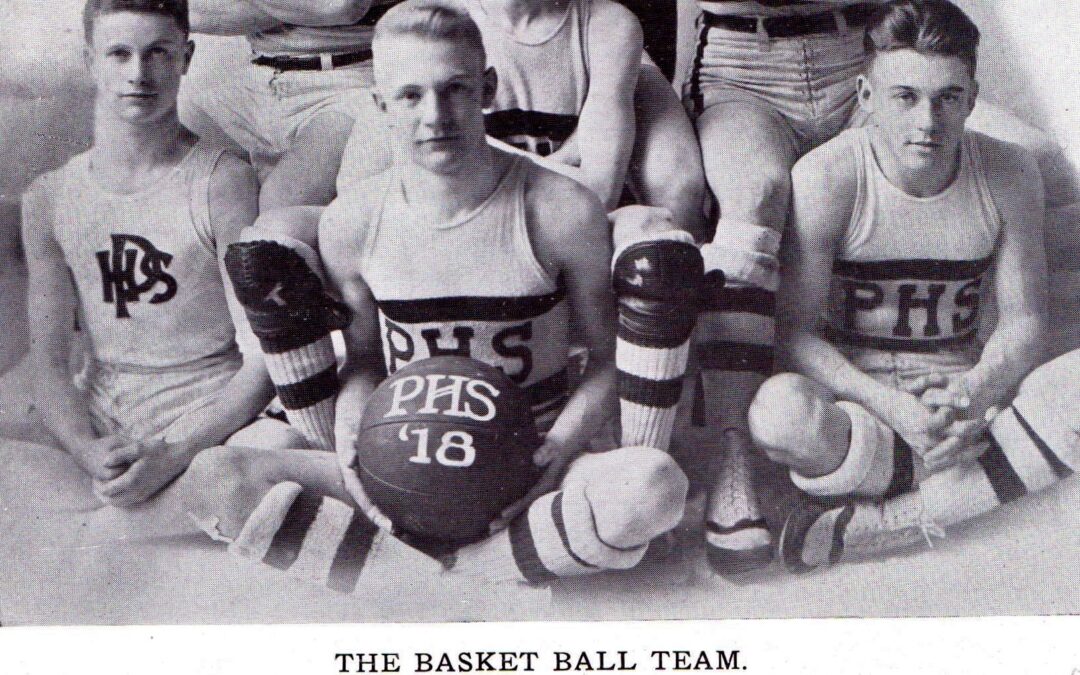
1918 Plymouth High School Basketball Team, Switzer on left.
George Switzer was born in Plymouth in 1900. He was a talented artist and at age 16 was chosen to illustrate the book, Centennial History of Indiana, by Judge John Kitch. George went on to graduate as the president of his class and studied psychology at the University of Illinois. He distinguished himself there as president of the arts and psychology fraternities, and as art director of campus publications. His first design business was launched when he successfully bid against Chicago firms for the decorations used in the college dances.
From college, George worked as a Bible salesman, where again, he excelled by doubling the business in 16 months. His desire to work in an artistic way led him to accept a job as an industrial designer. His work in Chicago led to an offer from an advertising firm in New York where he designed everything from envelope stickers to messengers’ uniforms and delivery trucks. Having made his name, Switzer opened his own office in 1929 as a designer and consultant. He subsequently worked for 65 American companies, and shortly opened an office in Paris, France. He designed a variety of things including letterhead, sausage labels and a Rolls-Royce automobile body. Switzer was instrumental in organizing the 1937 Exhibitions on Modern Packaging and Materials show in New York. He also promoted packaging shows in the U.S. and France. He won several awards for his designs internationally as well as stateside.
George passed away in 1940 following surgery for mastoiditis. His funeral was conducted in the Presbyterian church, and he is buried at Oakhill Cemetery. The print obituaries in the Museum’s archive summarize his life well, but it is the extra artifacts in the file that tell the real story. An article from a New York newspaper shares several nuggets about George:
“He still drawls, he still says mebbe for maybe. He might have been a farmer, except for one summer when he was nine years old, he ‘rented a piece of land from grandfather. I hoed and planted and watered all summer. The other kids were playing baseball or swimmin’. I kept careful books and at the end of the summer I had made 37 cents for four month’s work. I never wanted to be a farmer after that…’
“His interests range all over the earth: from re-designing ocean liners ‘so that folks will feel more like they are out on the seas that pirates used to roam over, instead of safe and sound in an apartment hotel…’ From that field, his interests range to ‘working out an art program for high schools…I am experimenting with it back in my hometown sort of…it’s based on a pretty simple idea that sounds sort of screwy when I say it, but here it is: Just teach kids that every place they leave, ought to be made more beautiful for their having been there.’”
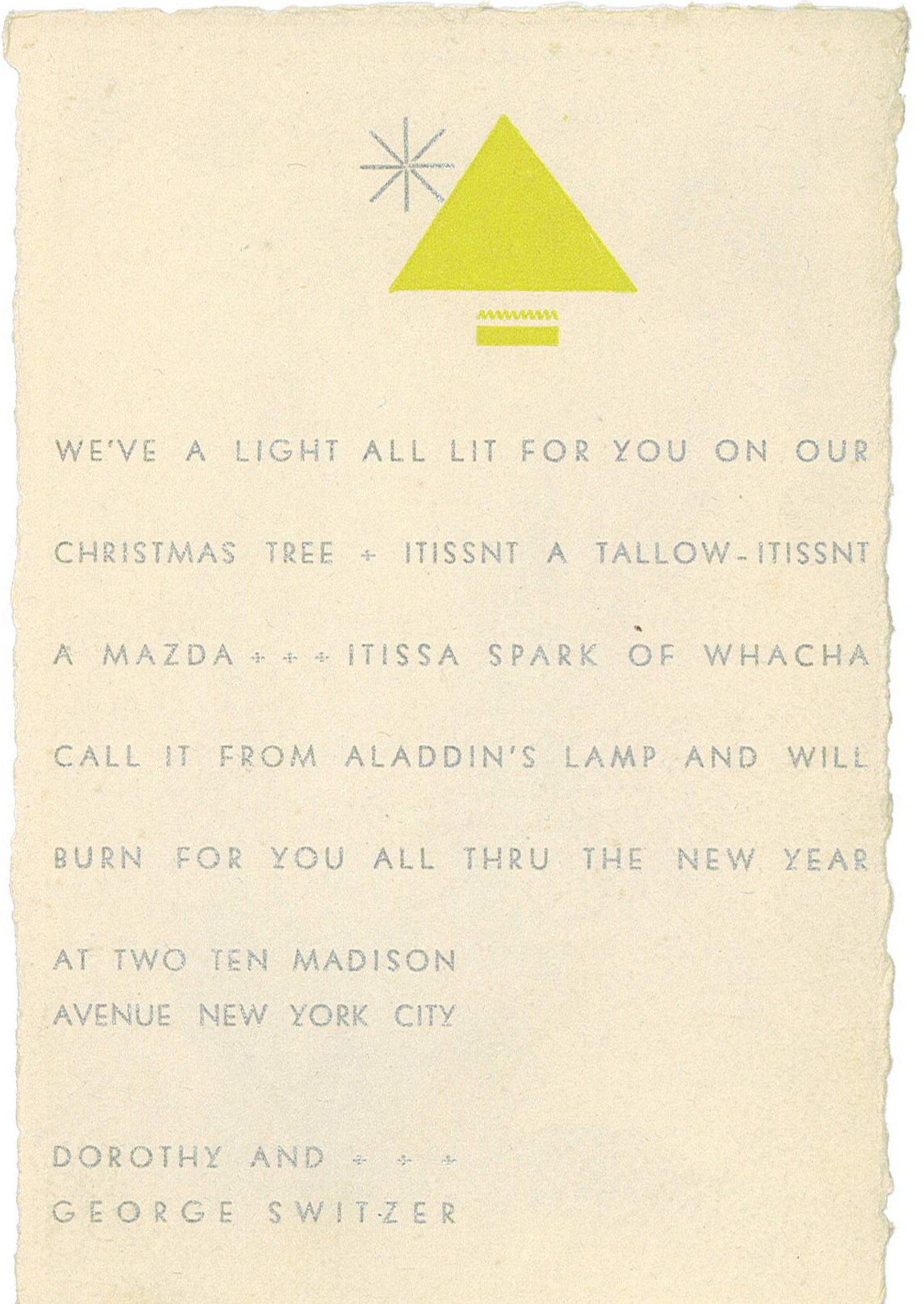
Christmas Card by George Switzer.
George never forgot his hometown and remained close to his Plymouth family throughout his life. Our archive includes letters to his aunts and an amazing collection of hand-made Christmas cards. His designs are as imaginative and fresh now as they were when created in the 1920s and ‘30s. Each year George created a sophisticated work of art, very much in the art deco style of the day. He used metallic papers and inks, embossed detail, intricate folds and handwritten verse. In these days of digital greetings, these pieces of art are all the more charming.
This is just one file in the Marshall County Museum’s archives, and one more story of a life that made an impact. We are privileged to preserve these items to tell our collective story! Come visit this holiday season. The Museum is open located at 123 N. Michigan St., Plymouth, and open Tuesday – Saturday, 10-4.