
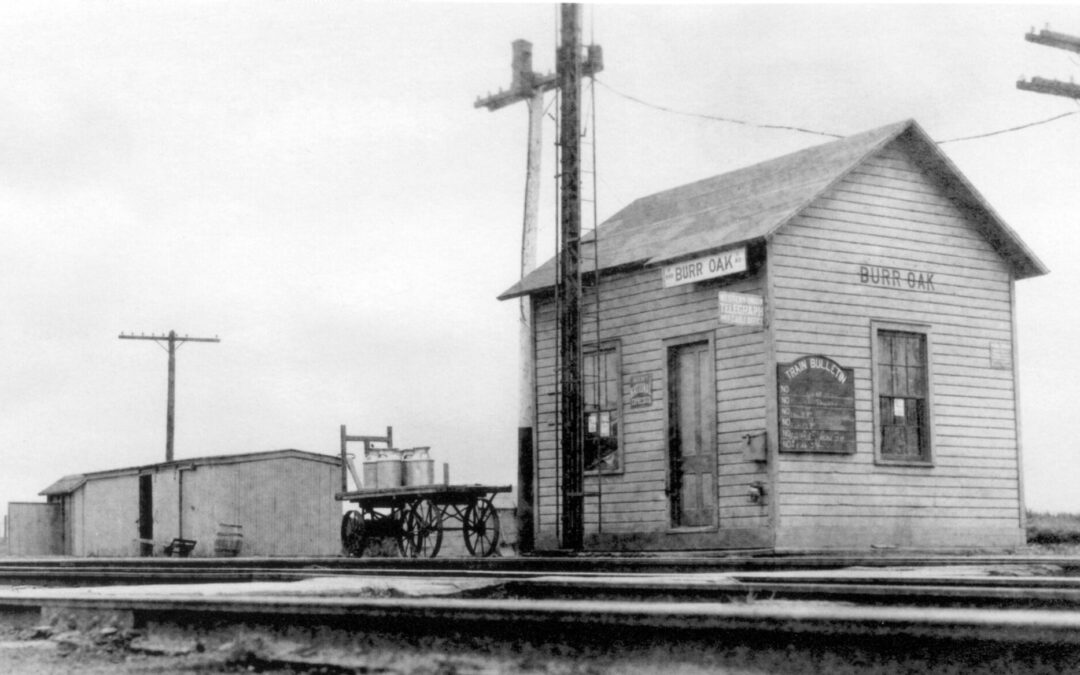
Burr Oak Depot, undated.
The information below comes from the Indianapolis Star Magazine, November 18, 1956, and the Culver Citizen of September 18 and 25, 1957.
Early Life of George Thornburg
George Edgar Thornburg was born at Stillwell, IN on April 3, 1891, one of four children of William Henry and Malinda (Kaser) Thornburg. By the time George was 9 years old, the family was living in the LaPaz area.
He married Amanda Lodema Strang on May 17, 1910, and they made their home in Burr Oak. They had five daughters, Opal, Elwyn, Kathryn, Mary Jane and Ramona. All five daughters grew to adulthood, married and lived in Marshall County.
A Career In Railroading
Thornburg went into “railroading” in 1910 and would have a 47-year career. Since telegraphy was the up and coming thing, he started by watching the telegraph key at the local junction in LaPaz. After George had mastered the code, he and his cousin rigged a line between their houses and practiced sending messages.
After a brief interval as a streetcar conductor in South Bend, he came back to the steam locomotives. ‘There’s something about a railroad,” he stated. So many people at that time felt the pull of the railroads.
At the time employees of the railroad worked nine hours, seven days a week. If the freight loads were heavy, the shift might stretch to 12 hours. Trains were dispatched by orders telegraphed ahead to each station. Thornburg would receive the orders, fasten them to a hook at the end of a long pole and hand them up to the engineer. If the train was not scheduled to stop at the station, he had to move fast, for the train’s speed would not slacken as the locomotive thundered past. Sometimes the orders involved two engineers, and he would have to get the orders to both.
Thornburg was employed by the Nickel Plate Railroad as an agent first at Ober, then Hibbard, then Burr Oak. In 1954 he was transferred to Hibbard again.
Memorable Days On the Railroad
In 1917 he said he saw a derailment, “and it was plenty for a lifetime.” A wreck occurred on August 30 of that year, described in the Bremen Enquirer of September 6, 1917. An arch bar broke under a car in a long line of cars going about 30 miles an hour. Fifteen freight cars were smashed to pieces and piled up along the south side of the B & O track near the bridge over the Yellow River a mile and a half west of Bremen. Oats, sugar, agricultural implements and various freight were all mixed up. Fortunately, no one was hurt. It was several days before the wreckage was cleaned up.
Thornburg did get to meet a celebrity, the well-known opera singer Mme. Schumann-Heink, whose son attended Culver Military Academy. George said she “had a nice way, pleasant and not a bit put on.” Tycoons then often travelled by private railroad car, and Thornburg would occasionally be the recipient of some delicious food shared by their chefs. On occasion a hobo would sneak in for a nap on a bench in the waiting room.
In the 1950s some Culver Military Academy students still used the Nickel Plate Railway station at the Hibbard depot, which was a flag stop. He would have to handle the luggage and make sure no items were left behind by the boys.
George Thornburg's Everyday Duties
Eventually the telephone and automatic signals replaced the skills of telegraphy and teletyping. But Thornburg still had to sell tickets and keep up with paperwork for baggage and freight. He had to receive the mail from trains that did not stop. He was sometimes helped in this by “a youthful assistant, Bobby Albert.” Bob Albert would grow up to work for the railroad and as a lifelong train enthusiast, still volunteers at the railroad museum.
Thornburg also had the regular duties of keeping the station swept, the waiting room benches dusted and the potbellied stove ready for a fire. A phone call would tell him if the train was on schedule. If a taxi was requested, he would call a cab company in Culver. When passengers wanted to board the train, Thornburg would put on his billed railroad cap and step out well ahead of the train to flag for a stop. He also figured tickets and helped plan trips. The longest ticket he ever sold was a 13-coupon ticket to Vancouver. He said he prided himself on being a good consultant and had a flair for scenic routes.
An important duty for Thornburg was that he had to closely inspect every passing wheel for “hotboxes,” an axle bearing that became excessively hot due to friction. If one got hot enough to burn out a journal bearing (a plain bearing without rolling elements), or a journal box, which housed the journal bearing, it could cause a wreck.
A Tragic Ending
On Monday, September 16, 1957, Thornburg said he called the Culver Citizen with a heavy heart to report bad news. He had received a telegram: “On and after September 24 all business in the Hibbard and Burr Oak stations will be handled at Knox. Tuesday, September 23 will be the last day that the Hibbard station will be open to the public.” This was perhaps the saddest disappointment of his long life of service.
But he never had to see the closing of the Hibbard station. A week before it was scheduled to close, he passed away of coronary thrombosis while sitting in a chair in his home at Burr Oak on the morning of September 18, 1957. Can a person die of a broken heart? If so, perhaps George Thornburg did. George Thornburg was faithful to his job working for the railroad for 47 years. He was a true railroad devotee.
Marshall County’s history is full of great stories about the people and events that shaped our area. The Marshall County Historical Society & Museum offers the opportunity to research and learn about our forebears. We are open from 10:00 until 4:00, Tuesday through Saturday, at 123 N. Michigan St., Plymouth. Call us at 574-936-2306.