
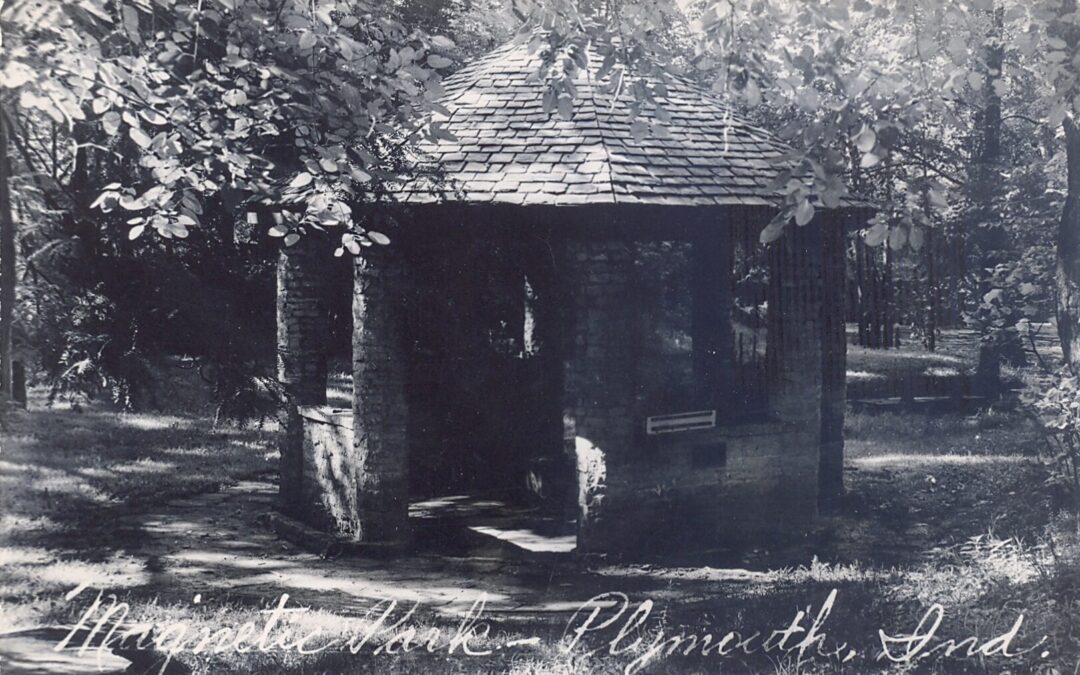
Plymouth’s Magnetic Park should be a top stop on a tour of Marshall County. Located along the Yellow River, Magnetic Park has a fascinating history.
Creating the Well
Magnetic Park gets its name from the flowing well of magnetic water. It is 11 inches in diameter and 38 feet deep, with a pipe that is 12 inches in diameter.
The well was driven in 1875 by Bailey & Capron, the owners of the Plymouth Water Mills. A horsepower tread was used to operate the drive hammer. The well was dug with the idea that an underground river would be found, into which the water from the mill race could be drained, giving more power to the water turbine. Instead, a gushing stream of water spouted eight feet high above the top of the well. Mr. Bailey commented, “Of all the wells I’ve driven this is the first one I wanted the water to run into and here the water is running out.”
A Magnetic Discovery
In 1876 Holland’s City Directory was talking about how clear and cold the water was. At first no one knew about the well’s magnetic properties, but it was shortly to be discovered. The directory stated that recent tests showed that the water was highly charged with magnetism and was possessed of medicinal and curative properties in an eminent degree. It stated, “It is without doubt the largest and finest flow of magnetic water in the world!”
Magnetic wells appear in area where the ground has a lot of iron. Soil can also be slightly magnetic. This is true of Marshall County. At one time, we had a place called Sligo where bog iron was processed. We will share an article about Sligo soon. To be fair, some believe that a magnetic water is not possible, but that the iron oxide that gathered around the mouth of the well dictated the name “magnetic” at that time.
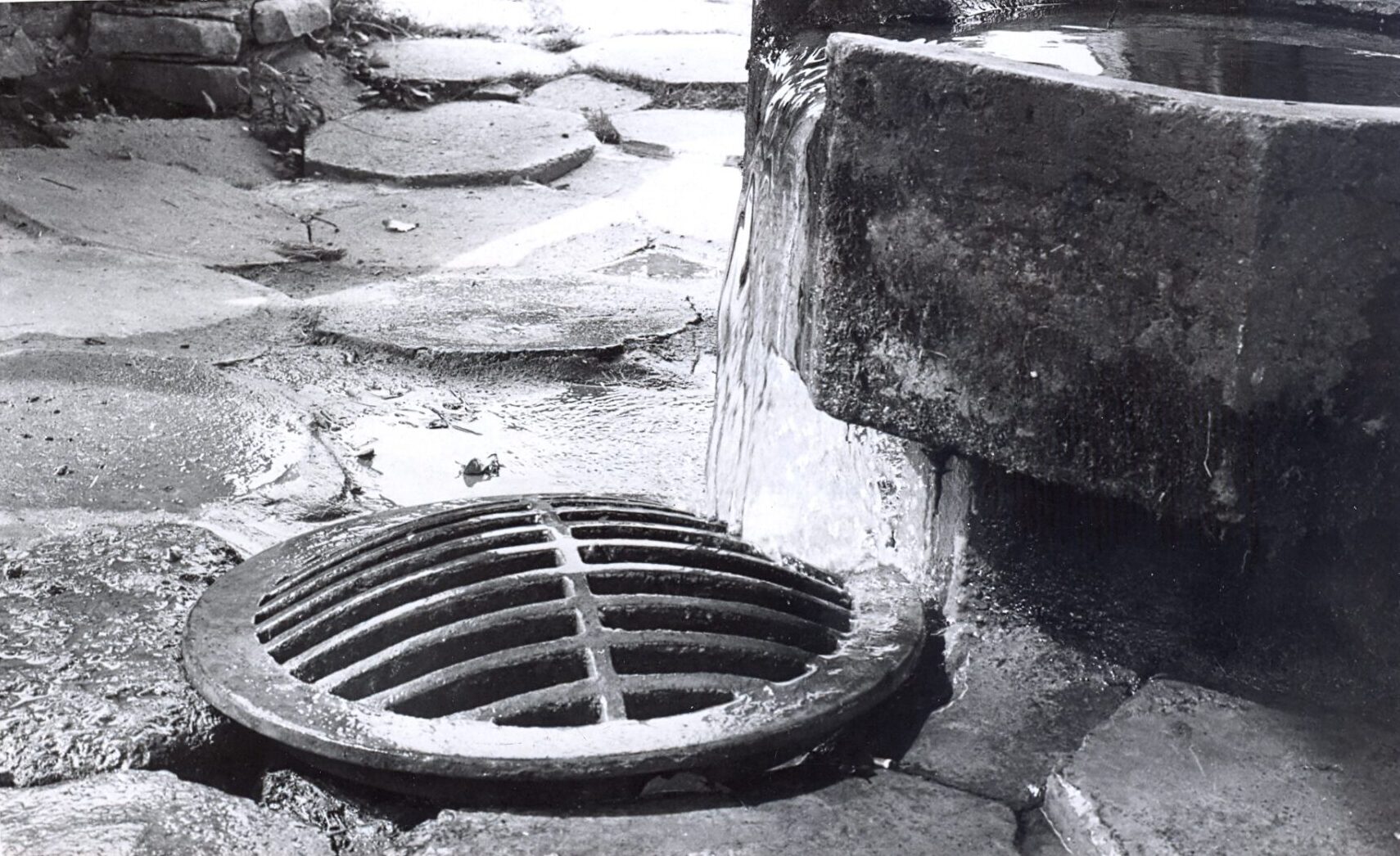
Magnetic Well flowing into drain.
Healing Properties and Pastimes
The writer of the article in the directory said the volume of water discharged was enormous, 500 gallons per minute, or 30,000 gallons per hour, and 720 gallons a day. It said that people suffering with rheumatic and dyspeptic complaints greatly benefitted by drinking the water, even before they imagined it was anything more than pure spring water. It was thought that Plymouth could become the Bethesda of the west. The reference was to the pool of Bethesda in Jerusalem, where Jesus healed the paralyzed man. After the removal of the old dam, the flow of water was decreased considerably.
The alleged healing properties were not the only reason people came to the well. A popular pastime was to suspend a metallic object into the well and let it remain for several hours. Due to the unique properties of the water, the object would become magnetized. Knives, shears, scissors, hooks and small bars of steel became magnetized by being placed in the water. A compass was said to be under its control at a distance of two feet.
Community Renovations
An 1878 newspaper article said that a movement was underway to improve the grounds at the flowing well. The place was called “Magnetic Park” in quotations. They planned to build a bridge across the race and an arbor over the “magnetic flowing well” and to clear and beautify the grounds. Bailey & Capron agreed to allow the free use of the grounds for the benefit of the public.
In 1914 a postcard pictured a small wooden shelter around the well, with two ladies in front of it. Later it was rebuilt with stone and has two identical markers on opposite sides of the structure. The markers are metal, one foot x two feet. Both markers read: “This shelter house – made possible – by the donations of – Mr. and Mrs. Jacob Price – of – ‘Price’s Steak House’ – erected in 1937 – for the public.”
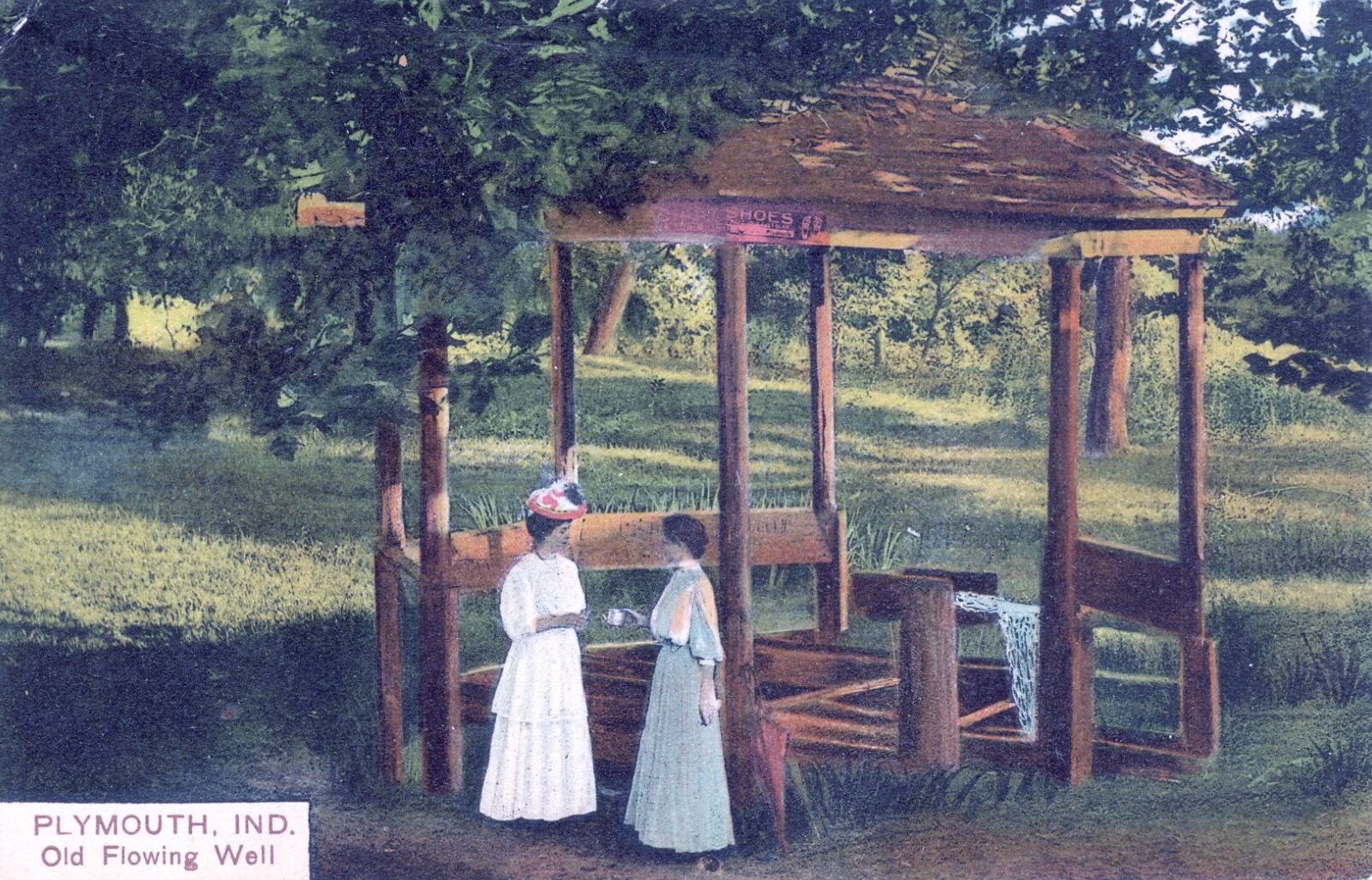
Two women at the “Old Flowing Well” ca. 1908.
Additional historical markers are located at the park, which is at 700 N. Water St. in Plymouth. Try to find them when you walk through this gem of a park along the Yellow River!
Curious Findings
A 1935 newspaper article discussed the articles found when the WPA cleaned out what was then called the “Old Flowing Well.” The workers reached the bottom of the well and the “relics” were recovered were put on display in the show window of the Eagle building, one door north of the Ball Store, which was at 116 N. Michigan Street.
There were more than 200 items. Among them was a bayonet from an old army musket, thought to be used on a gun during the War of 1812. There are War of 1812 soldiers buried in Marshall County, among them Benjamin Cruzan. Other articles included a gold locket, a silver spoon engraved E.M.E., an unbroken glass goblet and a boy’s pewter whistle which still blew loudly. Of course, there were the usual items like old whiskey bottles. A drive shaft of an automobile was recovered.