
Norman S. Woodward was 83 years old on December 11, 1911. He had lived in Plymouth for longer than anyone else at that time. A Weekly Republican reporter asked him “How does it feel to be 83?” “Oh, I have no reason to complain” was his reply. The interview that followed was full of stories about the earliest days of Marshall County. I will share just a few.
Mr. Woodward was known to have a mind “as bright as a silver dollar” and was frequently asked to settle disputes dating back before formal records were kept in Marshall County. He knew the given names and initials of men who lived back in the 1830s and 1840s. He knew the first officers of the county, things in the city, the cemeteries, the politics, the markets, the money used, and the facts of every character.
“I came to Plymouth on May 1, 1835, with my father and uncle,” said Mr. Woodward. “I was then only six years old, but I remember everything as distinctly as though it were yesterday.” At the time there were only five houses in the town without a name. Chester Rose ran a little store on the site at the corner of what is now Center and LaPorte Streets. Grove Pomeroy had the hotel at 101 N. Michigan. The hotel housed the Yellow River Post Office. Mail came once a week via horseback carrier, on a route that ran from Logansport to Niles, MI.
At that time, the county was unorganized and there were only a few white people among the many Indians. Five miles north, the first house belonged to Peter Schroeder, who was later elected the first probate judge in Marshall County. A half mile further north lived Adam Vinnedge, the first county treasurer. As Mr. Woodward states, “These people were curious to see us as we were Yankees, having moved to Indiana from Vermont. My uncle and father traded a wagon and some of their horses for 80 acres of Michigan Road lands.”
“In August of that year was the great Government land sale at LaPorte. Uncle and father went there to buy land. They went nearly to LaPorte before they saw a white man. At the Kankakee River the bridge was gone all but the stringers. Father and Uncle had their money in French francs and Mexican dollars, and it was quite a burden. The problem of crossing the Kankakee on stringers was a hard one. My father got across with his money, but Uncle could not do it. Father came back and got Uncle’s money and carried it across. Still Uncle could not make it. Father then saw a boat downstream. Leaving the money on the bank, he went and got the boat and took Uncle across. They bought their land for $1.25 an acre. Our home then became the farm now located just a half-mile north of the Brightside Orphanage on the west side of the road.”
“It is hard today to understand the hardships of that time,” said Mr. Woodward. “There was no food, no money, no market for anything if there had been anything to sell. My father went twenty-one miles beyond Logansport to Delphi to get grain ground for corn meal. That was the closest mill. Near there we bought some white corn and had it ground, but they did not “bolt” the meal then as hey do now, and mother had to sift it.” Bolting refers to a machine that had spinning screens that sifts the grain. He continues, “We had some cows, and hogs ran wild and fattened on the nuts in the forest. These pigs were shot for meat and game of all kind was plentiful. Neighbors would kill a beef at different times and divide with each other, trading back and forth. There was no market closer than Michigan City where we hauled our wheat. The price was 31 cents a bushel and later we got 40 cents. In a few years there was a mill at Bertrand, a mile north of South Bend, and people hauled their wheat there to be ground.”
Marshall County's First Election
“The first election was in the fall (1836) to organize the county. They called the town “Plymouth” after the New England Plymouth Rock. All the people of the county voted at Plymouth, though one could vote at any place he could find a voting place. I watched them vote. A man would come to the voting place and be asked how he wanted to vote. He would tell the name of his candidate, and the vote would be written down by the clerk. There were 83 votes in Center Township. In those days it was about an even split between the Whigs and the Democrats.
“A.L. Wheeler was the first man to run a real dry goods and general merchandise store. In the back part of his store were pails of New England rum for voters. In the rum had been put some “Black-strap” molasses, and all who wished, boys as well as men, could go there and drink. But there was never any drunkenness. It seemed that the human system needed whiskey to kill off the malaria so prevalent in those early days, and it being pure whiskey, did not affect them as now.
“The courthouse was at first a small wooden building located where Welcome Miller now resides on Michigan Street. The present site was donated to the county and that is the reason the building stands where it does today.
“On the present site of the Washington School building was the first cemetery. When they wanted to build the schoolhouse, they moved the bodies and made a new cemetery on the spot now occupied by the Pennsylvania Depot. When the railroad came to Plymouth, it passed directly through this cemetery and the bodies were again taken up and moved to the Stringer Cemetery and the present Oak Hill. My father was buried in the cemetery when it was located at the Pennsylvania Depot site.”
Woodward Joins the Gold Rush
In 1852, Woodward joined the thousands of daring men who crossed the plains to California, hunting gold. He and his companions made the trip in a wagon pulled by oxen. “We started in March,” said Woodward, “and on April 24 we crossed the Missouri River. At Fort Carney, we saw the first white people. From there it was 500 miles to Fort Laramie, the next white settlement.”
While crossing the plain, the group saw one of the most thrilling sites on their journey – a huge herd of buffalo stretching as far as the eye could see. The travelers let them pass, as it was too dangerous to get in front of them. “I bought two fine black buffalo hides from the Indians,” said Woodward. “They were nicely tanned and splendid ones in every way. I paid two cups of sugar for them.
“In July we arrived in Sacramento City, and there on Jay Street I met Charles Crocker, a Plymouth man, who afterwards become a millionaire gold miner.” For about two years, Woodward and his companions prospected, and during that time they “struck it rich” and were able to come back home with several thousand dollars in gold.
“Nobody trusted the banks in those times,” said Woodward, “so we all carried our money around our bodies in belts. My companions arranged to come home by way of Panama and had chosen the steamer Yankee Blade from San Francisco. Before we started, we met a friend who was also coming home that way and he advised us to take the steamer Sonora instead, because, he said, there is going to be racing between the boats and it is dangerous to go on the Yankee Blade. We took his advice and luckily so, for the Yankee Blade struck a rock and went down with all aboard on that very trip.
“Arriving at Panama, the ship came to anchor three miles out to sea and natives in boats came and took us within ten feet of the shore, where they stopped, and naked natives came and carried us ashore on their backs. There were 1400 on the boat.
“The first seven miles of the way across the isthmus was as fine as a paved road as I ever saw. Bolivar had made it when the Spaniards were in control, from the pebbles of the seashore. The railroad covered only 25 of the 50 miles across the isthmus, and we had to walk the rest of the way. In rained continuously. Finally, we came to the railway, a little narrow gauge one, but only about 600 of us could get on the train. The conductor promised to come back the next day, however, and take us. He came on the third day, and we were soon at the seashore. Here, the hundreds of passengers went pell mell over each other to see who could be the first to the ship and get the best berths. There was no order or direction of the passengers. Everybody took the best he could get.
“An awful storm overtook our vessel off of Cape Hatteras, and for many hours we saw our ship climb up and down the monster waves, expecting every one to go over her and send us to the depths of the sea. She rode it out however, but even after repairs in dock, sprung a leak on her next voyage and went down with a third of her passengers.”
Personal Life
While in San Francisco, Mr. Woodward met Henry Humrichouser, who would later become his brother-in-law, and they made the trip home together. Mr. Woodward was back in Plymouth in 1854. He became smitten with his friend’s sister, Miss Elizabeth Hunrichouser when she visited from Ohio. They were married on September 1, 1855. In the spring of that same year, he and H.B. Pershing started a drug store on the spot where Tanner’s drug store was at 122 N. Michigan Street. After a year, Mr. Woodward sold his share of the drug store to Mr. Pershing. He then started the first bakery in Plymouth at 106 N. Michigan Street. “One of those who worked for me at that time was H.W. Hill,” said Mr. Woodward. “But I was not long in the business for in March 1856 the whole town burned down, and my business with it.”
He continues “After this I bought the lot where the Star Restaurant is now (116 N. Michigan Street) and opened a little grocery store. In 1857, the Pittsburgh railway was being built through and I sold much supplies to the men. But the company went broke and could not pay its hands, so I could not get my pay, and bankruptcy stared me in the face. The company, however, agreed to pay its men in stock of the railroad. Mr. A.L. Wheeler came to me and said for me to take all the stock I could get from the men, and he would give me 25 cents on the dollar. I did so, and got much of it, paying 20 cents on the dollar. Some of it I kept, but most of it I turned over to Wheeler because I had to have money to buy goods with. Later this stock went up to $1.55 on the hundred and I sold all I had at that price, which made me a neat sum to continue my business. Wheeler, who had a large amount of the stock, sold it at the same price, and made a barrel of money out of it.”
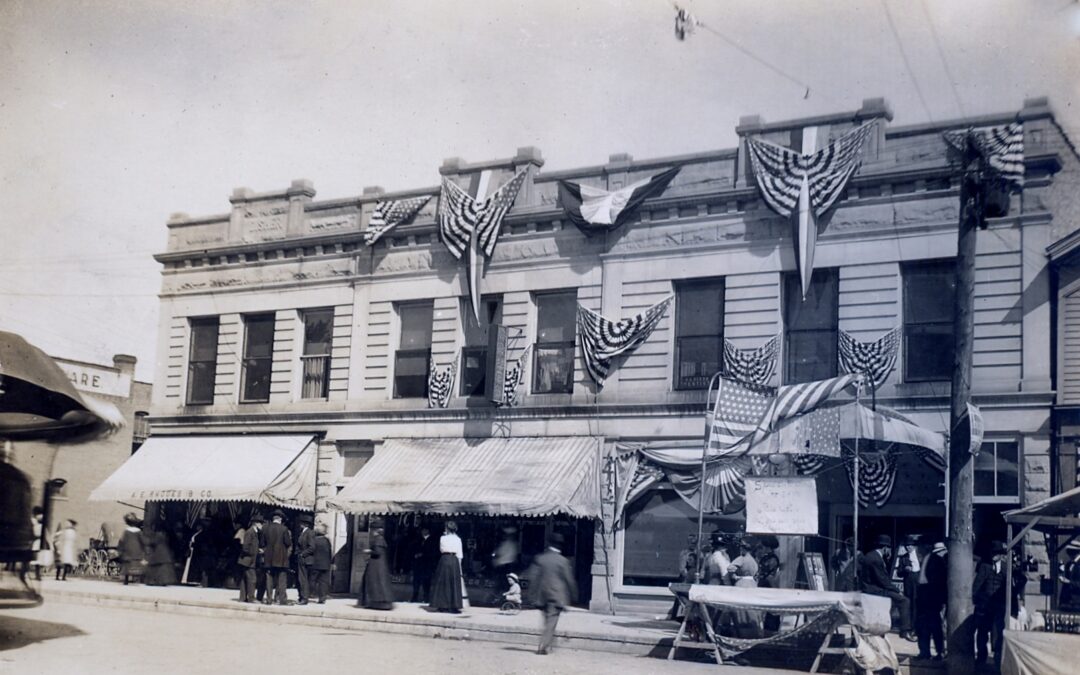
The firm of Hewitt & Woodward built the first brick block in Plymouth at 113 N. Michigan Street, currently the home of Wild Rose Moon. It was three stories high and considered a fine structure. Fire destroyed it in 1866 and the firm lost $15,000, as the insurance company went broke. After the fire, Mr. Woodward rebuilt the entire block.
He was successful in the sawmill and lumber business as well in the firm of Woodward, Oglesbee & Co. He was also in the grain business with Henry G. Thayer. He became a partner in the reorganization of the First State Bank that occupied one of his buildings. The bank was successful for many years and sold to Theodore Cressner in about 1867. After a varied and successful business career, Mr. Woodward retired in 1891.
Mr. Woodward Attends the Lincoln Convention
Early on, Mr. Woodward was a Democrat, but later became a Republican. In 1860 he attended the great Lincoln Convention in Chicago as an alternate delegate. He remembers every detail of what he calls “the most wonderful convention ever held.
“I remember when they brought in the rails and put them on the platform,” said Mr. Woodward. “I remember the moment when Lincoln was nominated. The convention went wild. Hats filled the air and yells were deafening. I assure you there has never been another such convention and probably never will be.”
The rails referred to by Mr. Woodward were symbolic wooden rails carried onto the convention floor. Lincoln was cast as a “rail-splitter,” a home-spun hero full of prairie wit and folk wisdom. People did not see Lincoln as a life-long politician and corporate lawyer with a decent income.
On March 3, 1904, Elizabeth Woodward died at Age 69. She is buried in Oakhill cemetery. 10 years later, in 1913, Mr. Woodward decided to leave Plymouth to live with some of his children, although he kept in contact with his Plymouth friends.
In 1915, he wrote “I am glad to say to all my friends that I am in splendid health and not dependent physically or financially on anyone. I transact most of my own business and hope it will be many years before I am incapacitated.
“I send greeting and good cheer to all of you, and though I am eighty-eight years old I trust the good Lord will spare me many years before I am called to Plymouth to my final resting place. God bless and protect all of you. Very sincerely yours, N.S. Woodward.”
Sadly, Norman S. Woodward died on November 27, 1916, succumbing to apoplexy while taking his morning walk. His obituary ran front and center in the Republican newspaper. Mr. Woodward returned to Plymouth for the final time and was laid to rest next to his wife in Oakhill Cemetery.
Visit the Museum from 10:00 am until 4:00 pm, Tuesday through Saturday to learn about early Marshall County or research your own family. The Museum is located at 123 N. Michigan St., Plymouth. Call us at 574-936-2306.