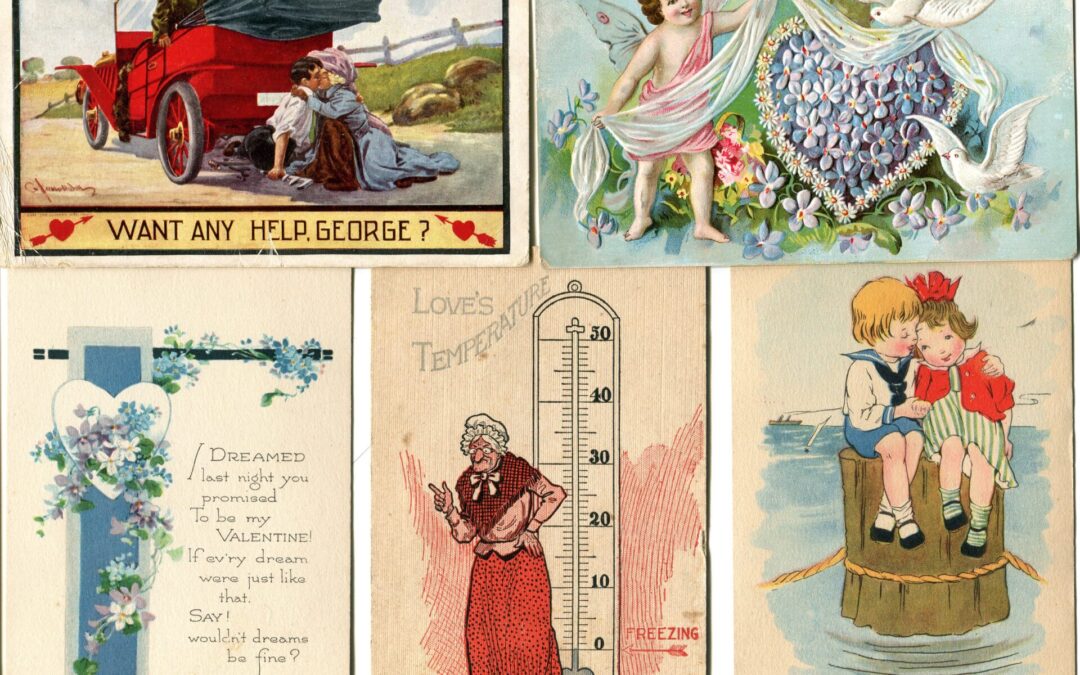
History of Christmas Cards

History of Christmas Cards

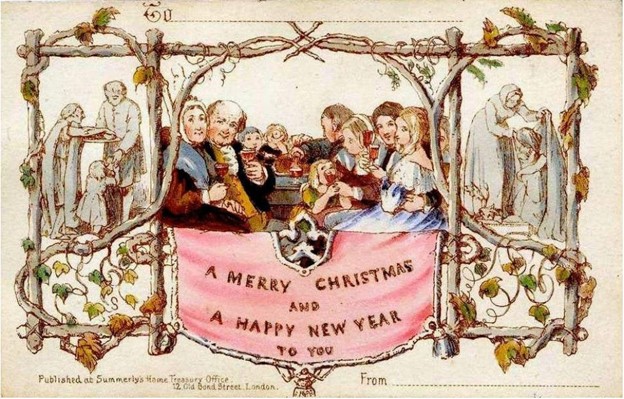
The very first Christmas card was printed in Victorian England in 1843. Sir Henry Cole, who is known for founding the Victoria and Albert Museum in London, had a problem. It was customary at the time to send letters at Christmas to all one’s friends. Because it was considered impolite not to answer a letter, someone with a lot of friends could have a correspondence crisis every December. Sir Cole approached an artist friend, J.C. Horsley, and asked him to sketch out an idea he had in his mind to solve his problem.

Cole took Horsley’s illustration and had 1,000 copies made by a London printer. The image was printed on a piece of stiff cardboard, 5-1/8” X 3-1/4” in size. He included “TO:_____,” allowing Cole to personalize his responses. The card said “A Merry Christmas and A Happy New Year To You,” and showed a family celebrating a holiday meal, flanked by two images of people helping those in need. It was the first Christmas card. Eventually, several in Cole’s circle recognized the value of his creation and started sending their own cards at Christmas.

First American Christmas Card

Louis Prang, a Prussian immigrant with a print shop near Boston, is credited with printing the first American Christmas Card in 1875. Unlike Cole and Horsley’s holiday inspired design, the first card had a picture of a flower with the greeting “Merry Christmas.” First-generation American card designs were mostly drawn from nature. Animals, flowers, and landscapes were common.

In the late 1800s, collecting Christmas cards became so popular that the new crop each season were reviewed in the newspaper, much like a film today. And of course, they became more creative and elaborate.

Modern Christmas Cards

The modern Christmas card industry began in 1915 when a Kansas City-based postcard printer named Joyce Hall published his first holiday card. Hall, later joined by his brothers Rollie and William, founded the Hall Brothers Company. Ten years later, the company changed its name to Hallmark. They set the industry standard of cheerful sentiments and holiday-inspired images on a booklet style card of 4” X 6,” which was then inserted in an envelope.

This new-style card became enormously popular from the 1930 to the 1950s. As demand for cards grew, Hallmark and its competitors reached out for new ideas to sell them. Commissioning famous artists to design them was one way. Salvador Dali, Grandma Moses and Norman Rockwell all designed Christmas cards for Hallmark.

Stamps & Other Designs

The U.S. Post Office printed their first dedicated Christmas stamp in 1962. It featured a wreath, 2 candles and the words “Christmas, 1962.” They ordered the printing of 350 million of the 4-cent, green and white stamps. They had wildly miscalculated the demand and had to reprint. Unfortunately, they did not have more of the original size paper for a 100-stamp sheet, so the remainder were printed on sheets of 90. Eventually, a total of one billion 1962 Christmas stamps were printed and distributed by the end of the year.

Today, more innovative designs and concepts are coming from niche publishers. As the digital age has exploded, greetings come in many forms like audio and video, as well as on paper. As always though, it is big business!

We have a wonderful selection of Christmas and holiday cards at the MCHS Museum. Stop in soon!

Thanksgiving in World War II

Thanksgiving in World War II

After celebrating Veteran’s Day, and as we get ready to celebrate Thanksgiving, it’s a good time to look back to wartime holiday celebrations, particularly during World War II. So many of the things we take for granted were adversely affected by Word War II, even the emotions of Americans. In 1944, Thanksgiving headlines were “50,000 Nazis Trapped on Rhine” and “Germans Fire Rocket Bombs at U.S. Army.”

Not all Americans celebrated Thanksgiving on the same day either. In 1941, federal legislation changed the date from the fourth Thursday of November to the third, but a few states were still celebrating on the later date.  Favorite holiday traditions were suspended during the war. The famous Macy’s Thanksgiving Parade had not been held since 1941, as the company donated the rubber used in their balloons to the war effort. The Detroit Lions, who had hosted an annual Thanksgiving game since 1934, put this tradition on hold from 1939-1944.

Kindness & Gratitude During Thanksgiving

Many hospitable families filled empty spaces at their own Thanksgiving tables with servicemen and women stationed nearby. Because of the ongoing war effort, many people were employed in defense- related industries. Production never stopped, so families had to schedule family time around shift schedules. Travel was difficult because of gas and tire rationing. Americans were encouraged to leave empty bus or train seats available for servicemen and women on furlough.

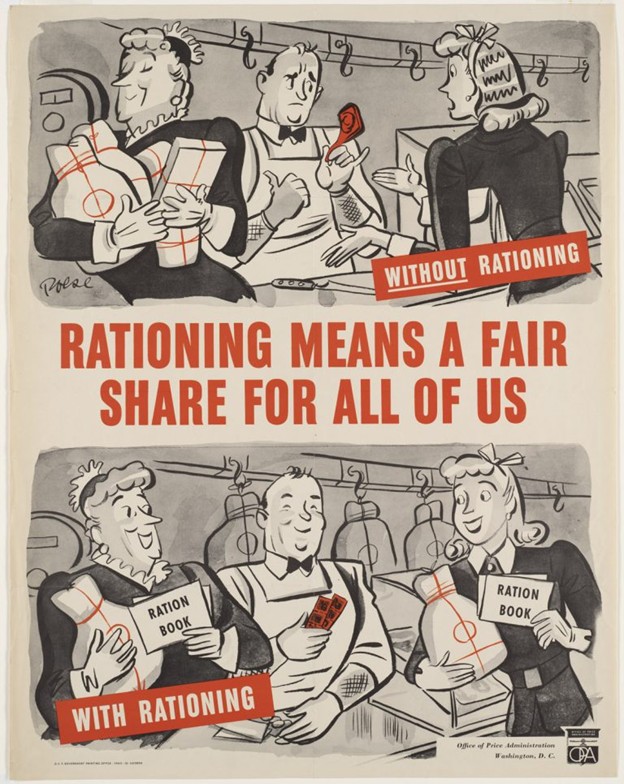
The war directly influenced food choices, again due to rationing. Imported foods like coffee and sugar, foods that needed to be shipped long distance, processed foods like cheese, butter, margarine and canned fruit were rationed. By 1944, there was great reason to be thankful though, because red meat was available again.

Planning Ahead During WWII

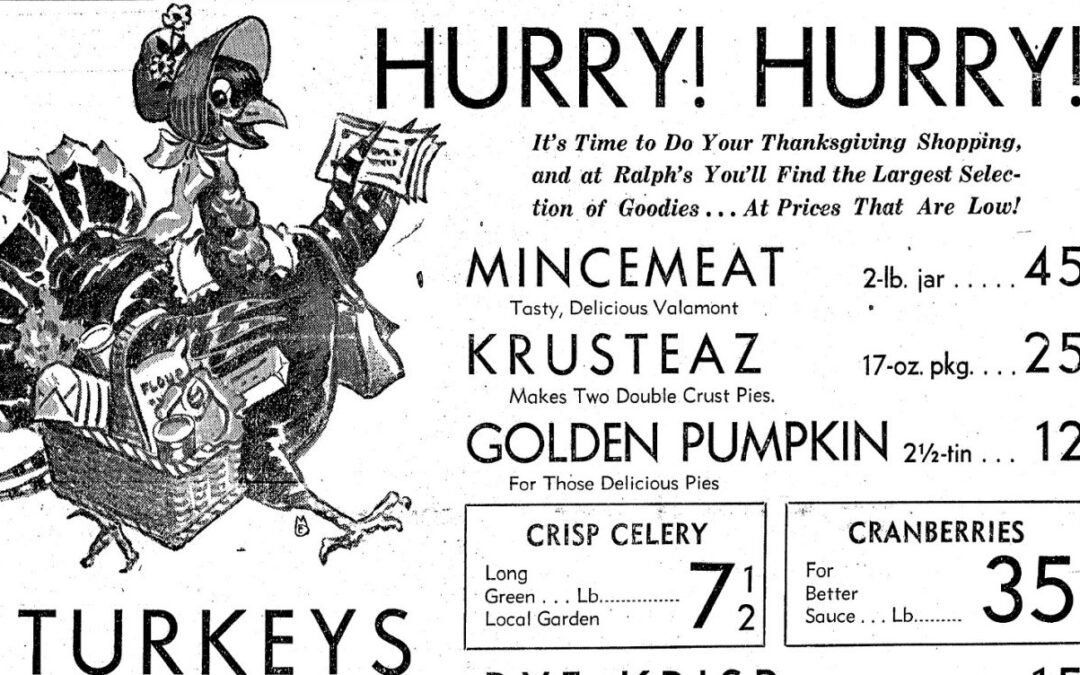
Rationing required a lot of advance planning. People saved rations for the big day! Newspapers published rationing calendars that listed which rationing stamps could be used and when for what products. Cooks could save their stamps to purchase food when available. Families that kept Victory Gardens generally had canned and preserved food to serve.

Newspapers also published articles about the local availability of items for Thanksgiving during World War II. The adverse effect of gas rationing affected trucking, with government demand for turkeys for troops, made even this dinner centerpiece unavailable in many areas. There was a black market for rationed or rare items if one wanted something bad enough. By 1944, lard, shortening, processed foods and coffee were no longer rationed in the U.S.

Rations Ad in World War II

Rations ad during World War II.

Even with hardships, people were generally willing to sacrifice for the war effort, but by 1944, the end of World War II could not come fast enough!

The Town of Donaldson

The Town of Donaldson

This article was published on November 30, 1911, in the Weekly Republican newspaper. It’s interesting to get a look at the Town of Donaldson, back when it was a truly bustling community. Note that the location is described according to which railroad the town was adjacent to, as opposed to roads. I have edited very lightly for readability.

“One of the interesting centers of Marshall County is the town of Donaldson, eight miles west of Plymouth on the Pennsylvania railway. This is an energetic little town and a good business center. The two institutions which make the place of more than ordinary interest, and more than an ordinary trading point, is the presence of Schlosser Bros. creamery station and of the Heinz salting plant. These two industries bring a large amount of money into the community every year. Milk, pickles and onions are the special crops which make Donaldson a prosperous center. By far the most important of these is the creamery. Its steady stream of money in return for the steady stream of milk and cream furnishes the big part of the “life blood” of the business. Onion and pickle raising are good sources of income also, but their returns come in bunches in the fall.

This goodly community has two good general stores, a blacksmith shop, meat market, a post office with a rural route, a railway station, hotel and livery, telephone exchange, United Brethren church and multi-graded schools. Donaldson needs a good physician. A large amount of veal, chickens and turkeys are shipped annually from Donaldson to Chicago. It is no uncommon sight to see two trucks full ready for shipment. It is estimated that about 500 dressed veal are shipped from here annually.

From 12 to 14 carloads of onions are shipped from Donaldson each fall, and this industry is increasing, as there is much land in this vicinity adapted to that kind of crop. The largest onion growers here are Nils Pearson, Lewis Seibert and Victor Newburg.

The largest pickle growers are Victor Newburg, who from 2 1/2 acres this year received $523.34: John Lavine, who got $195.01 from 1 1/2 acres; Andrew Bergstedt, who got $173.81 from l 1/4 acre and John Anderson, who received $126.98 from one acre.

Donaldson may congratulate itself that it has a very fine blacksmith shop. Mr. C. T. Danielson erected last summer a new building, 24 feet X 50 feet, and it is well equipped for the trade. It has a cement and wood floor combined. He learned his trade thoroughly when he learned it many years ago, and one will get here only the best of work. He makes a specialty of horseshoeing and knows that work in all its details. He is also equipped for and does all kinds of wagon work. Owing to the excellent character of his work, he draws trade from far to the north, from the south and from miles into Starke County.

In 1905 Mr. J. D. Garrison erected a splendid and well-equipped storeroom about a block north of the railway and opened a first-class general store. Here in neat arrangement, one may find those wares in the line of groceries, dry goods, clothing, rubbers and shoes, hardware, tinware, flour, horse blankets and saddlery goods, school supplies, etc., etc., which are the necessities of a country community. On entering this store, one is impressed with its cleanliness and neatness, and with the unusually large stock of all goods carried for the benefit of the community. Mr. Garrison is a careful and accommodating businessman and has built up a large and lucrative business which is still growing at a rate pleasing to the owner.

  1. J. Burgener has conducted a general store at Donaldson for 23 years and there is no one within a radius of miles who does not know him and his store. This wide acquaintance, coupled with fair dealing with all customers, has made his a large and constant business. About two years ago Mr. Burgener decided to move to Chicago, and in order to continue the business in the same good way he associated with him Mr. Albert Baum, a well-known young man of the community who has since been in active charge of the store. Mr. Baum is also acting agent for the Adams Express Co. and looks after the large express business connected with this trade center.

Mr. Burgener is also president of the Donaldson telephone company and was with others instrumental in forming this valuable local system, which not only gives the community good local service but allows them to reach without extra charge all the patrons of the Winona Telephone company in Plymouth. Mr. Hayes Munn is secretary of the company, E. R. Day treasurer, and F. H. Bollinger a director.”

The MCHS archives contain microfilm of all of the county newspapers. If you need to research a place or an event, we have the information and the way to read it efficiently. Stop by between 10:00 and 4:00 from Tuesday through Saturday at 123 N. Michigan St. and let us help you research your favorite topic! Call us at 574-936-2306.

Marshall County’s Only Prize Fight

Marshall County’s Only Prize Fight

The story is told in McDonald’s History of Marshall County of the only prize fight held in Marshall County:

The prize fight was to take place at Baugherville, on the Lake Erie & Western Railroad, about nine miles northwest of Plymouth between Lou C. Allen of Chicago and H.C. Hanmer of Michigan City, middleweights, on the evening of April 30, 1891. That afternoon some of the local boys were told about the upcoming event. “The favored few who were let into the secret were on tiptoe of expectation, and preparation was made to pull out quietly by livery teams about 9 o’clock. The secret was to be kept from Sheriff Jarrell and from those who would likely give him a pointer in that direction.”

It was not easy to get there. “The night was dark and the corduroy road through the woods was more than ordinarily rough. Some of the drivers lost the direct road and went a considerable distance out of the way; others ran into ‘chuck holes’ breaking a spring or a single-tree or something of that kind, but where there is a prize at the end of the goal there is always a way found to reach it. On they went, helter-skelter.

“The prize ring was in a large barn near a sawmill and a lumber yard near the Lake Erie & Western Railroad, a short distance northeast of Tyner. Lumber was piled up and scattered about everywhere, and there were acres of sawlogs and slabs and log wagons. There were no lights about to indicate that there was anything unusual going on, and those who were not familiar with the lay of the land had to feel their way in the dark.

“The Lake Erie fast train from the north arrived at 11 o’clock, bringing the pugilists and about 150 sports (fans) from Chicago, Michigan City and other points along the line, and it was but a short time until the preliminary arrangements had all been completed. A twenty-four-foot ring had been measured off, the building was gorgeously lighted, and in the glare of the kerosine the lamp of Aladdin would have cast but a faint glimmer. The 175 spectators who had each paid an admission fee of $5 were seated about the ring as conveniently as circumstances would permit, and the remainder were stowed away in the haymow, in balcony rows, one above another, from which elevated position they were enabled to look down upon the interesting spectacle before them through the large opening in the center.

“The gladiators were stripped to the skin and took their places in the ring, accompanied by their backers, trainers, seconds, umpires, spongers and assistants.” Also in attendance were a couple of Chicago newspaper reporters. “The doors of the barn were locked and guarded, and the doorkeeper was ordered not to admit anyone under any pretext whatever. Time was called and the pugilistic pounders came smilingly to the scratch. They knocked away at each other with all the strength they possessed. There was no doubt they meant business from the word ‘go.’ The first round was a success, and applause greeted the bruisers as they retired to their corners to be rubbed down.”

But when that many people know a secret, it is hard to keep. “It was late in the evening when Sheriff Jarrett was informed of what was going on. He and his deputies, Eugene Marshall and William Leonard, and Plymouth marshal William Klinger “pulled out from the county seat shortly after 9 o’clock and drove rapidly toward the seat of war. He had the misfortune to break his buggy, which delayed him, and he did not arrive until the first round had been fought.” The sheriff asked the doorkeeper to be admitted. “That distinguished dweller in the tents of iniquity informed them that under no circumstances could they be admitted, whereupon the sheriff jerked the latch off, opened the door, and he and his deputies rushed in upon the pugilists and their assistants, who were standing in the ring ready to commence the second round.

“Then ensued a scene of consternation which no pen can describe. There was a general stampede for the door and in the rush and confusion several were run over and knocked down. Some of the lights were turned out, and for a few minutes it seemed as if pandemonium had been turned loose. Both principals escaped the officers and got out of the building with only their thin fighting suits on. In the melee that ensued, trainer Ed Corey and seconds Con Cavanah and Dick Ford were captured. The remainder got away. Hanmer was so cold with only his tights on that he could not stand it and returned in search of his clothes. He was captured by the sheriff. Allen, the other principal, took the railroad track north as fast as he could run and never stopped until he reached Walkerton, where he boarded a freight trip for Michigan City and made good his escape.

“The spectators – well, they were panic-stricken and, if anything, were worse frightened than the fighters. When the sheriff and his party entered, the rapidity with which that audience dispersed has never been equaled in this part of the country. They did not stand on the order of their going, but they went at once. It was every fellow for himself, and the devil take the hindmost. As soon as they got out of the building they took to the woods as fast as their legs could carry them. They tumbled over one another, went head over heels over saw logs, log wagons and lumber piles, skinned their shins and bruised themselves up generally.

“Those who were in the hayloft, most of them Marshall County fellows, were all captured without an effort. They had climbed up on a ladder which had been removed when the fight began, and there they were, prisoners and unable to make a move for liberty. So, they scrambled back as far as they could and covered themselves with hay, except their feet, which stuck out in irregular sizes all around the first row, and waited further developments.

The suspense did not last long. One of them came near smothering in the hay and yelled out, ‘Put up that ladder. I can’t stand it with this d____d gang any longer.’ The ladder was put up and you would have just died laughing to have seen capitalists, merchants and businessmen, old men and young men, bald heads and gray heads, married men and single men, backing down that ladder with hayseed in their hair, and on their hats and all over their clothes. As they reached the floor, one of them remarked, ‘What in ____ would my wife say if she could see me in this fix?’”

There were probably many married men who would shortly find out what their wife would say.  “They were greatly relieved when Sheriff Jarrell informed them that he had no use for them, and they could go about their business.” The four who had been arrested were each fined $50, which was promptly paid. And thus ended the only prize fight ever witnessed in Marshall County.”

I would imagine that most of those married men suffered harsher punishment than the prisoners, don’t you?

It may not surprise anyone that Daniel McDonald was a newspaper owner and editor. His writing style is so highly entertaining. Come on in to read more from his History of Marshall County. The Museum is open 10 a.m. – 4 p.m. Tuesday through Saturday.


Dredging the Yellow River

Dredging the Yellow River

In 1909, Supreme Court of Indiana had ruled in favor of the farmers and cleared the way for the Yellow river to be dredged. This article has been edited from the Plymouth Tribune, December 8, 1910.

Working Around the Clock

Progress on the work of dredging the Yellow river is being completed much faster than was anticipated, either by those who let the contract for the work, or by those who are executing the task. Slightly over one lineal mile of the river’s bed has already been completely dredged since the start of the work on November 9th. Approximately 41,300 cubic yards of earth have been taken from the bed of the river within this mile. An average excavation of seven feet in depth is made in the river’s bottom, extending to a width of fifty-five feet at the bottom. The dredge is located at a point slightly over seven miles east of Plymouth and at the rate of progress now being made, County Surveyor Percy J. Troyer estimates that the dredge will reach the city within eight months and will complete the entire route in fifteen months.

The fire under the boiler of the great dredge is never allowed to go out, and in order to cheat winter and the coming freeze of the river as much as possible, the large crane and bucket are never still. Day and night without pause the dredge and its gang is at work. The outfit has its own electrical plant that illuminates the surroundings sufficiently to carry on the work at night. A gang of twelve men is employed, six on each shift, working twelve hours each. The dredge is in charge of W. A. Schultz of Milwaukee, a member of the dredging firm that has the contract to widen, deepen and straighten the Yellow river for eleven miles of its course, from the point eight miles upstream to three miles below Plymouth. 

The Mill Dam in Plymouth prior to dredging the Yellow River and removing the dam, ca 1912

The Mechanism Behind Dredging a River

The first change in the course of the river will begin later part of this week. This cut is known as the Nunemaker Cut and will consist of diverting the course of the stream across the ends of a “U” shaped bend. Instead of flowing around the bend, the river will be made to cut across the ends. As a result, all of the land enclosed in the bend, besides the old bed of the river itself, will be reclaimed for farming proposes, as the old bed will be drained by the deeper bed in the new course. The Nunemaker Cut will consist of a lineal cut of 1200 feet, and will necessitate an enormous excavation of earth, as the new riverbed will be laid seven feet lower than the present bed, and as stated above, will be fifty-five feet wide at the bottom. It is estimated that this cut will require somewhat over two weeks. There are two or three more such cuts to be made in the course of the Yellow River dredge.

A wonderful sight might have been witnessed at the work site on Thanksgiving Day, when a feat of engineering skill was executed by the dredge. The sixty-five-foot steel bridge, weighing 12 tons, which spanned the river at that point, was lifted from its abutments, swung around, and deposited upon the bank of the river. The scene of the steel bridge in midair with several workmen standing on the structure to preserve its balance was a novel one, and served to show the power, size and effectiveness of the great dredge. The bridge was bound to the beam of the dredge by steel cables, men were stationed along the floor of the bridge and at the word, the beam was raised. The bridge had to be removed in order to let the dredge pass down the river. After the river had been widened to the required dimensions at this point, the dredge was found to be too short to span the river and the steel structure is still reposing on the bank of the river, seven miles east of town. This bridge is a familiar sight to the boys of the city, many of whom have boasted of skating up to the seven-mile bridge.

Missing Pieces

Of course, we now want to know when and how the bridge was replaced on its abutments, and did it have to be lengthened? Unfortunately, our records do not provide those answers, nor is there any further mention of the bridge sitting beside the river.

Accomplishments of WPA in Marshall County

Accomplishments of WPA in Marshall County

In our U.S. history classes most of us gained a passing acquaintance with President Franklin Delano Roosevelt and his Works Progress Administration program that helped Depression-era workers get back to earning a paycheck. The projects were wide ranging geographically as well as in type. Everything from buildings to bridges were constructed or improved. WPA workers built roads, dams and hatcheries, just to name a few. Below is an article published in the June 5, 1940, edition of the Culver Citizen about the impact the WPA had on Marshall County. It has been lightly edited to improve readability.

The Works Progress Administration constructed eight new buildings, reconstructed or improved five others and paved or improved 78.5 miles of highways, roads and streets, according to a survey released today by John K. Jennings, state administrator. Jennings said the survey was the first all-inclusive one to be made of WPA accomplishments in Marshall County. It includes all major projects since the start of the work-relief agency in August 1935. The survey said that a total of 729 Marshall County men and women who lost their jobs in private industry have been given WPA work-relief at one time or another.

Almost all the WPA roadwork centered on improving farm-to-market roads, of which 71.8 miles were bettered. In city street and alley work, the WPA improved a total of 4.1 miles. Of that, it laid new paving on 2.3 miles.

The WPA constructed a new warehouse for the Plymouth City Hall, a bathhouse at Culver, a hatchery clubhouse (Isaac Walton Leaugue), a barn at Magnetic Park in Plymouth and one other building at the same park (Conservation Clubhouse). In reconstruction and improvement work, the WPA bettered the Marshall County Courthouse, highway garage, jail and infirmary (Shady Rest Home). It improved the school at Inwood, Lincoln High School Athletic Field, Culver Park, Bremen Cemetery, and Huff Cemetery in German Township.

Isaac Walton League Clubhouse in Argos, IN.


In miscellaneous construction work, WPA employees built a dam at Plymouth having a storage of 300 acre-feet, the Magnetic Park fish hatchery which now has a capacity of 10,000 fingerlings, and the Argos Fish Hatchery with a capacity of 375,000 fingerlings annually. Magnetic Park, 17 acres, and Centennial Park, 35-acres, both in Plymouth, also received improvements.

Throughout Marshall County, WPA workers reconstructed or improved 26 steel bridges measuring 2,356 feet, improved 352 miles of roadside drainage, paved 4.8 miles of sidewalks and paths, laid 7.7 miles of curbs and seven-tenths of a mile of gutters.

In the utilities and sanitation field, the WPA laid 2.2 miles of water mains, aqueducts, and distribution lines, installed 5.8 miles of storm and sanitary sewers, made 19 sewerage connections and dug 221 manholes and catch basins. Nearly 1,200 sanitary privies were erected by the WPA. (These privies had concrete slabs and vaults and were considered more sanitary. They were nicknamed “Eleanors” due to Eleanor Roosevelt’s support for the program.)

More than 2,300 feet of retaining walls and revetments were constructed. One new airplane landing field was built on which runways totaling 5,280 feet were laid. In the professional and service division, WPA workers renovated 2,232 books, turned out 15,183 garments from sewing projects, and completed 5,490 items other than garments such as mattresses, quilts, etc. The sewing products were given to the needy.

The impact of the Works Progress Administration on Marshall County and its residents can hardly be overstated. If you want to know more about the WPA in Marshall County, come into the Marshall County Historical Society. Our research specialists will be happy to help! We are open from 10 a.m. to 4 p.m. Tuesday through Saturday.