
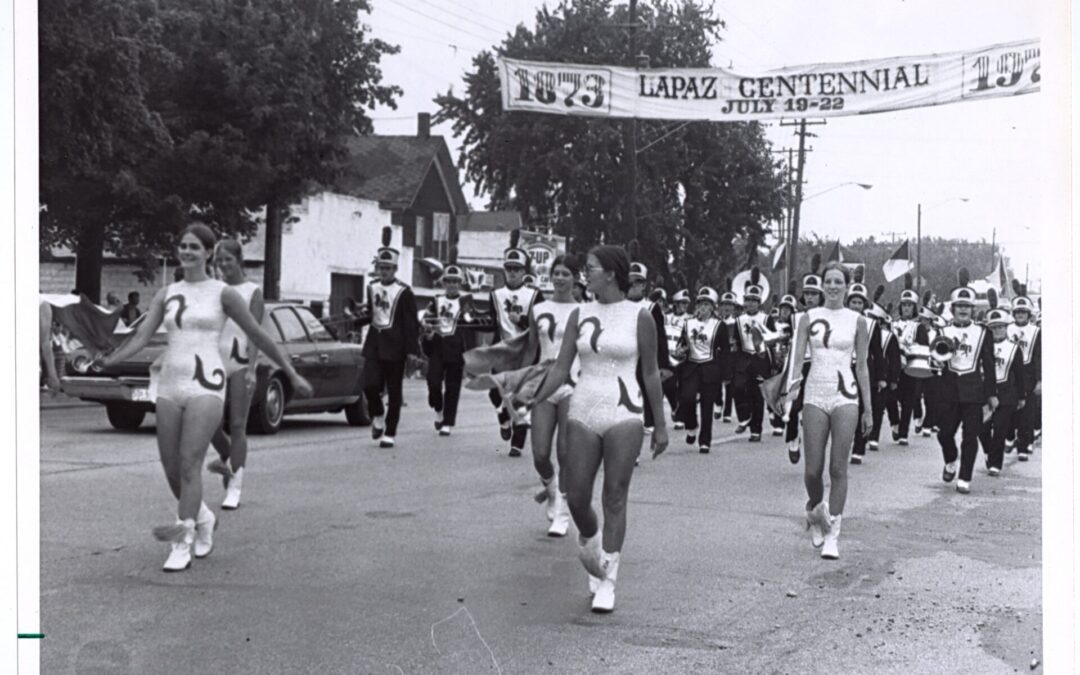
Feature Image. Parade celebrating the LaPaz Centennial in 1973.
The Baltimore and Ohio Railroad was built through Marshall County in 1873. Archelaus Hunt came back from South America following its completion. Like so many other towns, its location was determined by the fact that the railroad was there. Hunt wanted to lay out a town called “LaPaz” in honor of LaPaz, Bolivia. Archelaus had mined silver in Bolivia. He purchased 18.48 acres, Section 5 of the Michigan Road lands, which were surveyed, platted into 121 lots and recorded on August 9, 1873.
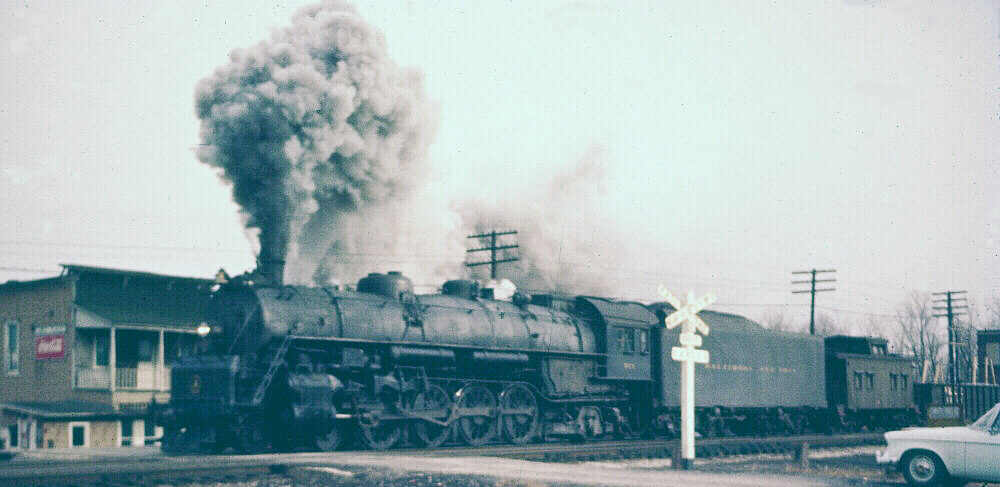
LaPaz Junction, Baltimore & Ohio 731 passing store.
A Life Cut Short
Archelaus was engaged to marry Sarah A. Schilt of Bremen. He recorded the plat of LaPaz on August 9, 1873, and took out a marriage license with Sarah five days later. Sadly, that marriage would never take place.
On Monday, October 27, 1873, Archelaus was leading his horse to water when the horse became playful and he gave it the full extent of the rein. According to the newspaper account, Archelaus was exercising his horse, which was said to be gentle. “Archelaus would give the horse the length of his halter and let him run around him. The horse playfully kicked up its heels and accidentally struck Archelaus in the chest. Archelaus walked a few steps along Michigan Road and then fell, expiring immediately. “
There is a notation in the marriage records at the bottom of the marriage license: “The above license was never used. Hunt dead.”
Researching Archelaus Hunt
Archelaus Hunt’s story came to the forefront this year when a researcher contacted the museum trying to find out about him and where he was buried. The researcher had made inquiries, and no one seemed to know where Archelaus was buried. A reference card in the Museum led to an older cemetery reading of the Bremen Municipal Cemetery dated 1934 that listed Archelaus’ name. The reading of his tombstone said he was 35 years old. Museum staff suggested that the researcher contact the Bremen clerk’s office, which he did, and reported that Tara Beasley and sexton Nate Lockwood were very helpful and able to assist him with finding the location in the cemetery. Archelaus owned eight graves in the Bremen cemetery.
Six years later, on July 9, 1879, Sarah Schilt married John Graverson. One of their descendants is the researcher who contacted the Museum.
Archelaus’ probate file is at the Museum. It refers to a brother Alvin and a sister Alwilda.
About Alwilda
Some creative searching led to Alwilda’s death record. Her name was Alwilda Dingman, and she died in New Buffalo, MI, on May 1, 1875, at the age of 29. She also died young and only outlived her brother by less than two years. Alwilda was born in Michigan, and her parents (and Archelaus’) were Merrit Hunt and Abigal Hunt. While we do not have a written record, it is likely that Archelaus was born in Michigan as well.
Alwilda appeared on the 1870 census in New Buffalo, Berrien County, MI. The Dingman household consisted of Isaac, 40, Wilda, 30, Henry, 12, Jennie, 6, and Nelson, 1.
This story is a great example of the genealogy & research services provided by the MCHS library. Collaborating with Bremen Clerk Tara Beasley and sexton Nate Lockwood, it perfectly illustrates the way information can be tracked in Marshall County.
For more information on early Marshall County, pick up a copy of our latest publication, From Crossroads to Communities: An Updated History of Marshall County, Indiana, written by Dr. Don Balka. Balka details the establishment of current and long lost communities over the course of our history. The MCHS & Museum is open from 10:00 until 4:00 on Tuesdays through Saturday, at 123 N. Michigan St., Plymouth. Call for information at 574-936-2306.