
Indiana has had some really memorable winter seasons, but in 1816, everything went haywire. Snow in June destroyed all of the crops, it was bitterly cold on the 4thof July, and blizzards struck in August! How could that happen? The dust from Mount Tambora, which erupted in early April 1815, had covered the entire globe. With all of that volcanic dust in the upper atmosphere, the sun was blocked and that created a weather phenomenon that led to food shortages all over the world.
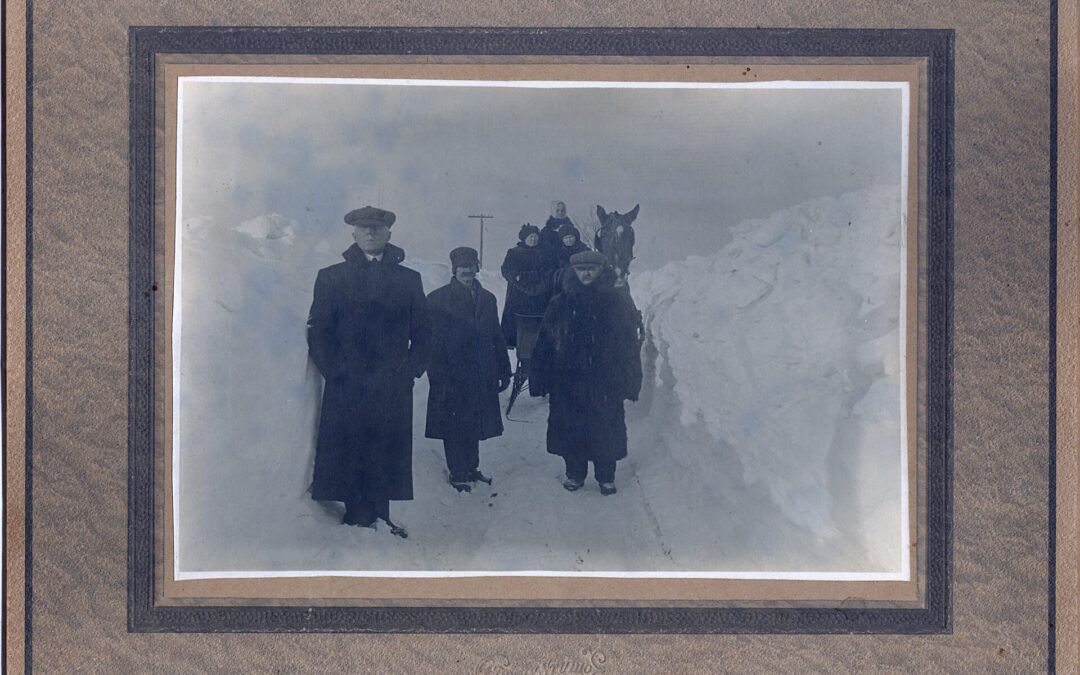
The fast forward about a hundred years. On January 11, 1918, Marshall County was hit with a blizzard that created travel mayhem for weeks afterward. The following is an excerpt from The Argos Reflector on January 31, 1918: “Since the big blizzard on Friday, January 11th, undertaker O.L. Grossman has had to use the bob-sleds for all funerals. January 8th was the last time that he was able to use the hearse. The north and south road to the Maple Grove Cemetery has a drift about six feet deep, the full width of the road. The rural mail carriers have been able to make only a part of their trips during the past week or more. Saturday was a hard day to get through and after another snow and heavy wind on Sunday, they decided not to try to deliver on Monday morning. John Leland brought W.D. Corley and family to town Sunday to attend the funeral of J.S. Wickizer. They started quite early in the morning and did not arrive until about noon. It was a five-mile drive.”
The coldest day in Indiana was recorded on January 19, 1994, in New Whiteland, just south of Indianapolis– a minus 36 degrees, not including wind chill. Just for the record, an easy way to calculate wind chill is if it’s minus 5 degrees outside and the wind is blowing at 25 mph, the wind chill is minus 30 degrees.
Who remembers the winter of 1977-78? It all started on December 29, 1977. Then temperatures started dropping, and Indiana would have 34 days of below freezing temperatures. That figures out to 880 consecutive hours of cold, brrr. The arctic temperatures lasted long enough to usher in the “great blizzard of 1978.”
The first ever Blizzard Warning for the entire state of Indiana was issued at 3:45 p.m. EST on January 25th, 1978. A heavy snow warning had been issued 12 hours earlier. Winds would approach 50 mph or more by midnight and continue through the 27th. Temperatures would plummet to a low of zero during the storm with wind chills approaching -50 degrees. Snowfall rates of nearly one half to one inch per hour were not unusual, but the duration of the heavy snow was. Significant snowfall for 30 plus hours, followed by continued cold and high winds, was a serious issue. This hampered recovery and relief efforts, leaving much of Indiana crippled for days. In areas, up to three feet of snow fell. The howling winds would push drifts up to as much as 20-25 feet. Visibilities would remain at or below one quarter mile for 25 hours.
Highways were clogged with stranded motorists. Doctors and emergency personnel were forced to reach people on skis and snowmobiles. The governor sent National Guard tanks onto I-65 to remove stranded semis. Indiana Bell was forced to halt all phone traffic but emergency calls. The governor declared a snow emergency for the entire state on the morning of the 26th. During the afternoon of the 26th, the Indiana State Police considered all Indiana roads closed. Seventy people died during the storm.
Hopefully, the winter of 2025-26 will spare us!