
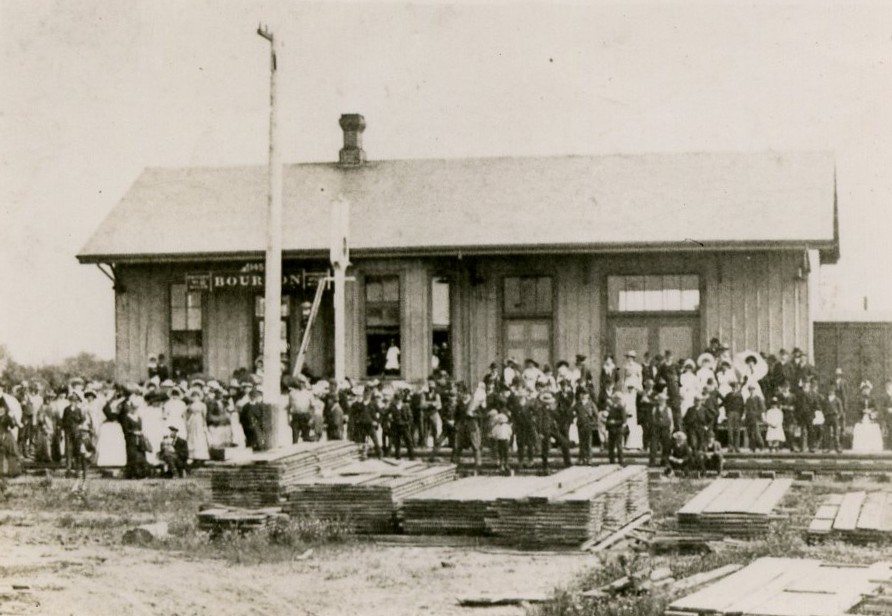
Feature Image. Bourbon railroad depot, ca 1883.
While the advent of railroads brought many advantages to the community, including easier access in and out of the area and an easier way for the farmer to move his crops, it also brought more people into the county, some of whom were unsavory characters. A group of robbers decided to make Bourbon their home base.
The story is told in McDonald’s History of Marshall County of those bold robbers who operated in Bourbon:
A History By McDonald
“During a considerable period before and after the completion of the Pittsburg, Fort Wayne & Chicago Railroad, the town of Bourbon was infested with a gang of counterfeiters and robbers who kept the inhabitants in a constant fever of excitement and fear. The existence of this gang and many of those connected with it were well known, but the evidence of their guilt was not sufficient to warrant legal proceedings. Some of them were, however, finally arrested, but the law’s delay and the many technicalities brought into requisition enabled all of them to escape the penalty they undoubtedly deserved.
“One night in the summer of 1867 a large number of housebreakers and robbers entered the residence of Joseph W. Davis. Before entering they blackened their faces and otherwise disguised themselves. They had taken the precaution to give the watchdog, a very fine Newfoundland, a dose of strychnine, which had put him effectively out of the way. They procured a large scantling (a piece of lumber of small cross section) and, using it as a battering ram, drove it with such force against the front door as to break it open with the first blow.
“Two of the robbers rushed into the bedroom where Mr. Davis and wife and infant child were sleeping and laid violent hands upon them before they realized the true condition of affairs. A pistol was under Mr. Davis’ head, and in making a desperate effort to procure it, he was struck several times on the head and face, making the blood run profusely. The burglars secured the pistol and (with one) holding Mr. Davis down by the throat, the remainder of the robbers went through the several rooms in the house, taking them one by one, going through the house and taking everything of value that suited their fancy. In one of the rooms they found the hired girl; in another, the hired man. At each of these rooms they placed one of their number on guard, and now, having everything arranged safely, they began to rummage every part of the house, They made Mr. Davis open his safe, from which they took all the money and papers and other valuables contained in it.
“They prepared an excellent supper from the supply of cooked provisions they found in the kitchen and buttery, of which they partook with evident relish. They remained about two hours and, having finished their work, bade the occupants an affectionate good night and hastily took their departure.
“When the robbery became known early the next morning, the whole town was in a furor of excitement and threats of lynching suspected parties were freely made, but as nothing definite could be ascertained as to who the guilty parties were, nothing was done. Sometime afterward the pocketbook and papers were found close to the railroad track near Bucyrus, Ohio, and shortly after returned to the owner. Several of the suspected parties soon left town and others were not slow to follow, and this was the last trouble Bourbon ever had with housebreakers.”
Who was Joseph W. Davis?
Who was Joseph W. Davis? The thieves picked their victim well.
Joseph W. Davis was a lumber dealer and farmer. He was in the milling business with his brother Omar and built a hotel in Bourbon. The Davis mills had been destroyed by fire in 1865. In 1867, the year of the robbery, the Davis brothers built again after the Davis block was destroyed by fire. In December of that year Joseph W. Davis was chosen to represent his party on the Board of Registry for Bourbon Township. Davis was also a lawyer, practicing law for over thirty years, and a state legislator. The gang would have figured Davis had something worth stealing when they broke into his house.
Born on January 22, 1829 in Ulysses, Davis would have been thirty-eight years old when he visited by the gang of thieves who ransacked his house. He lived to be seventy-two years old and passed away on February 1, 1901.
MCHS & Museum is full of great stories, and you are free to look anytime! We are located at 123 N. Michigan St. in Plymouth. Our hours are 10:00 until 4:00, Tuesday through Saturday. Call us at 574-936-2306.