
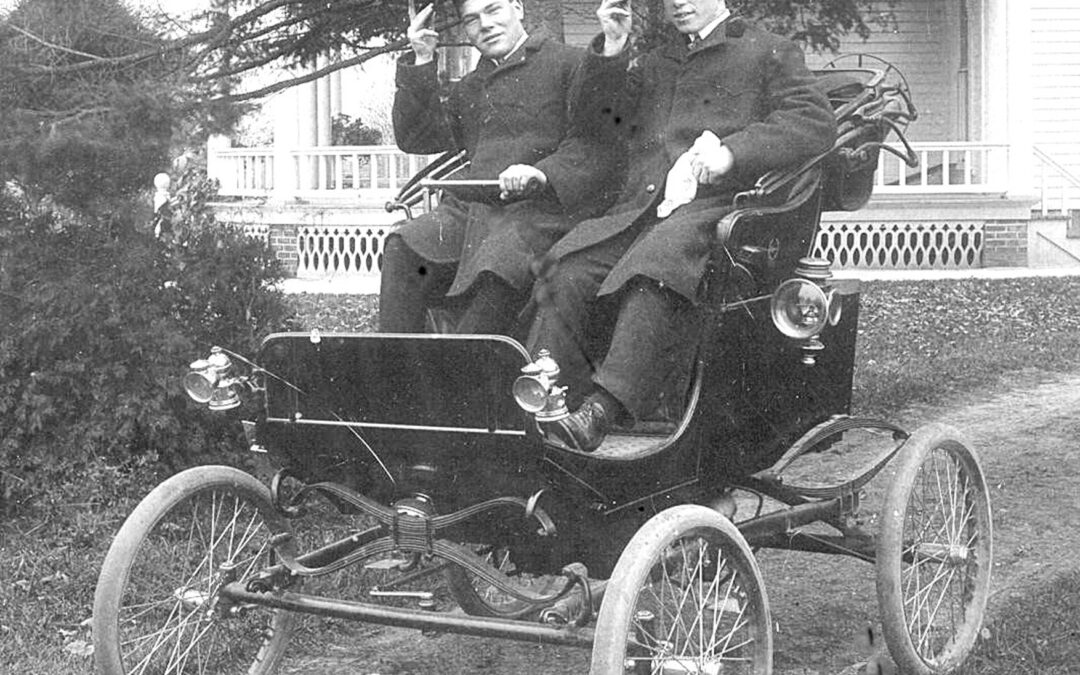
William Erwin, Jr. and his brother Lewis in Will’s automobile.
Edited by Sue Irwin
The dawn of the automobile age in Marshall County saw an incomplete and primitive road system, many different automobile models from many companies with varying operating systems and no safety features to speak of. Some early cars had tillers instead of steering wheels. There was no driver’s training, indeed, no driver’s licensing. It would be many years before automobiles would overtake wagons and buggies on the roads, but that didn’t stop folks from being curious about how the dad-blamed contraptions worked.
William Erwin, Jr., at age 17, brought some excitement to town when he became the first resident of Bourbon to own an automobile. The local newspaper, the Bourbon News Mirror, printed the following humorous anecdote in April 1902.
“What we have been waiting for has happened. Mr. (William, Sr.) Erwin has tried the automobile belonging to his son Will. The critter stood in the yard one day last week as docile and meek as a little lamb. Steam was up, no one was looking, and Mr. Erwin’s curiosity was aroused. It seemed a most propitious time to take a little whirl.
“In a mule, one can detect by the roll of its eyes whether it harbors any ill will toward he who has the desire to mount, and likewise in a Texas bronco, but if an auto has a green apple pain, and designs against any who desires to ride, it never whimpers, and you only know “where you are at” when the family talk in whispers around your bed, the house is filled with the aroma of liniment and camphor, or the coroner gets out a search warrant for you.
“Mr. Erwin got it. A simple twist of the wrist threw on the power, and in less time than a collar button slips down your back, the pesky critter’s ire was up, and it made for the nearest pine tree and up it started. Bang! it went; then it backed off, made a sidestep to the right, the back wheels slinging the sand like a Kansas cyclone, and started for the tree again. Mr. Erwin wasn’t scared. He was simply getting the gait of the thing and didn’t shut off the steam.
“Boom! An explosion! The tire blew up! Will then appeared and put a stop to the proceedings. Mr. Erwin conquered the thing at least, for it is now in the hospital while he is telling us how it happened.”
The article does not elaborate on how Junior felt about the wreck of his new automobile, but trial and error was most likely the way he learned to drive as well. It was the primary way all new drivers got their training. Sometimes car dealers provided instruction if the car was purchased from one. In 1902, however, there were few dealerships and only in big cities. Buyers went straight to the factory to pick out their auto or ordered it through a catalog at the general store. Delivery of the new automobile was via railroad car.
As more people purchased cars, drove, and had accidents, local and state governments began regulating the operation of the automobile. In Indiana, drivers were required to register their cars and have a license beginning in 1929. This was also the year that driver’s examinations were introduced.
The Marshall County Museum houses the Historic Crossroads Center, a comprehensive exhibit about transportation in Indiana and the various changes that have taken place because of it. The Museum is open from 10 a.m. to 4 p.m. Tuesday through Saturday. The interactive model trains operate from 11 a.m. to 1 p.m. on Saturdays in the adjacent Train Room.
The Marshall County Museum houses the Historic Crossroads Center, a comprehensive exhibit about transportation in Indiana and the various changes that have taken place because of it. The Museum is open from 10 a.m. to 4 p.m. Tuesday through Saturday. The interactive model trains operate from 11 a.m. to 1 p.m. on Saturdays in the adjacent Train Room.