
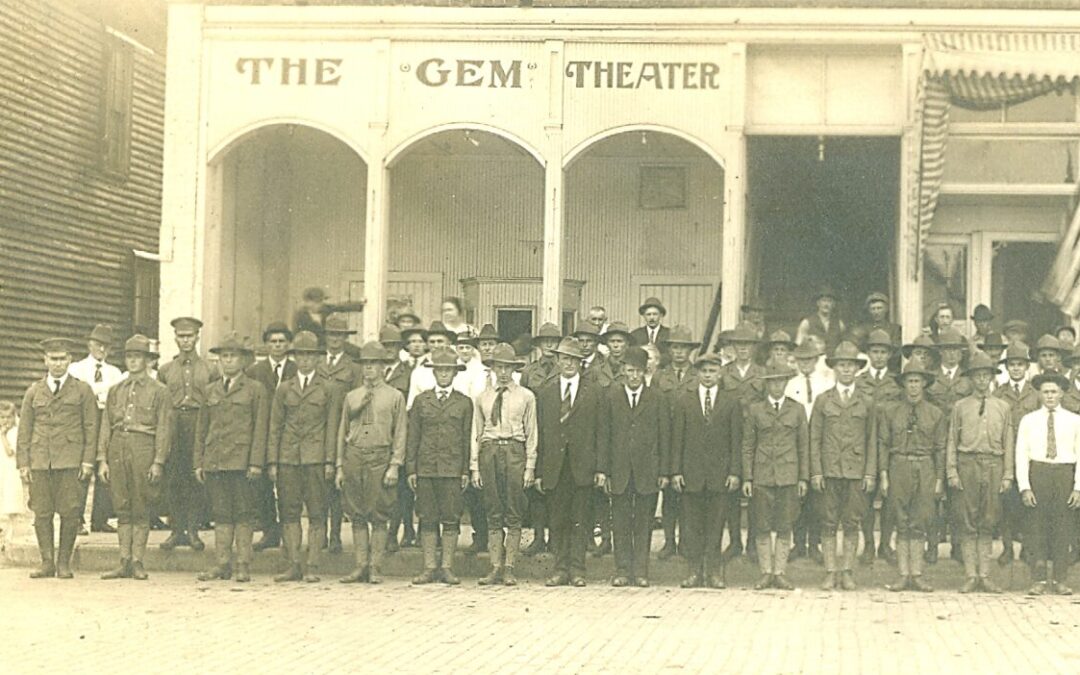
The Gem Theater.
One big change that took place at the end of the 19th century was the rise of commercial entertainment, especially for the growing middle class. Workers began to have more leisure time, and electric lights in towns and cities made the evening hours available for fun pursuits.
Sports, live music and vaudeville shows flourished, but nothing revolutionized leisure time quite like the motion picture. As early as 1910, there were already almost 10,000 movie theaters nationwide, and the movies had become one of America’s most popular pastimes. In Marshall County alone, there was at least one movie house in most towns almost continually throughout the first half of the 20th century. Young people especially sought amusement, escape and freedom from parental control. The relatively inexpensive movie theaters gave them a place to go to experience something new with every film.
The last half of the 20th century saw a return to home-based entertainment that continues today. Television in the 1950s, videocassette recorders (VCRs) in the 1980s, then high-definition TVs, and most recently, the various streaming services, all led to the demise of local movie theaters.
However, in recent years, interest in iconic downtown movie houses has surged, and many communities have found creative ways to restore and repurpose those buildings. One thing remains clear – Americans still love their movies!
The first theater in Argos opened in 1912 as the Princess. A movie-goer could see one whole reel for a nickel. By 1926 the cost of a double feature had gone up to 10 cents for children and 25 cents for adults. Ernest Parren purchased the theater in 1937 and changed the name to the Lido, after a famous theater in Italy. It operated for just under a year under Parren’s leadership before he closed the doors, leaving Argos without a movie house for the first time in 25 years.
Anthony Bokas from Chicago purchased the Lido in March of 1939 and remodeled it extensively. On April 12, 1941, the new Lido reopened with the movie Fargo Kid, starring Culver Military Academy graduate, Tim Holt. The following day, Rosalind Russell and Brian Aheme came to Argos to celebrate the new Lido opening and to promote their film, Hired Wife. The theater operated as the Lido until 1944, when it changed hands and became The Cozy. During the 1950s, the Cozy also showed Spanish language movies for the migrant workers during the season.
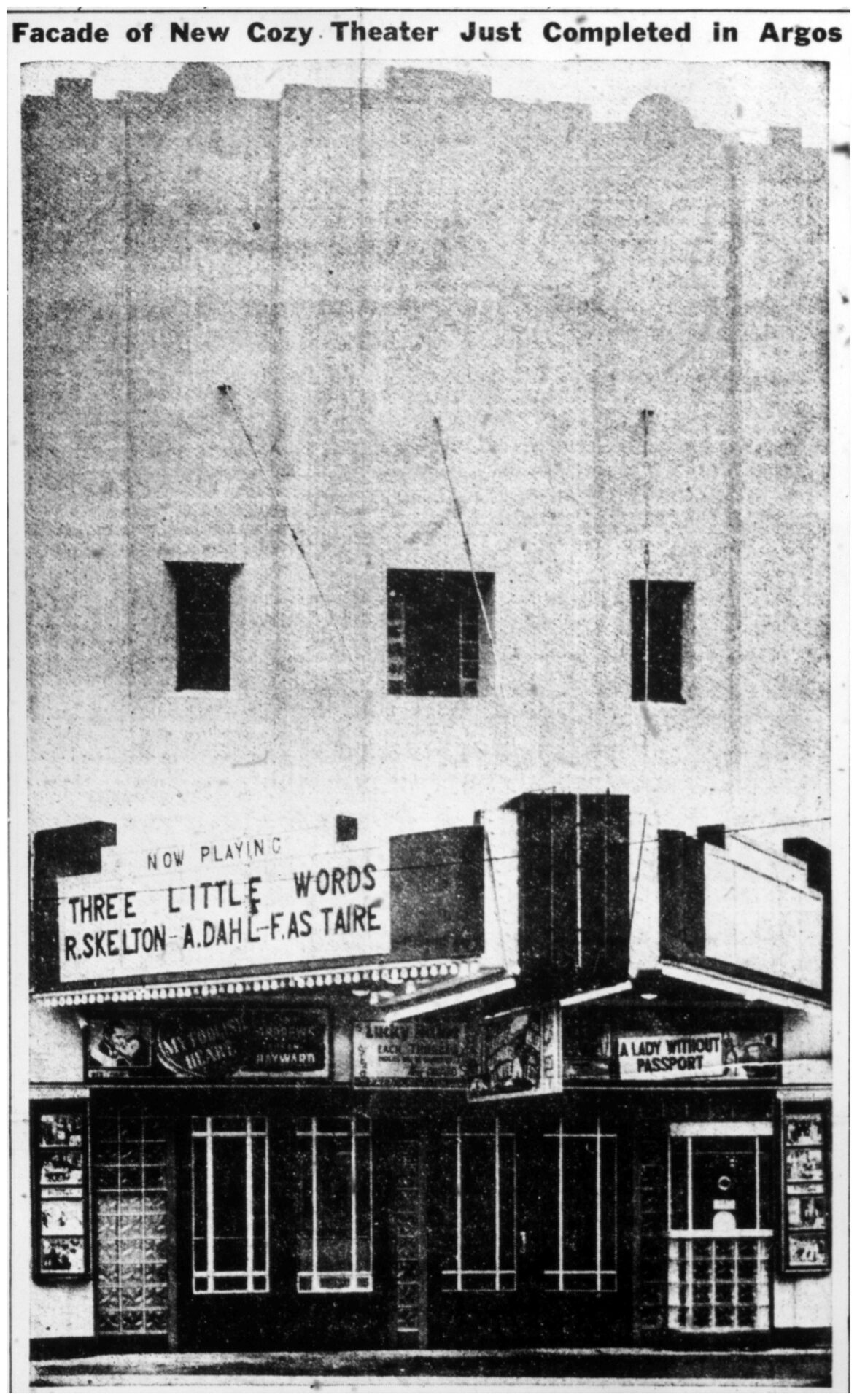
Facade of the Cozy Theater in Argos.
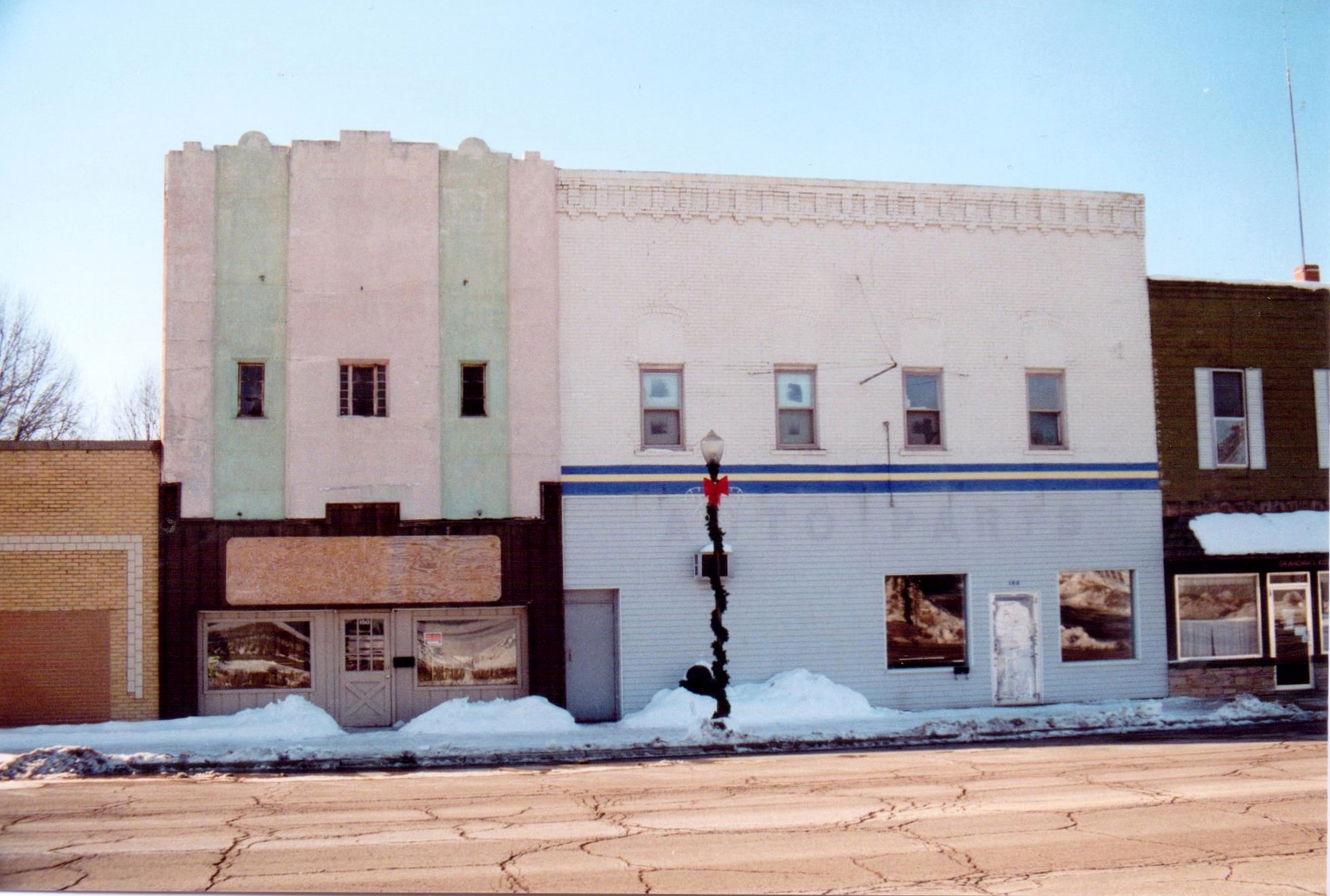
Modern image of theater building.
The August 8, 1907, issue of the Bourbon Mirror reported that, “We (Bourbon) have a permanent motion picture theater in the room just north of Vink & Co.” For 5 cents, proprietors Ward and Kern promised exhibitions every night except Sunday. In May 1910 a new moving picture theater, the Gem opened. Either the Gem changed its name, or a new theater opened in October 1911 as the Navarre, showing “the choicest in picture dramas.” Local history teacher and coach Gene Rovenstine built the Comet theater in 1946. It was named for the Bourbon High School sports teams. The movie changed three times a week, and the cost to see the opening film, Our Hearts Were Growing Up, was 14 cents for children and 35 cents for adults.
The Comet was the scene of a daring burglary in 1950. A man from out of town parked near the back door and bought a ticket to the last show of the evening. Before the movie ended, he made his way to the basement and waited. After the staff left, the burglar came upstairs, muscled the safe to the back door and loaded it into the back seat of his car. Approximately $900 was stolen, along with the safe. A few months later the safe was found in a field near Lapaz. It had been emptied of cash and dumped.
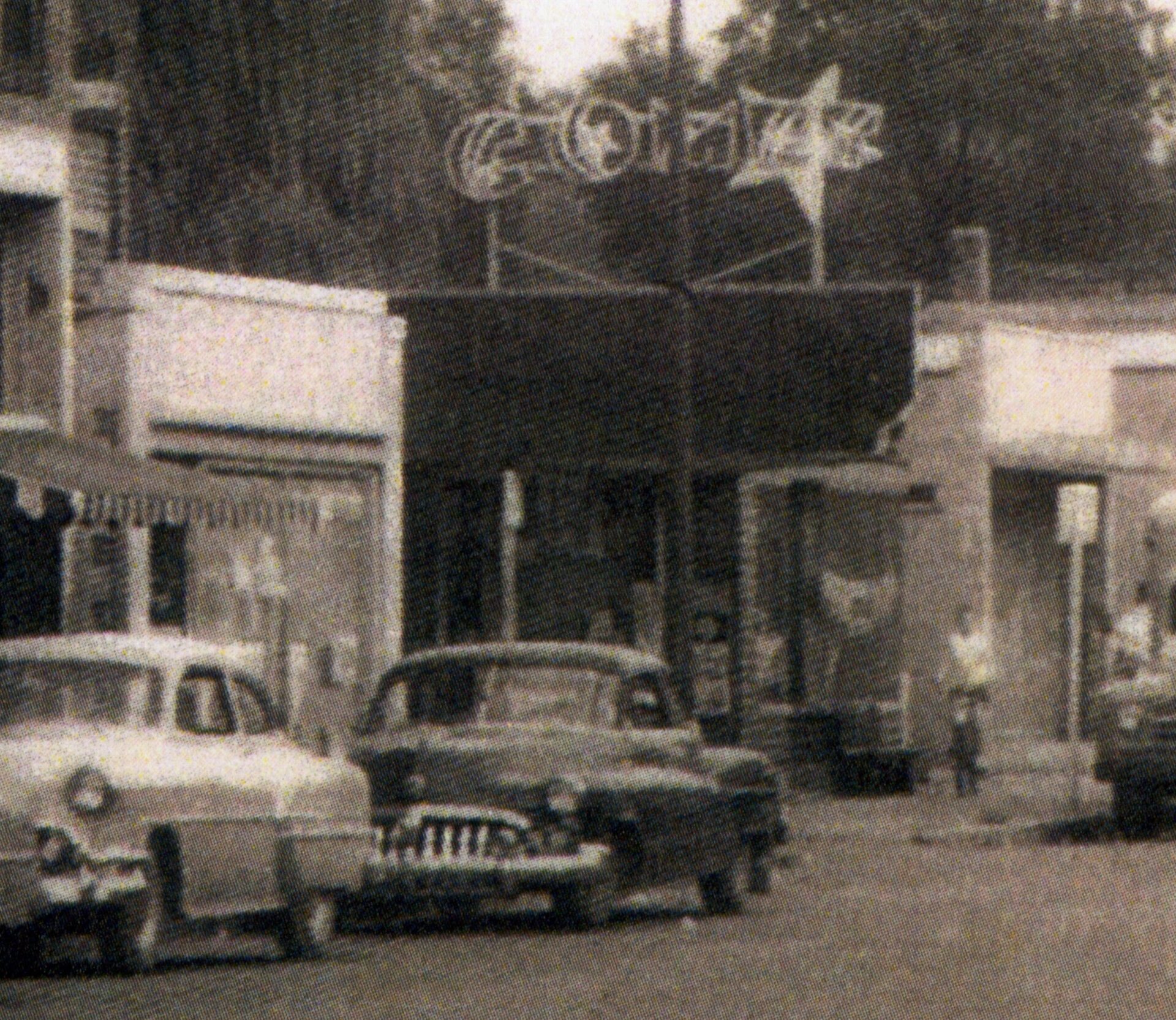
The Comet Theater in Bourbon, undated.
About the closure of his business in 1957, Rovenstine later wrote, “The theater was interesting work which I enjoyed and prospered doing, until television reared its ugly head.” Many early theaters started out as opera houses and followed the trend into moving pictures, as was the case in the town of Bremen. Animated pictures were shown at the opera house as early as 1897. Wilbur W. Drake was owner and manager of the Majestic Theatre and got himself into trouble during his tenure for “Sabbath desecration.” He pled guilty to showing movies on Sunday and paid a $5 fine.
The Majestic was the scene of the only known theater shooting in Marshall County history. On an October evening in 1917, there were about 260 people in the theater when a 16-year-old boy, who had just stolen a revolver, attempted to show it off to a friend. The gun accidentally fired, hitting a young boy across the aisle in the leg. Worried that children would be trampled in a rush to the door, Manager Drake rushed in and yelled for everyone to sit down. The victim went to the hospital and the shooter went to the “calaboose.” Sometime between 1920 and 1930, the movies shown at the theater, now called the Gem, became questionable in decency and taste. It finally closed in 1932. The new Bremen Theatre reopened in the same building two years later, offering only “first class, clean, talking pictures.” In December 1982, Jim and Sue Holliger of Goshen purchased the Bremen Theater, which had, once again, been closed for a couple of years.
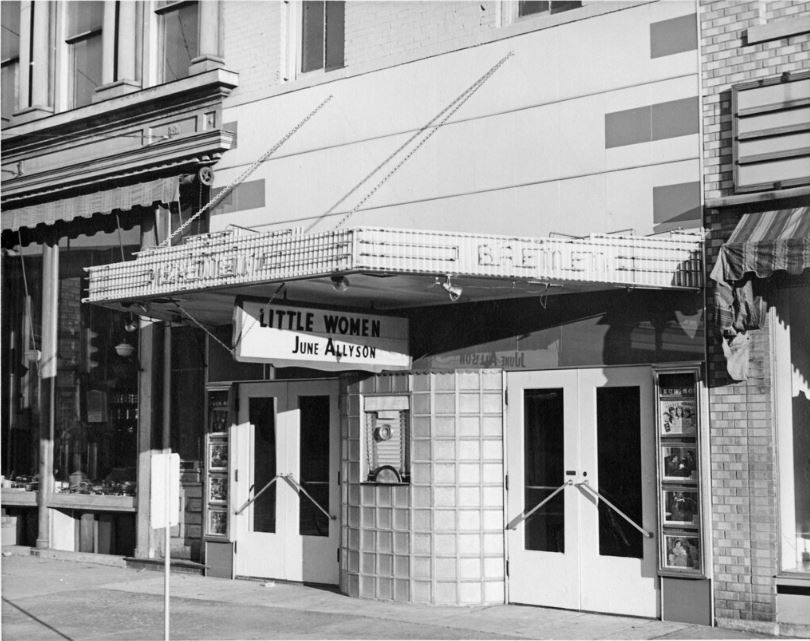
Bremen Theater showing Little Women, ca. 1949.
In September 1913 Billy Link bought a building lot in Culver for $675 and built a brick two- story building. The first floor housed a drug and novelty store, and the second floor was a movie theater. By 1919, Link expanded into the Liberty Theater, located on Scott Street. Known as “Culver’s Temple of Mirth,” it was remodeled from Hayes Garage into an 800-seat auditorium. Featuring two shows nightly, it was billed as “a big city show – all for twenty-five cents, plus war tax.”
The Home Theater on South Main Street was first owned by John Osborn and showed silent films. Ruth and Martha Werner played the piano. Osborn offered a free serial film to children after school. The catch was that they had to come back later to learn the fate of their heroes. The theater opened in 1914 and closed in 1930. A 1979 survey also listed a Star Theater located on the southeast corner of Main and Washington streets which opened in 1917 and closed in 1920. It was owned and operated by Milton Robinson, who also ran a bakery. In August 1931 the New Palace Theatre opened. It was located across from the train depot and had been completely remodeled. The grand opening featured Will Rogers in Young As You Feel. The New Palace Theatre later became the El Rancho, owned by Everett Hoesel. The El Rancho theater has changed hands a few times since then, but is currently closed.
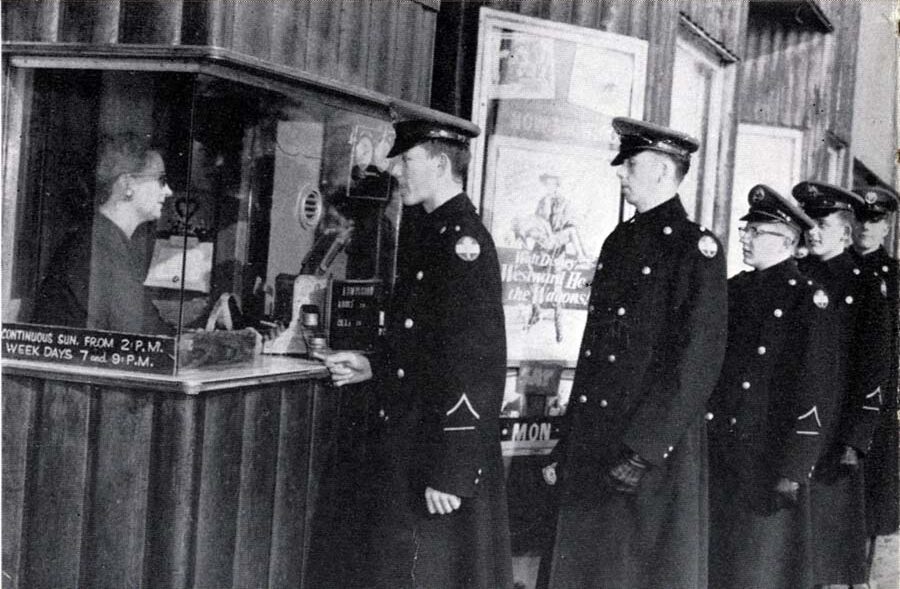
El Rancho Theater with cadets, ca. 1957.
It’s always worth your while to come in the see the rest of the Museum, located at 123 N. Michigan St., Plymouth, open Tuesday through Saturday from 10 a.m. until 4 p.m.