
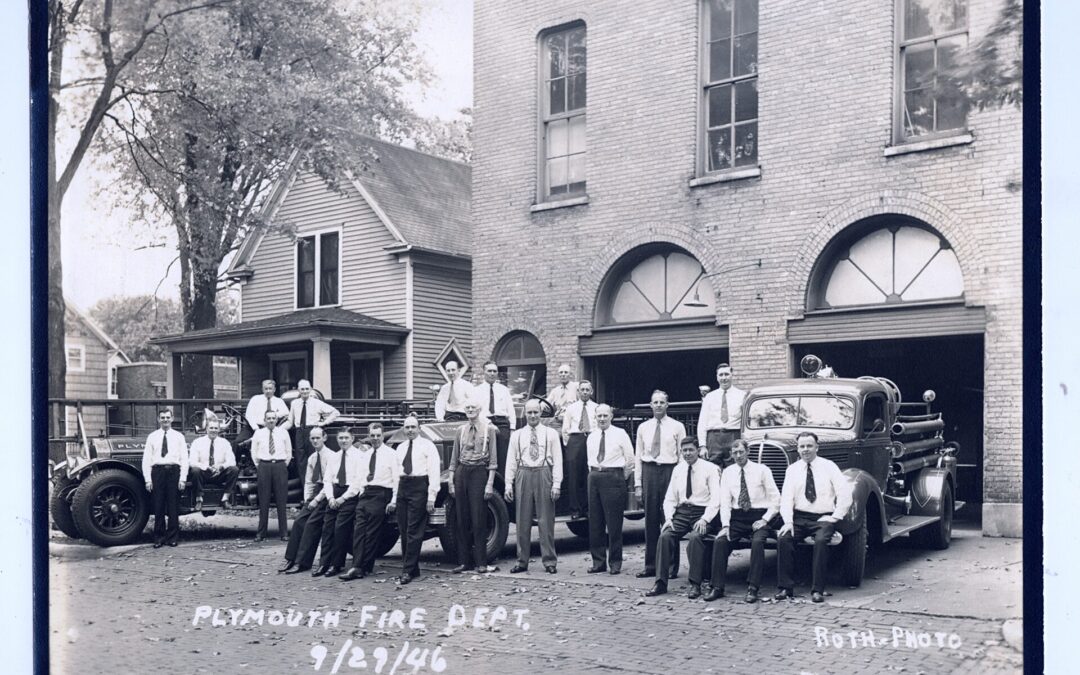
Innovation and necessity have been, and still are, the driving force of progress in almost any field; perhaps none so desperately as the need for fire safety. As communities in Marshall County grew in population, naturally, business enterprises took hold, and buildings sprang up to accommodate them. People used the most plentiful and available material – wood – and built their buildings quickly.
In Plymouth, the original plat map from the 1830s designated lots for a business district. It began with Lot #1 (where the REES Theatre is located) and moved north up to Lot #21 and then crossed Michigan Street and started back south with Lot #22 and ran through Lot #42. Those lots were side-by-side, as were the buildings constructed on them. It is no surprise, then, that when one wooden structure went up in flames, fire spread quickly, sometimes aided by the wind. More than once, the whole business district was wiped out.
Welcoming Progress
At the time, there was little by way of fire protection. Business owners simply accepted that a fire, once out of control, would destroy their buildings and typically their contents as well. A devastating fire in 1857 that consumed most of the downtown businesses convinced Plymouth town leaders of the need for a volunteer organization of firefighters. In February 1958, the Protection Hook and Ladder Company was formed with a total membership of 57. A bucket brigade was organized as a part of the group. A two-story frame building was built on the Adams Street riverbank.
Two other fire companies were organized in December 1865, the Adriatic Engine Company and the Torrent Hose Company. The City Hall and Engine Building on Center Street was completed in 1875 and served the department for 95 years. The first engine was purchased sometime between 1863 and 1868 and required five or six men to a side, pumping up and down to produce a stream of water. The problem of a dependable source of water was solved when a series of brick-lined cisterns were constructed. The sprinkling wagon, used to keep dust down in the streets, was charged with keeping the cisterns full. The city waterworks, built in 1888, finally replaced the cisterns.
Changing Standards
As equipment was added, so were horses drawn vehicles. The station floor was designed with grooves in it to provide traction for the horses as they raced to answer the alarm. Equipment was sparse. The Wide Awake Hose Company #2 paid $160 in 1883 for a hose cart. In 1912 the city purchased its first motorized vehicle, a hose and chemical truck for $5,000. In addition, city officials added a Gamewell Fire Alarm System with 20 alarm boxes placed around the area.
At about this same time, the City of Plymouth began to pass ordinances meant to set standards for buildings to improve fire safety. Downtown businesses had to be built of brick with fire walls in between, and ceilings were to be metal or some other fireproof material. In 1896, an ordinance passed that any stove and pipe put up for use in any building must be set on a suitable platform covered with zinc or other metal, or on brick. Also, where the stove pipe entered a chimney, it must be securely fastened and the spaces around it “securely stopped with some non-combustible material.” The ordinance went on with specifications about ventilators, cleaning, riveted pipe joints and other details.
The ordinance even stated that ashes could not be collected in a wooden bucket or stored in a wooden barrel within 20 feet of any building. The fine for violation of the ordinance could cost up to $10. The city marshal or chief engineer was placed in charge of inspections with the power to enforce the ordinances. If a building owner failed to address an issue, the City would have it done and bill the owner, adding a $10 fine to the cost.
Upgrades and Preservation
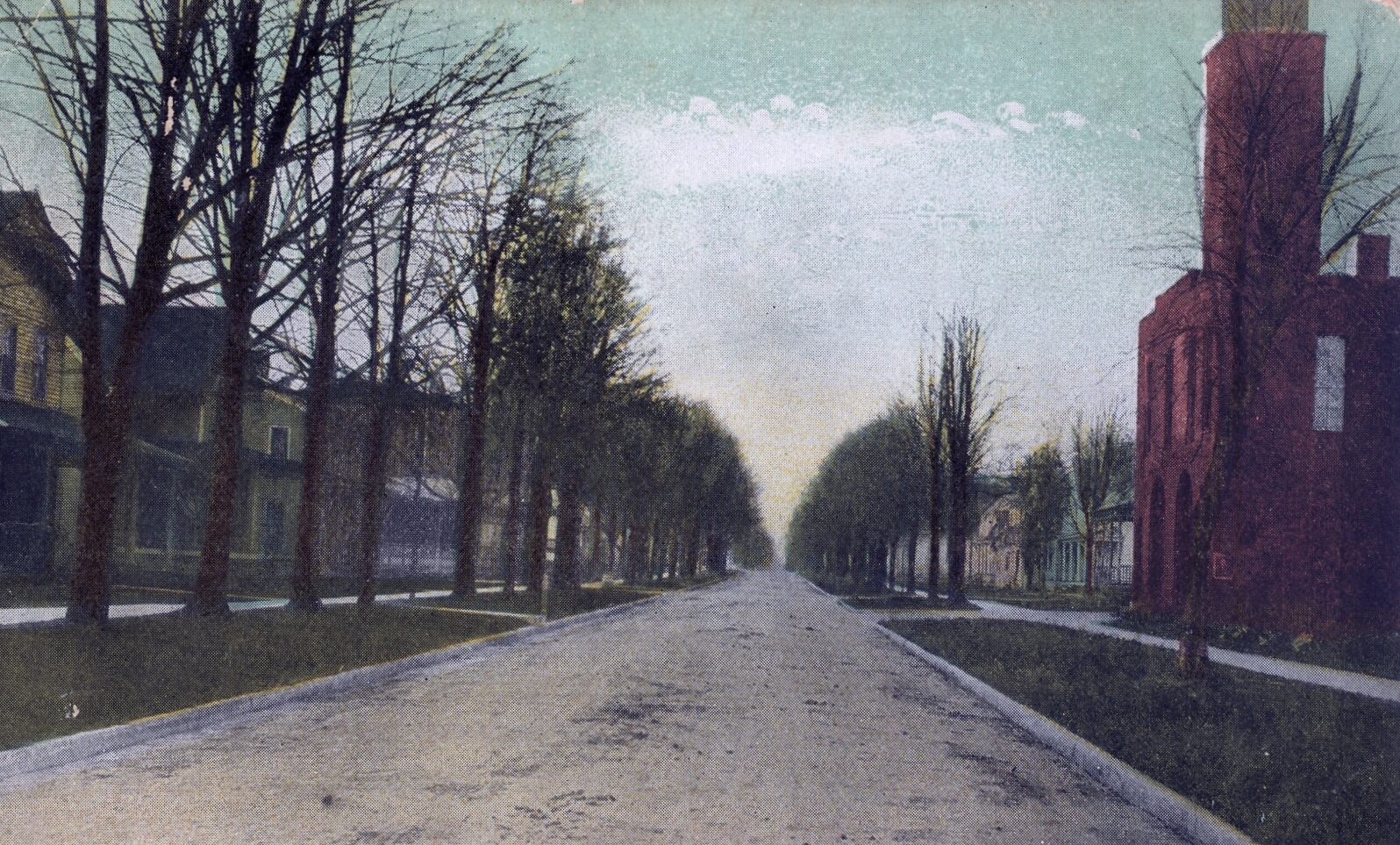
Center Street looking North in Plymouth, Indiana.
Innovations continued to make the fire department more efficient and more professional for a growing city. In the 1950s, several retired businessmen and volunteer firefighters began taking turns driving the trucks, sleeping in a 2nd floor room across the alley from the fire station. In 1970, the department moved to the current building. Throughout the 1960s and ‘70s, the roster of full-time firefighters grew, and the department added a pumper with an 80-foot snorkel at a cost of $72,000. At that time, six pieces of equipment were manned by six full-time personnel and 20 volunteers.
Currently, the City of Plymouth is looking for ideas on how to best use the old fire station (and once city hall) on the corner of Washington and Center streets. If you have ideas for its preservation and continued use, pick up a Request for Proposal form in the city clerk’s office and submit your ideas.
The Marshall County Museum and Research Library’s normal hours are 10 a.m. – 4 p.m., Tuesday – Saturday. Stop in and see us!