
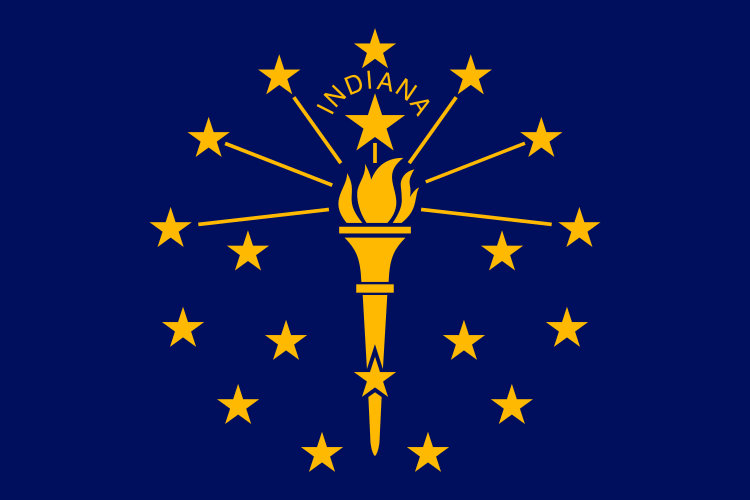
On December 11, 1816, Indiana became the 19th state to join the Union. The journey to statehood was long with several hurdles along the way. In honor of Indiana’s 209th birthday, we retell the story of our state. Today, we are known for our demonym “Hoosier,” corn, the Indy 500, our sports teams and more. Our history, however, spans thousands of years, starting with Paleo-Indians who roamed the Americas, including present-day Indiana, around 8000 BC following the end of the Ice Age.
Prehistoric Era
Paleo-Indians were nomadic hunter-gatherers who used stone tools and hunted large game animals (you can learn about the Ice Age in our Prehistoric Animals book, available now in our store). There is evidence of more permanent habitation around 5000 BC with earthen mounds that were used for habitats, ceremonies and temples. The Hopewell People around 1000 BC grew various crops, created pottery and engaged in trade. Between 1000 and 1450 AD, there was a Mississippian settlement near Evansville, Indiana on the Ohio River. They created complex mounds and earthworks that aligned with celestial events with incredible precision. You can visit this archaeological site today.
European Exploration
In the 17th century, French explorers reached present-day South Bend and traded with Native Americans for highly desired fur skins. French and French Canadians soon established trading posts, and some tried to control Native trade routes. When the British arrived, they also wanted control of the fur trade. The Natives sided with the French in these tensions and eventually went to war against the British. When the British won the French and Indian War in 1763, all French lands east of the Mississippi River and northwest of the colonies were ceded. The Crown proclaimed the land west of the Appalachians as “Indian Territory” and did not allow colonists to settle there, angering many people.
During the American Revolution, Congress passed a “Resolution on Public Lands” and allowed settlements west of the Appalachians with the intent to create new states. The United States gained its independence in 1783 with the signing of the Treaty of Paris. In 1787, present-day Indiana became part of the “Northwest Territory.” The Northwest Ordinance of 1787 gave this territory a government and a process to create states if they met certain stipulations. To apply for statehood, you had to have sixty thousand people or more, prohibit slavery and have a bill of rights, amongst other things. This land would eventually become Indiana, Ohio, Michigan, Wisconsin, and Illinois.
Expanding Settlements
In 1800, Congress divided the land again into the Northwest Territory, which would become Ohio three years later, and the rest was the Indiana Territory. The territories would be divided and changed many times as new states formed. The Indiana Territory was governed by William Henry Harrison, and its capital was Vincennes. In August 1804, Harrison called for an election to see if voters wanted a state government. By December, Harrison proclaimed that the Indiana Territory would have a General Assembly, moving it one step closer to statehood.
By 1809, the borders of our state were outlined with the formation of the Michigan and Illinois Territories. Ohio was still the only state that had formed from the original Northwest Territory, however. Becoming a state was controversial. Some people wanted to continue slavery, and some did not want the increased taxes and costs that came with statehood. It also meant leaders would be far away in Washington, making it difficult to communicate with them. Statehood slowly chugged along, and fighting between settlers and Natives continued.
Road to Statehood
In 1811, the Indiana General Assembly voted 4-3 to petition Congress for statehood. Congress denied their petition until the state’s population reached 35,000. Efforts were abandoned by the territory due to a lack of money and the beginning of the War of 1812. During this time, the territory’s capital was moved to Corydon because it was more central and less likely to be attacked by the Natives after the Battle of Tippecanoe.
The General Assembly petitioned for statehood yet again in 1815. With 63,000 people, we were above the minimum population. The only thing left was to form a constitution, which President Madison allowed by signing the Enabling Act in May 1816. The constitutional convention was led by Jonathon Jennings and continued through August, when Jennings himself was elected as the first governor of Indiana. While writing it, there were heated debates. Ultimately, the constitution did not allow for women or people of color to vote. It prohibited slavery within Indiana. It was also the first state to start a state-funded school system, which is now Indiana University. That November, we held our first General Assembly under the 1816 Constitution. Finally, on December 11, 1816, President Madison admitted Indiana into the Union as the 19th state!
For those curious, Indianapolis became our capital in 1825 after it was chosen and built in 1821 for its central location. Visit the Museum from 10:00 am until 4:00 pm, Tuesday through Saturday to learn about early Marshall County. The Museum is located at 123 N. Michigan St., Plymouth. Call us at 574-936-2306.