
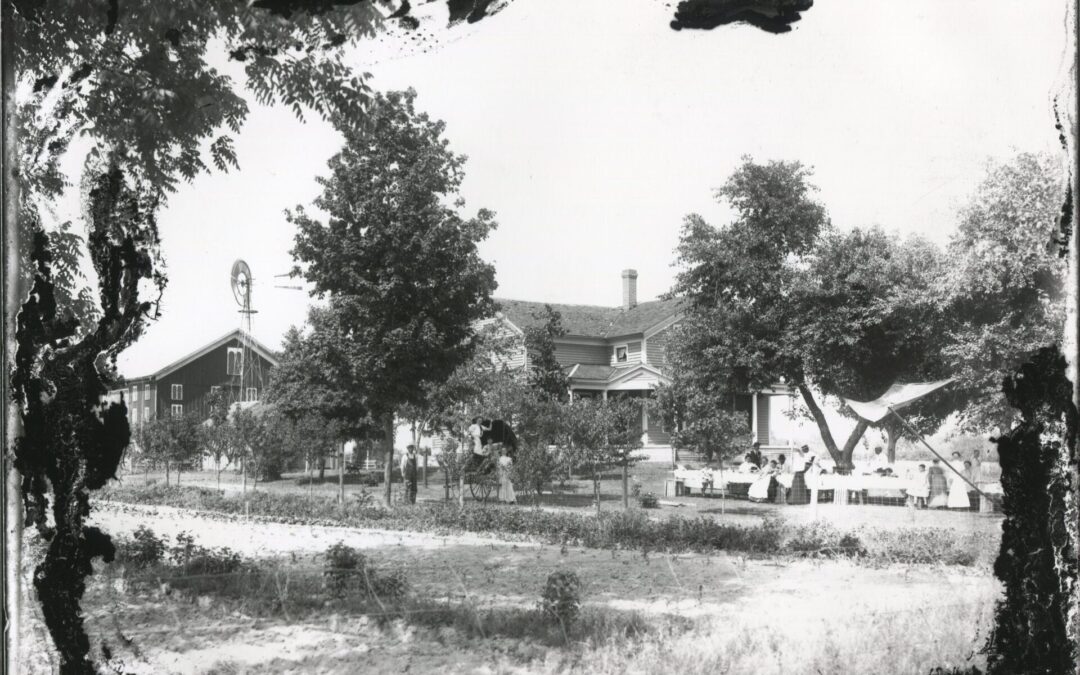
It is said that every family has a skeleton in their closet. One Bourbon family had a skeleton in their barn:
“After the body was accidentally discovered by a hired hand and became publicly known, an inquest was held. Witnesses were called, a jury summoned, and testimony was given on August 25, 1855, in S.M. Adams’ storeroom. The jurors examined the skeleton of a female body between fourteen to twenty years of age, about five feet two inches tall. The top part of the skull and the left side of the lower jaw were gone. The name of the person and the cause of her death were unknown. The body was found on the premises hidden in the barn of Grason Parks.
“Henry Strunk testified the body was found in Grayson Parks’ haymow in the northwest part of the barn. It appeared to be covered up and secreted. He helped remove the body from the barn by the order of the coroner. The body was removed on the evening of August 24, 1855, shortly after dark.
“Thomas Wilkins said he discovered the body. Grason Parks had sent him up in the hayloft after a piece of lumber. Wilkins saw a small corner of a box and supposed it to be the lumber he was sent for but upon taking hold of it, he discovered it to be a box. On August 20 Grason Parks had employed him to help haul in oats. Wilkens examined the box again and was led to suppose that it contained a human body. The box was in the same place and condition as it was when he had first seen it in Grayson Parks’ barn. Wilkins supposed the box to have been secreted in the hay with which was covered. Wilkins next saw the box on the evening of August 24 when he went up into the haymow by the order of the coroner to show where the box was. Wilkins saw the box opened in the barnyard. At that time, he discovered to a certainty for the first time that there was a human body in the box. Wilkins had no knowledge as to how the box came to be in the barn.
“Abraham Baker said he was frequently about the Parks barn the previous spring and summer. He often noticed that there was a bad smell in the barn. He said he was working for Grayson Parks in May, and while the cattle were eating at noon, Baker went up into the haymow and for the first time, he discovered the bad smell. Baker asked Grayson Parks’ son what smelled so bad. The boy replied that his father had killed a cat in the hay but had burned it the day before. Baker said that when he first discovered the box his brother was with him; he shook the box, and it gave a disagreeable smell and that he supposed it to contain a dead body.
“Dr. David Hazzard testified he had examined the body which had come from the barn of Grayson Parks and discovered no marks of violence. It was a female body. The upper part of the skull had been removed and the left under jaw was taken off. Dr. Hazard stated that Grayson Parks was not a physician or surgeon.
“Dr. J. E. Brooks also examined the body and saw no marks of violence. The skeleton was a female. Dr. Brooks supposed the subject to have been between fourteen and twenty years of age. He thought the body had been fairly well prepared. There was as little smell about it as any he had ever seen which was so recently prepared.
“James O. Parks said he had seen the body many times. He saw it in Leesburg. He said it is the property of Dr. Edward Parks. It was prepared by Dr. Edward Parks and probably others. James Parks said he saw it before it was dry. He said it was brought from Michigan. He never learned the name of the person. James Parks said it was a young female; he did not know the age but said it was “hardly matured.” He identified the skeleton to be the property of Dr. Ed Parks from the fact of the removal of the upper part of the skull and the loss of part of the under jaw and teeth.
“James Parks stated he could not say that he ever heard Dr. Ed Parks say that the body was his property, but he saw the body in Dr. Ed Parks’ lecture room in Kosciusko County. James Parks had no knowledge of the body being at Grayson Parks.’ James Parks said he was invited into Dr. Ed Parks’ lecture room by some of the students and went afterward without an invitation because they made him welcome. He said that it was prepared over a year ago.
“Dr. John F. Parks said he did not recognize the skeleton for a certainty to be the one which he had once or twice seen in the room of Dr. Ed Parks. Dr. John Parks said he had no knowledge of the skeleton being at Grayson H. Parks.’ He believed the skeleton to be the property of Dr. Ed Parks. He had seen a skeleton in Dr. Edward Parks’ room over a year ago and supposed this was the same one. It was in much the same condition as it was at the inquest. Dr. John Parks had requested Dr. Ed Parks to send him a skeleton two months before. Dr. John Parks had passed by Grayson H. Parks’ place but had received no notice of a skeleton being there for him.”
Apparently, the body was an open secret in the Parks family because they all seemed to know about it. In the early days of the study of internal medicine, it was very common for a doctor to acquire a cadaver to study. Some doctors were known to pay someone to dig up a recently deceased body, as in Charles Dickens’ A Tale of Two Cities.
The jury found Grayson Parks guilty of unlawfully secreting the skeleton of a human body. Those involved in what happened to the skeleton are gone now, all buried properly under tombstones with their names on them. They received much better treatment after their decease than that which was given to the young girl, whose name is still known only to God.
Be sure to stop by the Museum! We are open from 10:00 until 4:00, Tuesday through Saturday at 123 N. Michigan St, Plymouth.