
Culver’s African American History
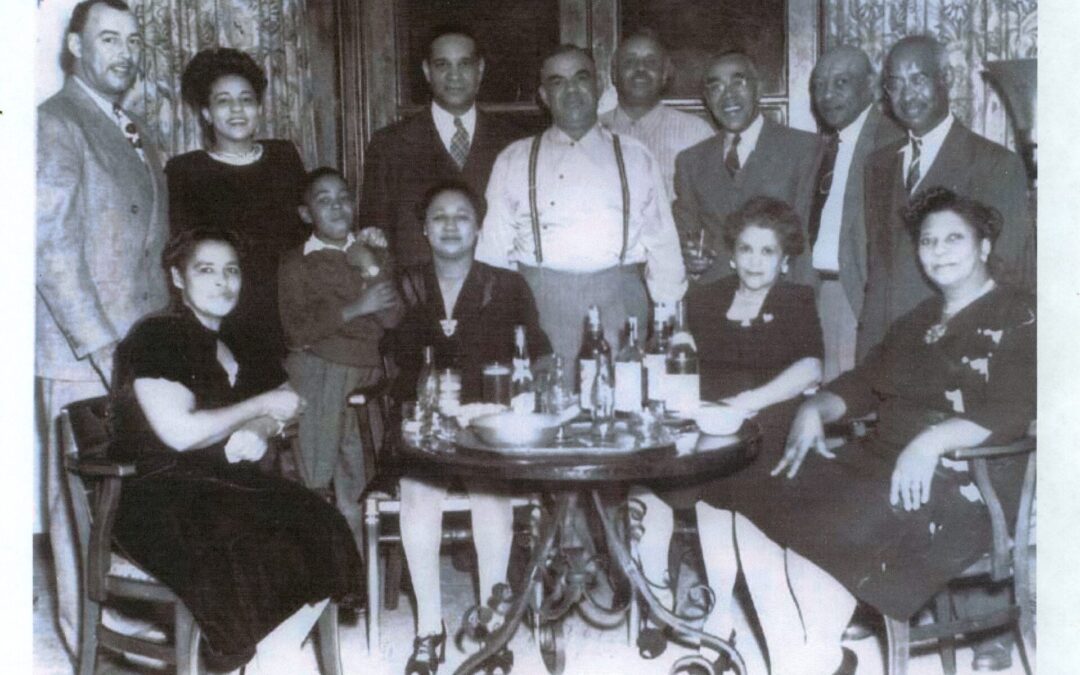
Above: fascinating photo of Culver’s “Cafe Society” pictured in the 1940s. The group was an African American social club which gathered in various homes. Pictured, from left: (seated) Thelma Hodges, LaVeda Pierce, Elsie Byrd and Adelaide Weaver, and standing, unidentified couple, Morsell (Bob) Hodges, Smoke Pierce from Michigan, Charlie Weaver, Ace Byrd, Roy Scott, and Roy Lear. The youth is unidentified. Photo courtesy Thelma Moorehead.
Culver’s history includes a rather unique presence and influence from its African American populace. A glance at early 20th century Culver High School yearbooks reveals a black populace integrated into Culver’s public schools and a part of the community of Culver, a somewhat unusual set of circumstances for a small Indiana town at that time.
Culver’s African American community had its roots in the origins of the Culver Academy, founded by H.H. Culver in 1894. When the only moderately successful school boosted its attendance by merging with students from a St. Louis military school that burned to the ground, there followed a contingency of black employees to Culver from the same St. Louis school. Being the era that it was, African Americans were primarily employed in service roles: domestics, waiters, custodians and the like, and Culver was no exception.
The heyday of Culver’s African American community was primarily between the 1920s and 1960s, after which older residents — retiring and with no reasonable jobs to replace the fading domestic and service jobs that had attracted black workers for decades — remained or were moved away by grown children who had found employment elsewhere. According to many residents of the day, Culver’s African American populace, which tended to be more middle class and educated, were fairly integrated into the community at large.
The Culver Military Academy, nearly from its outset, employed black help on its grounds. Perhaps most visible was its ongoing group of African American waiters. Today’s Academy students are accustomed to a cafeteria-style buffet dining experience, but until the late 1950s, meals were served to cadets by African American waiters, the leaders of whom became well known and beloved to many students and faculty over the years.
Some of these individuals become iconic members of the community, particularly the Academy community. Roy “Sheep” Scott held court at Culver Academy for decades in a number of roles, including overseeing the janitorial staff. He also became an unofficial “counselor” to students, many of whom adopted him as a beloved confidant and sounding board for any number of personal and academic problems. Scott, as was true of many of the long-term African American staff at CMA, was a resident of Culver for years, living on the south end of town. His daughter Thelma returned from a teaching career with her husband Bob Hodges and became one of Culver’s more prominent citizens until her death in 1990.
Thelma, an antiques collector, became manager of Country Cousins Antiques on the west side of Main Street in downtown Culver and taught antiques classes at Ancilla College. She was also active in local politics and real estate, and was a member of Wesley United Methodist Church, where her funeral was held in 1990.